Making a Rondel Dagger – Part 2

Today I planted new cherry tree but there was not much that I could otherwise meaningfully do, so I have spent about 40 minutes testing my belt grinder. It has worked reasonably well, but the supporting table needs improvement.

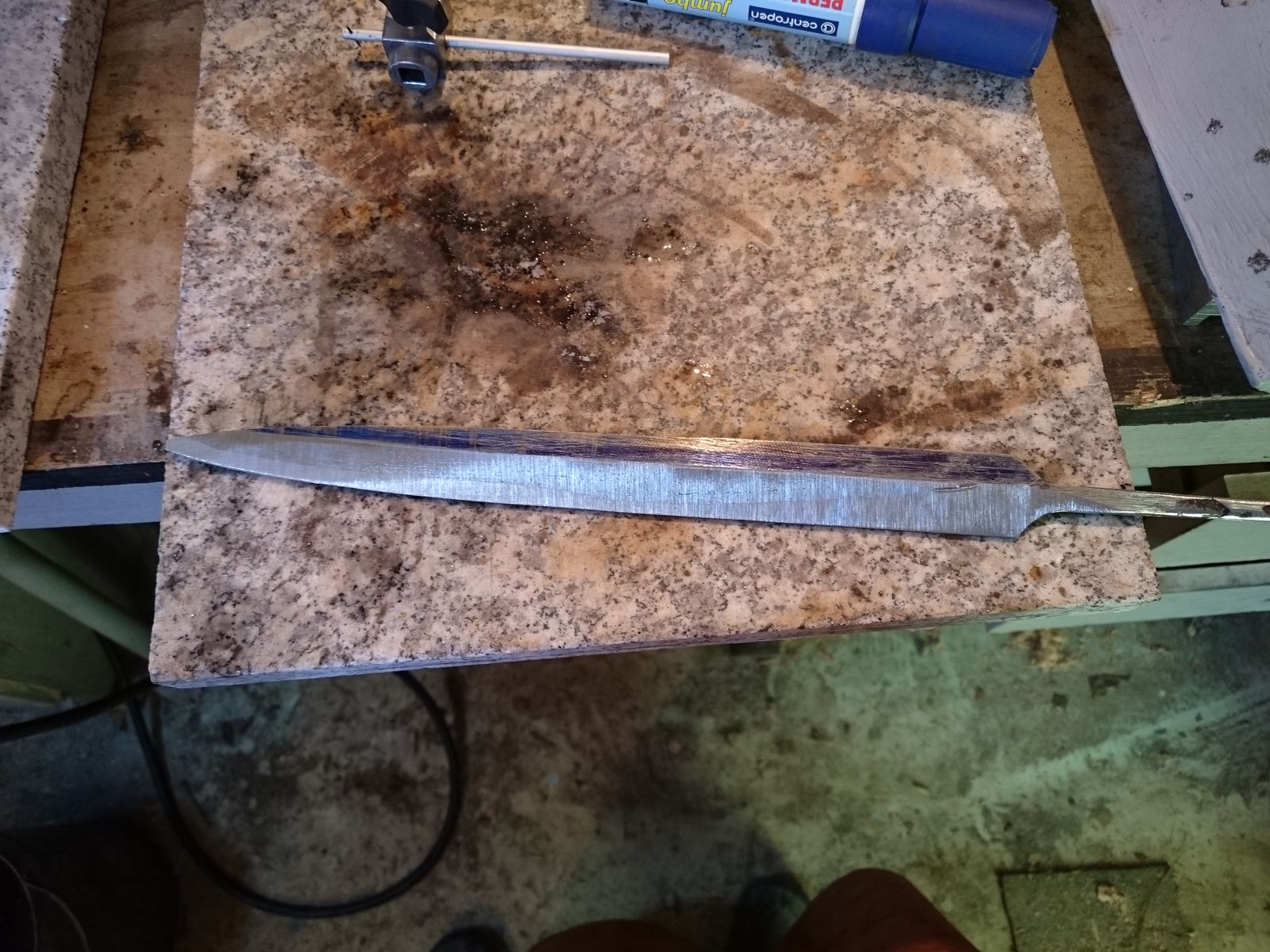
I chose this particular file for this project because it is thick at the base – almost 6 mm – and it already had a distal taper. That means I do not need to grind of as much material, but it is actually more challenging to work with, and therefore better exercise.
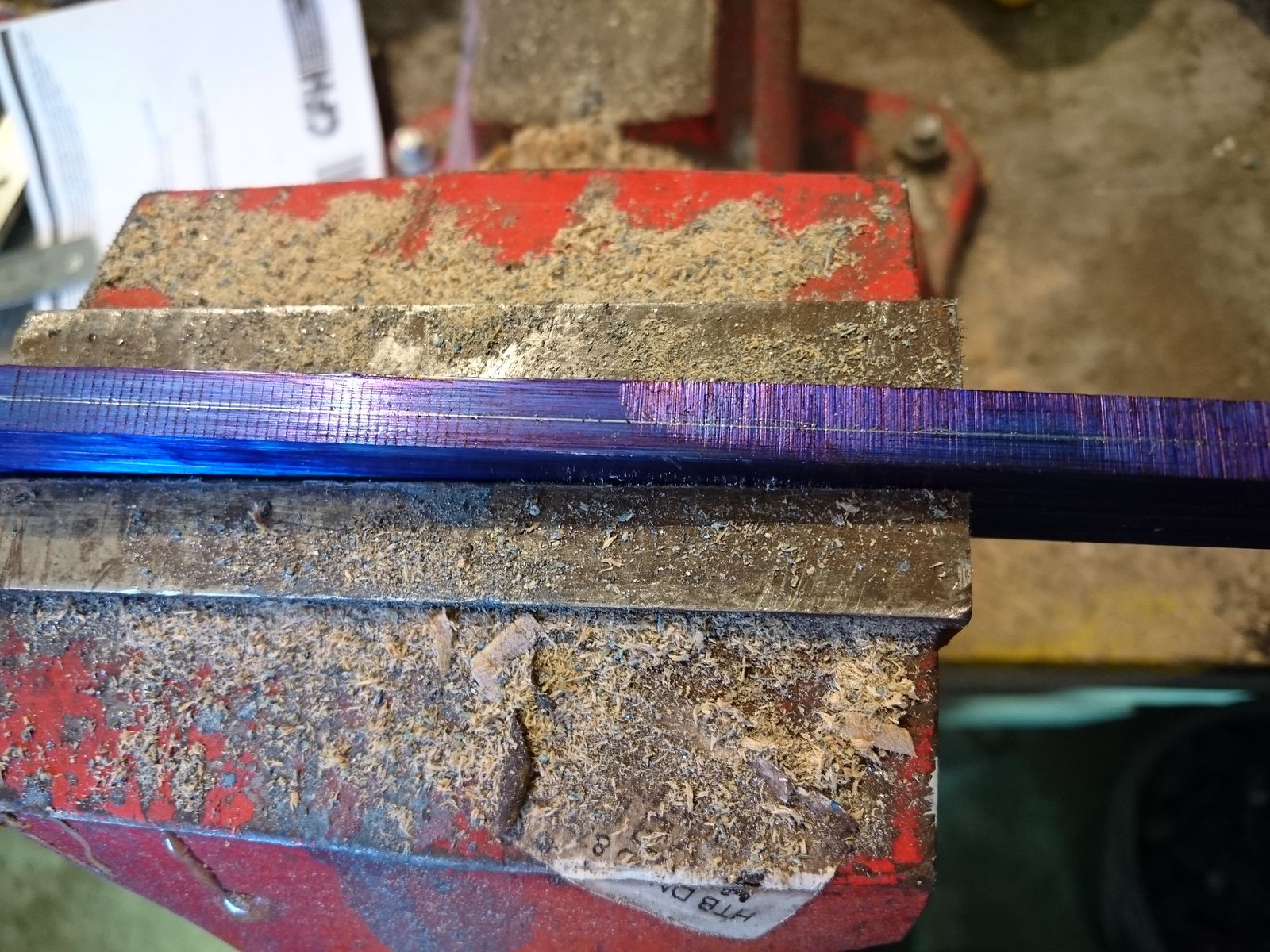
Centerline for he edge.

Centerline for the edge.

First problem was scribing the center line for where the edge shall be. Due to the taper I could not use my scribing tool because it scribes line at a constant distance from an edge. Luckily the curvature is very mild, so I could do with a steel ruler for most of the way and steady(ish) hand for the rest. I am not fond of measuring, I prefer to eyball the work, but for blade symmetry is important. The more asymmetrical the roughed out blade, the more it warps in quench. Very slight warp can be ground off, but big warp not. And of course grinding off a warp on hardened blade is tougher on the abrasive belts, and those do not grow on trees.


Scribed bevel lines.

Scribed bevel lines.

After scribing the center line, I also scribed two lines for where the bevels shall go. This dagger will have only one cutting edge, and in order to make it more useful as an ordinary knife, the bevel should go almost all the way to the spine at first grind, and wander de-facto all the way to it during polishing. On the other hand shallower bevel is easier to make and makes for stiffer blade. At this point I have not decided on the way I will do it. I scribed two bevel lines and decided to grind to the first one and reconsider.

With these preparations done, which took only about five minutes, I have spanned a 60 grit belt on my grinder and started. First time I was grinding with the use of supporting table and it was a great help at first and slight hindrance later on. For me it might be good to use the table for first facing and then go back to free-hand. I am slowly finding my personal way of doing these things. After slightly over half an hour I ground both sides to the first bevel line and had to call it quits for the day. Now I am considering my next step. Grind or not to grind, that is the question.
Ground bevels

©Charly, all rights reserved.

The Inquisition Tentacles Are Spreading.

I’ve written about Ralph Drollinger before. He’s one scary lunatic christian, and he wields way too much influence in the current regime. He’s crowing again, over all the “progress” he’s making. It’s as well to remember that Drollinger’s idea of progress is to bring back the inquisition or something like.

Ralph Drollinger, who runs fundamentalist Bible studies for dozens of members of Congress and President Trump’s Cabinet every week, said in a fundraising letter this month that his group “has been blessed by God with extraordinary growth beyond our wildest imaginings in foreign nations across the globe and most notably in former Soviet Bloc countries.”

[…]

We noted last fall that Drollinger is aggressively expanding his operations both at the local government level in the U.S. and in national capitals around the world. His April 4 letter includes some details about the latter:

In the last few months discipleship Bible studies have been established to Parliamentarians in Romania; Ukraine; Fiji; Papua New Guinea; and the Republic of Equatorial Guinea. A ministry is about to begin in Guatemala, and before fall, we expect work to be completed for ministries in the Central and South American nations of Peru; Ecuador; Brazil; Mexico; Uruguay; and Paraguay, as well as in the European city Riga, Latvia.

Work is current an ongoing with partners to establish discipleship Bible studies in Berlin and Bonne [sic]. We are enthusiastically pursuing an opportunity to plant a ministry in the European Union Parliament, a body of 600 Parliamentarians from 26 Western and Eastern European nations who meet two weeks every month in Brussels, Belgium and one week every month in Strasbourg, France.

We thought the Lord did not want us in the Middle East, but to our great surprise discussions are currently underway to establish a ministry in a Muslim majority nation in the Middle East.

[…]

Although Drollinger is quick to complain about news coverage he believes is unfair, his letter says a story published in a German newspaper helped attract new friends. And Capitol Ministries has been gushing about a recent BBC story that the group says “reached more than 1 million readers world-wide.”

I have no idea why people might find Drollinger favourable in any light, but even if you are one of the lucky people who lives in a happily secular nation, this should be worrying. Drollinger is naturally courting regressive governments, but there are always regressive asses in any government, and they are likely to listen to Drollinger. I fail to see the charm, and it’s beyond disturbing that Drollinger is not simply being dismissed. Just to give you an idea of what Drollinger wants to institute, as far as government is concerned:

Drollinger’s April 13 Bible study says it is a “disservice to the country” for public servants to “craft policy that is not somehow rooted in Scripture.” Here are some of the other theological and political positions Drollinger teaches public officials:

Drollinger likes to tell reporters that he doesn’t instruct public officials how to vote, but he makes it clear in his written Bible studies that, for example, Christian public servants are required to support the death penalty and oppose marriage equality.

Drollinger also has very specific views on the role of women: “there is a prohibition of female leadership in marriage, and female leadership in the church.” One of his Bible studies explains what he calls the “unambiguous” difference in responsibilities the Bible gives men and women, saying women’s “primary functions” include homemaking, home management, mothering, teaching younger women, displaying hospitality and dressing modestly.

There’s much more, RWW has the full story.

Word Wednesday.

Crotchet

Noun.

1: obsolete a: a small hook or hooked instrument b: Brooch.

2a: a highly individual and usually eccentric opinion or preference b: a peculiar trick or device.

3: quarter note syn, see caprice.

[Origin: Middle English crochet, from Anglo-French crochet, croket.]

{14th Century).

“It had occurred to Jakob that he’d left his beloved tobacco back at the house. A few puffs would perhaps have helped his mood a bit, but then he remembered, Johann Lechner, despised tobacco. If Schongau had not been a Catholic town through and through, the secretary could have been viewed as a crotchety, pleasure-hating Protestant.” – The Play of Death, Oliver Pötzsch.

W Is For White.

White.

Birch bark is white. The contrast with the landscape not yet green and no longer white is stark. This was taken in early April 2017 in Helsinki, from the park behind the congress and event venue Finlandia Hall towards the Linnunlaulu cliffs.

As a bonus picture (taken mid-November 2017), another birch, in a less bright shade of white and one corner of Finlandia Hall (completed 1971), designed by the architect Alvar Aalto (1898–1976), who is still, over 40 years after his death held in a very high regard about the aesthetics of his work.

However his acoustics design and construction technical choices have been criticised. The façade of Finlandia Hall is made of white Carrara marble from Italy. The marble plates will bend with time because of the climate and they have to be replaced every 20–30 years. They’ve been replaced once so far, in 1998–1999.

Click for full size!

© Ice Swimmer, all rights reserved.

Jack’s Walk

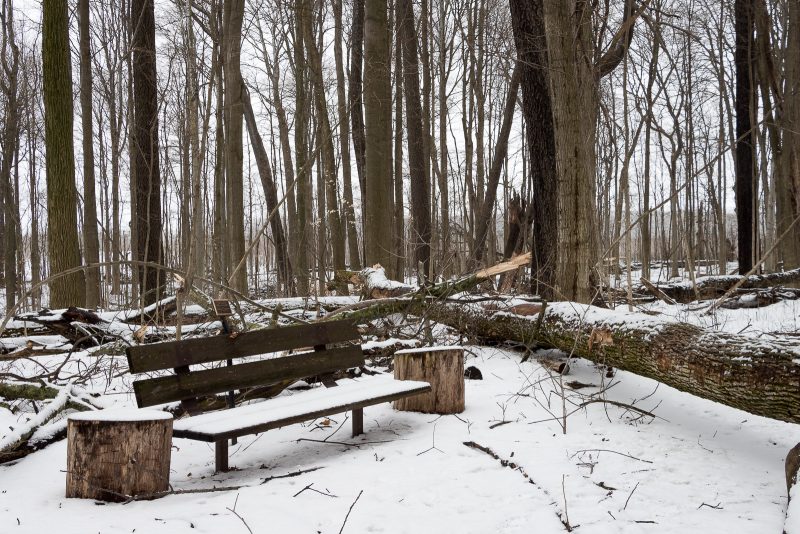
We had a lot of freezing rain over the weekend and it caused some minor damage to the trees in my neighbourhood. A few small branches down here and there, but nothing serious. I wish I could say the same about our favorite trail in the woods. Today we found major storm damage there, including three large trees, each about 25 – 30 meters high, pulled up by the roots and laying across the path. There are also several smaller trees and lots of large branches down across the forest and over the path. We went around a lot of obstacles today and in places we had to scramble up and over. This will likely cause damage to the flowers as well because people are treading off the walking path and onto the beds where the trilliums and jack-in-the-pulpit grow. We also heard a few branches cracking overhead which gave the whole place quite an eerie feel. All in all not our usual walk today.

fallen trees

Fallen tree

Uprooted tree

Uprooted tree

©voyager, all rights reserved


Wake: The Hidden History of Women-Led Slave Revolts.

Page from Wake by Rebecca Hall and Hugo Martinez (all images courtesy Hugo Martinez).

Page from Wake by Rebecca Hall and Hugo Martinez (all images courtesy Hugo Martinez).

In 1712, New York City witnessed a dramatic uprising when over 20 black slaves, fighting against their unjust conditions, set fire to several houses of white slaveowners and fatally shot nine. Known today as the New York Slave Revolt of 1712, the insurgence resulted in the conviction and public execution of 21 slaves, as well as more severe slave codes. While sources often state that these rebels were all men, the historian Dr. Rebecca Hall has identified four women who were captured during the clashing and were tried. Their names were Amba, Lilly, Sarah, and Abigail.

Erased from history books, their stories will now be told in vivid form by Hall, who has devoted much of her career to unearthing the roles of women in slave revolts. Hall is currently working on her first graphic novel, which will highlight female rebels in various 18th-century uprisings, from three in New York to those that broke out on slave ships. Titled Wake: The Hidden History of Women-Led Slave Revolts, the 150-page work emerges out of Hall’s 2004 dissertation on the same topic. She is now collaborating with independent comic artist Hugo Martinez to produce the storyboards and, through Friday, May 4, is raising $5,900 on Kickstarter to realize it for submission to publishers.

“The way the history of slave resistance has been written, this very gendered narrative developed about how manly and masculine enslaved men actually were, which served to elide the role that women played,” Hall told Hyperallergic. “I was going against everything being taught in women’s roles in slave resistance by insisting that, if I looked, I bet I would find these women.” She recalled how her dissertation advisor had told her that she wouldn’t find any sources to realize her chosen topic; how one archive claimed that it had no related material.

This is a fascinating, and I think, a necessary work. You can read and see much more at Hyperallergic, as well as on the kickstarter page, where there’s also a video. They are close to their goal, but could use a bit more help, so if you can’t donate, you can help to spread the word!

Anatomy Atlas Part 4 – Skull

This is no Jolly Roger, but it looks grim nevertheless. I do not think any other part of human skeleton is more evocative than skulls. And I wonder sometimes whether this is a purely a cultural thing, or whether there is something innate in us that associates skulls with death, danger and general unpleasantness. There might be, because our brains are clearly predisposed to recognizing facial features.

Content warning for description of a very unpleasant medical procedure.

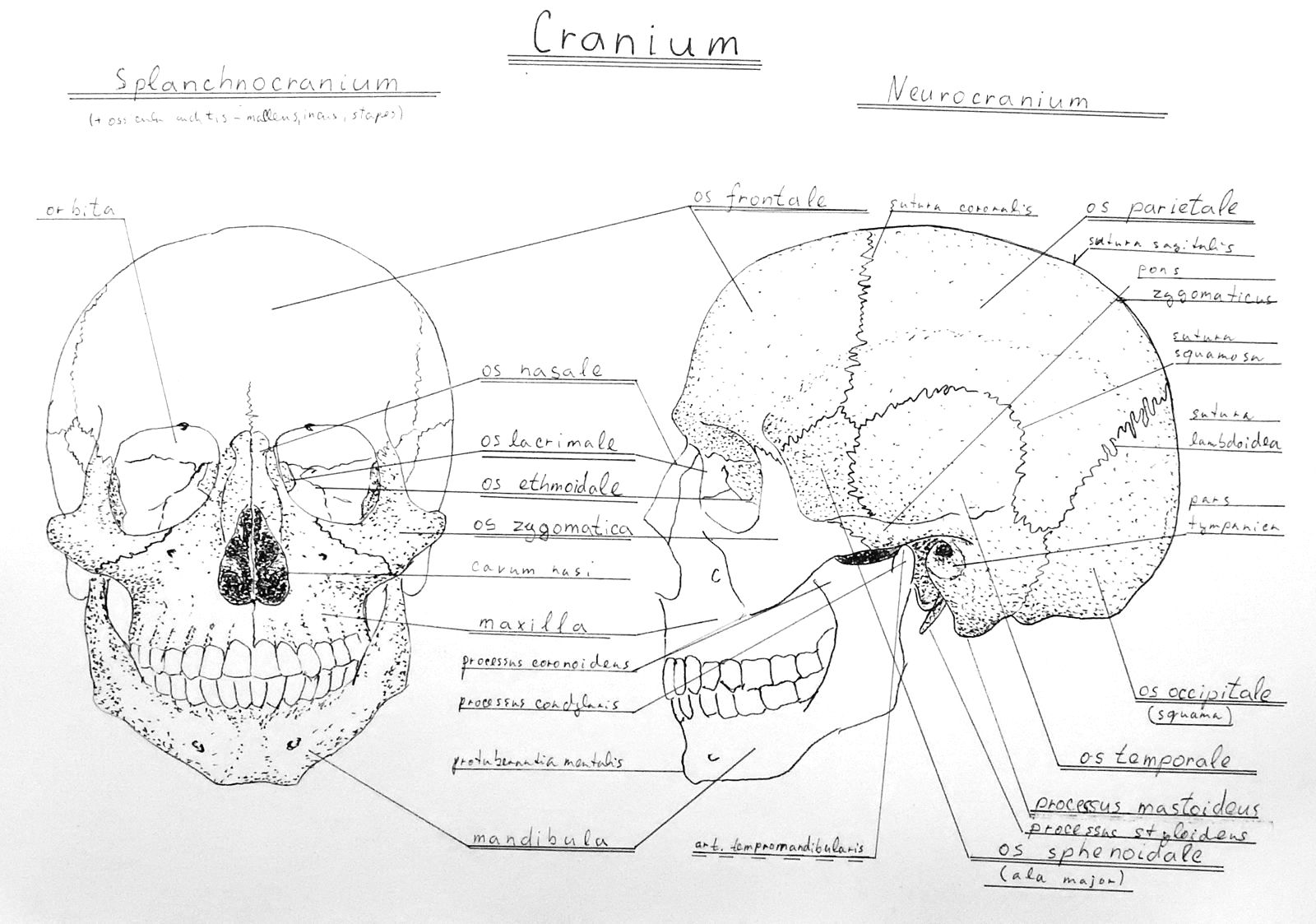
Skull Drawing

©Charly, all rights reserved. Click for full size.

The four dots at the jaw bones – bellow the eye sockets in each maxilla and two on the chin on mandibula –  and two dots above the eye sockets are points where the nervus trigeminus exits the protective shell of the skull to innervate facial muscles. That is why these points are more sensitive to pressure than other parts of the face. Professor Kos told us that an inflammation of this nerve is allegedly the most painful illness there is. The whole face hurts and a feather caressing the cheek may feel like being burned with hot poker. One way to reduce the pain in very severe inflammation cases (I do not remember whether this was an old procedure or one or still in use) was to inject a powerful neurotoxin directly into these points. Extremely painful procedure, but one that provided the needed long relief. He told us the patients would scream and sometimes pass out. And the neurotoxin used? Alcohol.

Nervus trigeminus is near surface once more just behind mandibula, right bellow the ear lobe. This knowledge has helped me twice in self-defence, once when I was held in chokehold but I managed to slide my hand to my attackers head and drill my forefinger into this point and second time when another person was having their arm twisted by a wannabe teenage ninja. The pain is so intense, that anyone will let go of anything they hold and try to get their head dout of the way. If you feel brave you can experiment on yourself. I did. I do not recommend it.