
I started slowly peeling the grains off the cobs of my corn harvest. From the small or otherwise inferior ears, it goes directly into a beaker marked “Food”, but the rest is being sorted by color into different beakers. Yes, I could not resist the compulsion to sort the seeds by color. So far, I have these:
white, yellow, orange, blood red, bright red, pink, brown, light lilac, dark lilac, grey, black(dark grey)
There is also one ear with some green and blue seeds. Really. Unfortunately, the colors are a bit wonky and it is only a few grains, so these colors will be rare.
And then there is a separate beaker with an assortment of seeds that have either pastel colors or do not have a uniform color (marbled).
I did not know that corn can come in so many diverse colors, and I am both thrilled by it and disappointed by the lack of proper greens and blues.
After I am done, I will sort the biggest seeds of each color into tiny transparent bags and store them in a jar in my dark cellar. The plan is to sow the same amount of each color to get the widest possible color spread the next year.
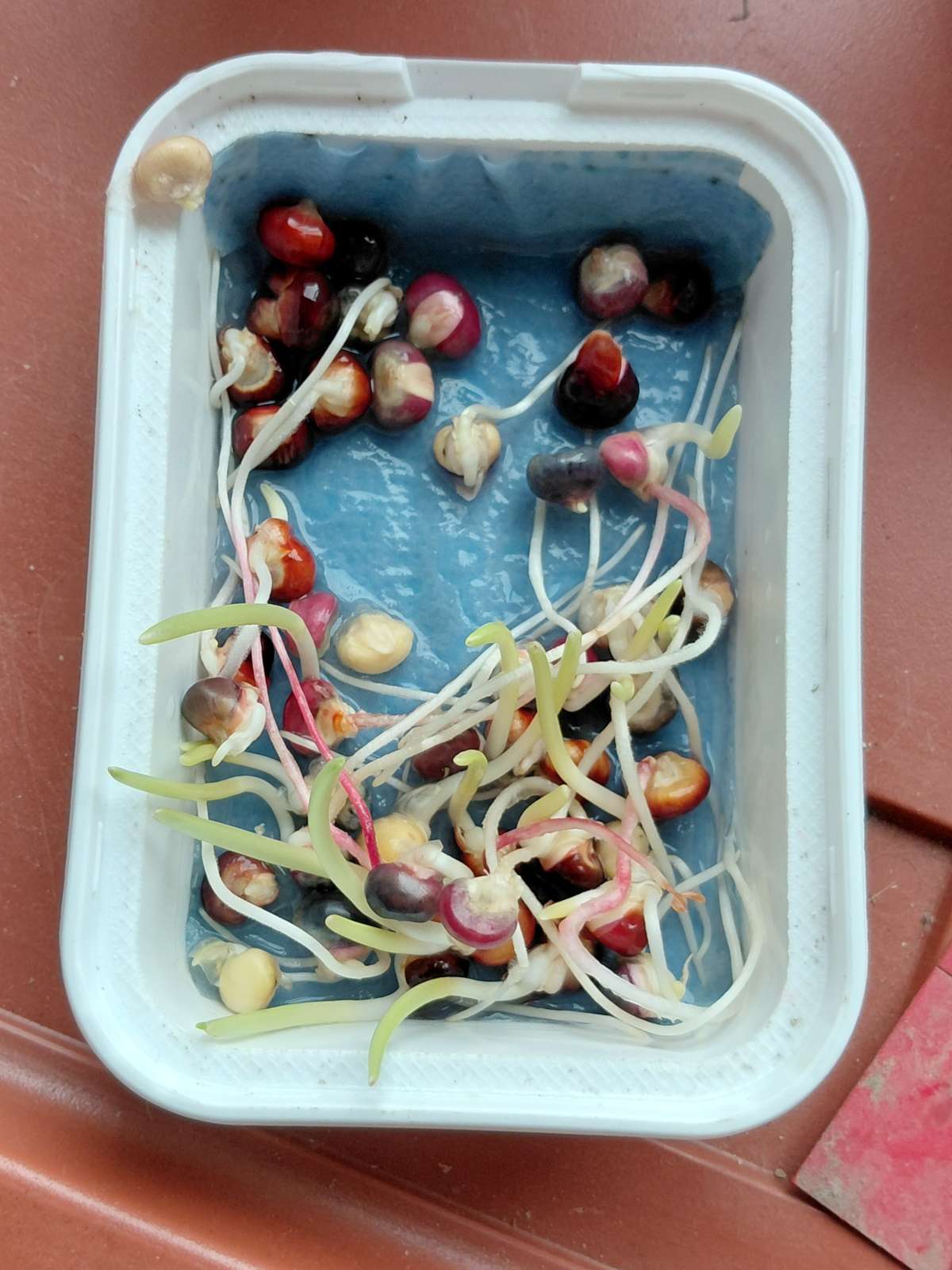
But before I started all this, I took two seeds from each ear I estimated as ripe, and I put them to a germination test.
© Charly, all rights reserved. Click for full size.
I tested 48 seeds overall, and 35 germinated within a few days. That is 73% germination rate, which is about the same that the bought seed had this year. I was hoping for a higher rate, but I can work with this. I plan to sow the seeds in pairs spaced about a palm-width apart, and when they emerge, pull and discard the second one. With this germination rate, that should ensure that in most spots (over 80%) at least one should germinate, thus minimizing empty places, as well as selecting for a fast germination trait. The downside is, of course, that I need to put aside twice as many seeds as I intend to sow. However, since I intend to sow them at the right time next year, not a month late, I should get even better results for the following season.