
Icosahedral Weave, designed by me
I spent an inordinately long time designing this model in 2024, so let me talk about it.
Icosahedral Weave, designed by me
I spent an inordinately long time designing this model in 2024, so let me talk about it.
Recently, the US Federal Reserve increased interest rates by 0.25% (CNBC). It may not seem like much, but it heralds further increases in interest rates, and it basically represents the failure of Trump policy. Let’s talk about it.
What are interest rates?
FYI, this is all stuff that you can learn about from more politically impartial sources, such as Wikipedia, or websites promoting financial literacy. I’m not saying anything new.
“Interest rates” is a generic term that describes how expensive it is to maintain debt, e.g. if you have a mortgage or credit card debt, you have to pay interest on that debt. But in this context, I’m referring to the Effective Federal Funds Rate (EFFR), which is a matter of US economic policy. The EFFR represents the interest rates that US banks pay on their debts to the US Federal Reserve. The EFFR is not identical to the interest rates that you pay on your own debts, but they’re strongly connected via market mechanisms.
Okay, but why are banks borrowing money?
When you deposit money in a bank, they don’t hold all that money in a vault, they turn around and invest the money. But you still need to be able to withdraw money when you need it, so banks maintain a certain amount of money on hand (aka liquidity). In fact, banks are strictly required to maintain a minimum amount of liquidity. If banks ever have too little liquidity, they borrow money from other banks that have too much. Or, they borrow money from the US Federal Reserve Bank.
So by setting the EFFR, the US Federal Reserve is basically setting the price of liquidity. And that affects the entire financial system.
If interest rates are low, then liquidity is cheap. You can borrow money to buy a house at relatively low interest rates. You can borrow money to start a new business. You can even invest in businesses that produce relatively little value to society, such as cryptocurrency or Twitter.
If interest rates are high, then liquidity is expensive. Starting a business is harder. Investors demand companies produce immediate profit, even if that means enshittifying their product. Even the US national debt becomes more of a concern, because the government, too, pays a higher interest rate.
Depending on your financial position, you may stand to personally gain or lose from higher interest rates. For example, if you have a fixed interest mortgage, lucky you, you’re protected. But the purpose of adjusting interest rates is obviously not to benefit some individuals and punish others, it’s for the health of the entire economy. In case of a recession or financial panic (e.g. the 2008 financial crisis), the Feds will lower interest rates to inject more money into the system. In case of supply shocks or inflationary spiral (e.g. recent years), the Feds will raise interest rates, basically discouraging spending and tamping down inflation.
The current hikes
So, here’s the EFFR over the last 10 years.
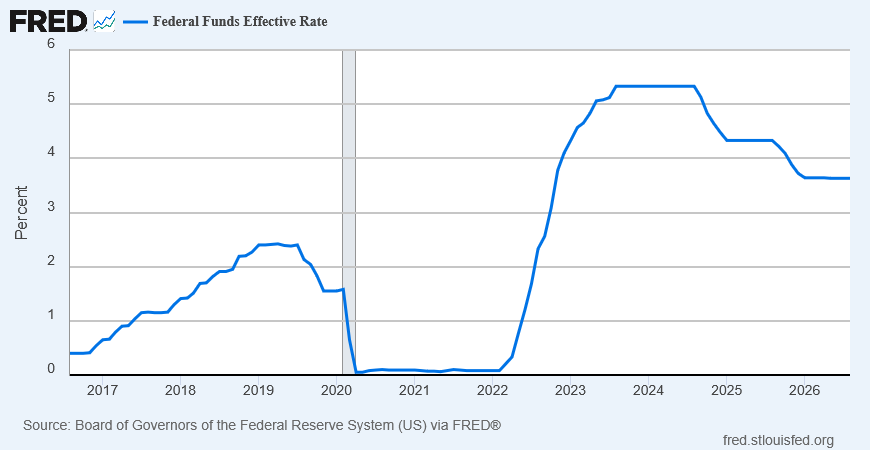
Source: FRED. The graph doesn’t reflect the latest increase in EFFR this month.
In 2020, the Feds suddenly cut rates in response to the pandemic, basically financial relief in the face of hard times. But it couldn’t last. In 2022, inflation started going up, attributed to pandemic stimulus checks, supply chain disruptions, and the Russian invasion of Ukraine. So the Feds responded by increasing interest rates. Under Biden, the economy was recovering and interest rates were slowly turning around. But Biden also took the blame, and this is probably the biggest reason why Democrats lost the election in 2024.
Trump put the brakes on economic recovery, as I’ve already discussed. He promised tariffs and immigration enforcement. So the Feds, conservative though they are, were concerned he’d make good on those promises, and slowed down interest rate cuts over the next few years.
The latest interest rate hike is pretty strongly related to another Trump policy: war with Iran. It turns out that if you take 20% of the world’s oil supply, and lock it behind the Strait of Hormuz, things get more expensive. Inflation goes up, and the Feds increase interest rates to tamp it down.
Trump, for his part, has been demanding that the Feds cut interest rates. He demanded it in 2025, and is demanding it today. He even installed Kevin Warsh as chair of the Federal Open Markets Committee (which decides interest rates), in an effort to pressure interest rate cuts. But the latest vote was unanimous, with even Warsh voting to raise interest rates.
Why has Trump been demanding interest rate cuts? It’s nonsensical. The interest rate hikes are easily attributable to his own damn policies. He’s openly advocating a policy of runaway inflation.
I’ve wondered if maybe Trump stands to personally benefit from lower interest rates. For instance, if he personally holds variable-rate loans. I found a source saying that he did, as of 2019. So basically, he’s advocating a nonsensical policy because of personal corruption. Unforgivable.
But another source argues that he’s demanding interest rate cuts in order to deflect blame onto the Feds. Hard to tell who exactly this would fool, as it requires you to simultaneously understand federal interest rates, and not understand federal interest rates. In any case, also unforgivable.
This has been your periodic reminder that the Nazis do not make the trains run on time. They just blame immigrants when they themselves screw up the trains.
The death of atheism
According to local mythology,* the atheist movement of ~2007-2015 was torn apart by the feminist wars. Back in the day, everyone was standing shoulder to shoulder, promoting the secular agenda. Then we took a bite of the elevator, and our eyes were opened. Some of these people we were standing next to were terrible actually. Why were we on the same side? Were we ever on the same side?
*This mythology may or may not be accurate, but for this post I’m rolling with it.
In the atheist feminist wars, there is one moment that sticks with me more than anything else. It’s in 2012, when DJ Grothe complained that there weren’t enough women at TAM (a conference run by Grothe’s organization), because women were warning each other about harassment.
Last year we had 40% women attendees, something I’m really happy about. But this year only about 18% of TAM registrants so far are women, a significant and alarming decrease, and judging from dozens of emails we have received from women on our lists, this may be due to the messaging that some women receive from various quarters that going to TAM or other similar conferences means they will be accosted or harassed.
Grothe was blaming women for warning each other about going to TAM. But if women are being harassed, that seems like pretty good justification for the warnings! And if the organizers believe no harassment is occurring, that’s the very opposite of reassuring.
Last month, I wrote an article about celebrities who stopped identifying as asexual (or who never did to begin with).
The Bisexual Problem | verilybitchie (video, 2:06 hours) – The video discusses the narrative logic that prevents bisexual characters from being portrayed on screen. If a character has a series of relationships, or a love triangle, then it’s only the last relationship that counts as their true love, and a referendum on whether the story takes the side of the straights or the gays. Already an incredible piece of media analysis, but then it veers into larger topics. What is sexual orientation anyway? Why does GLAAD seem to ignore bi characters? Why do bisexuals have worse outcomes than either gay or straight people? And what are some serious solutions?
I also strongly recommend the video for ace readers, though it doesn’t directly speak on ace issues. It’s all relevant by analogy, although I think it may take time to really digest the implications. There are also many narrative logics that make it difficult to tell “asexual” stories–not to mention “graysexual” stories or others.
The Wrong Kind of American | Julia Curlee | Atlantic (paywalled, but there’s also a free video interview) – I found this story because I know the author (friend of a friend), although she never told us what she was doing for work. Apparently she worked for the CIA, as part of the Presidential Daily Brief team. This team compiles information to present to the administration; for example, they would be the ones to tell the president that war with Iran would be a shitshow, not that the president would listen. Julia’s contributions were essential. But because she’s trans, the second Trump administration eventually pressured her out anyway, because they do not believe in competence.
In video gaming, there’s a meme that goes, “I want shorter games with worse graphics made by people who are paid more to work less and I’m not kidding.” To reassure you of the meme’s utter seriousness, the words are traditionally put into the mouth of Sonic the Hedgehog. The meme originates from a tweet in 2020, but continues to echo throughout games criticism.
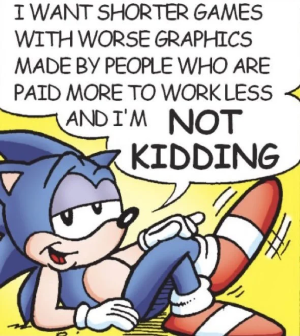
I think a major reason for the meme’s popularity, is that it represents an alliance of two interests. You have people who are upset about the poor work conditions of game devs. And then you have gamers who are tired of the monotony and conformity of big games, who think “worse” graphics make a game better.
Of course, gamers far outnumber game devs. So the tendency is to emphasize the concerns of gamers, and treat game devs as an afterthought. It is assumed, or openly argued, that the two concerns are aligned, which is certainly convenient for gamers.

Pacman Ghost, designed by Oliver Jiang.
No comment <_<
In my last post, I was talking about our search for a new apartment. For the record, my motivation was that I hadn’t written much lately, so why not write about what I’ve been doing? I was not specifically trying to comment on the politics of housing.
But the politics of housing are surely relevant, and worth talking about–at the risk of repeating myself.
As I’ve said many times by now, my household is relatively wealthy. Plainly stated, we are millionaires. That’s not a brag, I simply think you deserve my honesty. Since around 2020, my husband and I have become tech workers without any dependents, debt, or expensive tastes–it’s a recipe for wealth. In our position, some people expect that we would buy a house. But we don’t want to become homeowners, and we are ideologically opposed to the expectation that we should.