The Greater Gardening of 2026 – Part 35 – Thistle Test

I love thistles from an aesthetic standpoint, but in the garden, they are admittedly a huge pain in the wherever.

© Charly, all rights reserved. Click for full size.

One huge Carduus acanthoides emerged near the south wall of my house among the runner beans. That is a place where it actually does not disturb me in any way. It does not impede mowing the lawn, watering the beans, or moving around the garden in general, so I left it grow. It is beautiful, and pollinators love it.

© Charly, all rights reserved. Click for full size.

I especially like the spiky flower buds just before they open. They can be dried and painted for nice decorations, but I am not going to invest the effort in that. I enjoy them outdoors when walking by.

© Charly, all rights reserved. Click for full size.

Thistles are pioneer plants capable of driving their roots even through compacted loam very deep. And they are not perennial, so they are actually good for the soil because the roots decompose after two years, leaving channels in the clay through which water can seep into the soil. That way, they help to de-compact it over the years.

But what am I actually testing with this thistle right now, I don’t hear you ask? Well, nothing gardening-related, actually. After eight years, my phone was getting slow, and the battery was no longer holding charge for very long. And to top it off, I dropped it, and the loudspeaker started to sound crackly. So as much as I did not want to, I had to buy a new one. And after a whole day of setting it up with all the apps I use, the thistle provided a nice opportunity to test the camera.

I learned that it makes nice macro pictures, as long as I do NOT use the built-in macro mode. All pictures made in the macro mode were blurry and just 1600×1200 px. I got better results by taking the pictures in the default mode and cropping them afterwards, just like I did with my old phone. Funny how that works.

The Greater Gardening of 2026 – Part 34 – Bellarosa Bounty

I harvested my first potatoes of the year, the very early variety “Bellarosa”.

© Charly, all rights reserved. Click for full size.

Since I was growing these on top of the lawn under old compost mixed with some soil, moss, and tree leaves, I did not have to dig. I merely carefully raked the muck aside and picked the tubers off the ground. They did look quite nice, although they were not all nice. But that is normal.

© Charly, all rights reserved. Click for full size.

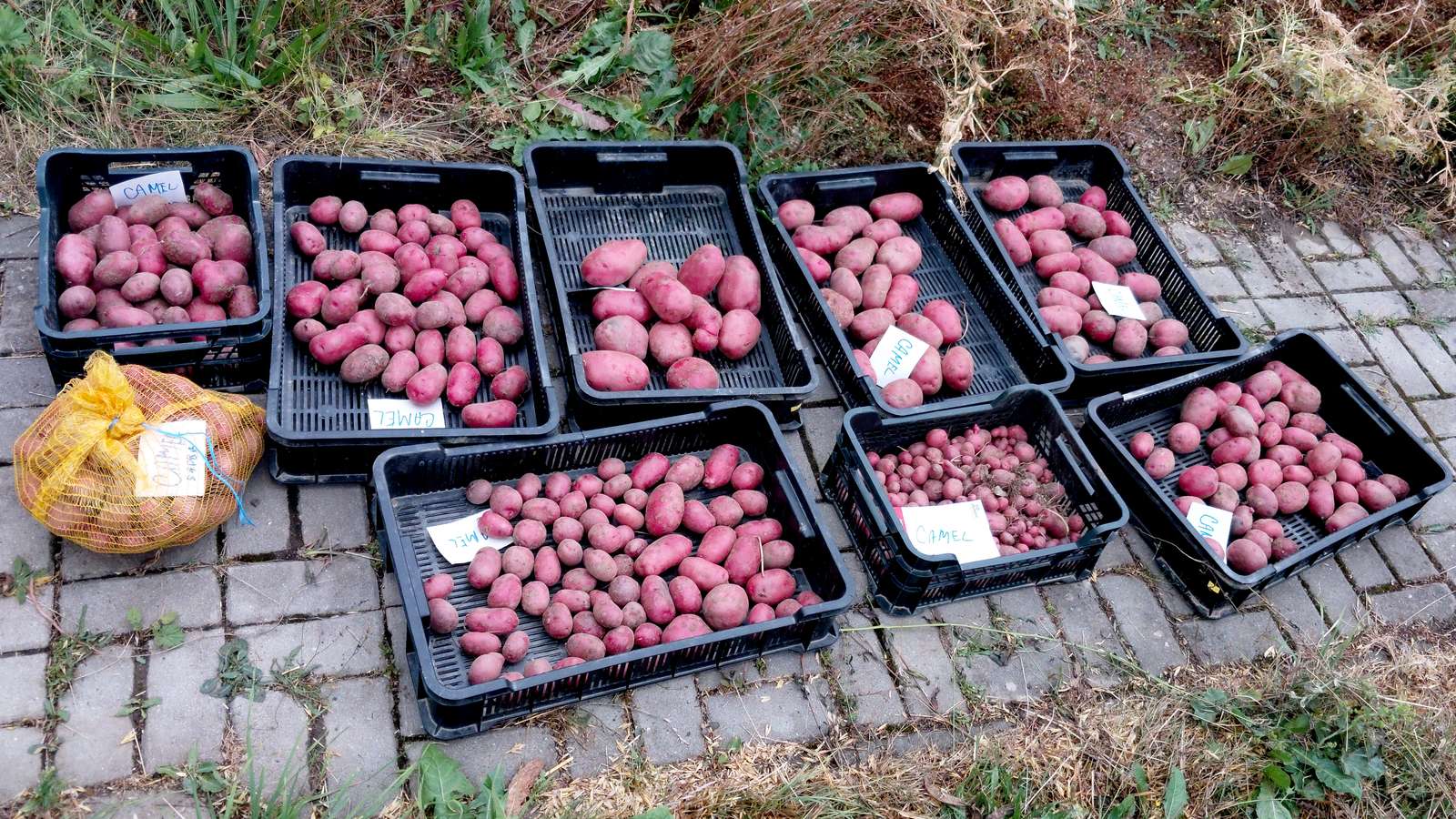
Each of these crates contains 4 kg, except the far left one, which contains 2 kg of the smallest tubers. There were also approximately 8 kg of tubers that had various degrees of damage from mice, slugs, insects, or the rake. Those will need to be processed, i.e., eaten, fairly quickly.

© Charly, all rights reserved. Click for full size.

I put aside 100 pieces of 40-60 g seed potatoes for next year because I do want to grow this variety again for the following reasons.

  1. Overall, I harvested about 38 kg of potatoes from 5 kg of seed. This is not fantastic, but it is good, especially for a very early variety with very short vegetation.
  2. There was no blight, and the pest damage is relatively minimal.
  3. I am especially pleased with the size of the tubers and the ratio of big/small/tiny – I got 20 kg of big, 4 kg of small and just 2 kg of tiny tubers in shape good enough for storage, and that is good.
  4. Since I grew them in the Ruth Stout method, it was relatively little work for quite reasonable gain.
  5. Despite not being planted deep, the plants fared reasonably well in the heatwave.
  6. Despite the heatwave, most of the tubers are quite nice-looking and not warty. Which is a cosmetic issue, but even so. They are also mostly round and not funny-shaped, which is a plus for peeling.

So although I am not super impressed, I am quite content with how this specific variety turned out. We will now cook a few meals with them and try to dehydrate them to see what uses they are best suited for.


The Greater Gardening of 2026 – Part 33 – Getting Grains

I extracted and weighed the oats. Let’s talk about it.

© Charly, all rights reserved. Click for full size.

The sheaves did dry into a very nice golden colour, although possibly still not quite enough. Maybe the threshing would be a bit easier and less laborious if I let them stay a few more days. But I wanted to be done with this so I can concentrate on other things. Also, the sparrows apparently thought I harvested the oats for them.

It did take a few hit-and-miss experiments to get a process that works for a small batch.

© Charly, all rights reserved. Click for full size.

First I put one sheaf heads-first into a thick plastic bag, and I chucked nuns at it for a bit. That softened the straw and loosened most of the grains, although unfortunately not all of them. I think to loosen all of them, the sheaves would need to stand outdoors for much longer, and possibly it would help a bit if they got rained on and dried again. I do not know for sure; there is not much knowledge about this floating around anymore – it was lost to combine harvesters. My mother only knew how to make the sheaves; she was doing it as a child.

© Charly, all rights reserved. Click for full size.

After the straw was a bit beat up and softened, I stripped the panicles into the sack using a thick leather glove, and I poured it all into a bucket. To thresh it thoroughly, I built an improvised drill-powered thresher. First I used only the wooden spokes. It worked, but not particularly well. Then I added bits of chain on the ends of all spokes, and that improved the performance quite significantly. When I have time in the workshop, I will probably build a better and more permanent structure from metal, because I want to grow more grains next year.

© Charly, all rights reserved. Click for full size.

If we had a bit of wind, separating the grains from the chaff would be easy. But we have almost dead calm, so I had to use an electric fan that I fortuitously was able to purchase last month. It did not work as well as natural wind would because of the limited cross-section of the airflow, but it did work. Unfortunately, the grains still need to be a bit sorted and cleaned manually, which is difficult without Cinderella, on whom such a task could be shifted.

So, what did I get? Approximately 3600 g of clean grain, circa 170 g/m². That is about half of what I was hoping for, and about 70% of what I would still consider a good-ish harvest. According to all the info I could find, 300 g per m² should not be impossible; indeed, most sources mention yields even 500g/m² or more.

I can only speculate about the reasons for such a poor yield:

  1. Poor soil. It was visible in the growth that about half of the patch had significantly poorer soil. The plants there were good 10 cm smaller, and the panicles had visibly fewer blossoms. I did fertilize the patch, but evidently not quite enough for it to really matter. This is a real-life demonstration of why most fields around here were transformed into pastures.
  2. Heatwave. The heatwave did have a negative effect. It was at exactly the wrong time, and as a result, the plants did not develop some flowers into grains. I did water the patch, but I waited a bit too long with it.

I still consider it a success in the sense that I learned something worth knowing. And I think it is worth pursuing growing naked oats (and other grains) next year on another, bigger patch of land. I will till in a lot of organic fertilizer and compost into that patch in the fall, so it decomposes and dissolves into the soil over winter, and I will do the same for the patches where I wish to grow various kinds of wheat next year. We shall see what comes of that.

As far as work goes, it is much, much cheaper to buy the oats, even organic ones, than to grow them on a small scale. I would estimate I needed about 4 hours in the spring and about 8 hours for the harvest. But it was mostly very light work, except the tilling in the spring, and the second time it will be a lot shorter, because I will know what I am doing. And I will not be tilling tough turf grass the second time, too – that also needs to be taken into consideration.

If I double the yield and halve the work time, it would be almost profitable. And I think it is doable, only it will take a ‘hole ‘nother year to find out.