
The Probability Broach, Appendix
In sketching his anarcho-capitalist utopia, L. Neil Smith wanted to put his best foot forward. Among other things, that means he wanted his world to appeal to all kinds of people, and not just white men.
In contrast to Ayn Rand, who loudly endorsed the prejudices of her era (for example, she denounced Asian culture and food, called Native Americans “savages” who had no right to their own homeland, believed women should be subservient to men, and tried to pretend slavery never happened), Smith was at least somewhat concerned about equality. He’s eager to show that his fictional North American Confederacy has less racism and less sexism than the real world.
That is, until we come to this line of the appendix:
89 1865 Actor John Wilkes Booth murdered by obscure Illinois lawyer.
As I previously mentioned, in Smith’s history, Abraham Lincoln assassinated John Wilkes Booth, rather than vice versa. You might think that this is a meaningless historical inversion, silliness for its own sake. But no: Smith despised Abraham Lincoln.
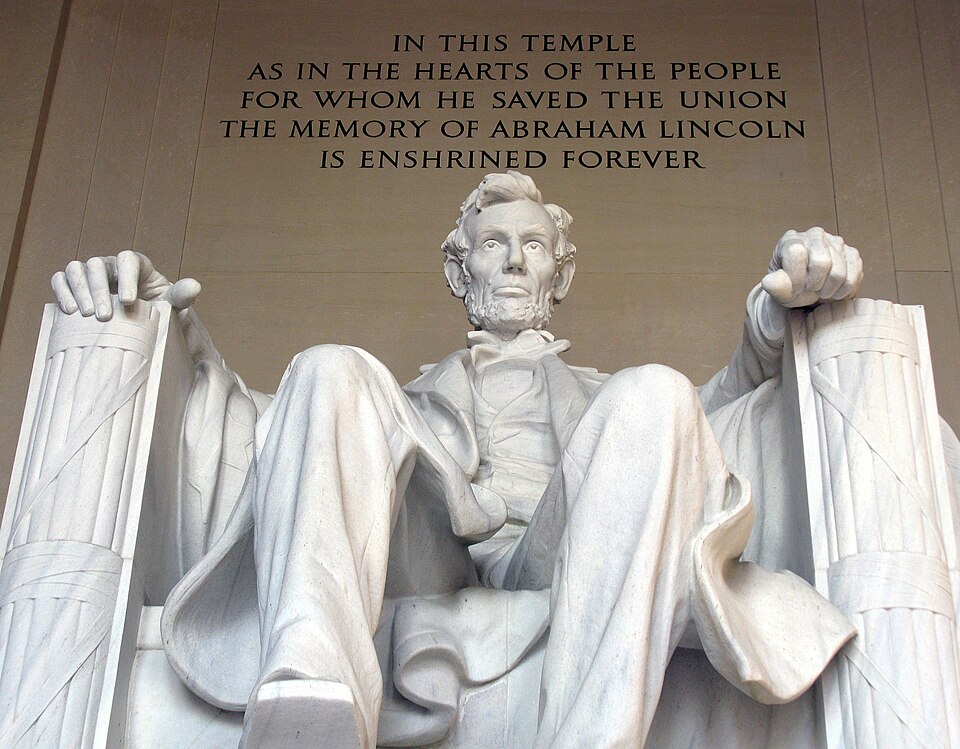
He said that Lincoln should have been put on trial for war crimes like the Nazis at Nuremberg. He said that pennies should be melted down, five-dollar bills should be shredded, and the Lincoln Memorial should be destroyed by wrecking ball. He snarled, “Libertarians know Lincoln as the worst President America has ever had to suffer.”
Why so much venom? In an essay on his archived personal website, “The American Lenin“, he explains why:
Suppose a woman—with plenty of personal faults herself, let that be stipulated—desired to leave her husband: partly because he made a regular practice, in order to go out and get drunk, of stealing money she had earned herself by raising chickens or taking in laundry; and partly because he’d already demonstrated a proclivity for domestic violence the first time she’d complained about his stealing.
Now, when he stood in the doorway and beat her to a bloody pulp to keep her home, would we memorialize him as a hero? Or would we treat him like a dangerous lunatic who should be locked up, if for no other reason, then for trying to maintain the appearance of a relationship where there wasn’t a relationship any more? What value, we would ask, does he find in continuing to possess her in an involuntary association, when her heart and mind had left him long ago?
If it’s not completely clear, the Southern states are the battered wife in this analogy, and Lincoln is the brutal domestic abuser. He held the Union together by force, when some of the states would have preferred to secede. In Smith’s anarchist view, that’s the greatest crime imaginable.
But that’s not all; Smith offers more reasons for his ire. He also says that Lincoln was to blame for the South wanting to secede in the first place:
History tells us that Lincoln was a politically ambitious lawyer who eagerly prostituted himself to northern industrialists who were unwilling to pay world prices for their raw materials and who, rather than practice real capitalism, enlisted brute government force—”sell to us at our price or pay a fine that’ll put you out of business”—for dealing with uncooperative southern suppliers. That’s what a tariff’s all about. In support of this “noble principle”, when southerners demonstrated what amounted to no more than token resistance, Lincoln permitted an internal war to begin that butchered more Americans than all of this country’s foreign wars—before or afterward—rolled into one.
This is a reference to tariffs such as the Morrill Tariff, which was passed shortly before the Civil War. The tariff was a tax on imported goods such as metal tools, machinery and textiles—the idea being to weaken European competition and boost the growing Northern industrial base. But Southern states, whose plantation economy relied on cheap imported goods, hated the tariff. Smith, as a libertarian, takes the South’s side and argues that free trade is a sacred right, so any law that impedes it must be evil.
Now wait just a minute, you must be shouting. Maybe the Southern states had reason to dislike tariffs, but they practiced human slavery on an industrial scale. What’s more, it was enforced with extreme brutality and arbitrary terror. How can that not figure into Smith’s thinking? How can an anarchist libertarian, who claims to value liberty above all else, not cheer the downfall of this monstrous system? What’s really the lesser evil here?
Here’s his answer to that:
The fact is, Lincoln didn’t abolish slavery at all, he nationalized it, imposing income taxation and military conscription upon what had been a free country before he took over—income taxation and military conscription to which newly “freed” blacks soon found themselves subjected right alongside newly-enslaved whites. If the civil war was truly fought against slavery—a dubious, “politically correct” assertion with no historical evidence to back it up—then clearly, slavery won.
With this passage, all of Smith’s pretensions to anti-racism evaporate in a puff of smoke.
This paragraph lays bare the ugly, seething racism beneath the surface of right-wing libertarianism. Smith may have abolished slavery in his fictional world, but when push comes to shove, he still downplays and excuses slavery in the real world.
In the libertarian view, having to pay a percentage of your income in taxes, or being drafted into the army to protect your country in time of war, is exactly the same as living in brutal 24/7 servitude to a master who forces you to perform backbreaking labor for no pay; who tears families apart for profit; who forbids you from traveling or getting an education; and who can have you tortured or murdered for showing the slightest hint of resistance or resentment.
Smith’s extreme binary thinking sees no distinction between these scenarios. Needless to say, anyone who’s actually experienced racism or other kinds of prejudice knows the difference.
The obvious historical reality is that enslaved people wanted to escape and did so whenever they could. In later generations, Black people migrated to the North in huge numbers to escape Jim Crow and other kinds of institutionalized prejudice. In Smith’s view, there was no reason to do this. Since the North had taxes, it was just trading one kind of slavery for another—a monstrously ignorant and insulting dismissal of the lived reality of millions of people who survived unimaginable terrors.
Right-wingers like Smith engage in revisionist history because the Civil War causes them cognitive dissonance. They don’t want to admit that the side that wanted centralized government and more economic regulation was also the anti-slavery side, and the side that wanted small government and laissez-faire was pro-slavery. It casts an unflattering light on their pretenses to moral superiority.
In his fiction, Smith’s solution was to rewrite history to put everyone on the “right” side. In the real world, this move isn’t available, so instead he tries to obfuscate the record and reduce the Civil War to a solely economic dispute provoked by the tyrant Lincoln.
But this revisionist history founders on the fact that we have the Confederate states’ declarations of secession. We can read the reasons they wrote. And each and every one of them cites the preservation of slavery as their chief motive. It’s small wonder that libertarians want to whitewash the record and retreat into fantasy rather than address the evidence in front of them.
Other posts in this series:
Even that isn’t, strictly speaking, true, as it assumes there was a side that actually wanted small government. As you note, the articles of secession show that slavery absolutely was the reason for the American Civil War. But the proposed Confederate Constitution, while mostly copied from the American Constitution, also included things like a formal ban on any state being able to pass anti-slavery laws. So much for ‘State’s Rights’: the only right they cared about was the right to enforce slavery, as they actively took away the right to repudiate it.
Even before the formal Civil War, you had the Fugitive Slave Act which attempted to force non-slave-owning states to act as proxies to enforce laws in slave-owning states. It was never about freedom from government in general.
In practice what the Confederates wanted was the same thing that their successors still want today: small government when it came to their personal business, and big oppressive government when it came to regulating everybody else they disagreed with.
The Confederacy was emphatically not small-government/libertarian. Even before the war, they passed laws against abolitionist activity, required free blacks to show Papers to prove they were, in fact citizens — and in general they were a centralized government even more so than the north. They had a draft, albeit with exemptions for the rich and some working class people bitterly resented this (see the Jones County Mississippi insurrection).
As for income tax, the government would do absolutely nothing if Smith found a way to shift his income into nontaxable forms. Or, assuming he had the cash, simply retiring and never working again. That is not slavery.
LIncoln himself said openly he wouldn’t try to ban slavery, simply prevent its spread (though overtime as the slaveholding states became a minority, they might have lost their grip on power).
Even if you believe the Confederate states had a right to secede (this is a point where the legal debate is beyond me to judge), albeit for an evil cause, that doesn’t make slavery good. I will take people like Smith seriously when they show respect for John Brown, Nat Turner, Denmark Vesey and everyone else who took up arms to fight for freedom against a tyrannical government. Even if Smith were alive, I wouldn’t hold my breath.
Thanks for covering this book in such detail.
I don’t get why some people have a problem with the concept of “everyone sucks here”. Even if I would disagree with that assessment, or agree with it for entirely different reasons, some people seem to have a problem with the idea that a conflict can be anything other than 100% right versus 100% wrong. Black and white thinking is a thing, obviously, but that can look pretty weird sometimes even through that lens, when deciding which side is which requires total pretzel logic.
The main exception is when pure bigotry takes over, then you get “I don’t care who’s right, I just want the [slur]s and the [slur]s to destroy each other.”
The South had one principle – protection of slavery. If freedom of speech conflicted with protection of slavery, freedom of speech went by the boards (and it did, with the prohibition of antislavery literature in the South). If states’ rights conflicted with protection of slavery, states’ rights were out (as mentioned by others with regard to the Fugitive Slave acts, which set up unaccountable “law enforcement” agents who could go anywhere and do anything). The South’s version of income tax required that citizens pay “in kind” – not with Confederate money, but with food and other supplies, which is of course, much more like slavery that a monetary income tax is.
Slavery also imposed major governmental controls on white people: mandatory gun ownership and (for able-bodied men) regular participation in “militia” (patrols for runaway slaves, suppression of slave rebellions, etc) – all at individual expense, of course.
Funny how that tends to slip right-wing minds…
Many years ago now (more than 20, at least), I was interested in libertarianism and hung around in some online spaces then frequented by libertarians. I learned there that many hated Lincoln, largely because he strengthened the power of the federal government in the USA. I also learned that some of them considered paying taxes to be as bad as actually being owned by someone else, which is one of the reasons I ended up rejecting libertarianism. In retrospect, it’s obvious that libertarians who sympathize with the legacy of the Confederacy over the USA that Lincoln led are either being hypocritical or haven’t thought things through, for reasons already pointed out in the original post and by previous commenters.
@Snowberry #2
I think I may understand what you mean about both sides being bad to an extent in many conflicts, including the US civil war. It is clear that the reason the southern states seceded and formed the confederacy was to protect slavery, which is obviously an abhorrent cause. The US government, though, took up arms first and foremost to preserve the union of the states, and only gradually did it turn into a war against skavery as well. In a modern context, waging war against a portion of a nation that wants to break away and form its own nation is usually viewed negatively by progressives as a bad thing, something dictators and other authoritarian regimes do. The general consensus today, at least on the left and center, seems to be that portions of a larger nation have every right to become independent nations themselves if that is what most of their people want. From this perspective, Lincoln seems to be in the wrong – if one doesn’t look at the central reason the confederacy was trying to become a separate nation in the first place! That’s why people who want to generate sympathy for the confederate cause in modern times almost always have to try and obfuscate the motive for secession – anything but slavery! At the same time, though, the USA’s cause looks much better to progressive eyes today when one emphasizes the latter part of the war, when it became a war against slavery as well as preserving the union.
The Fire of Freedom by David Cecelski spotlights how black Americans fighting to abolish slavery and claim legal equality were frequently at odds with the US government during the war. It does drive home that the Union wasn’t unambiguously good.
Secession is complicated. In almost every modern region with secessionist impulses there are residents who want to stay part of the bigger nation, as well as enclaves who want to secede from the secessionists.
No kidding. Here in Canada where Quebec separatism has been a thing for generations, one of the things that sometimes comes up during discussions is what would happen with various First Nations treaty lands/reservations. Not only are those actually technically federal jurisdiction rather than provincial, so legally Quebec wouldn’t be able to just walk off with them without a whole lot more going on, but most of the First Nations aren’t terribly fond of the separatists. They don’t like the federal government either (and historically the First Nations got along better with the French colonists than the English), but given how actively nationalistic and bordering on xenophobic many of the louder separatists are, a lot of the First Nations would prefer the devil they know.
In some ways the Quebec separatist movement has been a victim of its own successes. Between the investment in Quebec, and things like the laws that require people working for the Federal government to be functionally bilingual (which biases hiring since people whose native language is French are more likely to learn enough English to be bilingual than the other way around)… most people in Quebec see separatism as a bad deal these days, as they feel they have enough hooks inside the system to be worth fighting for incremental change. The last referendum that got even close to passing did so by a fair bit of weasel-wording about how it was a referendum on ‘re-opening discussions on the place of Quebec in Confederation’ rather than being about separatism on its face.
@springa73: A peaceful separation was possible – but it would have required a lengthy negotiation to resolve a lot of issues, like:
1) Taxpayers in the North paid off the substantial debts of the Republic of Texas when Texas joined the Union – will those taxpayers be reimbursed for that debt?
2) How long do pro-Union citizens of southern states have to move to the US (and vice versa)?
But the Confederacy foreclosed on the prospect of peaceful negotiation by attacking Fort Sumter (an artificial island built using tax money raised from throughout the Union (and out of New England granite) to protect Charleston, and which the state of South Carolina had ceded all rights decades earlier)
The book “Madness Rules the Hour” shows how Charleston and South Carolina were chomping at the bit to secede, with little patience for the Southerners who thought they could work things out peacefully.
Thank you for that reference – I’ll be looking for a copy