This is a fun children’s book and the illustrations are fabulous, so if you’re looking for something to do I recommend checking it out at the link below.
via: The Internet Archive
This is a fun children’s book and the illustrations are fabulous, so if you’re looking for something to do I recommend checking it out at the link below.
via: The Internet Archive
A bee fly in midair. I didn’t have much luck with the camera on our walk, mostly because the woods have never been that popular before, but this little fellow didn’t care much for all the crawlers on the ground.

Photo by Hans Hillewaert via Atlas Obscura
Today’s tree is one you should admire from afar. Really far. In fact, don’t go anywhere near it because contact with any part of this tree could be lethal. Just ask Ponce DeLeon. Oh, wait, you can’t. Because he’s dead, and this is the tree rumoured to have killed him. It’s a Manchineel Tree, known in Spanish as arbol de la Muerte, literally “tree of death.” Its fruits are called la manzanilla de la Muerte, “little apple of death.”
You might be tempted to eat the fruit. Do not eat the fruit. You might want to rest your hand on the trunk, or touch a branch. Do not touch the tree trunk or any branches. Do not stand under or even near the tree for any length of time whatsoever. Do not touch your eyes while near the tree. Do not pick up any of the ominously shiny, tropic-green leaves. If you want to slowly but firmly back away from this tree, you would not find any argument from any botanist who has studied it.
An unfortunate radiologist took a bite while in the Caribbean, and she describes the experience for us.
I rashly took a bite from this fruit and found it pleasantly sweet. My friend also partook (at my suggestion). Moments later we noticed a strange peppery feeling in our mouths, which gradually progressed to a burning, tearing sensation and tightness of the throat. The symptoms worsened over a couple of hours until we could barely swallow solid food because of the excruciating pain and the feeling of a huge obstructing pharyngeal lump. Sadly, the pain was exacerbated by most alcoholic beverages, although mildly appeased by pina coladas, but more so by milk alone.
Over the next eight hours our oral symptoms slowly began to subside, but our cervical lymph nodes became very tender and easily palpable. Recounting our experience to the locals elicited frank horror and incredulity, such was the fruit’s poisonous reputation.
The tree is found throughout the Caribbean, Central America and into the northern part of South America. They live in clusters in coastal areas, and they rely on the movement of water to disperse their seeds. The tree is also found in south Florida, making it America’s deadliest tree.
The sap, white and milky, is spectacularly toxic; it causes burn-like blisters upon any contact with skin, and if you’re unfortunate enough to get it in your eyes, temporary blindness is highly likely. This sap is found throughout the tree, including in the bark and leaves, so, you know, don’t touch any of it.The specific toxins found in this sap and in the fruits remain partially unknown, but not unused. The aboriginal peoples of the Caribbean were familiar with the tree and used it for many purposes; the sap, in particular, was used to tip arrows. “It is believed that the Calusa used it in that manner to kill Juan Ponce de Leon on his second trip to Florida in 1521,” says Hammer.
Manchineel is a member of a family of plants known as the spurges. (The name comes from “purge,” because, although all these plants have toxic sap, the toxicity varies, and some can be used as a laxative.) Spurges are found worldwide, in various forms, ranging from tiny herb-like plants to large bushes and trees. Manchineel is one of the largest, reaching up to 50 feet in height, but despite its dangerous reputation is not the most famous—that’d be the poinsettia, the manchineel’s more festive cousin.
Story via: Atlas Obscura

Olive Thorne Miller. True Bird Stories from my Notebook. Illustrated by Louis Fuertes. Boston & New York, Houghton, Mifflin, 1903.
via: The Internet Archive
Kestrel has sent us an extra-special bit of adorableness.
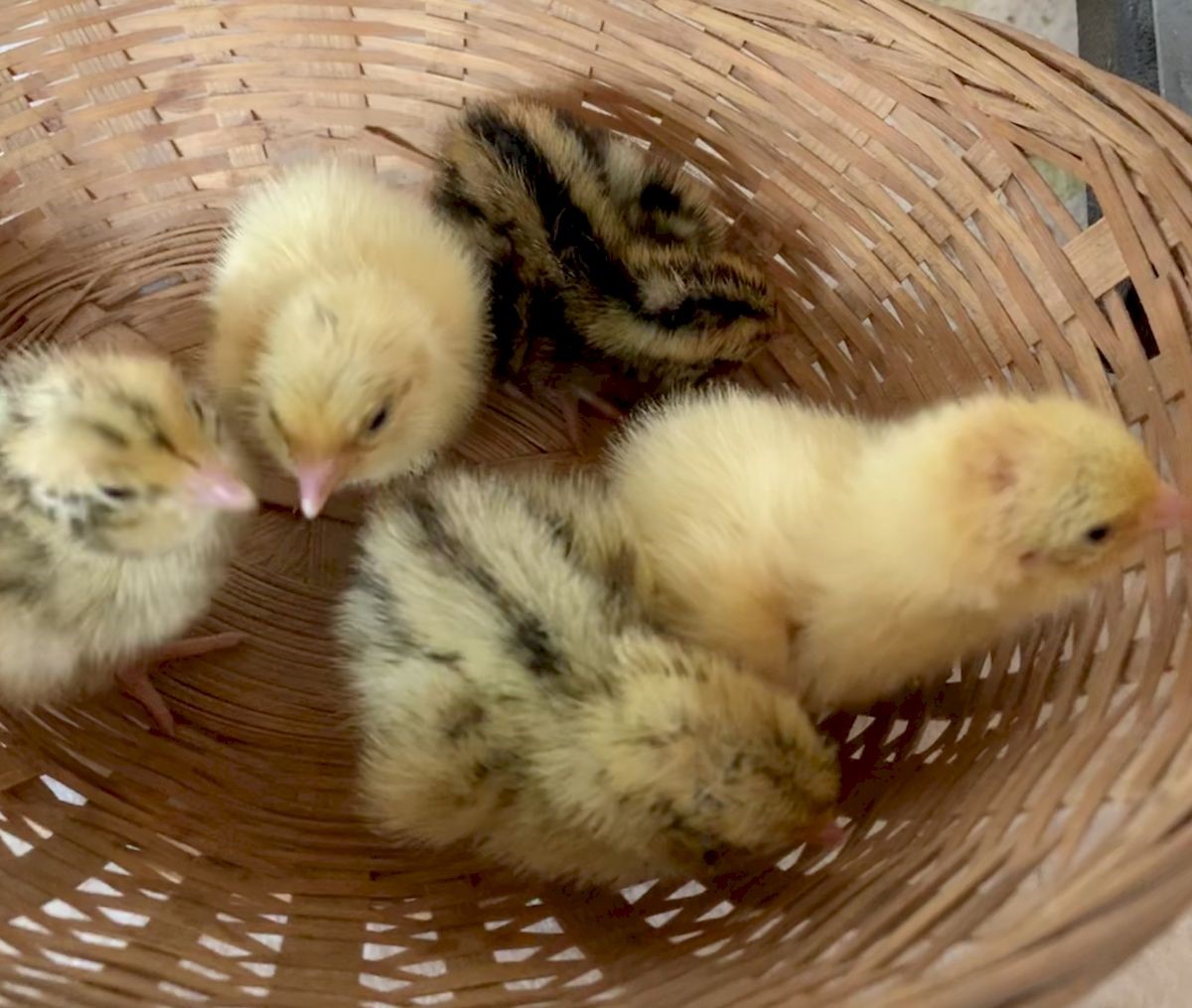
I raise quail – these are Japanese Coturnix quail. On Easter morning I woke up to this sight in my incubator:
After the main crush was out of the incubator, one little late-comer to the party hatched out right into my hand.
This was my Easter basket, but none of them ever turned into chocolate, or marshmallow.
Hanging out at the water cooler in their new digs. The marbles are to stop the tiny little things from drowning themselves. Like all little babies they can get themselves into all sorts of trouble. Most of them are underneath the brooder plate, that black and yellow thing to the right. The underside of it stays warm, about 100F, but that is just not hot enough to start a fire, so these are much safer than heat lamps. The other benefit of the brooder plate, besides safety, is that since it does not work by a light, it gets dark at night, allowing the chicks to sleep like they naturally would. With a heat lamp you have to keep that light on all the time.
Now they are one week old, and much bigger. They are even starting to get feathers, just like real grown-ups! The feeding frenzy is over very finely diced hard-boiled quail eggs, full of important nutrition
This is the one that hatched into my hand on that first day a week ago. (I can tell, because this one has two white toes.) They grow very fast! By the time they are 3 weeks old they will be ready to leave the brooder and won’t need any heat to survive. These quail will be fully mature by the time they are 6 to 8 weeks old, at which time they will start laying eggs of their own and the whole thing will start all over again.
via: The Internet Archive
This week it’s the Green Fairy Book and I’ve plucked a few of my favourite illustrations to share with you. Most of the artwork that I’ve chosen involves animals. My absolute favourite drawings, though, are from the last story in the book, The Three Dogs. Enjoy!
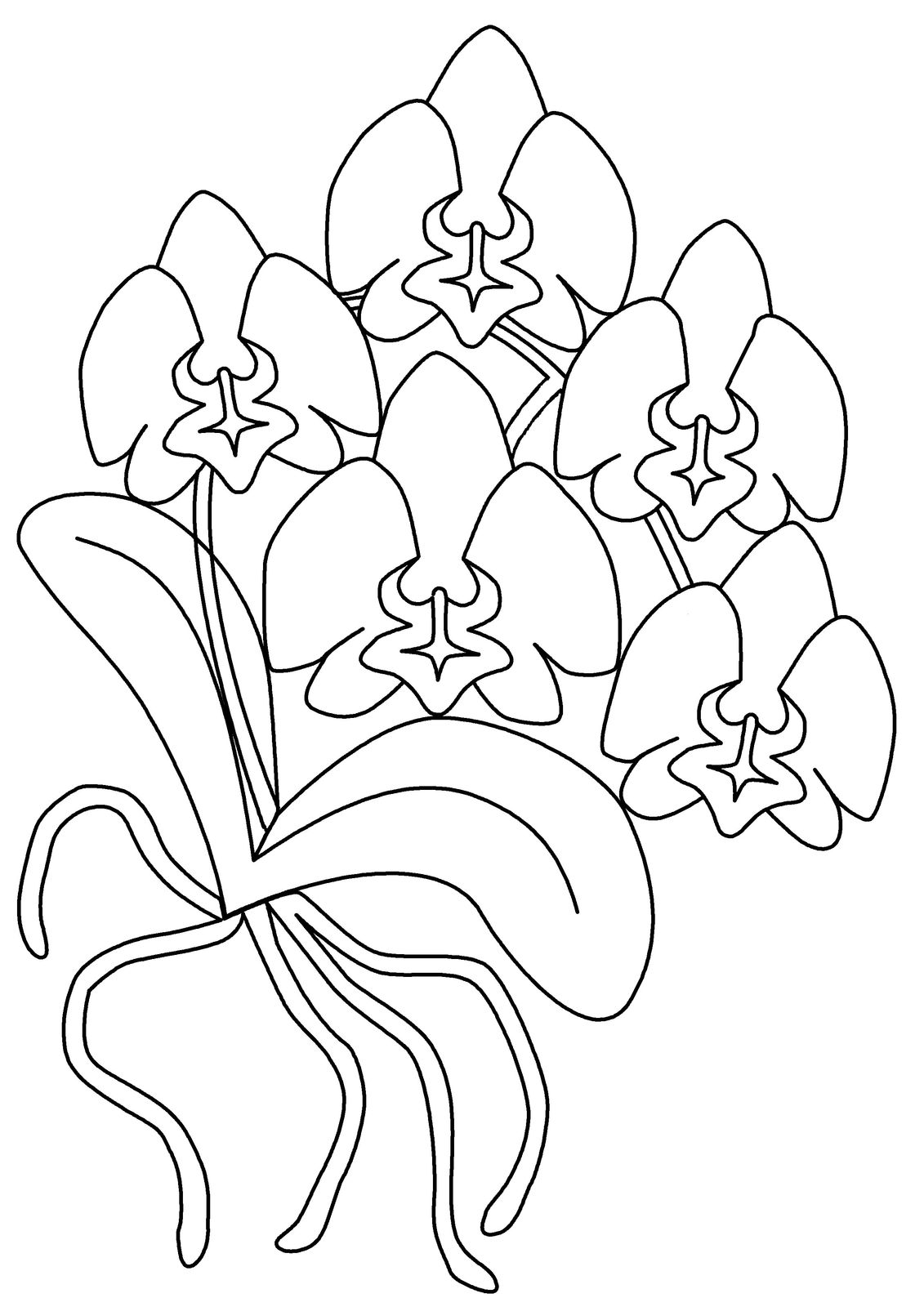
My next bobbin lace project was a picture of an orchid. It was inspired by the orchids that my father grows on the windowsill in our living room, but it is not, of course, intended to be an accurate representation of any specific plant/species. This time I did not use paper and pencil at all, I started rightaway drawing on my PC with my tablet and I ended up with this coloured sketch.
From the sketch, I have made a template that could be printed out. The important thing to not forget by an assymetrical design like this is to mirror the image – the lace has a front and back. In this case not only all the knots are on the back side, but important is also the stalk of the blossoms which is in front of the right leaf.
The final step was, of course, making the actual lace. It took me circa 40 hours. you can look below the fold whether it was worth the effort.
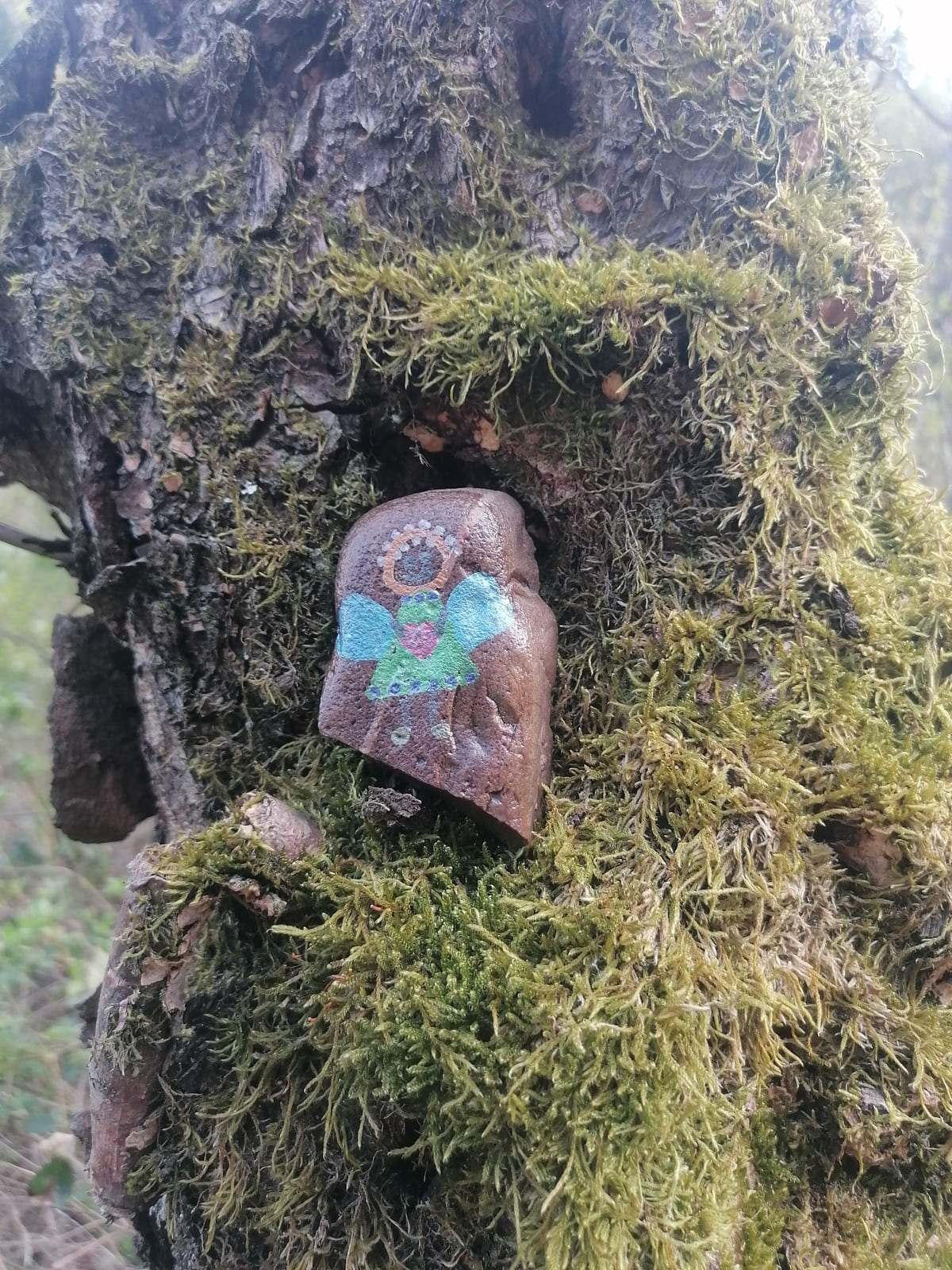
Yesterday brought us news about the search for Oma, which reminded me that I probably met a distant relative of Jack’s fairy friends.
maybe Jack can ask them if they’re related, the little fairy was a bit shy and didn’t talk to me.
When we went to the wholesale supermarket I bought a whole crate of zucchini, which means we’ve been using them in a whole lot of dishes, and since they are true neutral, I also decided to make zucchini cake. It turned out really, really nice and it would be a shame not to share.
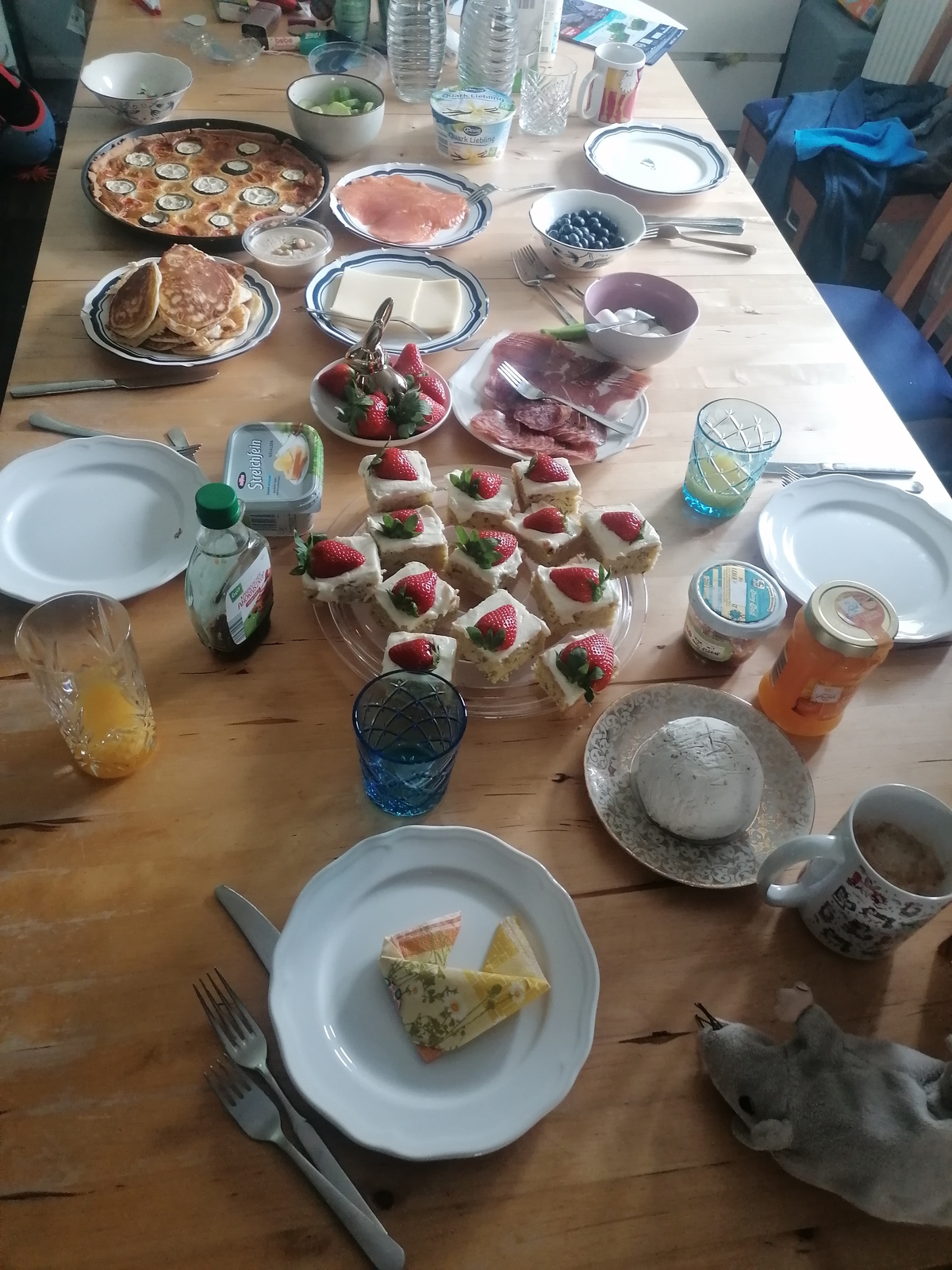
Uhm, yeah. our easter brunch…
For the cake you need:
Grate the zucchini, mix wet ingredients (including the zucchini), mix dry ingredients, combine, bake a 160° with ventilation.
One thing that made me wonder about the recipe was that they told you to bake it in a 26cm (10″) round tin. Every experienced baker can see from the amount of ingredients that this is way too much and I’m sorry for the inexperienced bakers who flooded their ovens with cake batter. I baked it in a tray for about 30 minutes.
Another thing is that there’s really little sugar in the recipe. This means that it’s perfect for a sweet topping. The original recipe had a chocolate ganache, but I went for lime and cream cheese with fresh strawberries on top and it was just perfect. If you don’t want to add a topping I’d recommend adding something like another 100g of brown sugar for extra flavour and sweetness. Or you leave out the sugar completely, add more salt and grated parmesan, which should work as well.