Diableries.

From a group of 11 tissue-stereo views of Satan (1860s–70s) (all images courtesy Swann tiontion Galleries).

From a group of 11 tissue-stereo views of Satan (1860s–70s) (all images courtesy Swann tiontion Galleries).

Hyperallergic has a great story on some 19th century stereoviews, some of which will soon be up at auction. Hell doesn’t look so bad, rather playful!

As one group of 19th-century French artists envisioned it, hell was no desolate destination for the damned. Rather, it hosted boating races, witnessed parties with a “live” band, and even boasted a lavish boudoir for one “Madame Satan.” Such are the scenes they depicted in their series of humorous stereoviews produced in the 1860s that capture a vibrant underworld of devils, skeletons, and satyrs, each carefully hand-colored so the frozen figures came alive with glowing red eyes.

Titled Diableries, the series was published primarily by Frenchmen François Benjamin Lamiche and Adolphe Block, as told in a publication, also called Diableriesthat chronicles the works’ history. Unlike most stereoviews, these images married sculpture and photography: sculptors (unidentified on the images) would craft small dioramas from clay that would then be photographed and printed on albumen paper. The artists then applied watercolors to the fragile prints, added a layer of backing tissue, and inserted the prints into cut-out windows of two cardboard frames. The tissue stereocards, therefore, offer two views: when seen with light hitting only their front sides, their images seem black-and-white; but when illuminated from the back, colors appear to render hell in vivid visions. The artists would also pin prick sections of the images and apply color to these markings so light passing through the holes would highlight details on costumes or settings, even making them sparkle slightly.

A full set had dozens of individually captioned scenes, guaranteed to provide viewers with a unique form of entertainment in 3D when placed on a stereoviewer. Stereoviews were highly popular in the 19th century, but the Diableries would have certainly stuck out from many other sets: collections of travel photos, artworks, and religious pageantry have quite a different tone from these scenes of skeletons riding bicycles, playing instruments in a bony band, and dancing in flouncy dresses.

[…]

Swann Auction Galleries is selling 11 cards (est. $600–900) as part of its forthcoming sale “Icons & images: Photographs & Photobooks.” A couple of these scenes show hell as you may expect it: in one, winged demons poke weapons at skeletons crowded in a massive cauldron while wide-eyed monsters gawk from dark corners; another shows the entrance to hell, governed by a three-headed beast and monsters holding pitchforks. Humor, however, is the clear, reigning mood in these Diableries: a sign above the beast in that latter image reads, “Speak to the concierge”; there’s also a skeleton lifting his top hat to a guard while a woman in the corner offers water for passersby to refresh themselves.

Much more to see and read at Hyperallergic.
The Materiality of Mourning.

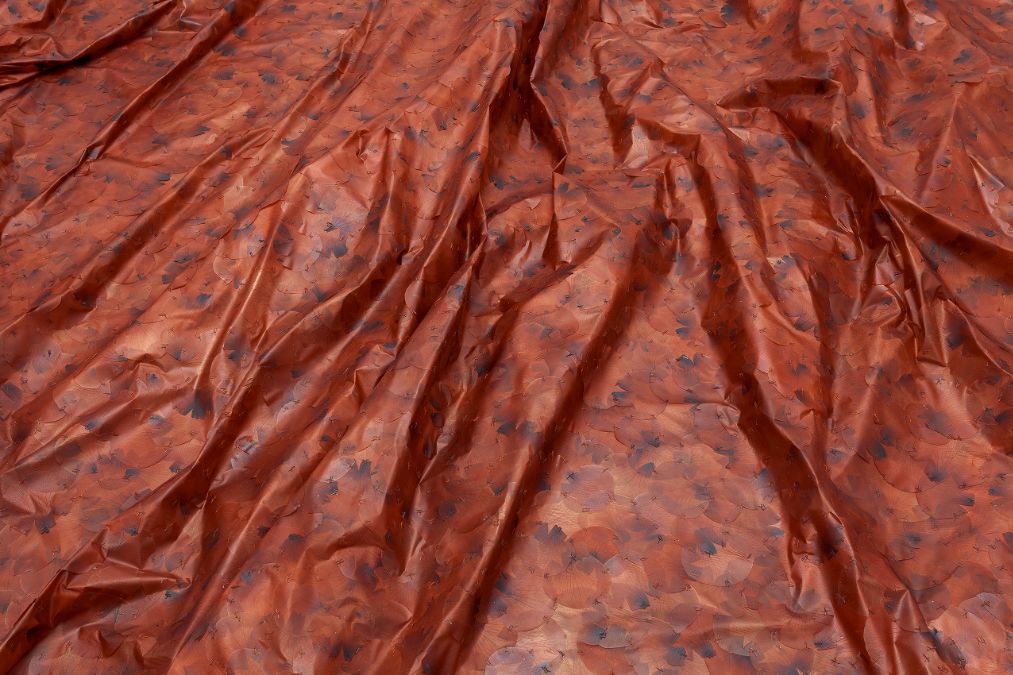
Doris Salcedo, “A Flor de Piel” (detail) (2013), rose petals and thread (Harvard Art Museums/Fogg Museum, Gift of Mr. G. David Thompson, in memory of his son, G. David Thompson, Jr., Class of 1958, by exchange; purchase through the generosity of Elaine Levin in honor of Mary Schneider Enriquez; and purchase through the generosity of Deborah and Martin Hale, 2014.133. © Doris Salcedo, photo by Joerg Lohse, image courtesy the artist and Alexander and Bonin, New York, and White Cube, London).

Doris Salcedo, “A Flor de Piel” (detail) (2013), rose petals and thread (Harvard Art Museums/Fogg Museum, Gift of Mr. G. David Thompson, in memory of his son, G. David Thompson, Jr., Class of 1958, by exchange; purchase through the generosity of Elaine Levin in honor of Mary Schneider Enriquez; and purchase through the generosity of Deborah and Martin Hale, 2014.133. © Doris Salcedo, photo by Joerg Lohse, image courtesy the artist and Alexander and Bonin, New York, and White Cube, London).

Doris Salcedo’s The Materiality of Mourning is at the Harvard Art Museums (32 Quincy St, Cambridge, Mass.) through April 9.

Installation view of Disremembered IV (detail) in Doris Salcedo: The Materiality of Mourning, on display November 4, 2016–April 9, 2017 at the Harvard Art Museums. © Doris Salcedo. Photo: Harvard Art Museums; © President and Fellows of Harvard College.

Installation view of Disremembered IV (detail) in Doris Salcedo: The Materiality of Mourning, on display November 4, 2016–April 9, 2017 at the Harvard Art Museums.
© Doris Salcedo. Photo: Harvard Art Museums; © President and Fellows of Harvard College.

Hyperallergic has the full story on the exhibition. The Materiality of Mourning at Harvard Art Museums.

Also, go have a visit at the Center for Artistic Activism.

Cool Stuff Friday.

B1

A close look at the marker drawings of Ben Biayenda reveals a wide range of direct references from African tribal art to French Post-Impressionism and current pop culture. The Paris-based art student’s work celebrates black beauty in all of its diversity. His sensitive portraits depict black women in moments of intimacy, connection and self-care. His scenes are of beauty parlors and plant-filled bohemian apartments. In girl’s dinner, three black women sit down together to share some sushi rolls. An African mask, a Matisse cut out, and a poster of Angela Davis hang on the wall behind them. One of the guests has vitiligo, perhaps an homage to Winnie Harlow, a Canadian model with the skin condition.

B2

Biayenda started drawing black women two years ago, inspired, he says, by “black femininity, sisterhood, and little moments of beauty.” He is also inspired by black feminist conceptual artists like Adrian Piper and Michèle Magema to interrogate race, gender roles, Western beauty standards, and art itself through his work. Born in Namibia to French and Congolese parents, the artist grew up in France and was exposed to fine art at a young age. He grew to especially love French painters, from Jean-Auguste-Dominique Ingres to Henri Rousseau. “I was really fascinated by painting and I was going to museums in Paris. I really loved it, but there was some frustration to not see much black representation in famous paintings,” he recalls to The Creators Project over a Skype call. His response was to create his own version of art history through work that reflected his own standards of beauty, while drawing on the poses and atmosphere of the classic works he admired.

You can read and see much more at The Creators Project, his website and Instagram.

The Creators Project has a great look at Awol Erizku, and his aesthetic for photographing Beyoncé’s pregnancy:

1

Click on over to read the full story and see much more.

In the nick of time…

Nick

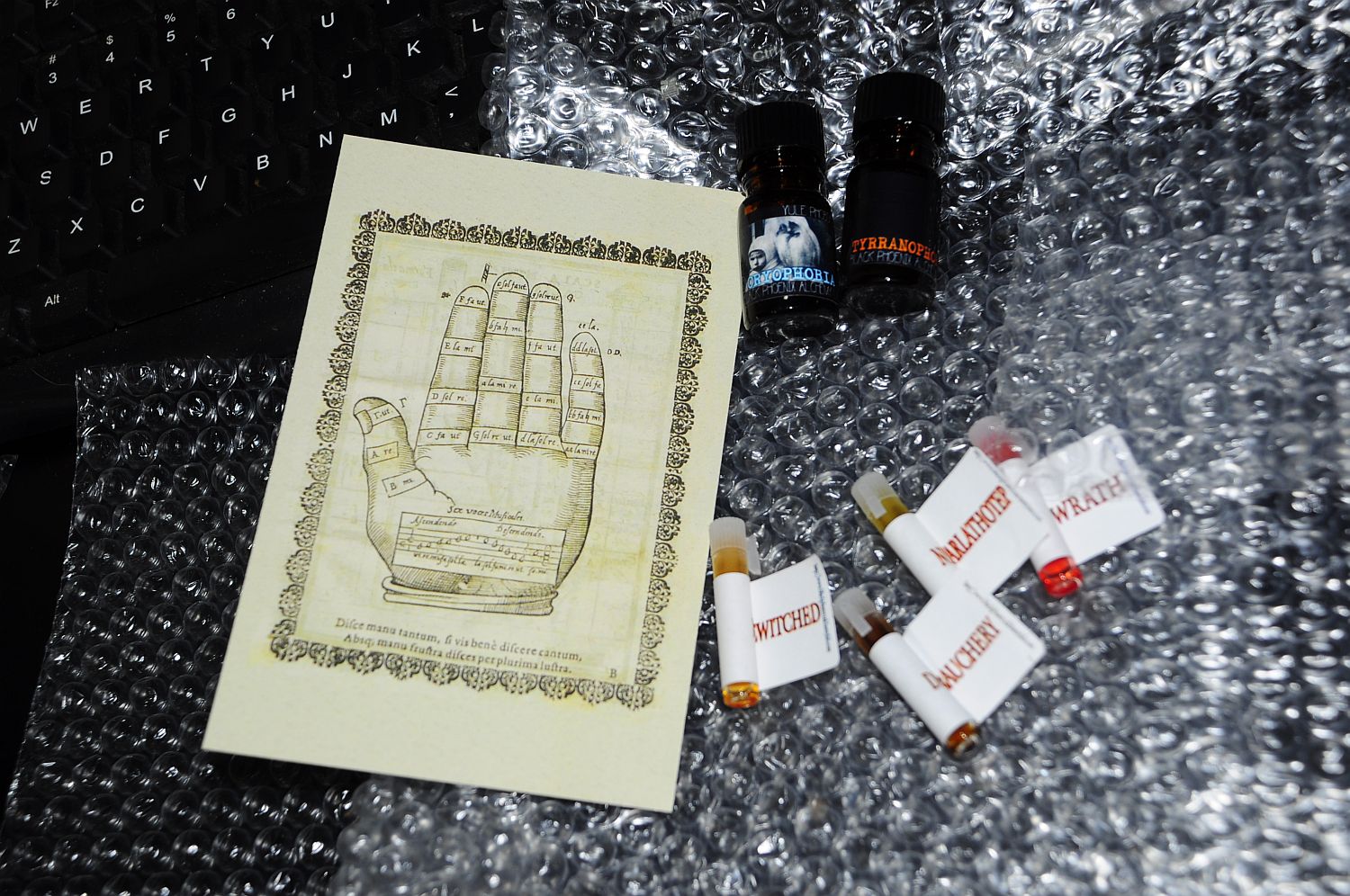
They arrived, just in time to accompany the pants™ and myself into town tomorrow. The Tyrranophobia is dark, a swirl of tobacco and opium, with a slash of jarring black cherry, or something like. I forget what’s actually in it. The Cryophobia I’m in love with, it’s like wearing clarity wrapped in Juniper. Of the samples, Debauchery won my little black heart. Spice, a hint of orange and clove, all rather debilitated and languishing. *Happy*

Pants, Pants, Pants.

Pants3

© C. Ford.

Marcus wanted to know what was on the flip side, and this is it for now. The pants must be finished today, to be worn into town tomorrow. That ought to be fun – I’ll be at the pain clinic, which is, naturally, mostly populated by older people who listen to Fox news in the waiting room at a deafening level. Must remember headphones…

Starting My Book.

I love these books of handmade paper. They are just for me, to mess about, play, get ideas out of my head, get me in the mood, whatever. This is my second book, the one I got for winter solstice. On my mind, Wakinyan Rising, probably because it’s very windy and cold.

Book

Book1

Book2

© C. Ford.

Don’t Call It Fashion.

CUNE-2016-SS-Meat-in-the-sky-1

Raw Meat, Cabbage, Moldy Bread, and other things that have inspired Japanese fashion label CUNE.

Don’t call it fashion. At least that’s what Hironori Yasuda will tell you if you ask him about his label CUNE, which he started in 1994. If anything, they’re “barely clothes,” he says.

Yasuda isn’t swayed by trends. He makes what he wants, and each season he picks a seemingly arbitrary theme, one that typically has no place in the world of fashion, and designs his entire collection around it. He doesn’t think about who would wear his clothes, or how they would wear them. In fact, he even says “you don’t have to buy them.” But with two stores in Tokyo, one in Fukuoka and a thriving online shop, people seem to like his bizarre creations.

You really need to click over and see all the stuff, it’s amazing. I love the red cabbage dress, and I’d buy it in a heartbeat. Same with the meat jacket pictured above.

It’s all at Spoon & Tamago.

Art History and Modern Sensibilities.

Warning: blood, gore and human nastiness on display.

.

.

.

I was reading an article about some street art in Brussels, and how a lot of people are shocked, disgusted and upset by it. These two works:

588b2f94b0121.image

588b2f94e5953.image

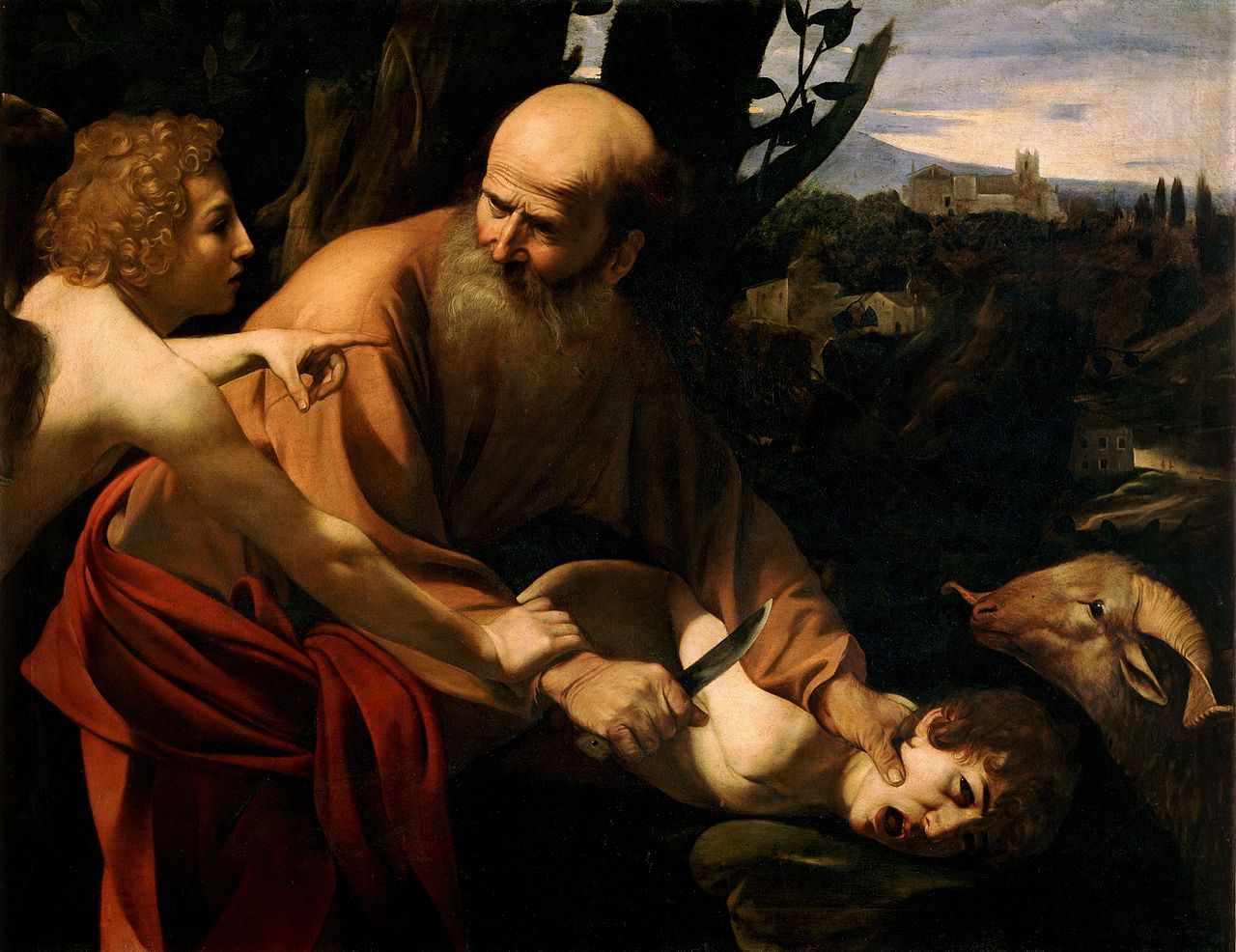
Some people are quite distressed and outraged, and many protest on the basis of children seeing these works. Thing is, there’s history bound here, as these are takes on paintings by Jan de Baen and Caravaggio, or at least attributed to those august painters. If people don’t want children to be upset by Caravaggio’s Sacrifice of Isaac, they shouldn’t be teaching them anything about christianity, either.

Sacrifice_of_Isaac-Caravaggio_(Uffizi)

As for The corpses of the brothers De Witt, there’s not only a great deal of history bound therein, but also the depth of ugliness in human nature. The modern take on it is actually less brutal than the original, which, when viewed in person or at full size, shows terrible detail. Limbs sliced, toes and fingers cut off, noses cut off, genitals cut off, gutted, and hung upside down. It’s not a nice painting, but doing that to the De Witt brothers wasn’t nice, either.

During 1672, which the Dutch refer to as the Rampjaar (“Year of Disaster”), France and England attacked the Republic in the Franco-Dutch War. De Witt was severely wounded by a knife-wielding assassin on 21 June. He resigned as Grand Pensionary on 4 August, but this was not enough for his enemies. His brother Cornelis (De Ruyter’s deputy-in-the-field at the Raid on the Medway), particularly hated by the Orangists, was arrested on trumped up charges of treason. He was tortured (as was usual under the Roman-Dutch system of law, that required a confession before a conviction was possible) but refused to confess. Nevertheless, he was sentenced to exile. When his brother went over to the jail (which was only a few steps from his house) to help him get started on his journey, both were attacked by members of The Hague’s civic militia in a clearly orchestrated assassination. The brothers were shot and then left to the mob. Their naked, mutilated bodies were strung up on the nearby public gibbet, while the Orangist mob partook of their roasted livers in a cannibalistic frenzy. Throughout it all, a remarkable discipline was maintained by the mob, according to contemporary observers, making one doubt the spontaneity of the event.[18]

Jan_de_Baen-_De_lijken_van_de_gebroeders_de_Witt

I can’t say I’d be happy to see such a sight writ large on a building, but I can’t say it would bother me, either. Mostly, I’d be intrigued and interested. Overall, I’d be in favour of it staying, because it never pays to forget that we’re much more ape than angel. It’s not as though we have stopped being barbaric apes, we haven’t. What has changed is art. The old patron system of art is long gone, as are the specific schools held by various masters. The church no longer dictates what is to be depicted, and current events are no longer primarily chronicled by art, as we now have much better means to do that sort of thing. That said, most people remain completely unaware of just how much history is chronicled by paintings. Most people have also successfully distanced themselves from the atrocities we continue to commit, not all that different to what was done to the De Witt Brothers. We tell ourselves that we don’t do that sort of thing, those people do. Being reminded of our long lasting bad habits is not a bad thing. If these make people uncomfortable, good. If they make people think, all the better. It never pays to ignore history, or pretend it isn’t important, and if it takes a sort of resurrection of old pieces to drive that home, it works for me.

The article about the Brussels works is here.