Jack’s Walk

See you in March. Photo by Janet B.

I’m leaving for Mexico tomorrow and won’t be back until the end of the month, so after today Jack’s Walk is on vacation until March 2. I’m going to a place called Jocotepec to help a friend pack up her house. She and her husband lived there for 12 years, but he died 2 years ago and Janet moved back home. She’s sold her house there and we’re going down to finish the paperwork and pack up the last of her things. It won’t be all work, though. We have a few interesting field trips planned, including an Iguana Park, a pyramid and a mud bath! We’ll also be going to Manzanillo for a few days because I’ve never seen the Pacific Ocean and we could both use a little beach time. I’ll share the photos when we get home, but you may get the odd Postcard From Mexico while I’m away. No promises, though. I’m ready for a break.

I can promise that The Art of Book Design will be here every day as usual and I thought that Jack’s absence would be a good time to put up the next part of my Russia series, so there will be 2 or 3 posts published about our stay in Uglich. Be sure to look for those. I’ll see you all in March.

Tree Tuesday

Today’s tree story is about another victim of the cult of Greed. Developers, building artificial islands for luxury resorts, are buying mature coconut trees from farmers, but their removal and relocation has many people worried.

Kaashidhoo is one of the largest of the 1,192 islands that make up the Maldives archipelago, but unlike many other islands, it does not teem with sunbathing Europeans. Its broad dirt roads are often deserted, flanked by pink Maldivian roses, mango-orange impatiens, and papaya and banana plants. The main occupation of the islanders is cultivating coconut and other tropical produce that can be sold in Malé, the Maldivian capital.
But lately, the local economy has been thrown out of balance. Crater-like holes have begun to appear across the island, some filled with dry leaves and others left as barren pits. These bald patches are the places where mature coconut trees used to stand tall. In the last year, Kaashidhoo farmers have sold hundreds of trees to new luxury resorts on nearby artificial islands.

While some locals are grateful for the newfound income—$20 to $100 for each tree—others worry that beach erosion has intensified since the trees started getting uprooted. They see this as a fragile ecosystem threatened by the proliferation of luxury resorts. “It’s a huge issue,” says Ibrahim Naeem, Director General of the Maldives Environmental Protection Agency. “Importing coconut palm trees is prohibited in the Maldives, so they have to rely on residential islands.”

As time has gone on, environmental changes have set in.

Yet as the year went by, and more coconut trees disappeared, Jameel says that many locals grew concerned. Coral islands like Kaashidhoo are highly dynamic, constantly adjusting and dancing to the idiosyncrasies of wind, tides, and relentless waves. “Everyone has observed far more erosion around the beaches. That’s what we end up talking about most of the time,” Jameel says. In response, she joined a non-governmental organization called Young Leaders, to spread awareness about environmental issues on the island.

Also, once these areas are developed, locals are encouraged to stay away, and many of the benefits that they were promised from development have never materialized. Environmental groups are now co-ordinating campaigns to strengthen and enforce the laws, and they’re using the #mvtreegrab. I usually forget to Twitter, but today I will, and I’ll add that hashtag. There are plenty of pretty pictures with the story, so go have a look… if you can stomach another bad news story.

story via: Atlas Obscura

Jack’s Walk


Prelude to a shake  ©voyager, all rights reserved

Jack isn’t happy today. I brought my suitcase upstairs to begin packing, and Jack knew something was up right away.

“Are we going to see Grandma in Montreal?” he asked.

“No, no, we’re not Jack,” I replied. I saw a shadow pass over his eyes but he sat quietly for a pause before he said,

“Are we going all the way to the east coast?”

“No, Jack,” I said. “Just mummy is going away this time. I’m going to Mexico with Aunt Janet.”

I know Jack doesn’t like it when I’m away, so I’ve been keeping the trip quiet. I didn’t want to spoil more days than necessary.  Typically, Jack is very zen, and he doesn’t often get emotional, but I heard a catch in his voice as he asked,

“How long will you be gone, mummy?”

“13 days, Bubba. We’re going to pack up Aunt Janet’s house because she’s sold it. And since we’ll be near to it, Aunt Janet and I are going to go to the beach, so I can see the Pacific Ocean. I’ve only seen it in pictures,” I said.

“13 days is a long time! And you’re going to the beach without me! I’ve never seen the Pacific Ocean either.” He was starting to sound a bit petulant.

“I know, it sucks, Bubba. I wish you could come with me, but you’d need to fly on an airplane, in a crate, away from Mummy, and I know you wouldn’t like that.” We’d had this same conversation when I went to Russia.

“I would be afraid of that….” then a longish pause and, “How far away is Mexico and the Pacific Ocean? Is it as far away as the east coast? Is the ocean as big as our ocean?”

“It’s a lot farther away, Jack. If we drove, it would take almost a week to get there.”

“A whole week. That’s really far away.”

“Yup, and it’s bigger than our ocean, which is the North Atlantic Ocean. A lot bigger. The Pacific is the biggest ocean on the entire planet. Here, let’s sit down with the Atlas, and I can show you. After that, I’ll show you pictures of where I’m going.”

And so we spent the rest of our afternoon looking at maps and pictures and talking about my trip. Eventually, I started packing, and Jack got quiet again. Finally, he said,

“I’m going to miss you mummy, and it isn’t fair for you to go to the beach without me, but… I hope you have a good time, and I hope you bring me home a nice present. Maybe something that smells like the beach. Also, Mummy, I don’t think you should take those shoes. You’re clumsy in those shoes. And you’ll trip if you wear the Palazzo pants. What else have you put in there?”

Sheesh, why do men always think they can comment on a woman’s clothing?”


Plum Trees in Bloom

Our Monday flowers from Nightjar are bursting with brilliant raindrops.

Trees here have definitely started to bud. No, wait. I mean, bloom. They started to bloom. This is our plum tree. It’s a little too soon and I’m worried because there are still not that many bees around. We’ll see how it goes. Meanwhile, flowers with raindrops always give me some inspiration, even though macro photography in low light is always a challenge.

©Nightjar, all rights reserved

©Nightjar, all rights reserved

©Nightjar, all rights reserved

©Nightjar, all rights reserved

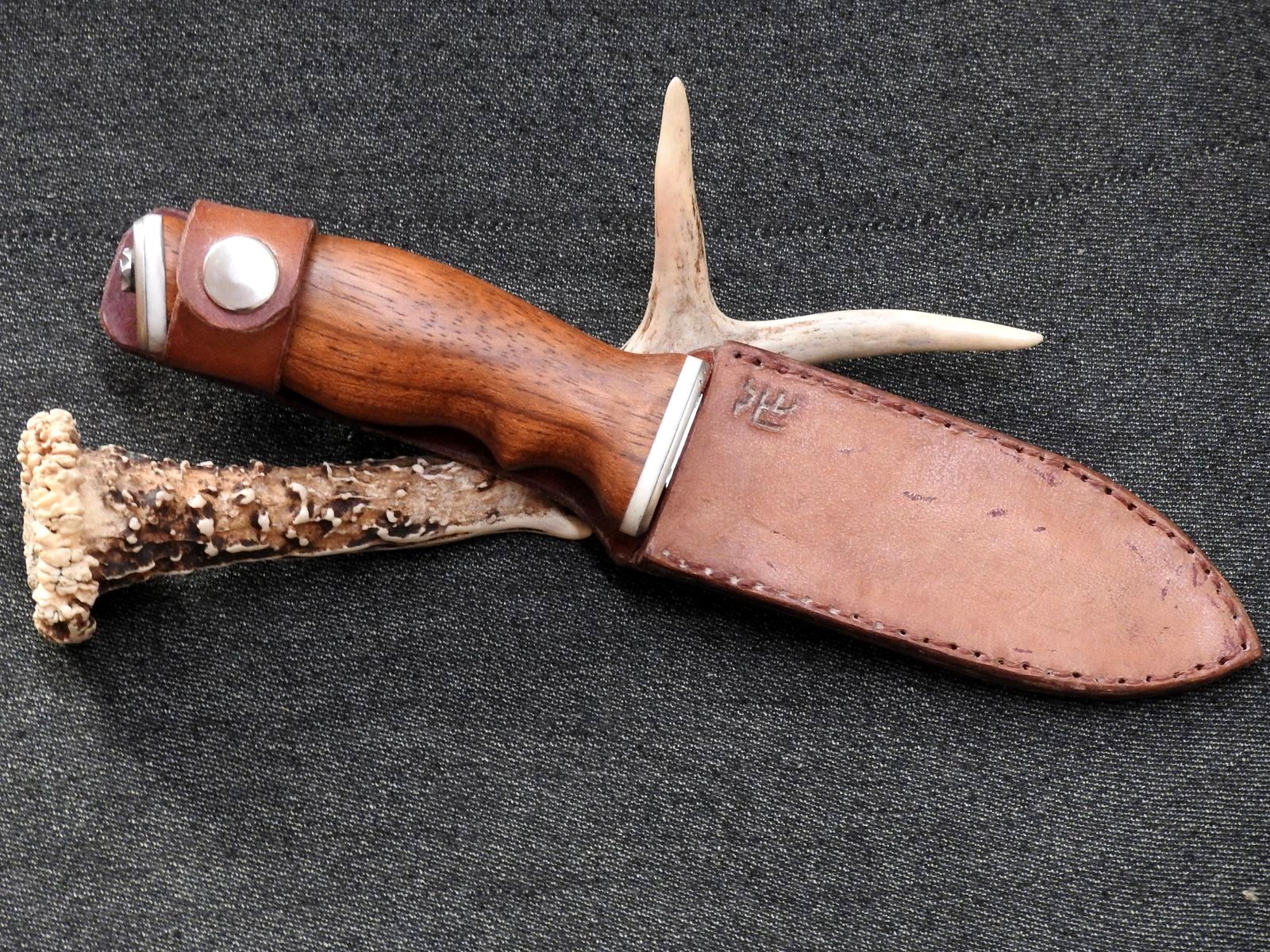
A Hunting Knife – Auction for FTB Legal Defense Fund

You can still donate, the damage Richard Carrier has done with his petulance is not undone yet. I cannot afford to donate any meaningful cash right now since I have no income. But I can afford to donate a bit of time. So I am giving this knife in exchange for the highest donation. Details see further.

© Charly, all rights reserved. Click for full size.

Technically it is a hunting & fishing knife since my first customer specifically requested it for angling, but you need not be a hunter for having a use for it. I am regularly using a knife like this when collecting mushrooms or just walking in the forest when it might come handy. It would also be useful as an all-purpose knife for camping. The false edge is sharp, but not cutting sharp. The blade is signed and numbered “2” in Glagolitic script.

© Charly, all rights reserved. Click for full size.

I made a simple leather scabbard, this time symmetrical so the knife can be conveniently fastened on either left or right side since the preference of its future owner is unknown.

© Charly, all rights reserved. Click for full size.

The handguard/bolster has a few dark spots. These are inclusions in the used material (see further).

© Charly, all rights reserved. Click for full size.

The endcap is fastened over an ornate stainless steel washer into which is the end of the tang peened.


If you are interested, write your bid in comments or per e-mail to affinity (note, I might not be able to post your e-mailed bids in the comments next two days, there is a huge storm coming our way and I might experience blackout).

If you bid from outside of the European Single Market, please make sure that you are allowed to import such things and be prepared to pay for any import/customs fees, duties or other taxes as may be relevant in your region/country/state. I will pay for the postage.

The knife will be sent to you after submitting proof of the promised donation. If the highest bidder reneges on their promise, it will go to the next one in line. The start is 10$ (the cost of materials), the sky is the limit.

The auction will run for two weeks until February 23. 2019 and this post will be pinned to the top of the page until then.

More info below the fold.


[Read more…]

Teacher’s Corner: Teaching Languages

By Source, Fair use, https://en.wikipedia.org/w/index.php?curid=58710265

Cover of one of the most prestigious English Grammars

My blogging colleague Andreas Avester has written an interesting post on learning languages and what he found worked best for him. He raises several good and interesting points, others that I disagree with, and some that made me plain wonder about his university instructors. As you may remember, i am, in my heart of hearts, a language teacher. I currently rarely have the opportunity to teach foreign languages, and I am happy being a teacher no matter what, because I always teach kids first and subjects second, but this also means that I got the full training of a language teacher.


Language teaching has its history, just like all of teaching has and language teaching started out as Latin and Old Greek. For a long time these were the only languages a young man of renown would come in contact with, until the kids of the Bourgeoisie needed some modern languages to do trade. For a long time, Latin was the lingua franca ( a language used by two people of different native languages. Both Andreas and I use English as a lingua franca here), then French. German used to dominate the sciences but now the world speaks English.

Nevertheless, as modern language teaching rose in the wake of the Enlightenment and the Industrial Revolution, it simply took the Grammar Translation Approach from Latin and applied it to modern languages. And it’s damn amazing how long and how much of it is still present. When Andreas talks about having to memorize grammar tables and vocabulary lists, thank the fucking Romans.

Another approach was the Native Speaker Approach. This had its basis not in science or education but in the British Council’s need to find employment for tons of well educated Brits. The central paradigm is that nobody can teach a language like a native speaker. As a native speaker who taught her native language as a second language (and who still does) I call this bullshit. Native speakers often have very little abstract knowledge of their own languages and when I first did this I was very hard pressed by the most simple questions my students asked.

In Germany the Audiovisual Approach was in vogue following WWII when the West needed tons of translators for the American Forces and all the schools and universities got audio labs where you’d sit and listen to tapes and repeat the sentences. Mind you, those still have a part in phonetics training.

When I went to school the aim was to have “near native speaker competence” and the methods still echoed the old grammar translation approach. My English teacher (a full grown bully and bastard) used the following: whenever we had a unit text we had to copy the text into our workbooks and then translate the text. We also had to use file cards for our vocabulary. Front: English, back: German. I got into lots of trouble for refusing to do most of it, because at 12 I could already detect bullshit when I saw it and I developed some deep hatred for file cards. It took me 10 years to discover that they can be wonderful learning tools.

Grammar was taught deductively: The teacher explained the rule, then we applied the rule. Fun fact: the books were already geared towards inductive teaching, but most teachers are at least two generations behind in their teaching. They learn their teaching from some old geezer who teaches what was the current approach back when they were young and since many teachers think they know everything they never bothered to update their teaching.

Some time during my baby break the paradigm shifted again: Now the aim is to create an intercultural speaker: Somebody who cannot just speak another language, but who is also verse in the target culture or has at least a set of tools that allows them to notice cultural misunderstandings and navigate those pitfalls. The methods that are currently favoured are: task based, competence oriented, inductive. I’ll come to all of them in detail.

Andreas describes how he learned languages the best: not in school, but in contact with speakers of the target language:

By the time I was twelve years old, I got a Russian speaking friend. While we were playing hide-and-seek, whenever she found me, she would say the phrase “я тебя нашла” (“I found you”). Whenever I found her, I just repeated the same phrase. I wasn’t thinking about the fact that I used the verb “to find” in past tense. I wasn’t thinking about the various forms of pronouns. Instead I was repeating the words after her and using the language in order to communicate. In the process, I learned the language, I also learned the grammar rules.

What Andreas describes here is what we call “language acquisition”: it’s a natural process that we all undergo when we learn our native language. It’s also something that happens when we learn secondary or foreign languages and it is the reason why your truly will use perfect American idioms pronounced in the nicest British RP you can imagine. As Andreas says, we don’t consciously learn any rules when we do that, but we do learn the rules. That’s why all kids will form ungrammatical sentences in their native language where they’re applying the wrong rule. A typical example in English would be “sheeps” or “he catched me”.

In language teaching this approach is described as as providing a “language bath”: give the student as much input as possible and language acquisition is what follows. Now, while this obviously worked a treat for Andreas, this often has issues when applied to teaching. First of all, we get 4, maybe 5 hours of language classes a week. We are not in the target culture, we have one person competent in the target language in the classroom,  so it’s hard to “recreate” that natural acquisition. And also, this doesn’t work for everybody. I have migrant kids in my classes who, despite having been immersed in German language and culture and classes for two, three years, have not learned more than a few chunks. One approach never works for all.

Andreas said he had to take a class on how to teach foreign languages and that he keeps disregarding everything he learned there, which makes me wonder: what do they teach those kids at school?

In order to get my master’s degree in German philology, I had to take university courses about how to teach languages and also how to create language courses. As you can see, when I actually worked as a language teacher, I threw out of the window some of said ideas that my professors had taught me.

Here’s how I learned to teach a language: Create a context where the kids will want/need to use the new words/structures. So we create a shopping situation (numbers, prices, stationary, polite forms). Maybe bring the articles to class. I even have some British play money for real fake shopping. Demonstrate the forms, let them discover the words (hold up a pen when you say “pen”) , let them practise the new words and forms in a variety of contexts. One exercise my students really liked was as a quick succession of very short dialogues with a new structure. We do shopping? The kids get a card with the item they need on the front and the price on the back. They walk through the classroom and practise with a classmate:

“How can I help you?”

“I need two pencils, please”

“That’s 2.50”

“Here you are”

Then they do the classmate’s dialogue, swap cards, go to the next classmate, rinse and repeat. This gives them a lot of practise and they can practise with their peers (rather than having to speak in front of the class).

And grammar? Well, you still need to learn it. Not all kids learn rules intuitively. there are kids you can make absolutely unhappy with the answer “you just have to learn it” when they’re asking why on earth it is “caught” and not “catched” and there is no rule which verbs are strong verbs and which ones are not. In my experience they are very happy in Latin classes (which I almost failed spectacularly). If possible grammar is inductive: I give examples of a new structure, the kids find the rule. After 10 sentences “I like dogs, I don’t like slugs, I like horses, I don’t like bugs” most kids can tell you that to negate a sentence you need “don’t”.

To summarize, current language teaching prioritises tasks, active usage, cultural competences and lots of language input. Some good old-fashioned drill exercises still have their place, but a small one.