
Lavender Files 27.

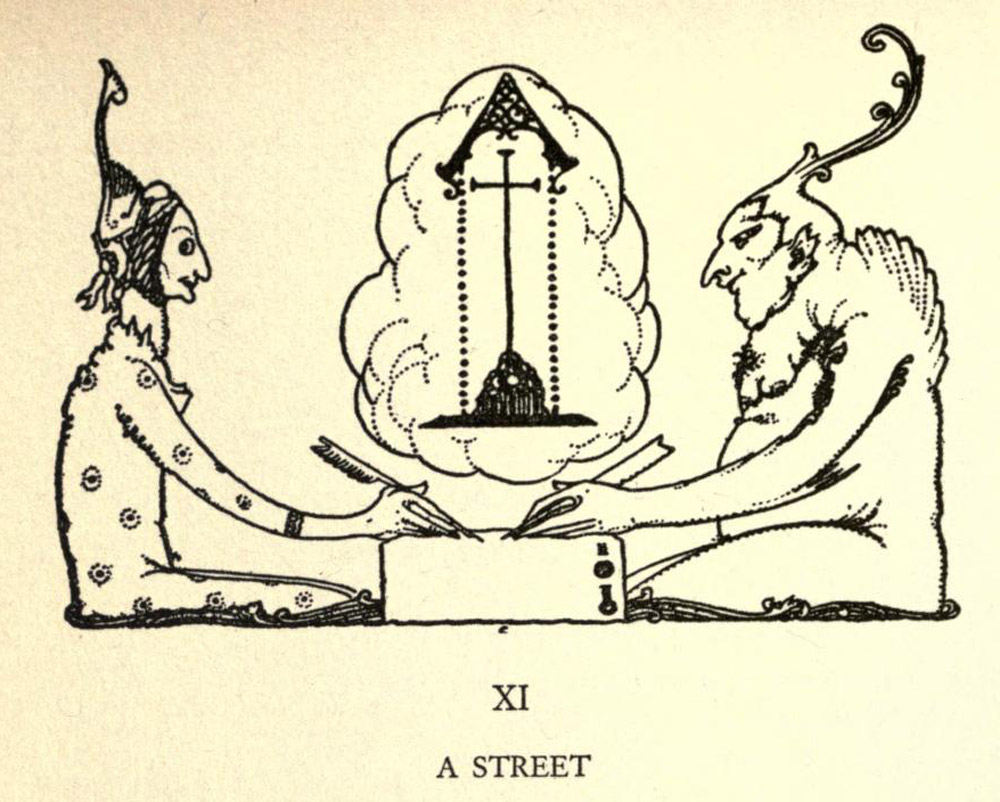
The Price of Salt and Spring Fire are both well known, especially Highsmith’s Price of Salt. Spring Fire started the Lesbian pulp genre, and the author, Marijane Meaker, was always unhappy about the forced ending she had to do. As for Satan Was A Lesbian, people may not know the story, but it’s probably one of the best known pulp covers, which has been reproduced on all manner of goods.

A Russian Art Connection.

Leonardo da Vinci, “Salvator Mundi” (c.1500), oil on panel, 25 7/8 x 18 in.(65.7 x 45.7 cm) (image courtesy Christie’s).

There was an astonishing sale at Christie’s, the last privately held da Vinci, supposedly, for an unprecedented amount of money: over $450 million dollars. The Russian connection is of interest, as is the doubtful provenance of the painting. There’s also the problem of such a painting, if it’s a true da Vinci, going into private hands. No museum could possibly have coughed up over 400 million for it.

Last night, Christie’s auction house sold “Salvator Mundi,” which it claims is the last painting by Leonardo da Vinci in private hands, for an astounding, record-setting $400M (the final price was over $450M with fees). The sale was controversial for a couple of reasons: that mind-numbing number itself, but also the fact that there are a lot of questions — and serious doubts — about the painting’s authenticity, restoration, and provenance.

One can therefore be forgiven for initially overlooking another elephant in the room — the identity of the seller. When there’s this much money involved, though, it usually pays to follow it, and here the money leads directly back to the Russian billionaire Dmitry E. Rybolovlev. Rybolovlev’s family trust sold the painting, through Christie’s, to an undisclosed buyer, but if his name sounds familiar for other reasons, that might be because in 2008 he paid (through a company he controlled) $95M to buy a Palm Beach mansion from Donald Trump.

You can read more about this at Hyperallergic, and there’s an earlier article too. The earlier article is disheartening, to say the least, as half of all the world’s wealth is in a very small circle of people, while little money ever goes to all those things which make for a healthy society. Once again, I’m reminded of A Perfect Circle’s new beatitude

Women and Demons in Medieval Finland.

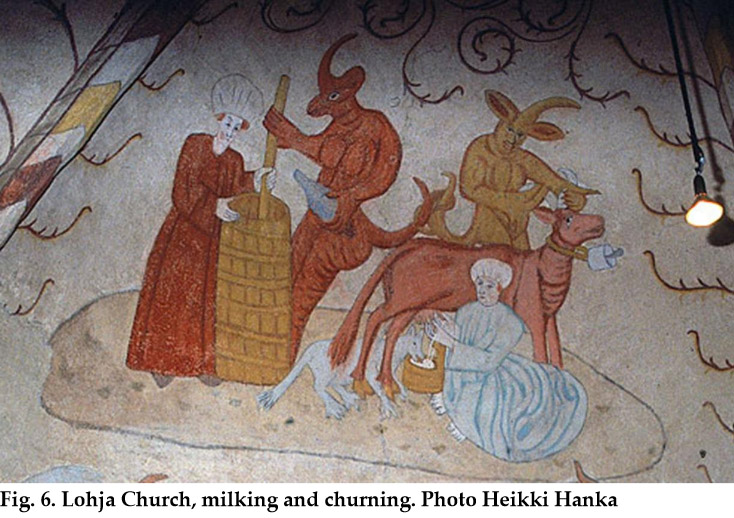
The aim of the article is primarily to examine late medieval wall paintings in the church of Espoo that include women with some form of diabolical entity. The paintings under examination include five different motifs: the milking and churning, the Journey to Blåkulla, Skoella and Tutivillus.

The milking scene in Espoo shows a woman with a cow and a man-size demon with horns, hoofs and a tail observing the task (Fig. 1). Immediately above the woman milking a cow
another woman is seen riding on a broom, holding a pouch-like object in her left hand and a horn in her right (Figs. 1, 3).

On the south side of the church, the milking scene continues with a scene representing a demon assisting women in churning the butter (Fig. 2). Skoella scene represents a demon passing a pair of shoes to a woman on the west wall above the entrance (Fig. 7), and above, three demons are seen twiddling with a parchment (Fig. 9). This motif is referred to as Tutivillus. The analysis of the motifs begins with the examination of the images at their visual level in which the content of the images is explained. The analysis then proceeds to the examination of the motifs in their cultural and historical context. The article discusses the origin of the different motifs and compares them to similar ones found among other early
sixteenth-century wall paintings in Finland. The methodological approach combines art historical analysis and cultural-historical contextualisation.

A fascinating look at the pairing of women and demons, where a woman-centered activity is involved. Demons, always so much more interesting than saints and gods, even in churches. The paper may be read here.

The Migrant Quilt Project.

TUCSON SECTOR 2004-2005, 282 deaths.
Made by Carol Hood, Sunny Klapp, Phyllis Sager, & Virginia Wenzel, of Prescott, Arizona.

Picked from the desert, I’m gazing at the tiny pieces of Jeans. These are what’s left of real lives. They had hopes and dreams of better and safer futures. (Virginia Wenzel)

There is a wealth of heartbreak at The Migrant Quilt Project, but it’s heartbreak all should feel. No one should be able to turn a cold heart and hateful mind to the mute witness of so much death.

The Migrant Quilt Project.