
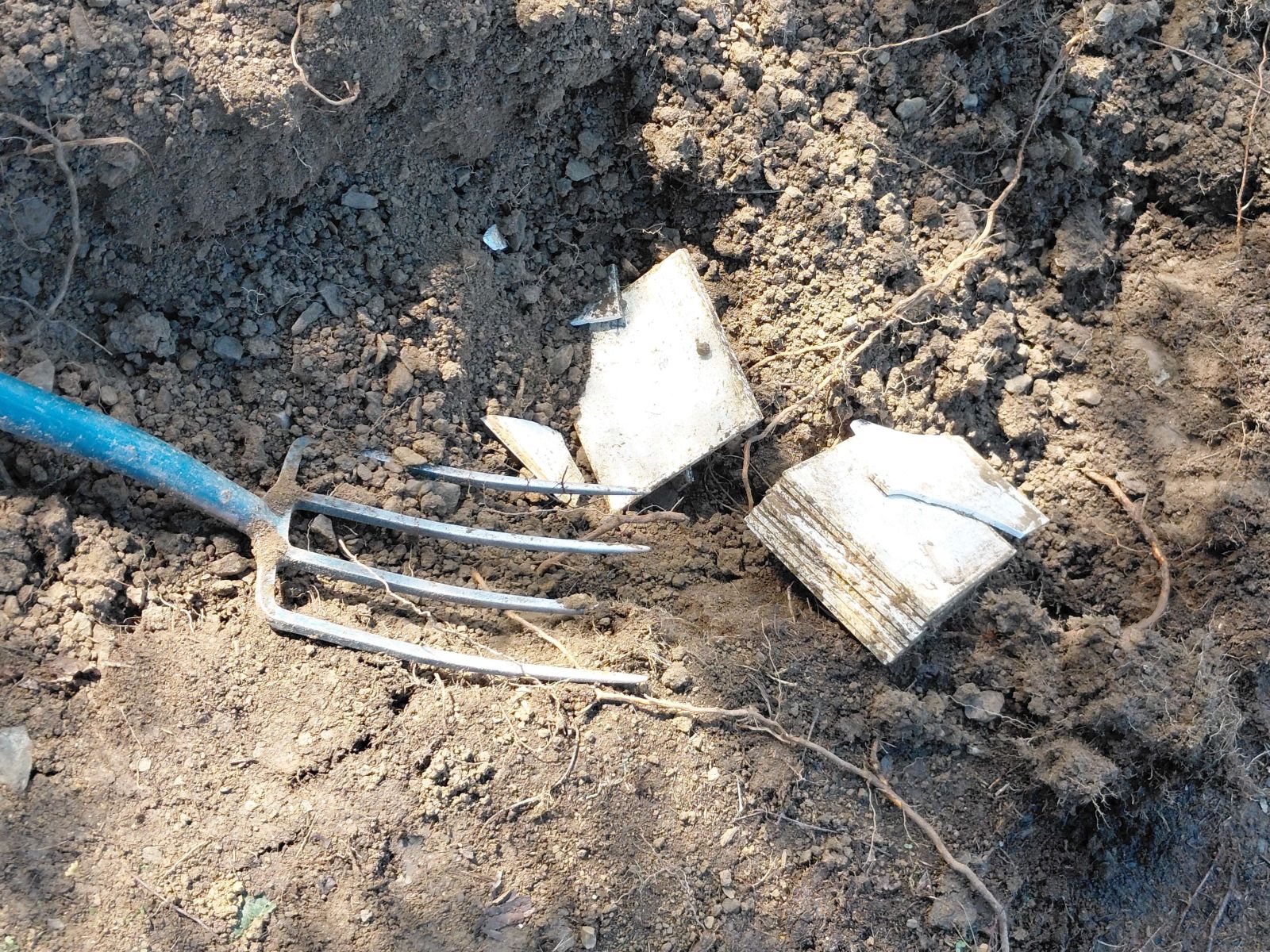
Just after I wrote my answer to dschultz under my last post about why I am inflicting the double-dig torture on myself with my heavy clay soil, I went to my garden to till another row on the potato patch, when suddenly the garden fork hit resistance just barely 10 cm under ground. As I do in such a case, I tried to reposition it to work around the obstacle, expecting it to be a larger stone or maybe a half brick. Occasionally, I dig out even a whole brick, and the biggest thing I dug out so far was a ca 30×40 cm phyllite paving stone. But I could not find the edge, and when I did, I could not get the fork deep enough to lever the seemingly big thing out. Then I managed to pry several small pieces off.

© Charly, all rights reserved. Click for full size.
It turns out that just under the surface were buried several white tiles. I did not think much of it at that moment; an occasional tile or a piece of ceramics is not uncommon. And I continued to search with the fork and pry the tiles out.
© Charly, all rights reserved. Click for full size.
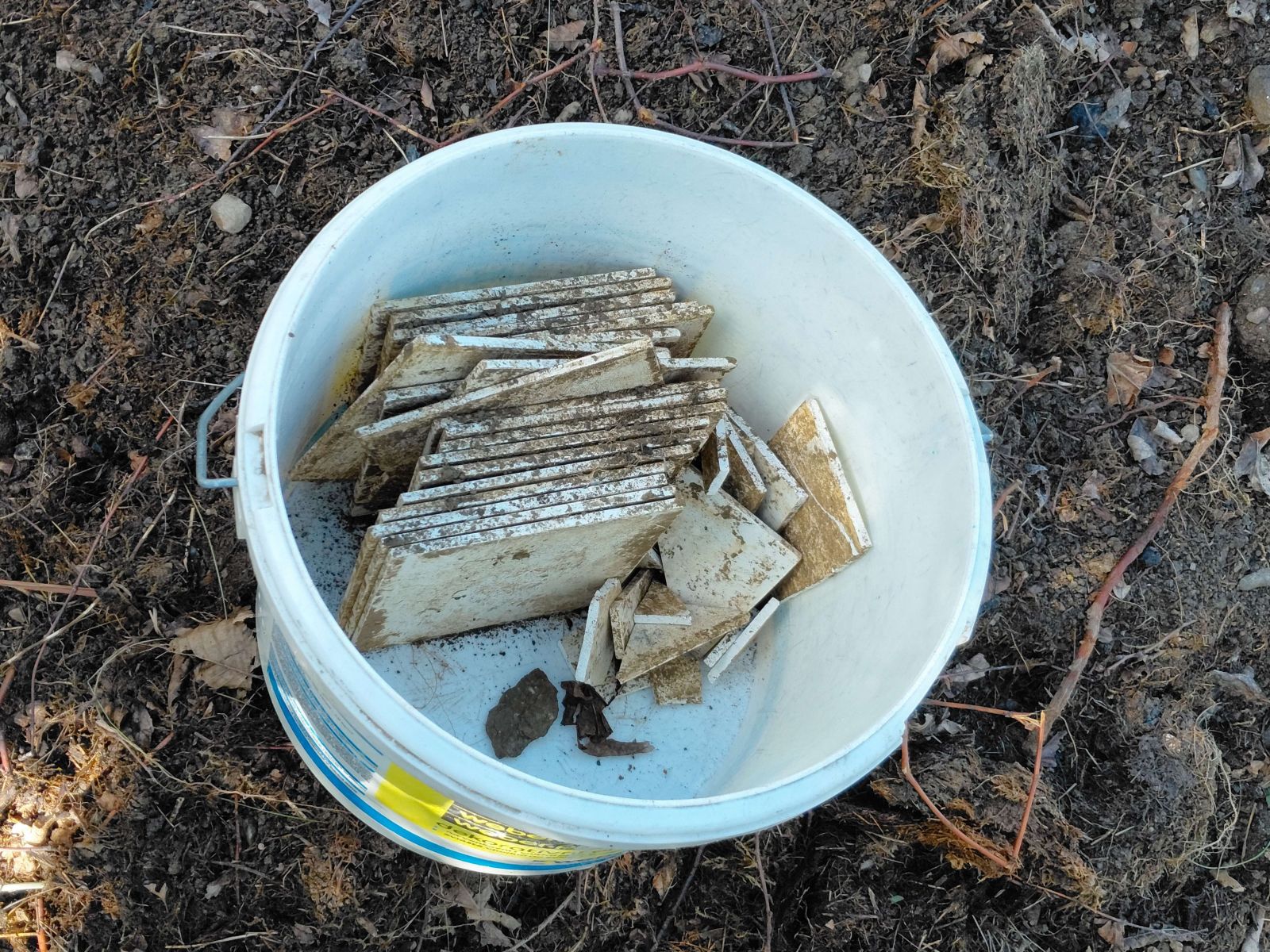
Then a whole stack of tiles came out, and several more after that. At this point, I decided to put the tiles into a separate bucket.
© Charly, all rights reserved. Click for full size.
I thought, maybe I will fill the whole bucket, and I did not want these tiles to be completely mixed with the stones I sort out of the soil, because the tiles are not as useful as, for example, road pothole filler. I was wrong about the bucket.
© Charly, all rights reserved. Click for full size.
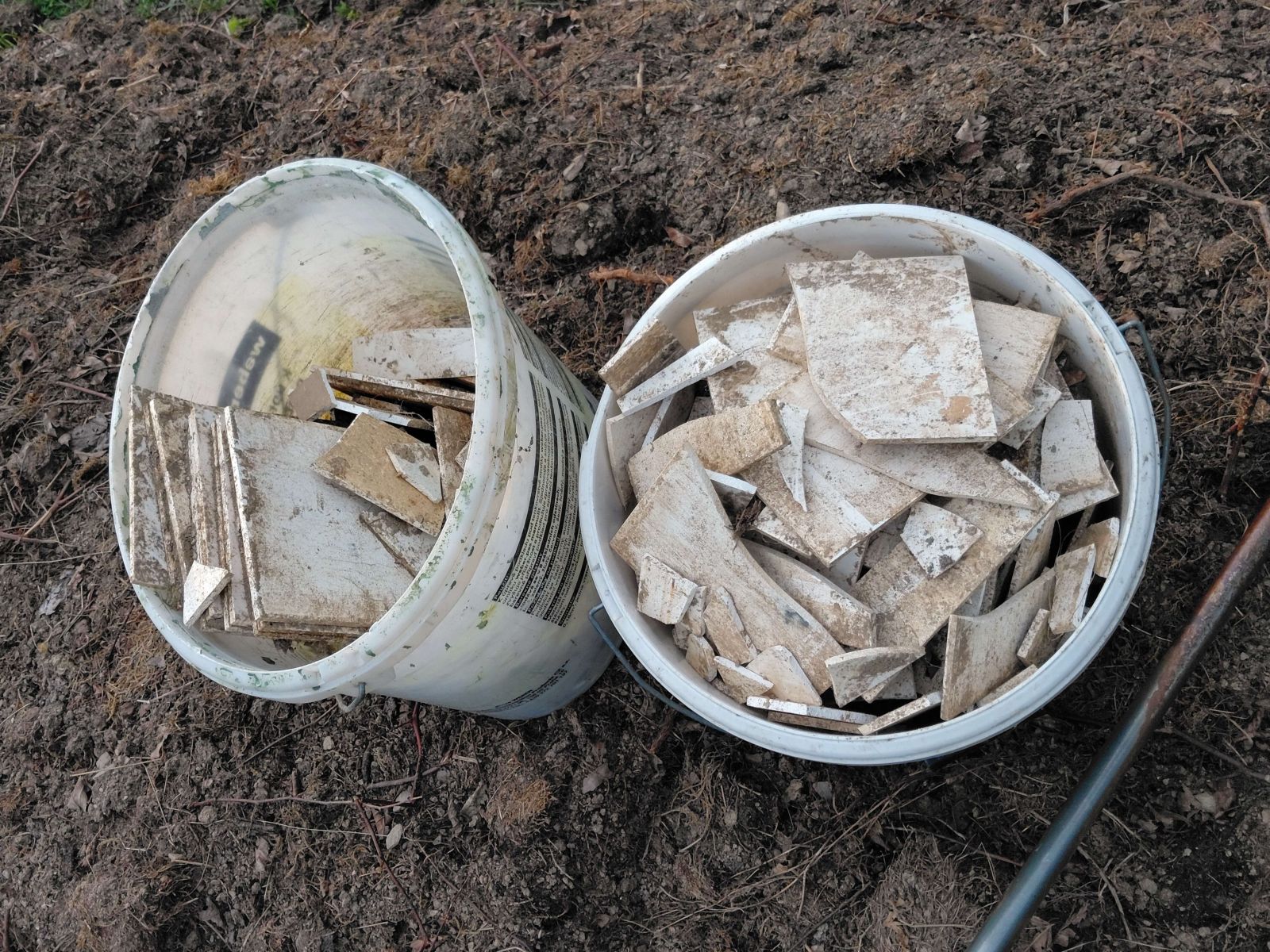
I almost filled two 10-liter buckets with these pure white tiles. There were several stacks buried in that place. And, funnily enough, it appears they were at the edge of the onerous piece of land. After this, the soil became suddenly less stony and much easier to till.
I already had proof that I was not working on a natural topsoil, but these tiles are definitive proof that something other than grass was on this piece of land before my time, probably before my grandfather got the house after WW2. I do not have a way to identify the age of the tiles. I did not look for any manufacturing markings yet, but they are definitely older than 50 years, since my whole life there was nothing but grass in this part of the garden.
Ahhh, I absolutely love Things You Find In The Garden ™. Seems like the common attitude towards stuff you didn’t need was to bury it. But that’s a lot of intact tiles, I would have expected people to use them. For example one of my cellar rooms has a floor that clearly consits of leftover tiles from several different houses.
Think positive: It could have been blue concrete.
@Giliell, blue concrete is a certifiable nightmare. If I found a block of blue concrete, I would treat it the same way as a granite massif -- ignore it.
What is baffling about these tiles is that they are high-quality precision tiles, and it seems that they were buried mostly whole and in a stack. Many of the broken edges are pure white, which means they broke when I was digging them out. Only some of the broken edges are dirty, so they broke in the ground some time ago or were buried broken.
I just cannot fathom why someone would bury a whole stack of fairly expensive tiles -- each of the intact tiles costs about 0,5€ in today’s money. To my parents’ memory, there never was a place in the house where these tiles were used.
Charly
Can you re-use them for anything?
We had a similar experience in our last garden, except the area you couldn’t put a fork in was about 2m 50cm, which worried us until we exposed the area. It was not a deceased and concealed body, but a couple of enameled metal ‘hearths’ of the kind put over wooden floor boards as protection when there was no proper stone hearth. We were surprised at how much effort someone had gone to to dispose of something you could have taken to the local tip and dumped for free.
Whenever I hit something in the garden I’m glad if I a) find metal, as it means I didd’t accidentally dig up something Roman and b) find concrete, as it means I didn’t accidentally dig up an unexploded WWII bomb.
@chigau, there are too few in good shape to resell, and I have no need for them in my house. The only reuse that comes to mind is to flatten the non-glazed side, glue them to a board with the glazed side, and give them away to friends as very fine honing whetstones.
@Jazzlet, finding things that were disposed of by burying is a phenomenon not unknown to me. But it is a bit surprising, considering that there used to be a disposal site for this kind of stuff just about a kilometer away from our house. It is sealed and re-greened now, but it was still active when I was a kid, and AFAIK was there at least since WW2.
@Giliell, I am not at great risk of finding anything of archaeological value, nor of hitting unexploded ordnance. However, over the years I did dig up some WW2 German coins, some old Czechoslovak coins, a badge of mysterious origins, a tiny ceramic doll’s head, several glass beads, two 6 Kreuzer from 1806, a very rusty dagger blade (either Commando or Freikorps, impossible for me to say), and a few rusty pieces of WW2 gun ammo that still had viable gunpowder in them. I did not bother to contact the police; they were so rusty the bullets broke off with ease, so I spilled the gunpowder on a flat stone and ignited it.
The best thing I have found while gardening was a fossil of a bit of plant stem, something like an equisetum maybe, but much bigger, it’s only 2-3 cm long, but 2.5-3.5 around (it’s oval in cross section). The stem is ridged and has a partial line suggesting the stem was segmented. Just in the soil I was digging so not ‘in situ’.
@Jazzlet, finding such a fossil sounds lovely, tbh. The shale around here is unfortunately metamorphosed so much that no fossils are preserved.
@Charly it was a good find, and I pick it up from time to time to look at and feel the ridges and wonder at it’s age. I don’t know if it came from the local rock, the house was stone built, the garden stone terraced and the soil deep, my speculation is that the fossil came in with either the house or the garden stone. That said both types of stone were probably local, meaning most likely Carboniferous (or less likely Permian) which would fit with the kind of plant it looks to have been.