Behind the Iron Curtain part 16 – Languages

These are my recollections of a life behind the iron curtain. I do not aim to give perfect and objective evaluation of anything, but to share my personal experiences and memories. It will explain why I just cannot get misty eyed over some ideas on the political left and why I loathe many ideas on the right.


In Czech we have a saying – how many languages you know is how many times you are a human. As a grown man I do appreciate the wisdom of this saying, since language barriers are difficult to breach and in combination with other things they do lead to a lot of nasty stuff. It is for example very easy to other people whose language you do not understand and with whom you therefore cannot effectively communicate. Even with all other barriers removed, language barrier in itself can be insurmountable obstacle. And when you can and do speak with people, all other differences tend to fade away.

As a child, I did not appreciate the saying at all. My parents were trying to get me to learn German from early age, but since they are not the pushy type and I was not too receptive, it did not work out. Later at school from age 10 Russian language was compulsory. But there we hit the snag of not only another language, but another alphabet as well – for me it was difficult enough to learn writing in one alphabet and sure enough, another one was difficult even more and soon I started to write fluently but illegibly in Azbuka as well.

I do not remember whether the explanation as to why we must learn Russian was given to us as a matter of course or whether someone asked, but it was given to us nevertheless. It was argued that it is useful to know at least one widely distributed language so one can communicate with more people. And that most widely distributed languages are English, Spanish and Russian, because USSR covers one eight of inhabitable land and Russian is spoken in all other countries of the Warsaw Pact, covering most of Europe and Asia, therefore Russian is the most useful language for us of them all. Q.E.D.

You probably have spotted already the flaw in that argument, as did I – the area of inhabited land is not as important as the amount of actual people with whom you can speak using given language. But lacking further data, I have not questioned the wisdom of this and I thought that it is a valid argument at the time. So I plodded on with difficulties trying to learn Russian, torturing my teacher in turn as much as she tortured me.

However it did not take long to learn how untrue this argument is in real life. It started when I saw how difficult it was for children to get help with homework in Russian language. Nobody could read it and nobody understood it much, despite the fact that they all learned it in school. That way I learned that actual use of Russian among ordinary people was so minimal that most of them forgot most of it as soon as they left the school. Second observation was when I was at a summer camp in German Democratic Republic. We were allowed to have some pocket-money and to do some shopping. Hooray! We are in a foreign country, but people here learned Russian in school, therefore we will be able to communicate with them! And to this day I remember the totally blank expression of a quite young shopkeeper when I told her that I would like to buy that aeroplane model of – (I forgot the exact type) and I had to resort to pointing and grunting instead. Huh, so much for that argument then.

By the time my elementary school education was nearing its end, I was convinced of two things – first was that I am hopeless at learning other languages and I hate it. Second was that learning foreign languages is nearly useless.

For the second conviction I actually had some solid data at the time – the Iron Curtain was an effective barrier going anywhere west of my home, making any need to understand people living there moot. And from experience I knew that even if I manage to get to some of the other eastern countries, Russian will be of nearly zero use.

To this day my generation and those older are still the least language-savvy generations in our country. And the country as a whole has therefore still abysmal proficiency in other languages, as well as in many other former east bloc countries. The Iron Curtain persists in this form, still fostering xenophobia and bigotry. A reminder that a regime change is not enough.

Teacher’s Corner: Retarded!

As you may know by now I have recently started a new job as a special ed teacher without having actually trained as a special ed teacher. This is pretty challenging on top of the job being challenging anyway, and I’m trying to desperately read up on the concepts and theories of the discipline. In doing so I stumbled across a word that is one of the nastier ones flung around in English: retarded.

And I discovered that it is a good word. Or at least used to be.

See, special ed went through it’s development just like regular teaching. Concepts and ideas about children, learning and teaching have changed, change which is often (though not always) reflected in our schools. In its earlier stages, special ed saw children who were slow to learn as “defective”. Children who could more or less keep up with the classwork were “normal” and the other ones were broken, damaged goods, lacking. You see where this is going.

Then came science and studied children and how they learn. They put many things educators had long known on a scientific basis and formulated scientific concepts. One of the still most influential people in this area is the Swiss psychologist Jean Piaget, who described the processes through which we learn and also formulated stages through which we develop.

Screenshot of Piaget bok covers

Yes, there’s an endless amount of books on and by Piaget

All legitimate criticism aside (it relates mostly to how far you can take his models and where are limits of their application), his models are still important. As teachers we want and we need to challenge our students to help them in that development, which isn’t an automatism. We need to construct our input at the right level. Primary school teachers will endlessly use concrete things and pictures to teach their students. They need to literally take away five marbles to find out what 12-5 is.

What especially Piaget’s students found out was that not all children develop at roughly the same pace. Some children are much slower than the average, they stay behind, they are “retarded”. The concept as such was revolutionary. The children were no longer seen as defective, just slower. They were not inferior to their peers but would reach the same levels of cognitive development as their peers, just later. This had, and has, great importance for teaching children with special needs, as it means that we need to give them different input, teach them using a much more hands on approach than with their peers and most importantly, get them to the same place, just a little more slowly.

It’s sad to see how ableist ideas turned such a revolutionary concept into a nasty slur. It also shows that you need to change society, not just words. The slur does not mean what the word means in a professional context. It still means “broken and defective”.


A tree story

Raucus Indignation sent this in a few weeks ago and I had planned to post it on Tree Tuesday, but I’ve now decided that this submission is about more than just the tree so I’m posting it today instead. I’ll let Raucus explain:

I have many old apple trees around my home.  The property is on an old orchard. This one didn’t survive the winter.  It will be replaced by another apple or maybe a hazelnut in honour of Caine.  I’ll send photos of the new trees once they’re planted.

I’m sorry to hear about the lost apple tree, but I think that planting a new one is the perfect way to remember a friend who loved trees and the birds that make them home. I look forward to seeing the photos of the new tree once it’s planted. Thanks so much for sharing, Raucus.


©Raucus Indignation, all rights reserved

©Raucus Indignation, all rights reserved

©Raucus Indignation, all rights reserved

©Raucus Indignation, all rights reserved

Shiny

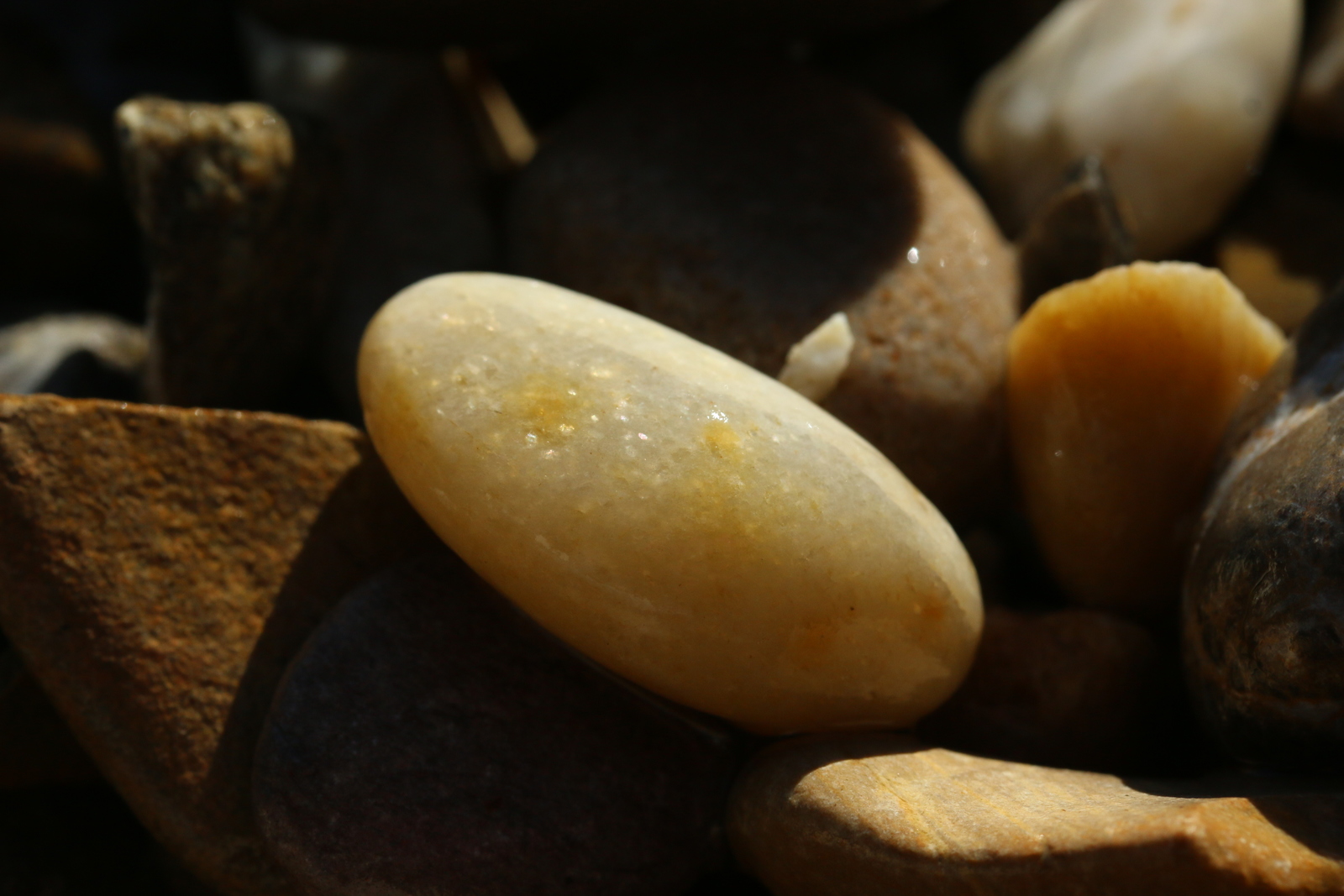
In early summer we shovelled about 1.200 kg of pebbles into the gap between the front yard and the house.

One of the secrets is to wash them and make them wet or you’ll suffocate, and also, wet pebbles are just too pretty. I proudly announce that I did not put any of them into my mouth.

©Giliell, all rights reserved, click for full size.


PebblesPebbles

More below the fold

[Read more…]

Harakka Island – Chapter 3

It’s time for the next chapter of Ice Swimmer’s series, Harraka – An island. Thanks again, Ice Swimmer. I’ll let you take it from here


Chapter 3 – Former FDF Building


1. Main Door, Former FDF Building, ©Ice Swimmer, all rights reserved

The building is from 1928 and it used to belong to Finnish Defence Forces and nowadays it is used by artists who can hire studio space for five years at a time there. This is the main entrance.


2. The building and the Birch, © all rights reserved

There is a big birch next to the building.


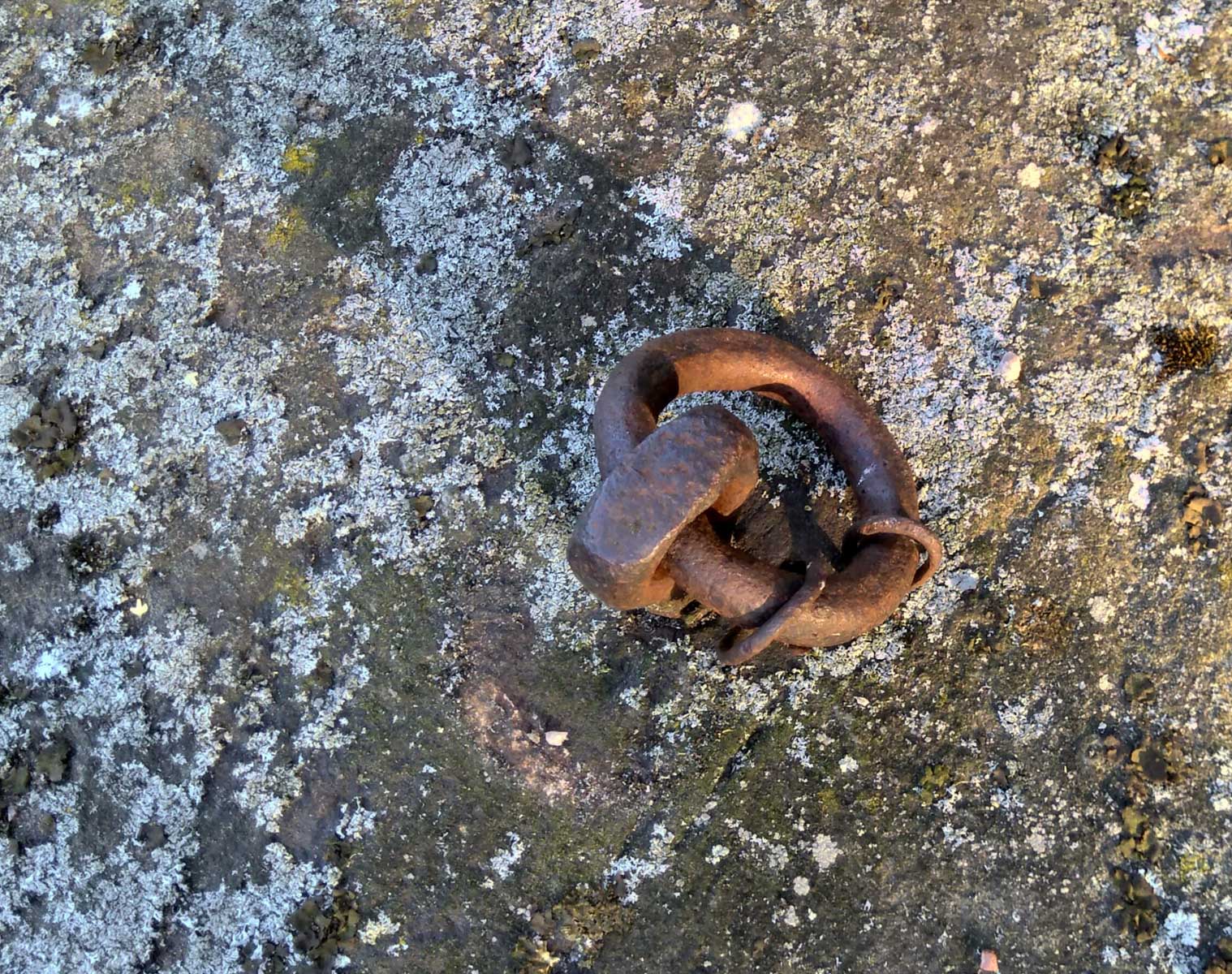
3. Rusty Ring, ©Ice Swimmer, all rights reserved

A ring fixed into bedrock next to the building. As for the picture, Caine was definitely an influence for me in this kind of photography.


4. Corner, ©Ice Swimmer, all rights reserved

We’re going around the building. This is the northwestern back corner.


5. Backyard and Fireweed, ©Ice Swimmer all rights reserved

There was a lot of fireweed in bloom on the island. Now we’re in the backyard of the Artists’ Building, looking at earthworks built when Harakka was partially fortified.


6. Tractor, ©Ice Swimmer, all rights reserved

The little tractor is probably used for hauling various things.

7. Chemistry Equipment, ©Ice Swimmer, all rights re

The building was used by the FDF as a chemical laboratory. For that reason, while there were plenty of wild raspberries, strawberries and other berries growing on the island, tasting them didn’t feel too attractive. The building is actually the third site for the FDF Chemical Laboratory. At first, the laboratory was in downtown Helsinki, in the same building that housed the University of Helsinki Chemistry Department and after that in one of the garrisons in Helsinki before it was moved to the island.


8. Whose Island part II, ©Ice Swimmer, all rights reserved

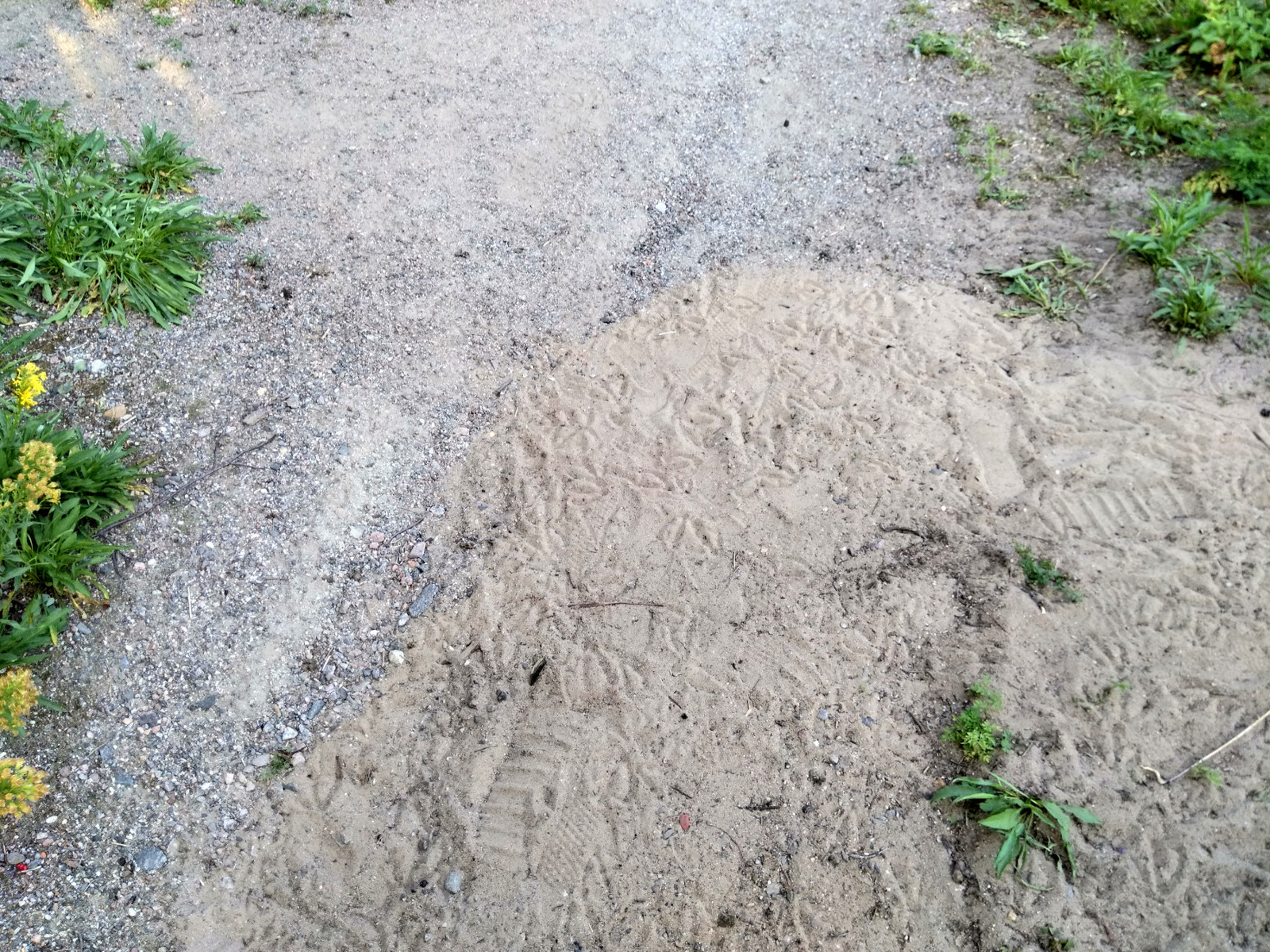
The ratio of shoes / webbed feet is fairly small.


9. Birch stump, ©Ice Swimmer, all rights reserved

At the southwestern corner of the building, there used to be a birch.

Now we have seen the building used by military chemists and subsequently artists and some of its surroundings. Next, we’ll go a back, a bit south in the backyard of the building.

(link to previous post, Harakka an Island: Chapter 2)


Jack’s Walk

Terracotta Park, Pointe Claire, Quebec ©voyager, all rights reserved

This photo was taken in a place called Terracotta Natural Park and it’s right in the heart of Pointe Claire. It’s a huge park (almost 100 acres) with lots of connecting and well maintained trails. It’s one of Jack’s favorite places to go, but unlike our woods at home I won’t allow my boy off-leash here because of the threat of coyotes. We’ve never seen one ourselves, but there are signs posted at every entrance to the park advising extreme caution and noting that they’ve been spotted in the area. My husband grew up near the park and we’ve been taking our dogs to it for about 15 years and this is the first time we’ve seen such warnings. That probably means there’s an established population of coyotes. And why not? The park is exactly like their natural environment and it’s filled with their natural prey plus it has the added bonus of human leavings. As their environments shrink or die all animals, including large predators, will move ever closer to populated areas just trying to eke out a life and avoid extinction. I think they have as much right to the land as we do. Maybe more. At least they’re not destroying the planet.

Last Sunflower Resident

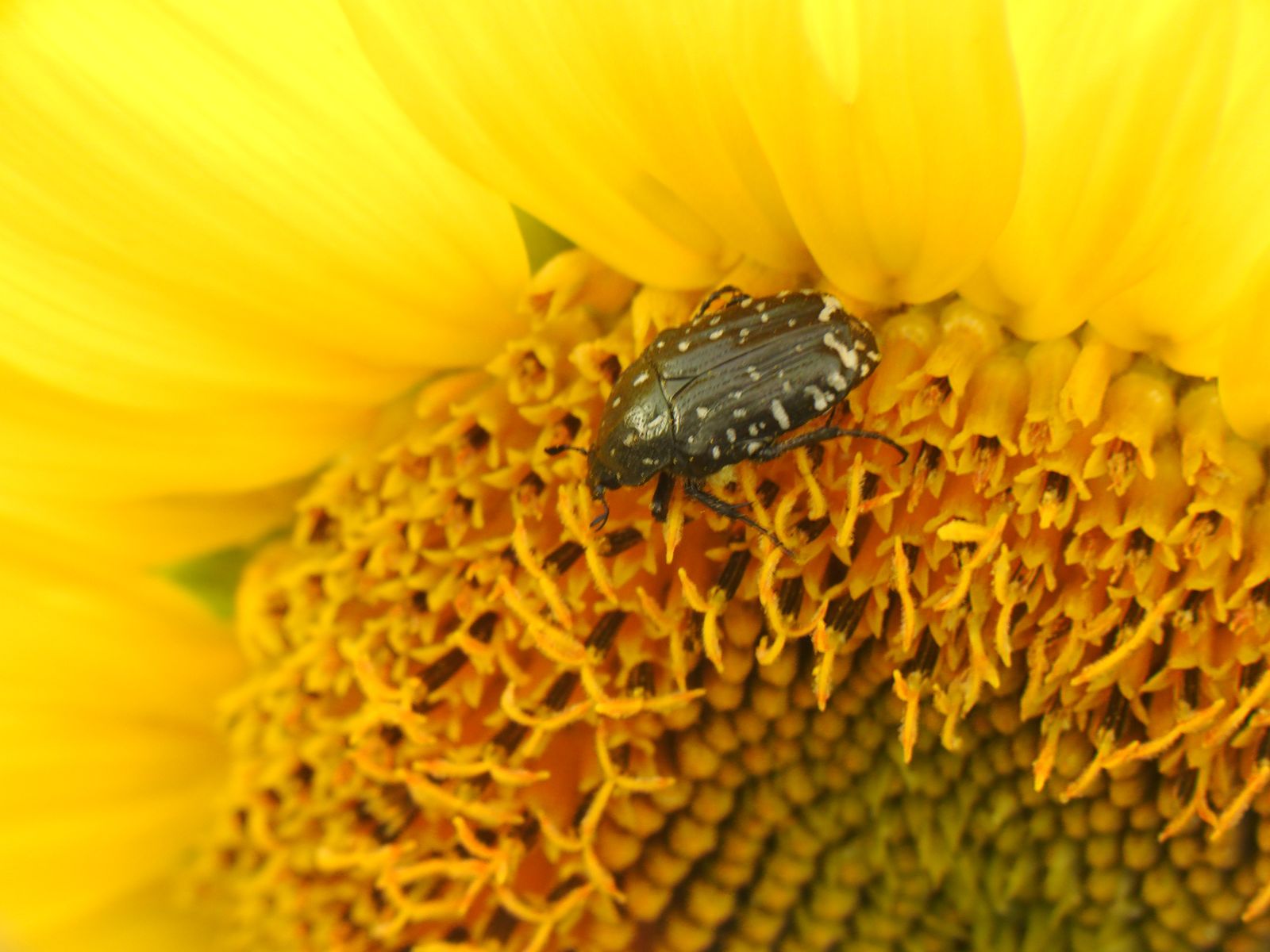
The sunflower is now slowly drying, all the heads full of seeds. But when it was still in bloom, I encountered on it this beetle, one that I have never seen before. I have recognized that it is a member of the family Cetoniidae (flower chafers) but that was it.

I think that it is mediterranean spotted chafer Oxythyrea funesta, which was preliminarily confirmed to me by an actual active biologist. In that case, it is a rare sight because the beetle is rare in Czech Republic and is protected by law.

©Charly, all rights reserved. Click for full size.

Jack’s Walk

Milkweed, ©voyager, all rights reserved

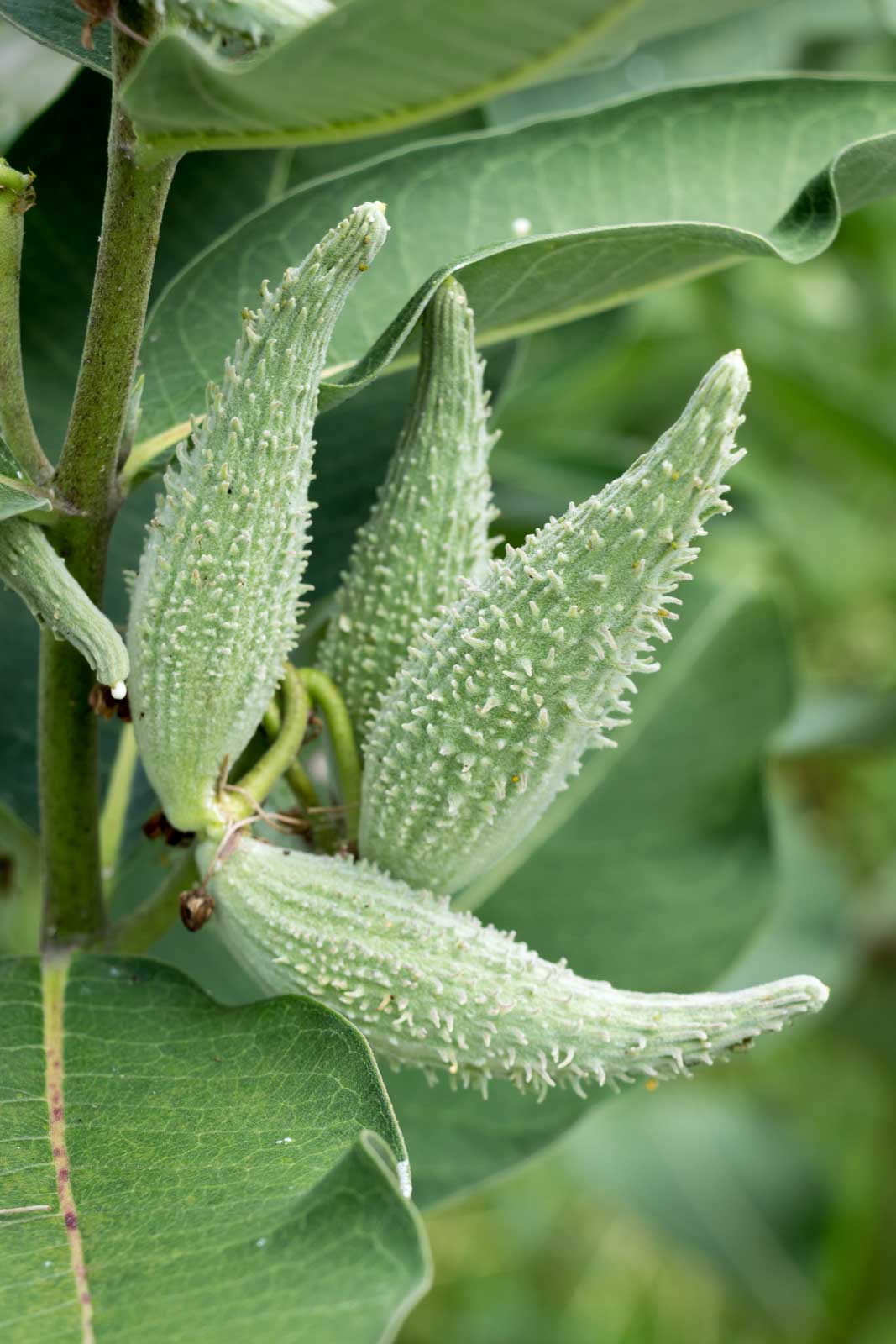
Jack and I are having a better day today. It’s still humid, but the temp plummeted overnight and today it’s a reasonable 22 º.  We actually went for a real walk around the neighbourhood this morning and just down the street we found a front garden full of milkweed. When I was young I used to love pulling the pods apart and playing with the silk and it was awfully tempting to pluck one today. Instead, I took this photo, but the desire is strong and I cannot guarantee that I won’t pick one later.

Youtube Video: Nurgle Plague Sword Build

Michael Cthulu is not a smith, he is a welder. And he does not make historically accurate replicas, he makes ridiculous, humongous swords from computer games that have no chance whatsoever to being actually functional in the real world.

But he is entertaining to watch and he has shown some tricks in his videos that are valuable to me in my workshop – like his unique working goggles with replaceable glasses.

He also seems to be a genuinely nice person, at least judging by the ammount of his products he auctions for charity ever since he makes enough money for comfortable living.

Mild content warning – the video takes almost an hour and contains half-naked and very hairy dude in his fifties doing dangerous things with fire, electricity and fast spinning machinery.

Tummy Thursday

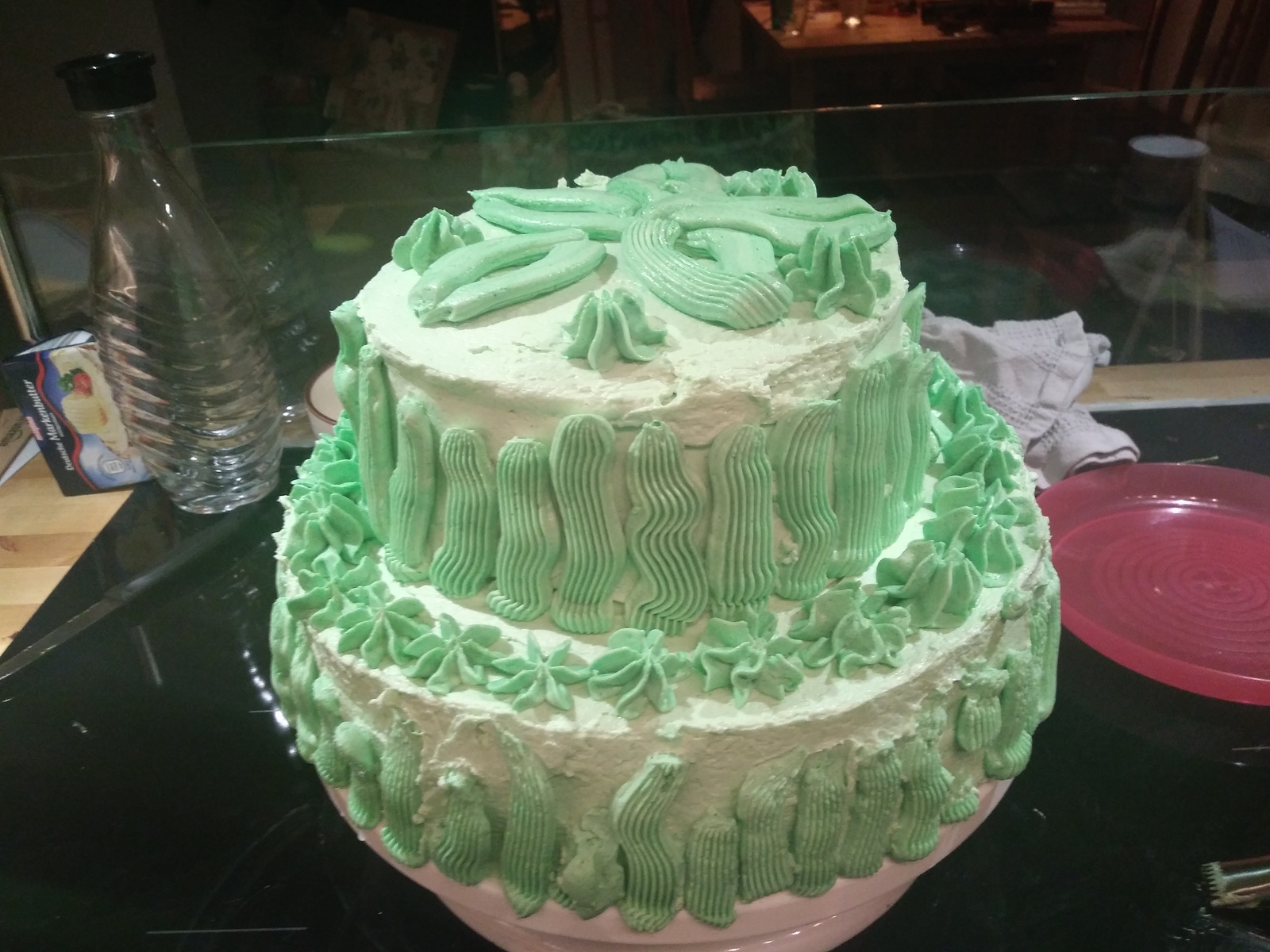
Today’s post is less a recipe than a post about cake making.

I love making cakes. I especially love making the “big cakes” where you can go wild. Chances are that if you invite me to an event above “kiddie birthday” and ask to bring a cake, I will use it as an excuse to turn approximately 100.000 calories into a cake.

The excuse for the following cake was my friend’s kids holy communion (the family’s catholicism has been puzzling to us for generations. Girl, I know what you did in your 20s and 30s).

The cake base was a red velvet cake with cherry filling, which I frosted with chocolate ganache. This was pretty not spectacular although already delicious. I went for two layers, though. If you do, use a cakeboard or a wrapped piece of cardboard supported by some sticks because otherwise the very heavy second layer will sink into the soft first layer.

Choclate frosted cake

It didn’t have to be very even because there’s a second frosting to come. I always wanted to do an Italian meringue buttercream, but I never tried because my old kitchen machine was designed by an engineer who put the motor below the bowl and the gears into the middle of the bowl. Don’t ask. Regular buttercream regularly ended in a disaster because everything just melted, so after a particularly annoying instance I decided to get a new one and Mr convinced me (I’m using that word in a very loose sense here) to get something decent and I went for a Kitchen Aid. I never looked back. The only problem was that I could have done with a second one to keep whipping the meringue while I was creaming the butter, but that was possible to do by hand. In the video, Yolanda just adds the butter, but I was following a different recipe.

Since communions are in spring I went with green, first a light one to cover the whole cake and then a darker one for the grass.

cake covered in green buttercream

But that’s only about 80.000 calories, so the next step was to break out the fondant and go crazy. I love that silicone forms have become quite affordable. The trick is to dust them with starch, as well as the finger you use to push the sugar into the form.

I was quite pleased with the result.

Finished cake

Fancy Bats

Joseph Zowghi has sent us another of his fancy bat portraits. This time it’s a group of Ectophylla albas, otherwise known as Honduran white bats, gathering under a leaf. I was happy to find this submission because I’m fond of Joseph’s drawings. The rounded, repetitive lines draw me in and the artist has a talent for making bats look appealing. Thanks so much for sharing, Joseph.

Jack’s Walk

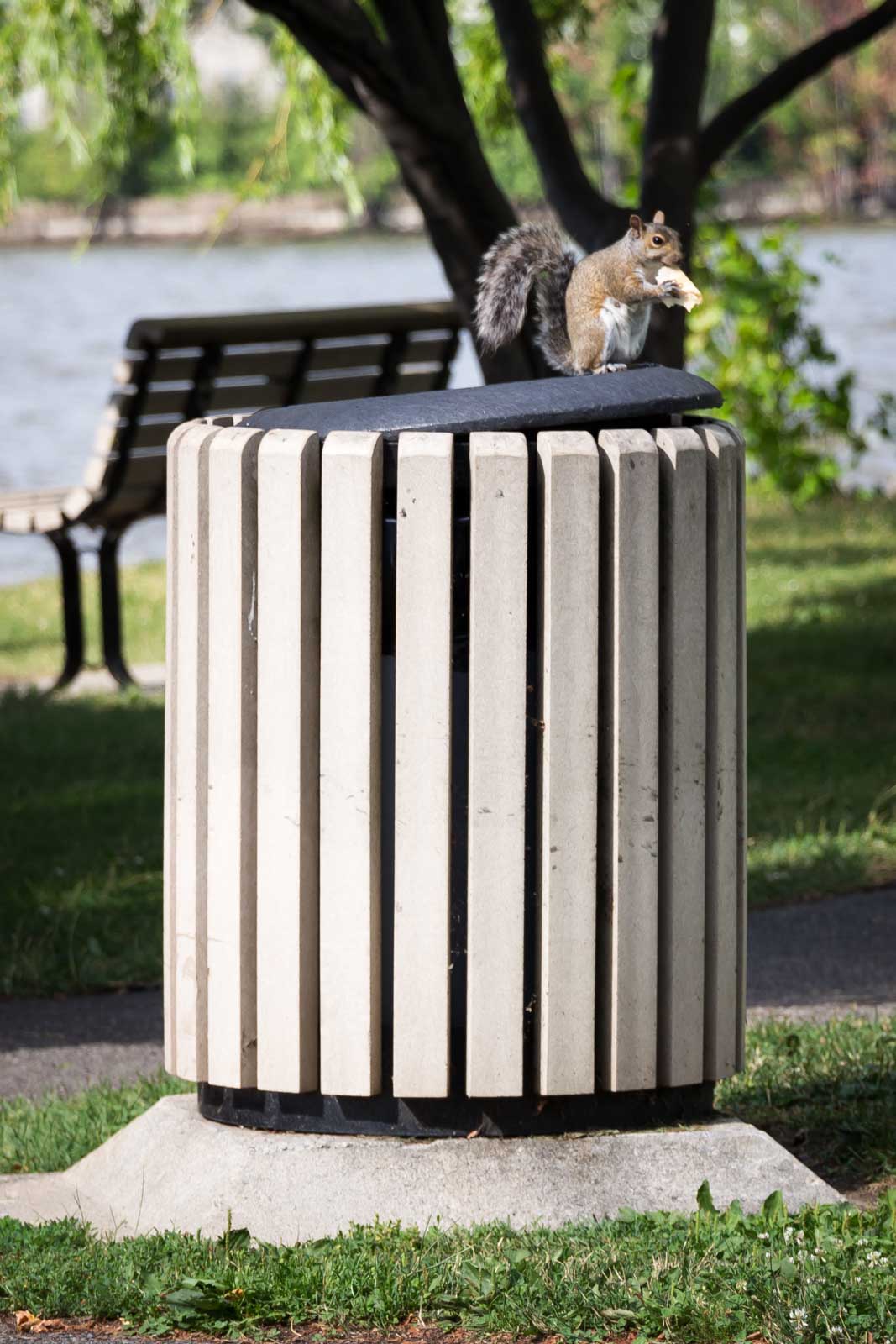
Scrappy squirrel©voyager, all rights reserved

Well, it’s a scorcher of a day here. 31 degrees with a humidex of 40 degrees. Ordinarily I could laugh it off, but we’re staying with my mother-in-law who doesn’t have air-conditioning and it’s just not as funny when there’s no relief. Poor Jack is suffering the most. Thankfully, he’s still in his light summer coat, but he’s disinterested in everything except sitting in front of the fan. That’s pretty much my attitude to life, too. My fibromyalgia flares up in high humidity and it feels like I’m walking through a dishwasher in double gravity boots. As a result, our walk today was strictly business related and once Jack’s business was done we trudged back home to sit in front of our fan.