The Philosophy of Beards.

Thomas Gowing felt the mighty yet fragile English Beard to be threatened with extinction by an invasive foreign species, the Razor. So he set out to defend the furry face mammal in every conceivable way. The resulting lecture was received so enthusiastically by a bushy-faced audience in Ipswich that it was soon turned into The Philosophy of Beards (1854) — the first book entirely devoted to this subject.

It is Gowing’s ardent belief that the bearded are better looking, better morally and better historically than the shaven.

[…]

In the last section, Gowing gambols through the ancient and modern past, attaching a beard or lack thereof to thousands of years of heroism and cowardice, honour and deceit. Viewing history through the prism of the beard makes things nice and simple: “The bold Barons outbearded King John, and Magna Charta was the result,” … “Henry the 7th shaved himself and fleeced his people”. Napoleon I only allowed men in his empire to have an “imperial”, an upturned triangle of a beard, as a way of letting them know “that they were to have the smallest possible share in the empire”.

[…]

Finally, he dismisses as “a foul libel” the idea that ladies don’t fancy a beard. He declares, presumably without much survey data to hand, that “Ladies, by their very nature, like everything manly,” and cannot fail to be charmed by a fine flow of curling comeliness.”

You can read much more at The Public Domain Review, including the book itself. The book has also been recently republished by the British Library, for the first time since 1854. You’ll find a link at The Public Domain. I’d think the book would be a fine gift for anyone’s bearded friends and loved ones.

You might also be interested in Beards of Time:

Two photographs of the same unknown man, each taken at a different studio in Texas – Source: left and right.

Two photographs of the same unknown man, each taken at a different studio in Texas – Source: left and right.

Stitching Medieval Manuscripts.

I have a deep and abiding love of Medieval Manuscripts, there’s always more to discover and wonder over, and here’s a new and delightful discovery to me, the early repairs of manuscripts, where beautiful embroidery was utilised to repair flaws in the parchment.

A plain-colored stitch incorporated into a drawing. Gerald Raab/ Courtesy Staatsbibliothek Bamberg.

A plain-colored stitch incorporated into a drawing. Gerald Raab/ Courtesy Staatsbibliothek Bamberg.

In the Cantonal and University Library in the ancient city of Fribourg, Switzerland, is a 14th-century manuscript with some gloriously beautiful defects. Scattered throughout the text are small tears and holes. And many of them have been carefully, intricately stitched together with colorful thread.

[…]

Holes in the parchment weren’t always dealt with, but when they were, any repairs needed to be done before it could be written on. This might include both patching over holes and evening out edges, explains Sciacca. The repair method could be crude or rudimentary—“Frankenstein” repairs, as Sciacca jokingly calls them—but, as writer Paul Cooper recently highlighted, sometimes they could be quite beautiful.

In that same 14th-century text in Fribourg, a single page is elegantly adorned with two sets of thin stitches, one pink, one green. Elsewhere in the same manuscript there are rainbow-hued repairs of different shapes and sizes. In a text held at the Engelberg Abbey library in Switzerland, stitches at the edge of the page create a “rope”, as Sciacca refers to it, to fill in the edge of the parchment. And from the same library, the missing side of one page has been patched with an additional square of parchment.

A series of repairs made in James of Voragine’s 14th-century Golden Legend. Courtesy Cantonal and University Library Fribourg, Switzerland, Ms. L 34.

A series of repairs made in James of Voragine’s 14th-century Golden Legend. Courtesy Cantonal and University Library Fribourg, Switzerland, Ms. L 34.

As medieval book historian Erik Kwakkel points out, these repairs must have been common in certain monasteries. “Where I was finding a lot of these embellishments were in manuscripts that came from either nunneries, or from what they call in Germany, double cloisters,” Sciacca says. “So you have this paired male and female monastic community. They live separately, but they’re allied with each other, and they’re physically located next to each other. So it seems that this may be part of what was, in fact, women’s training, what was nuns’ training, which was to practice embroidery. And they were doing it not just on textiles, but also actually in manuscripts.”

Stitching wasn’t the only way to make the best of flawed parchment. There are instances of holes being incorporated into illustrations, or used to reveal an illustration on the following page. The stitches themselves could even be embellished. In a text in Germany’s Bamberg State Library, a curve of plain-colored stitching is surrounded with the drawing of a man so that the thread resembles his skeleton.

You can read much more, with lots of links, and see much more at Atlas Obscura. Fascinating!

Youtube Video: Your Ancestors Tried to Kill Each Other!

Matt Easton is not the greatest orator of all time, a lot of tangents upon tangents upon tangents. However this is still  a good point well made and an excellent response to the more and more vocal nationalists and race purists in Europe.

As someone of mixed Germanic/Slavic ancestry who in WW2 had relatives both in SS Waffen* and in Totaleinsatz I can only nod in agreement.

*For the sake of completeness the story as said by my mother:

One of my grandmother’s cousins was conscripted in Wehrmacht and during the war he got transfer order to SS Waffen. That is an offer one cannot refuse, so he has swallowed a bullet, because he just could not follow the orders anymore. However there is no doubt in my mind that I had relatives on that side of the family who fought and slaughtered for the Führer quite happily.

Behind the Iron Curtain part 5 – Environmentalism

These are my recollections of a life behind the iron curtain. I do not aim to give perfect and objective evaluation of anything, but to share my personal experiences and memories. It will explain why I just cannot get misty eyed over some ideas on the political left and why I loathe many ideas on the right.


Today it seems like protecting the nature has become a leftist issue, and raping and pillaging it is the modus operandi of the right. This amuses me slightly, because the “left” that I grew up with was very different.

Unofficial motto of communist regime was “Poručíme větru, dešti.”. Translated into English “We shall take command of the winds and the rain.”. Humans were central to any policy and it was seen as imperative to take total control of nature and shape it to our needs and wants. In retrospect, some of it resembled christian ideas about humans being given dominion over the Earth.

One of the environmental abominations the communists did whose damage pays heavy dividends these last dry years had three steps.
First was connecting the by then relatively small fields divided by boundaries of bushes and small trees into vast fields. Second was to drain as many marshes and wetlands as possible so they can be ploughed by heavy machinery. Third was to straighten as many rivers and creeks as possible.

The negative consequences were visible within a few years but despite that these things were, to my memory, touted as a sucesses to the very end.

And those consequences?

Destroying the bush covered boundaries admittedly reduced slightly the occurrence of some infections affecting crops (especially the grass rust), and some insects. However it also drastically reduced the birds populations by depriving them of nesting places, and it exposed the soil in the spring and fall to heavy wind and water erosion. That took a few decades to be visible with naked eye, but today there are fields in CZ that have patches completely stripped of all topsoil.
Draining marshes and wetlands brought near to nothing to increase crop production. Thusly gained soil when dried was heavy infertile clay that did not want to take in water from rain and where nothing very much grew. The only things that seemed to prosper there were pioneering plants like birches and chamomile. What was lost almost immediately were multiple species of orchids and other wetland plants, many of which became endangered as a result and to this day grow only in few areas.
Straightening the creeks and rivers was perhaps the most damaging of these all. Together with the first two steps it created a landscape where water retention capabilities of the land are damaged beyond repair. Today we are seeing the consequences in the form of droughts and subsequent flash floods when rain water does not seep into soil, but flows away as quickly as possible across the uninterrupted fields and through the straightened water-bed. Oh, and salmon are mostly gone too.

Anther thing to consider is the regime’s contribution to acid rains and global warming, which were both acknowledged as real and both ignored on grand scale. In school we were taught that the success of a state can be measured in the tonnage of coal mined and steel produced. So coal was mined and steel produced even at a time when western European countries already realized that this is not the right way to go. And this was touted as an example of our magnanimous socialist countries outperforming those dumb evil capitalists.

Our (CZ) coal power plants burned sulphur rich coal and made no effort to filter out the sulphur oxides and fly ash even at a time when in neighbouring Germany many, if not all, such plants have been equipped with both sulphur and fly ash capture. Thus when the wind was blowing from the west, the air was fresh, when it was blowing from the east, it was foul. In a rare occurrence these facts were mentioned at school to us and I have asked the teacher why our coal plants are not equipped with the same devices. surprisingly I got what probably was an honest answer – it is expensive and our state cannot afford it. I did not ask further but I do remember the dissonance I felt thinking about it – we are outperforming those evil capitalists yet we cannot afford to protect our environment like they co?

Last thing I want to mention is the protection of animals against abuse. There was none. As a child I have read an article about this in one children magazine my parents were buying to me. The author somehow got through censors very sincere article talking about this problem, and demonstrated how wild as well as domestic animals are being abused and tortured on regular basis. He mentioned an instance where some state representative was asked why the regime does not try to enact such laws which again were common in many western countries at that time. The answer was “Socialist human does not need laws to be kind to animals.”. The author of the article finished with bitter words “Well, it is evident not everyone deserves to be called (not only) socialist.”.

The problem, like with many other things, was that whatever the regime has decided to do or not to do was correct by definition. The regime had all the smartest people, the bestest people, and was in possession of all the answers. Evidence was only acknowledged when it could not be ignored anymore, and even then very reluctantly. Remind you of something/one?

That made me wary of anyone who claims to have all answers.

Women’s Suffrage Mapped.

Click for full size.

Click for full size. Map created by Cuba Holidays.

The map above shows when women got the right to vote in each country around the world.

2018 marks the centenary of Women’s suffrage in the UK and even then only with several restrictions (had to be over the age of 30 and meet property qualifications).

You can read much more (with links) at Brilliant Maps: Women’s Suffrage Mapped: The Year Women Got The Vote By Country.

Saint Agatha’s Breasts.

Source: Atlas Obscura.

Source: Atlas Obscura.

According to the story, not only did 15-year-old Saint Agatha of Sicily refuse to abandon her faith, she also rejected a Roman governor’s advances. As such, she was punished by having her breasts amputated, then died of her wounds in prison on February 5, 251 A.D. Frescoes of the mutilated martyr are easily recognizable. She’s often depicted holding her breasts on a platter.

Known as minne di Sant’ Agata in Italian, these sweet cheese and marzipan desserts are an edible reminder of Saint Agatha’s suffering. Bakers craft the perfectly round confections using a base of shortcrust pastry topped with ricotta. After adding in chocolate or a piece of boozy spongecake to accompany the filling, they blanket everything in pistachio marzipan and a thick, creamy glaze. A candied cherry on top completes the anatomically-correct aesthetic.

Each February, hundreds of thousands of people flock to Catania to honor Saint Agatha in a three-day celebration. The centuries-old festival features an all-night procession and delicious replicas of saintly, amputated breasts at every pastry shop.

You can read more at Atlas Obscura. A bit grisly, but I’ll admit they do look on the delicious side. Religions certainly do come with a side order of weird. There are many depictions of Agatha of Sicily, including ones of her holding her breasts on a platter, her breasts alone are carved in stone, and much more.

Minne di Sant’Agata Recipe.

“Going to the Dogs?”, Workshop.

“Going to the Dogs” Workshop #2 brought together scholars from England, Scotland, and Poland to discuss the various and complex intersections of disability- and animal-studies research. Discussions centred on talks delivered by Rachael Gillibrand (Institute for Medieval Studies, University of Leeds), Dr Ryan Sweet (School of English, University of Leeds), Dr Andy Flack (Department of History, University of Bristol), Dr Neil Pemberton (Centre for the History of Science, Technology and Medicine, University of Manchester), and Dr Justyna Włodarczyk (Department of American Literature, University of Warsaw). The talks covered topics including the animal assistants of disabled people in the late-medieval West; nineteenth-century representations of animals with prostheses; connections between historical understandings of animals that live in darkness and vision-impaired people; the role of the caress in 1930s America human-guide-dog partnerships; and current controversies surrounding emotional-support animals in the US.

-Via Medievalists.

The full set of workshop videos.

The Beautiful Town Idstein – Part 4 – Schloss

German, as well as Czech, has two words for a castle. One is “das Schloss” which means a luxurious aristocratic residence. The other one is “die Burg” and means a fortified luxurious aristocratic residence.

Castle in Idstein

©Charly, all rights reserved. Click for full size.

From what I have been able to decipher on German Wikipedia the castle in Idstein used to be both of those. Originally it started with a lookout tower (the previously mentioned Hexenturm) around which a fortified residence was built. Sometime around the Renaissance period the castle was rebuilt from fortress into purely representative luxurious dwelling.

First picture shows the castle as seen from the town. The castle itself is located uphill and can only be accessed via the gate near Rathaus.


Castle in Idstein

©Charly, all rights reserved. Click for full size.

At the foot of the Hexenturm is this beautiful building connecting the base of the tower with the gatehouse (named “Alte Kanzlei”). This building, at least its lower parts, is what remains of the original fortress. There were some significant damages to be seen, right behind the gatehouse the original stone wall was bulging out and it had markers on it probably to keep an eye on the bulge. Unfortunately in our somewhat chaotic and unguided stroll through the town I did not make more pictures  of the remnants of the original fortifications, because I did not know where to look and for what.

However I did make a picture of the main castle building. With “chemtrails” behind it. Today it serves as a high school, a much better purpose than a demonstration of wealth and power.

Castle in Idstein

©Charly, all rights reserved. Click for full size.

Hans Holbein’s Dance of Death.

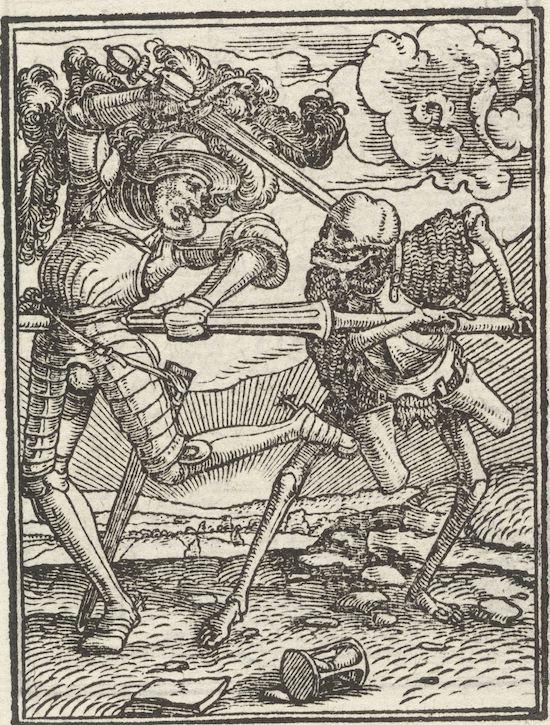
The Knight.

The Knight.

The Dance of Death by the German artist Hans Holbein (1497–1543) is a great, grim triumph of Renaissance woodblock printing. In a series of action-packed scenes Death intrudes on the everyday lives of thirty-four people from various levels of society — from pope to physician to ploughman. Death gives each a special treatment: skewering a knight through the midriff with a lance; dragging a duchess by the feet out of her opulent bed; snapping a sailor’s mast in two. Death, the great leveller, lets no one escape. In fact it tends to treat the rich and powerful with extra force. As such the series is a forerunner to the satirical paintings and political cartoons of the eighteenth century and beyond. For example, Death sneaks up behind the judge, who is ignoring a poor man to help a rich one, and snaps his staff, the symbol of his power, in two. A chain around Death’s neck suggests he is taking revenge on corrupt judges on behalf of those they have wrongfully imprisoned. In contrast, Death seems to come to the aid of the poor ploughman, by driving his horses for him and releasing him from a life of toil; the glowing church in the background implies this old man is on his way to heaven.

Holbein drew the woodcuts between 1523 and 1525, while in his twenties and based in the Swiss town of Basel.

The Miser.

The Miser.

The Monk.

The Monk.

These woodcuts are beautiful and highly detailed. In Holbein’s hands, Death makes its feelings known; Death is quite gentle in the cases of the old woman and old man, poor folk, and those of the peasant class. On the other side, Death is more than a little rude, as in the violin playing as Death drags the Duchess out of her bed. Death is not kind when it comes to the abbot, the abbess, or the monk.

One notable thing makes these beautiful woodcuts all the more astonishing, the size of them:

Holbein’s achievement is the greater because of the miniature scale he was drawing in. Reproductions obscure just how tiny the wooden blocks were — no bigger than four postage stamps arranged in a rectangle. The blocks were cut by Hans Lützelburger, a frequent and highly skilled collaborator of Holbein’s. Lützelburger had cut forty-one blocks and had ten remaining when Death surprised him too. The blocks were then sold to creditors, and eventually printed and published for the first time in Lyons in 1538 as Les simulachres and historiees faces de la mort.

You can read and see much more at The Public Domain.

Youtube Videos: Capwell & Easton: A medieval knightly effigy in Dennington, Suffolk

This is a very interesting and informative series of three videos about a knightly effigies, what they are, why they were made and how they can help us understand the history of medieval armor from times where very few real exemplars are left. The series takes overall about an hour. Info on Tobias Capwell can be found here -click-


Behind the Iron Curtain part 4 – Healthcare

These are my recollections of a life behind the iron curtain. I do not aim to give perfect and objective evaluation of anything, but to share my personal experiences and memories. It will explain why I just cannot get misty eyed over some ideas on the political left and why I loathe many ideas on the right.


Content warning, graphical description of illness.


Ever since childhood my health was not great. I was allergic to almost anything one can be allergic to, I got sunburned in an instant and to add insult to injury I was wearing glasses. Twice I got blind due to allergy – once when mosquitoes bit my face and it has swollen so much that I could not open my eyes, and once when we were outside with school class and the teacher has allowed us to go into a field of rye. Where a piece of awn got stuck under my eye and again caused my lids to swell to the point I could not see. I had to be led out of the forest by my classmates, and we had to keep in shade because light has made my eyes hurt like hell.

That was not the worst of it. At early age I have developed chronic tonsilitis. It could be treated with antibiotics, but it did not work in the long run. The illnesses came more and more often and a pattern has developed – two to maybe three weeks of relatively normal life, then suddenly my neck tonsils got swollen and I vomited pus and congealed blood during the night wishing I die. Then I developed fever and I could barely eat for a week during which I was on the antibiotics. After the antibiotics (penicillin mostly) have done what they could I was weakly for another week and I had to abstain from any physically challenging tasks and I was excused from gym classes.

Thus about two years have passed in this rhythm. My growth was stunted and I was not behind in school only thanks to my high intelligence and a help from our neighbour’s sister, who was a teacher and tutored me one year during my illnesses.

The problem was of course that I should have been sent for tonsilectomy after the second or third bout of antibiotics at the most. The children’s physician for our district insisted on not doing this because it might, in her words, cause asthma later on. So when the antibiotics did not seem to work in the long-term after years of torturing me, she tried to prescribe a “preventional” course of penicillin, where I was taking half a pill each day. Needles to say this did not work at all, quite the opposite. I developed an allergy to penicillin and another antibiotic had to be used from then on.

She also tried to send me for a month on a recuperation vacation stay in the mountains. Something that was intended for children living in smog-covered cities. Needless to say it was useless for a country kid and I was sick during that vacation too.

My parents have only vocational education and they lacked the knowledge to challenge the physician’s authority. They did the right thing – they delegated the problem to the expert. Unfortunately the expert was an idiot. I do not blame my parents in the least, but I refuse to greet the physician on the rare occasion I meet her although she seems to think I should like her. She should have known better.

I had a stroke of luck in that I almost died and when my parents had to call an ambulance, the arriving doctor was the general practitioner for our district. And he was competent so he explained to them that the antibiotics are now doing nothing for me and are only de-facto poisoning me. And that tonsilectomy is the only viable long-term option. After I got tonsilectomy, the last in a long string of tortures, I could not eat properly for a few weeks, and I had to avoid some foods for a few years, but the wounds healed, one tonsil even grew back, and I only had tonsilitis once or twice ever since and never as serious as it once was.

My story highlights both the strengths and the weaknesses of the system.

First strength was accessibility. Each district had a general practitioner, gynaecologist, dentist and children’s physician that rarely were more than two bus-stops or half an hour walking distance away. Hospitals were relatively regularly dispersed, so the travel to one was not too long either. Getting to a doctor was usually not a problem. The same for apothecaries. Whenever I was sick, we could mostly just walk to the doctor and pick the medicaments on the way back.

Second strength was availability. My parents did never need to worry about the costs of any of this. Everything was paid for in taxes, and everybody had available all the care they needed (even the dentist). And they got paid leave to take care for me whenever needed. That does not mean there were no economical decisions made – some rare illnesses might not be treated because the costs were too high for the state to afford. But nobody had to worry about slightly complicated flu bankrupting them, or having their teeth pulled out because they cannot afford the repair.

But the weakness was that people had their assigned physicians and there was no real choice. There was no “second opinion” really available and people did not even know that such thing exists. So if your physician was an idiot, you were foobared.

But I still think that this is one of the things the regime actually got mostly, even though not completely, right.

Wake: The Hidden History of Women-Led Slave Revolts.

Page from Wake by Rebecca Hall and Hugo Martinez (all images courtesy Hugo Martinez).

Page from Wake by Rebecca Hall and Hugo Martinez (all images courtesy Hugo Martinez).

In 1712, New York City witnessed a dramatic uprising when over 20 black slaves, fighting against their unjust conditions, set fire to several houses of white slaveowners and fatally shot nine. Known today as the New York Slave Revolt of 1712, the insurgence resulted in the conviction and public execution of 21 slaves, as well as more severe slave codes. While sources often state that these rebels were all men, the historian Dr. Rebecca Hall has identified four women who were captured during the clashing and were tried. Their names were Amba, Lilly, Sarah, and Abigail.

Erased from history books, their stories will now be told in vivid form by Hall, who has devoted much of her career to unearthing the roles of women in slave revolts. Hall is currently working on her first graphic novel, which will highlight female rebels in various 18th-century uprisings, from three in New York to those that broke out on slave ships. Titled Wake: The Hidden History of Women-Led Slave Revolts, the 150-page work emerges out of Hall’s 2004 dissertation on the same topic. She is now collaborating with independent comic artist Hugo Martinez to produce the storyboards and, through Friday, May 4, is raising $5,900 on Kickstarter to realize it for submission to publishers.

“The way the history of slave resistance has been written, this very gendered narrative developed about how manly and masculine enslaved men actually were, which served to elide the role that women played,” Hall told Hyperallergic. “I was going against everything being taught in women’s roles in slave resistance by insisting that, if I looked, I bet I would find these women.” She recalled how her dissertation advisor had told her that she wouldn’t find any sources to realize her chosen topic; how one archive claimed that it had no related material.

This is a fascinating, and I think, a necessary work. You can read and see much more at Hyperallergic, as well as on the kickstarter page, where there’s also a video. They are close to their goal, but could use a bit more help, so if you can’t donate, you can help to spread the word!

Youtube Videos: European and Japanese Armor Mobility

Two short videos comparing two different types of medieval armor from practical point of view. One by an enthusiast owning a medieval armour replica in European style, and one by an enthusiast owning a medieval armour replica in Japanese style. Both armors were made specifically for these individuals, so they are fitted as well as they should be.

A lot of the things I learned in school about medieval armor and swords was evidently completely wrong. Like that armor restricted movement so much that it was impossible to move quickly, or that swords in Europe were blunt metal bars out of poor quality steel.