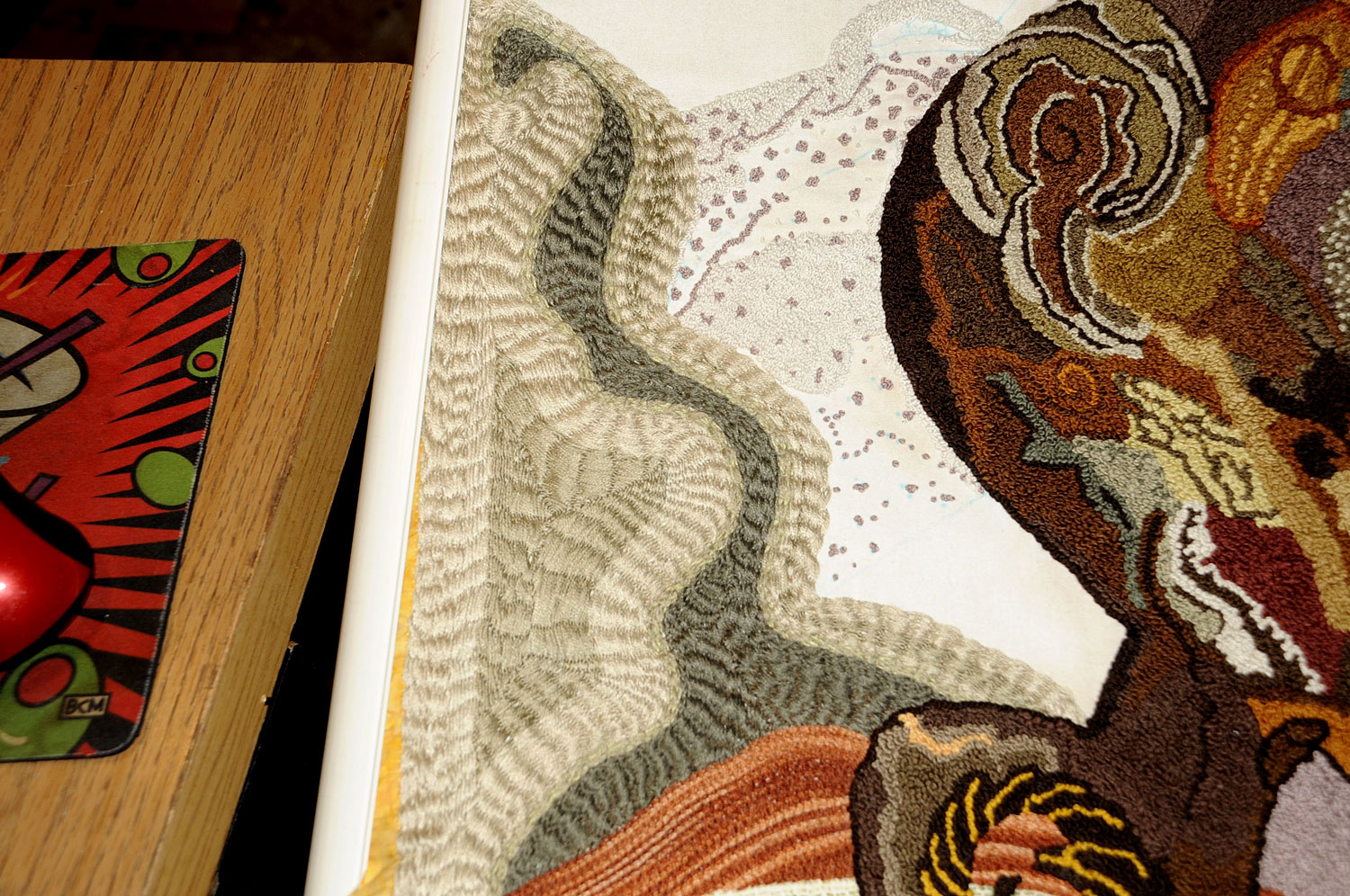
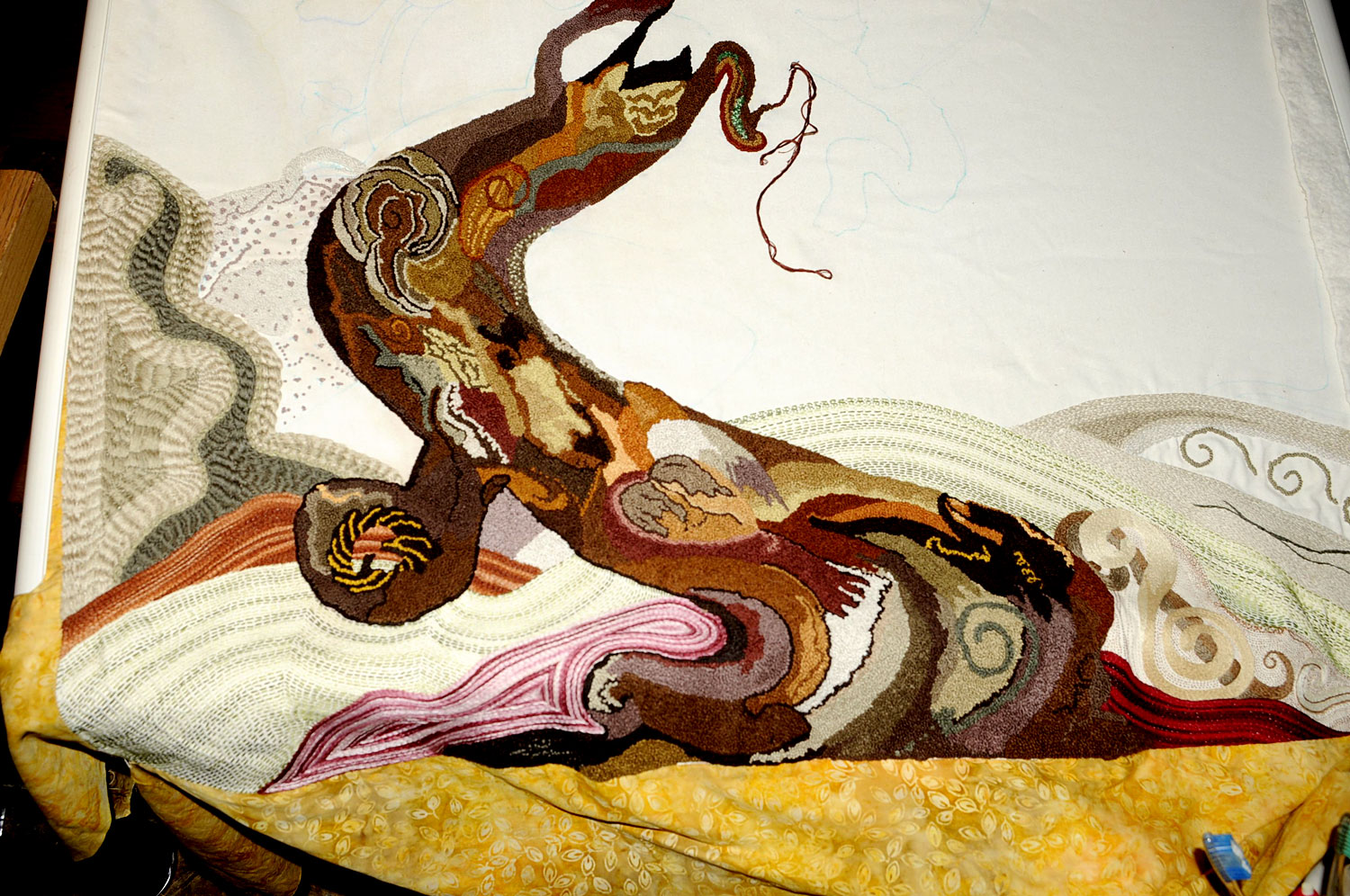
For a short while, anyway. One and a half hours saw the rest of the cocoa done. As this is another seriously high pain day, I’m calling it good. Click for full size. Current Hours: 940. Skeins used: 133.
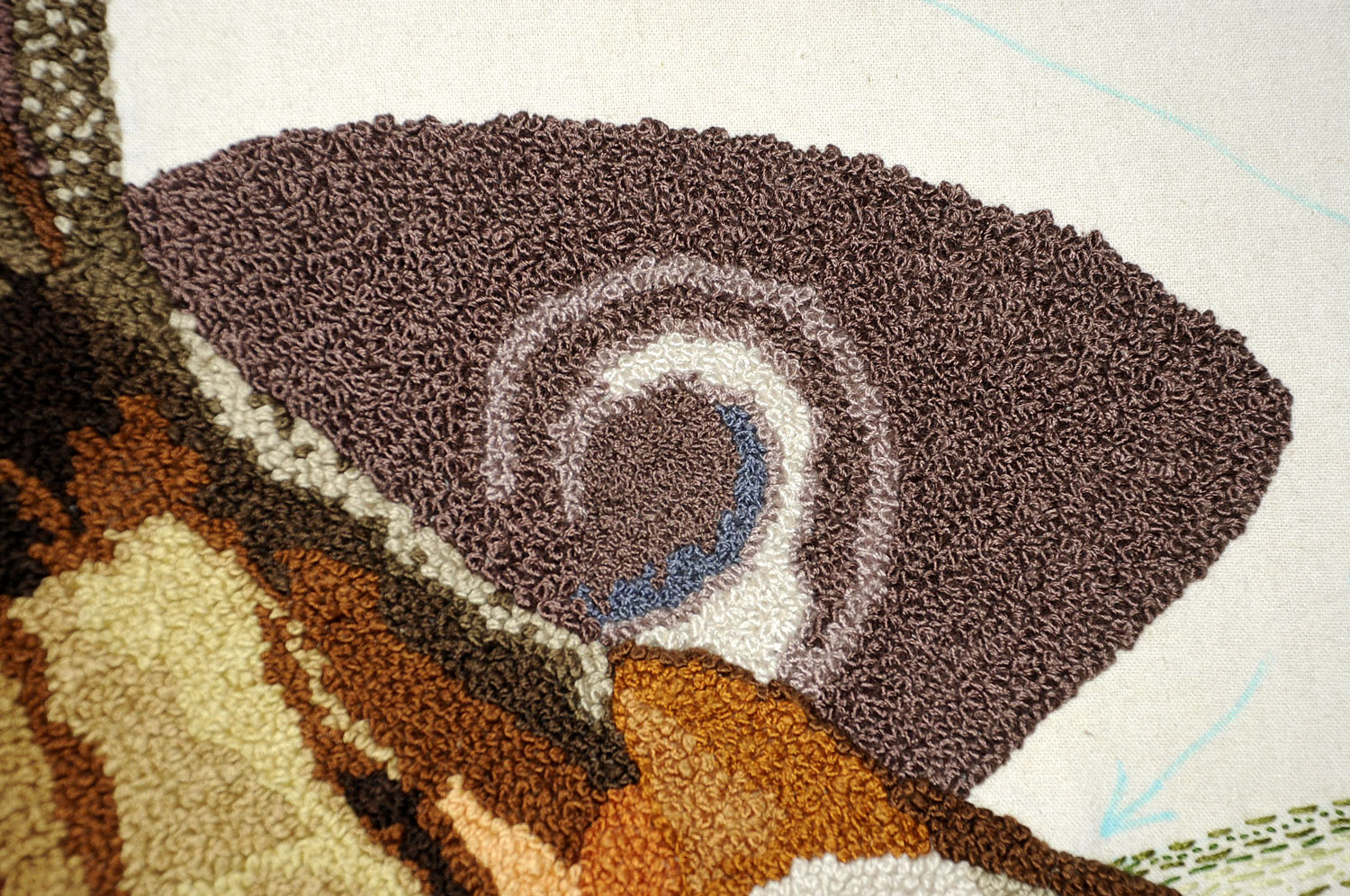

For a short while, anyway. One and a half hours saw the rest of the cocoa done. As this is another seriously high pain day, I’m calling it good. Click for full size. Current Hours: 940. Skeins used: 133.

Click for full size. Current hours: 939. Skeins used: 132. I have 3.5 skeins of this particular colour left. So I’ll have enough. Been a long bloody day, as I started at 4 a.m.
Cycle is a new animation from art director Kouhei Nakama that uses a wide range of physics-based particle animations to explore the human form. Music by Kai Engel. Via Vimeo Staff Picks. Full of ooohs and aaaahs, this.


Click images for full size.
Over 150 years ago a group of anonymous Japanese artists created a 34-ft long scroll titled He-Gassen (屁合戦), literally: “Fart Battle.”
The scroll, which was created during the Edo Period (probably around 1846) in Japan, consists of roughly 15 different scenes depicting people directing their farts at other people or objects. There are people farting at each other. There are people farting through objects. There are people combating farts with fans. There are bags of farts being released. Trees and cats get blown away by farts. And the scroll culminates with a divine gust of flatulence knocking over a ceremony and causing complete and utter chaos.
The scroll in its entirety was digitized by Waseda University and can be seen in hi-res format by accessing their database.
Via Spoon & Tamago.

In an effort to dismantle the film industry’s historically stereotypical portrayal of Native actors in buckskin, feathers and painted faces, Los Angeles-based media professional and photographer Pamela J. Peters (Navajo) has created a series of photographs entitled Real NDNZ Re-Take Hollywood, in which contemporary Native American actors recreate classic Hollywood portraits of movie stars such as James Dean and Audrey Hepburn.
[…]
The seven Natives involved in the project include actors from the Dakota, Cherokee, Crow, Blackfeet, Shoshone, and Seminole nations. They are Noah Watts (Crow /Blackfeet), Shayna Jackson (Dakota / Cree), Deja Jones (Shoshone), Kholan Studie (Cherokee), Krista Hazelwood (Seminole), JaNae Collins (Dakota) and Brian Vallie (Crow).
“All participants have a passion to work in the film industry, but they also have ties to their tribal communities and enjoy sharing their respective backgrounds with each other,” says Peters.
“I would like people to think critically about my photos, and hear the young performers’ stories about how they navigate an extremely competitive field of entertainment. Furthermore, I want society to know that we are many nations, with many stories, and that we can make a conscious choice to reshape perceptions of modern Indians today.”
The showcase will take place at These Days LA at 118 Winston Street, Los Angeles, 90013 from Aug 4th to 7th from 11 a.m. to 7 p.m. Information about the show can be found online. Her exhibit will showcase 24 images and a short video of her project. On Saturday, Aug 6th live art and drumming will be held from 3 p.m. to 7 p.m.
More information about Pamela J. Peters can be found on her website: www.PamelaJPeters.com.
Via ICTMN.
![[Photo: Kirk Morales via Unsplash. Illustrations: NYC MTA/ tovovan via Shutterstock]](https://i2.wp.com/freethoughtblogs.com/affinity/files/2016/08/3062539-poster-p-2-this-simcity-of-subways-lets-you-redesign-the-mta.jpg?ssl=1)
[Photo: Kirk Morales via Unsplash. Illustrations: NYC MTA/ tovovan via Shutterstock]
New Yorkers frustrated by the high fares, cramped commutes, and long walking distances to the nearest stop have long loved indulging in the city-wide pastime of playing armchair design critic to the MTA. But is it possible to design a more efficient New York subway system? Like SimCity for subways, Brand New Subway is a new web game that lets you give it a shot—and it just might give you a newfound appreciation for the efficiency of the MTA.
Based upon an accurate map of New York City, the goal of Brand New Subway is to design your own subway line. You do so by putting icons representing existing MTA lines onto the map, with the computer automatically connecting stations into lines by calculating the optimal path between them. Crossovers can also be manually assigned, so that multiple lines form a citywide network.
Where things get interesting is that when you drop a station on the map, Brand New Subway automatically pulls in local data from a variety of sources, including information about population, jobs, transportation demand, taxes, and so on. It then calculates how successful your subway is based on a couple of metrics: how many people it can move on an average weekday, and the cost of a single-ride MetroCard for the network.
You can read more about the game here. Brand New Subway.
Furenexo wants to make assistive tech.
Would you purchase a basic digital camera connected to a 22″ LCD monitor for $3,000?
How about a GPS unit to announce your location for $800?
Unfortunately, a hugely overlooked segment of the population has no choice but to pay these prices for outdated technology – namely, people with disabilities.

We at Furenexo believe it’s time for Makers to become advocates, and recently launched our Kickstarter campaign to develop low-cost, highly accessible assistive technology using open source hardware and software. We see an amazing opportunity to empower Makers to become “enableists”, and make better things — and things better — for our world.
Why Make Assistive Devices?
– Because advances like Arduino, 3D printing, and object/face/voice recognition are making concepts that were only pipe dreams a few years ago possible.
– Because the challenges faced by people with disabilities have been ignored for so long and any progress could have a deep impact.
– Because nobody needs an “Uber for dry-cleaning” or yet another disco light set-up for Burning Man.
– Because engaging with disability at any level could be a personal challenge outside your comfort zone.
– Because around 49 million Americans (3.8 million of whom are veterans) are affected by some physical or sensory impairment. The economic impact of even slightly reducing some of these challenges people with disabilities face could be profound.
– Because just making something to help a neighbor could earn you a smile and thank you to light up your day, and every day.
There’s much more at Make Magazine. Furenexo’s website.
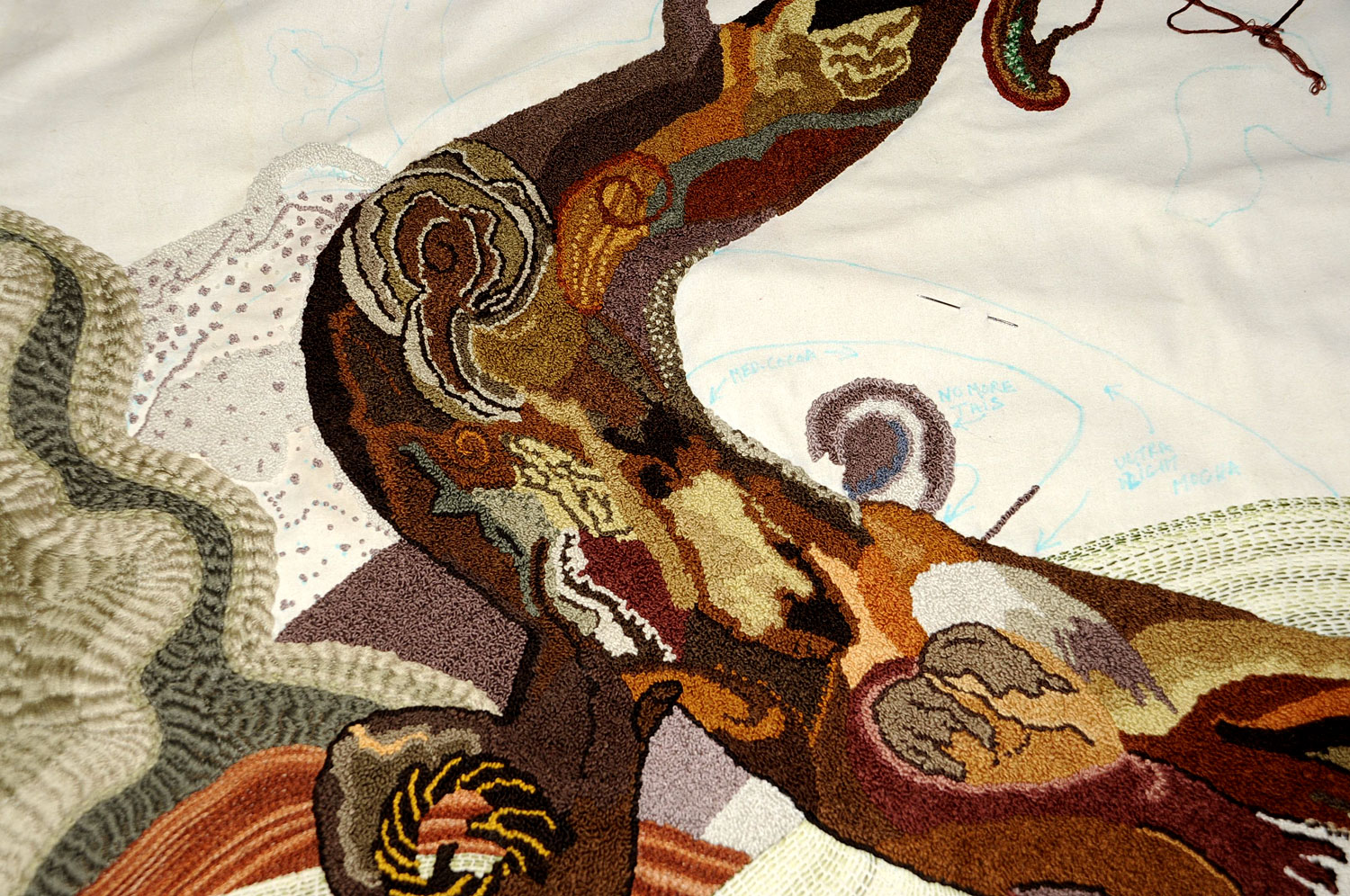
Best laid plans and all that. The large section of background I’m currently working on, I had planned doing in light cocoa, and ultra light mocha. In a stroke of brilliant idiocy, I somehow managed to completely forget about the light cocoa thread when I stocked up on the colours needed for this bit of the tree quilt. Normally, this wouldn’t be a problem, I’d just get to Joann’s and get more, but I am dire broke, and will be that way for two weeks. Yes, I could work on another bit for two weeks, but I am motivated, right now, to get this section done. I have to go with these motivated moments, because if I stop working this section, it will just turn into a massive chore of tedium, and I’ll find reasons to put it off.
So, a change of plan. I had just enough light cocoa to tie it into the bottom section of light cocoa. As I have 7 skeins of medium cocoa, medium it is. It always pays to be flexible in the face of fuck-ups.

Using the 150 year old technique of chronophotography, Spanish photographer Xavi Bou has figured out a way to take pictures of migrating birds while retaining the fluid sense of motion that gives them all their mystery, poetry, and grace.
You can see much more at The Project: Xavi Bou, (horizontal scroll) and read about Ornitographies here. Via Colossal.

Herb Williams works in crayon, and his pieces are stunning, pure awesomeness.
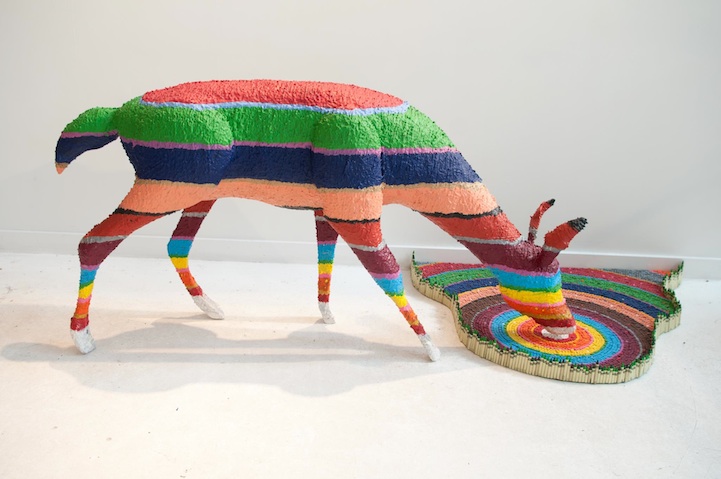
Crayons are a gateway drug. To most adults, the sight and smell of crayons produce specific memories of childhood. The twist in the road to nostalgia is the creation of a new object, from a medium in which it was not intended. This element of unexpected interaction and play had me at hello.
I am one of the only individual wholesalers of crayons in the world. Because I am in pursuit of larger ideas, the playful aspect of my medium is integral to the works of art I’m creating. I can subversively insert a concept that may bloom well after the initial recognition of the form as a familiar children’s implement. To create my work I need to produce sculpture on a grand scale (which takes thousands and thousands of crayons), so I order each color individually packed (3000 to a case) and cut the sticks down to the length I need. I then bond the paper—not the wax—to a form I have carved or cast, completely enveloping the form.
I am interested in identifying iconic objects that society perceives to fit one role and then reintroducing them in different subtexts. Intriguing questions arise when an object associated with childhood, such as a crayon, is used to address issues dealing with more adult matters, such as sexuality, religion, and social hierarchy. The sculptures are childlike in their curious approach to the object as icon, but beguiling and satisfying to me in the use of pure color as form. Larger room installations also add the element of playing to the olfactory sense, as the scent of the wax completely saturates the environment. My intent is to continue to seriously create art that looks at itself unseriously.

Spend some looking around his galleries, you won’t be disappointed! One of Mr. Williams’s projects was also featured on Colossal.
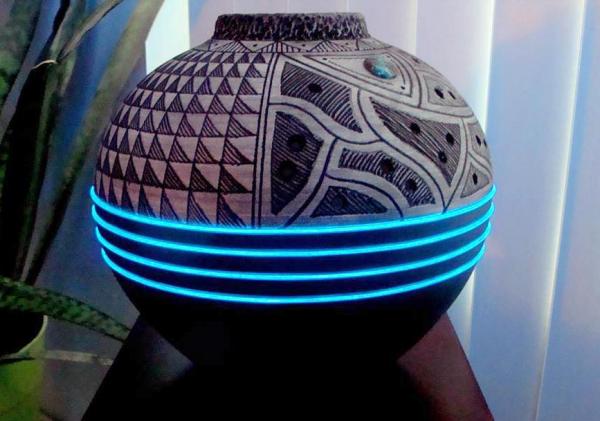
Billing his work as contemporary Navajo pottery, sculptor and graphic artist Gerald A. Pinto is expanding the boundaries of traditional sculpting. Courtesy of the artist.
Billing his work as contemporary Navajo pottery, sculptor and graphic artist Gerald A. Pinto is expanding the boundaries of traditional sculpting by mixing media such as copper, turquoise and even battery-power into his work in innovative ways.
“I always tell people it blends the past with the present,” says Pinto. “Even though I call it contemporary, I showcase some of the more traditional designs, too.”

Gerald Pinto’s Elemental gourd and seed pots. (Courtesy)
Pinto has been doing pottery for around 28 years, but committed to it full-time after leaving his job with Amtrak in 2003. He credits his family with being his biggest artistic influences and inspirations. “My mom is a weaver and my dad was a silversmith; they taught me a lot about Navajo designs.” His cousin, Dennis Charlie, who is known for his carved pots, encouraged him to pursue the art. “For a while, I was doing pieces similar to his, but over the years, I moved towards my own style.
“I developed it over the years … the copper and the turquoise is how people recognize my work.” Brown pots, that were pit-fired with copper and turquoise, are part of the Elemental Series.
The full article is at ICTMN. Gerald A. Pinto on Facebook.
Got the side section finished, and a bit more background knotted. Current Hours: 913. Skeins Used: 126. Click for full size.

© C. Ford. All rights reserved.
17 inches done. Many more to go. Current hours: 903. Skeins used: 125.

© C. Ford. All rights reserved.

Artist: Sam Jinks; Title: Kneeling Woman (2015); Art Central 2016 (Gallery: Marc Straus); Silicone, pigment, resin and human hair; Photo by longzijun.
Artist’s Website: www.samjinks.com