
The Probability Broach, Appendix
We’ve reached the end of The Probability Broach. But following the conclusion of his story, L. Neil Smith includes an appendix that recounts the fictional history of his anarcho-capitalist North American Confederacy. There are a few points of interest I’d like to highlight.
Smith’s appendix dates significant events using two numbers, the first in his new “A.L.” scheme, the second in the older (i.e., “our” world’s) CE scheme. Here’s one of the earlier entries:
11 1787 Federalists under Hamilton, Jay, Madison meet in Philadelphia, illegally adopt new “Constitution” creating strong central government.
12 1788 Ratification by ninth and last necessary state (New Hampshire).
There’s an awkward contradiction here which Smith doesn’t linger on. He condemns the Constitution as “illegal“—yet even in his alternate history, it was debated, voted on and ratified by the states, the same way it was in our timeline. If the Hamiltonians were so ruthless and power-hungry, why didn’t they impose it by force? Is calling for open debate and a democratic vote the act of a wannabe dictator?
Smith’s next point concerns his hero, Albert Gallatin, who led a successful rebellion against the Constitution and George Washington, then became the first president of the newly formed North American Confederacy:
20 1796 Gallatin confirmed by Congress; calls for neutral stance between England and France, humane Indian policies, and revision of Articles.
Smith wants you to think of his founder as a principled and ethical person, but doesn’t go into any detail about what these “humane Indian policies” were. Whatever they were, it doesn’t seem that they involved Native American sovereignties getting to keep their own land.
As I noted earlier, the North American Confederacy spread westward the same way as it did in our history, just with a slightly different ideology justifying it. There’s no acknowledgment that any of this territory was already occupied, or if it was, that the people living there posed any obstacle to settlers taking whatever land they wanted for themselves.
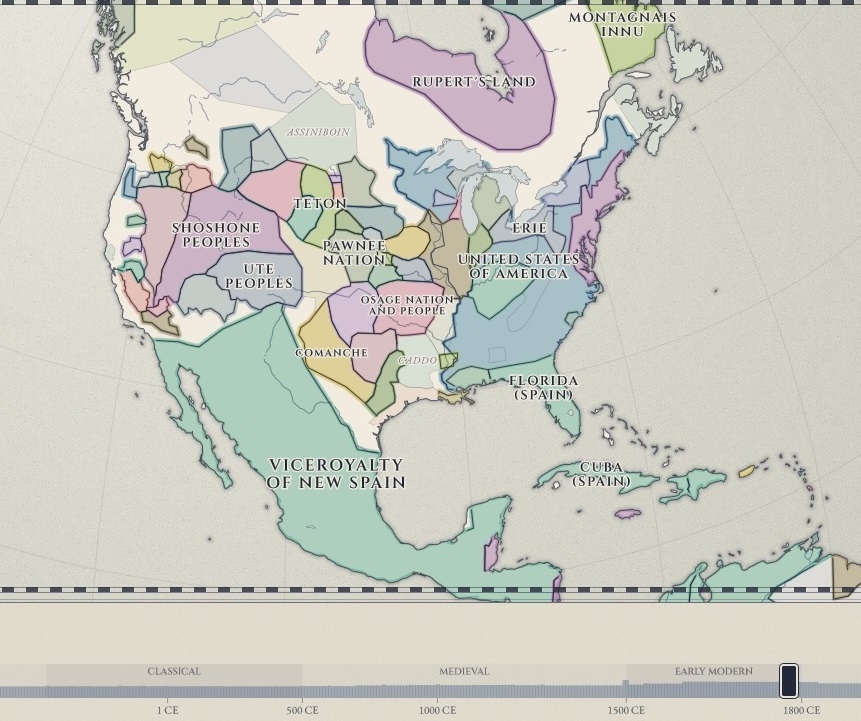
Here’s what the American West looked like circa 1800. Does it look like vacant land just waiting for white homesteaders to roll in? (via Human History Map)
The same issue exists with the the Louisiana Purchase. Smith has it take place in 1803, the same as in the real world, with the only difference being that it involved “borrowing from private sources against [the] value of [the] land” rather than with public funds.
What goes unsaid is that France sold the U.S. a huge swath of land it only controlled on paper. In reality, that land was inhabited by untold numbers of Native American people and tribes. The U.S. claimed that, because it had “bought” this land from an overseas emperor, it had the right to displace the people who actually lived there—either by paying them a pittance, or through outright theft and violence.
How could this same thing have happened in the NAC? How can anarcho-capitalism, which supposedly shuns coercion and values property rights above all else, countenance buying people’s homeland out from under them without their consent?
In fact, the next point in Smith’s appendix further emphasizes the problem:
40 1816 Genêt re-elected (second term), proposes abolition of slavery, reparatory land grants to slaves in West.
Again, Smith wants to show that his alternate timeline was more moral and humane than our own. But it poses the question: why did it seem like a good idea to grant freed slaves land in the West? The only reasonable deduction is that in Smith’s history, like our own, Americans perceived this land as unoccupied and free for the taking, even though it wasn’t.
If Smith had taken his own premises seriously, what would make more sense would be to have freed slaves seize the land held by their former masters and take it for themselves. That way, they’d be the ones to benefit from all the labor they put into it, rather than having to start over somewhere else. That would be fairer and more just than the scenario Smith envisions, where the enslavers get to keep their property and all their ill-gotten gains, and former slaves get the consolation prize of being resettled on someone else’s land, displacing them in the process.
Shouldn’t an anarchist cheer the idea of an uprising where enslavers are cast down and their slave-labor plantations are turned into free communes, owned and run by the people who were once forced to toil there? Wouldn’t that be a transformative change that would symbolize America becoming a truly free society?
Alas, L. Neil Smith lacked the imagination to conceive of such things. He’s not against revolution in general—he approved of the American Revolution, obviously, and in another throwaway line in the appendix, he says that Guy Fawkes’ Gunpowder Plot succeeded in this timeline, wiping out Parliament and precipitating the collapse of the British government in favor of an anarchist alternative.
But this tinkering around the edges with real history seems to be all he was capable of. He doesn’t grant Black or Native American people the dignity of autonomy, of being able to decide their own destiny or participate in this world as true equals. At most, he depicts them as unimportant side characters in the glorious American story of colonialism and manifest destiny. His world has more or less the same outcomes as ours, just with a slightly different ideology justifying them. For all he wrote about liberty, he lacked either the vision or the courage to follow that principle to its truest and most radical conclusion.
Other posts in this series:
“If Smith had taken his own premises seriously, what would make more sense would be to have freed slaves seize the land held by their former masters and take it for themselves.” I was going to make a similar point, though not as lucidly. What happens if they don’t want to move out west? For that matter, we’ve seen lots of white people out in Colorado — why isn’t it a black-majority state?
“Shouldn’t an anarchist cheer the idea of an uprising where enslavers are cast down and their slave-labor plantations are turned into free communes, owned and run by the people who were once forced to toil there?” The people who celebrate the Confederacy as a libertarian defiance of big government (yeah, i know, they’re wrong) never see any merit in Denmark Vesey, John Brown, Nat Turner, etc. defying slavery.
“in another throwaway line in the appendix, he says that Guy Fawkes’ Gunpowder Plot succeeded in this timeline, wiping out Parliament and precipitating the collapse of the British government in favor of an anarchist alternative. ” Oh, bloody fuck, excuse my language. Guy Fawkes (who was only a point man in the plot — Robin Catesby was more the leader) wasn’t an anarchist, he was working for a conspiracy to replace England’s Protestant monarchy with a Catholic one. And the book came out before V for Vendetta establishes Fawkes as an anarchist symbol so Smith doesn’t have that excuse.
And the Gunpowder Plot happened in 1605 so ending the British monarchy means American history turns out differently — would there even have been a revolutionary war?
In fairness to Smith, he does say earlier in the book that the white people traded fairly to buy the Native lands. Which as you pointed out isn’t remotely plausible but very little human behavior in this book is plausible.
As this is the end of the book, this really may be the stupidest stuff I read online for a while.
The Carolinas, Georgia, and most of Virginia, Pennsylvania, and New York were not part of the USA in 1800?
Actually I find it very believable. Not the part about it being a near-mirror of real history, but the part where NAC seriously fails to live up to its own standards for most of its history.
A lot of the US Founders either failed to live up to their own ideals and/or failed to truly understand the true implications of their own ideologies. Even in the areas where most of them didn’t, it was a very slow and painful process to actually force the people in power to go along. Later generations living in the 1800s were worse in a lot of ways. Thomas Jefferson, for example, wanted to force Native Americans to be “equal” by destroying their language and culture, and forcing them to speak English and conform to the local White cultures. His patronizing version of genocide was still far kinder than the later forced relocations and exterminations were, by people who didn’t give a damn about their rights or humanity. We didn’t start to truly implement equality until the mid 1950s, and 7 decades later it’s still a work in progress.
I really don’t think that was Smith’s intention, though. Given the general lack of imagination displayed throughout the book, it’s probably just lack of imagination.
Yeah, Smith’s previous sections make it quite clear this is a wonderful culture that outstripped our North America from the get-go. Slavery abolished, no sexism or racism, no crime, no prisons to abolish, better medical care, the average joe (or jane) can buy a house with six month’s salary, etc. This whole series of posts has made it clear Smith doesn’t think things through because it falls apart if he does.
In my own experience libertarian/anarcho-capitalists can’t really handle the Native Americans as they don’t nearly fit into their ideology, and thus usually they’re ignored or glossed over.