
Blah blah AI no creativity, whatever, blah.
It’s still fun.
I was lying in bed trying to sleep and had an idea. The music I was playing was the incredible 3rd Symphony by Gorecki. My brain cross-shorted with the dinner scene from Stanley Kubrick’s Barry Lyndon* and I had an idea:
Dinner for Gorecki’s Third
A meal of quiet light, intended to be eaten slowly, with conversation fading as the music deepens.
Aperitif
A single glass of Champagne Blanc de Blancs (preferably with several years of bottle age).
Served with:
- Warm gougères
- One perfect oyster
- A few toasted Marcona almonds
The Champagne is not celebratory here—it is crystalline, preparing the palate like the opening measures prepare the heart.
First Course
Thinly sliced raw sea scallops
Finished only with:
- Meyer lemon
- First-press olive oil
- Flaked sea salt
- Tiny leaves of chervil
Wine: A mature Chablis Premier Cru.
Nothing sweet. Nothing aggressive. The wine should taste like cold limestone after rain.
Second Course
Clear consommé of woodland mushrooms
Floating:
- One handmade raviolo filled with ricotta
- A few drops of brown butter
- Fresh thyme
The course should almost disappear after eating it.
Wine: An older white Burgundy.
Main Course
Slow-roasted saddle of lamb
Accompanied by:
- Celeriac purée
- Braised young carrots
- Black lentils
- A restrained rosemary jus
No towers.
No foams.
No artistic geometry.Simply arranged with confidence.
Wine: A beautifully mature red Burgundy from the Côte de Nuits.
This is the emotional center of the meal.
Cheese
A small wedge each of:
- Comte (36 months)
- A gentle aged goat cheese
Served with walnut bread.
Wine: The last glass of the Burgundy.
Dessert
Poached pears
With:
- Creme fraiche
- Honey from a single varietal
- Toasted hazelnuts
No chocolate.
No sugar fireworks.
Only warmth.
Wine: A small glass of late-harvest Chenin Blanc, served barely cool.
To Finish
Strong coffee.
One square of very dark chocolate.
Silence.
Remain seated until the symphony ends.
The final course is not food but gratitude.
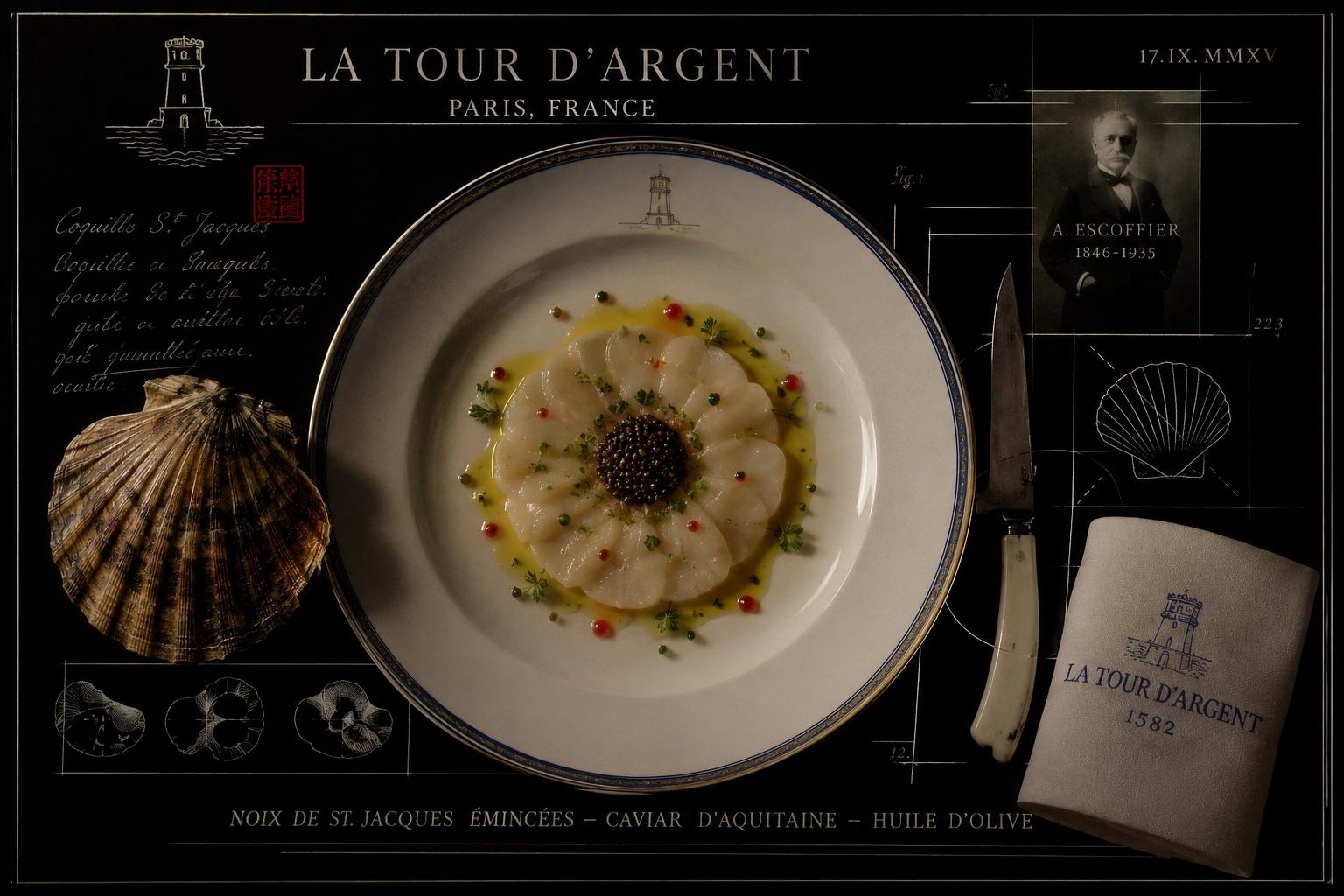
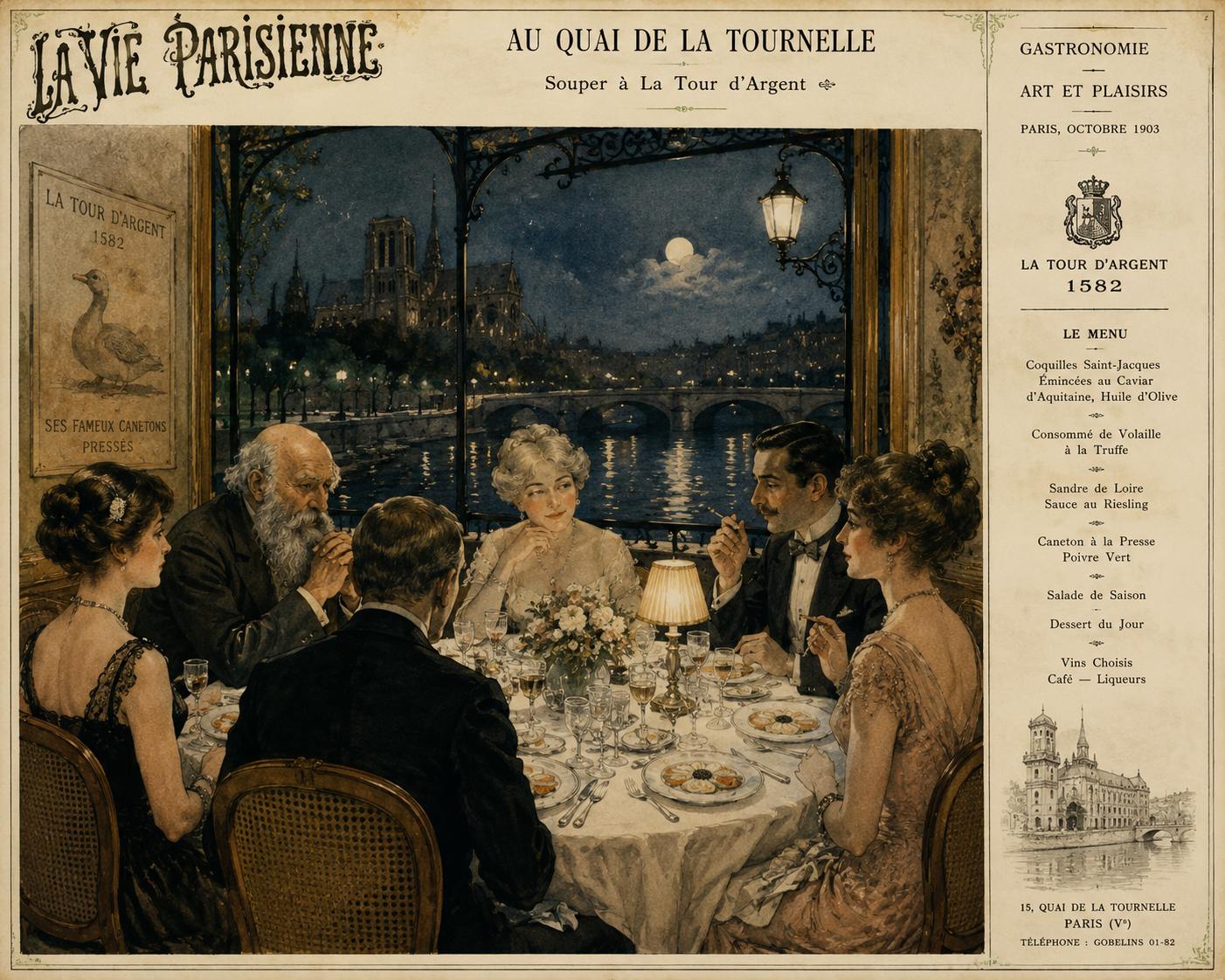
That led us into a discussion of other menus and meals, which (because the ambien was kicking in) mushed in my brain with Peter Greenaway’s The Cook, The Thief, His Wife, and Her Lover. which led to musing about an ideal guest-list. I thought that seating Dame Helen Mirren next to Auguste Rodin would be fun, if only for the chaos. From there, following the Greenaway thought-path, we segued into a dinner/performance of Carmina Burana as an emplaced feast with comedy and acting taking place all around the room. “That would be a blast”, thought I, as sleep took me.
 * I often have “brain farts” in which my brain retrieves one concept but confabulates it with another, and it still gets through my generative filters to a cognitive layer that consumes it strategically. So, Schubert’s Trio Op100, which was in the scene before the dinner scene in Barry Lyndon retrieved incorrectly with Gorecki and I thought “the dinner scene would have been cool if it had been shot with Gorecki as the theme. Also, appropriate to the sadness of the situation in the film.” This is where I think imagination or creativity come from: offset or erroneous retrievals that become confabulated. Unless someone wishes to propose a non-algorithmic model for creativity…?
The AI took my request for a “belle epoque” illustration of guests enjoying the dinner, and decided to stick with the theme of La Tour D’argent, and it even stuck Rodin and Helen Mirren in there. Is this “creativity”?
But wait, there’s more: it asked if I wanted to be included in the dining party, with my dad, because I had recently sent it some pictures from my lunch in Paris a few weeks ago.
Marcus, I suggest you complete this creative process with an AI chef that prepares your meal. It might surprise you with some additional tasty ingredients like belladonna or diesel. 😜
as soon as they’re better than human at a given task, the joke has to shift its goalposts. the number of tasks at which they supercede our skill increases every day. what’s the tipping point when the naysayers wake up and smell what the ai’s cooking? i will have been replaced at my job by then, i’m quite sure of that.
Well it certainly seems to have sourced that from the more surreal corners of the foodie internet. I’m afraid I couldn’t read it all as my eyes started to glaze over but that was the impression I got. So dreamtime inspiration seems about the right speed for it.
#Bebe: Not everything about AI has to be pro- or anti-. Sometimes it’s just damn weird and there’s nothing wrong with noticing that.
Hmmm. I’m not certain about the raviolo in the soup, I fear the ricotta would drown the flavour of the mushrooms. I’d be willing to try it.
Strictly as a matter of taste I would prefer a Sauterne to the Chenin Blanc (and I think my wife would prefer a Tokay).
… where I think imagination or creativity come from: offset or erroneous retrievals that become confabulated.
Which reminds me of Arthur Koestler’s The Act of Creation, in which he (again) gets a bit out over his skis in Grand Theorizing. In short (it’s a rather fat book), he describes any given skill-set as a plane, and sees creativity – in art, humor, science, whatev – as an intersection of two such planes (“bisociation”), with results depending on the extent/density of the conjoined sets.
In this model, the combinations can arise by happenstance or deliberately: I think he hoped for a way to systematically engineer new convergences. Prob’ly AI engineers have already absorbed and applied his approach.
Three Burgundies is hardly creative! /s
don’t gaslight me lanir. “if it was cooking for you it would make a poisonous mistake” is obviously anti-ai. it’s also obviously a joke so nbd, but recognize.
Bébé @#7:
It is recognizing the limitations of AI. For software developers and system admins like me, AI can be a useful tool. You just have to know that you can not trust its output, and direct its use accordingly.
There was a clickbait article in The Guardian a few days ago about how people today are following other people’s recommendations on how to enjoy life, but finding the actions other people recommend do not bring them joy.
At least that’s how I read the article. Because the article itself was trying to suggest that the aesthetic movement in Britain in the last few decades of the nineteenth century was superior to the quest for pleasure or joy today. The author got rather wrapped up in their admiration of Oscar Wilde and the rest of the aesthetes and came across as an old man yelling at clouds.
However, it got me to thinking. I do think that many people never learn how to discover joy. They experience it, certainly, but they don’t analyze why they experience it, or the conditions which can allow it to occur.
Reading the above menu brought me joy. I have experienced most of the foods above, in settings which allowed me to appreciate the flavors and textures of such food. It really is a tremendous privilege to have those memories, but it would make me even more joyful if it wasn’t a privilege at all, and everyone could have them. Since I’ve introduced my wife to the pleasures of the palate, it has given me even greater joy. We can discuss, with enthusiasm, the food we are eating, the tastes we are experiencing, and the pleasure we are getting. Of course, I get the blame for her gaining 20 pounds, but I’ll gladly accept that in order to have a companion whom I can share these experiences with.
Food, however, is not the only source of joy. A playful rabbit, a child’s smile, even controlling a machine racing at 80 miles/hour down a highway, can bring joy. Sports exist because they bring joy. There is pleasure to be found in a perfectly thrown dart, or a well executed football play. It’s when those activities become careers for other people that the joy tends to drain from them.
It’s not that people have forgotten how to find joy, many of them have never learned. When my wife and I travel we see tour groups filled with people who are earnest about being on the tour but never getting any joy out of it. Why go?
Is it cultural? When I lived in Turkey several decades ago I visited Cappadocia a number of times. One time I was waiting outside a small room which was filled with a tour group. I wasn’t in a hurry so I was waiting for them to leave. There were some pictures on the ceiling I wanted to take a long exposure of to get a good image. They were a French tour group, and they didn’t pay any attention to their guide at all. They were all chattering away in French while their guide was talking. As they left a German tour group arrived. Again, I was not in any hurry, so I continued to wait. When the German tour guide started to speak, everyone fell silent and focused their attention on the tour guide. There was a a completely different culture being shown. Yet, that probably didn’t matter. It may have been that some of the French tourists found joy in their discussion, while some German tourists found joy in paying attention to the tour guide. Joy is where you find it.
I can find joy in the commonplace. I also can find joy in the exceptional. Last year when we visited Prague we found joy in the fabric patterns on the chairs and benches of the Cafe Orient, but also in the wait-staff. There are perfect moments, yet joy can also be found in imperfection. Schiller and Beethoven can generate enough joy to overflow into tears. Satie will tap-dance through your mind with notes of joy, none of them stronger than a whisper.
I learned how to recognize when I’m feeling joy through studying Zen Buddhism, yet I know other people who studied with me who never learned how to recognize joy. It can be learned, but I don’t know how to teach. There is no greater pleasure in life than to encourage joy to develop in others. If there is any meaning to our lives, it is to experience joy and share it.
/drunken ramble
Bébé @#7:
Here is a new article by Matteo Wong @ The Atlantic: The AI Industry Keeps Breaking the Internet
The article has lots of hyperlinks to more details.
Put me in mind of this, kind of the opposite ..
https://youtu.be/t60MMJH_1ds
@flex, 9:
This struck a chord – very insightful. I think this is why I’ve never been able to take any pleasure from football, even the recent men’s World Cup – it’s too obviously a television commercial for team jerseys in the form of a competition between two sets of cheating millionaires. And why the Olympics briefly generates such public enthusiasm for things like curling or parallel bars – it’s inspiring to see someone dedicate their every waking moment to something so pointless, so unmonetisable. It’s why I’ve always been drawn as a participant to sports that have no globally recognised stars. I mean sure, there IS a world champion paraglider, but I don’t think *I* could name them, let alone expect anyone else to be able to. And yet I still know who David Beckham is. /shrug/
That’s a thing I first noticed about the French when I was a teenager. I saw a group of kids in a railway station, sitting around in a circle, all talking in French. And by that I don’t mean that they were talking TO each other. I mean they were, every single one of them, talking, all at once. It was, as far as I could tell, impossible to make out what any one individual was saying, because there was a person on each side of them also talking incessantly, barely pausing for breath. I assumed at first it was some sort of game, but it went on without cease for about ten minutes before a person I assume was their teacher came to get them and they left. It was never clear to me what was going on – none of them could possible hear what anyone of the others were saying, they were too busy talking at the tops of their own voices. It was fascinating. I’ve seen it happen several times since… but only ever in French.
@Bebe #7: It’s not gaslighting. You implied you were categorizing someone as a naysayer for making a throwaway joke. Understanding how a tool fails is just a part of knowing how to use it well.
Let me show you in a way you can understand.
If Marcus tells a story about building something with wood and I joke about making sure he doesn’t whack his own fingers with the hammer he’s using, does that make me a naysayer about hammers? I’m pretty sure you’d say that was entirely different. Why? Because you don’t get defensive about hammers. You do get defensive about LLMs and (I think?) similar software.
Understanding how a tool can fail (or if you prefer, how you can fail a tool) is fundamental to competently using it. Like knowing to be careful so you don’t whack your fingers with a hammer. Or lining it up straight so you don’t make a glancing blow and drive a nail in at an angle or bend it.
I know you want usage of LLMs to be more widespread and more accepted. If you really want to promote that I honestly think you’ll get something out of looking a bit closer at where you consider the line to be between understanding limitations and bashing. Reacting defensively isn’t persuasive.
@Pierce #5: (I’ve always appreciated your comments while lurking.) Tried and failed to read Koestler years ago; was that little fat book finally worth it for you?
…this post made me hungry, but not up to cooking the meal.
lanir@#13:
f Marcus tells a story about building something with wood and I joke about making sure he doesn’t whack his own fingers with the hammer he’s using, does that make me a naysayer about hammers? I’m pretty sure you’d say that was entirely different. Why? Because you don’t get defensive about hammers. You do get defensive about LLMs and (I think?) similar software.
I agree, with provisos. Part of the problem is, as always, your reasoning. If your argument is “hammers are bad” then I’d weigh in and say hammers are an important tool that needs to be understood in context and applied carefully. If your argument is “hammers are an important tool that needs to be understood in context and applied so they miss your thumb” then we are violently in agreement.
I hope, at least, that most of you here think I am open to argument on this topic, and have tried to present my feelings and the reasons for them. That is what I think of as a sort of conversational scientific method, though it’s really a rhetorical form that is lost in time. People appear to be very willing to compress groupings, e.g.: instead of a nuanced understanding that some AIs might be lifesaving and others not, one person might compress that grouping down to “all AI are bad” or “all AI are good.” In all of my years here, trying carefully to use variations of extreme skepticism and nihilism to destroy your sense(s) of language, I hope you see that compression as the antithesis of what I am about.
If someone wants to argue that “AI suck at code” I will ask “which AI in particular?” and almost certainly say that none of the systems that exist today, at their best, could have touched me at my worst. But that doesn’t mean they are bad, it means they are being misapplied – using Claude to code a significant application is like putting a CS graduate in charge of a complex production system that relies on multiple callouts to offsite services, and which is not allowed to fail. (there is an answer to this, as some of you know, but it’s like a jet engine that powers itself using pure money) I have tried to frame my arguments in this context in terms of philosophy as I understand it: namely a lot of high school and college nietzschean nihilism leavened with Humean rationality and Voltairean humor with a dash of good down home New England Rawlesean common sense and Marxian idealism. I apologize if that makes me a difficult target: it’s supposed to.
Understanding how a tool can fail (or if you prefer, how you can fail a tool) is fundamental to competently using it.
Absolutely true. By nature of how they learn and how they reason, AIs are going to be wrong. From there things get interesting: will they be more or less wrong than my high school math teacher? Or my history teacher? It is important to realize that mathematical and historical analysis are extremely different things, and knowing when you are right about one is not the same as knowing when you are right about the other. My position remains approximately where it stuck a few years ago, which is that if the AI’s correctness is important to you, then by all means use it as a research assistant and psychological provocateur but don’t use it as a mine of facts. If it’s not (e.g.: the digit count does not matter) then have fun, but don’t put anyone’s life on the line with the output. This seems obvious to me. I have made the argument before, in other ways, and will recap it now:
– the ability of an AI to answer questions is a creative process
– all creative processes are a loop between generating plausible hypotheses, and filtering them based on an assessment of how well they (work, are funny, are correct math, make sense, have generally pleased crowds, etc.)
– it is my opinion that the creativity algorithm in humans is not so dissimilar from that in AIs, until someone comes along and shows me soul, spirit, or beauty in a way that is not algorithmic
– therefore AIs fall on a spectrum of creativity along with many animals including dogs, horses, humans, badgers (!go Stoffel!) AIs, committees, and geniuses. If we grant that creative processes are not vastly different, then we have to accept that AI will eventually crush humans the same way they crushed human chess players and go players and that will not actually bother anyone except the small number of humans who give a shit.
– if a human wants to use an AI, why not? It’s like a dynamic reference library that will automatically offer up interesting stuff. But if you want to develop expertise in a field, or even mastery, you need to check all your sources, understand them, and work from that. For example, if I wish to produce a masterpiece sword, I am equally foolish if I ask ChatGPT how to do it, or if I ask a bunch of internet randos on reddit. The notion of “masterpiece” embeds not only master-level physical creativity – hands on the metal – and master-level comprehension of the processes involved.
Short form, I think a lot of AI users are lazy assholes.
Slightly longer form: but having AI make me designs for Tshirts is fine so long as the Tshirts aren’t hurting anyone.
Jörg@#8 writes:
AI-written code has itself been shown to have more security flaws than human-written programs.
This is such a fascinating topic, I know you played that card as bait to lure me out, and like a trout I’ve got to have at least a nibble…
AI are not trying (at present) to be super geniuses at everything. A rough estimate I can defend is that a software development program that incorporates a code security audit and security design loop is 3-4X as time-consuming (expensive). The premise of AI is that they will give what amounts to common answers to common programs (based on statistics encoded in their branching trees). All of the security people with a clue (about 10% of the community) were groaning and clutching our temples when we learned that OpenAI and others had scraped stackoverflow for code examples. Most of us know professional “software engineers” who do that, too, and try to get them out of our code base, out of our company entirely.
AI are being trained on a corpus of code that would be best described as “quick and dirty amateur work” to this old systems programmer. That means that, if you ask it how to do something, you’ll get quick and dirty amateur work. That’s still pretty cool, if that’s what you want. But if you want code that would pass inspection from me, or Tom Liston, or whoever, the odds it will be good enough are approximately zero.
This is the best explanation I have for the problem:
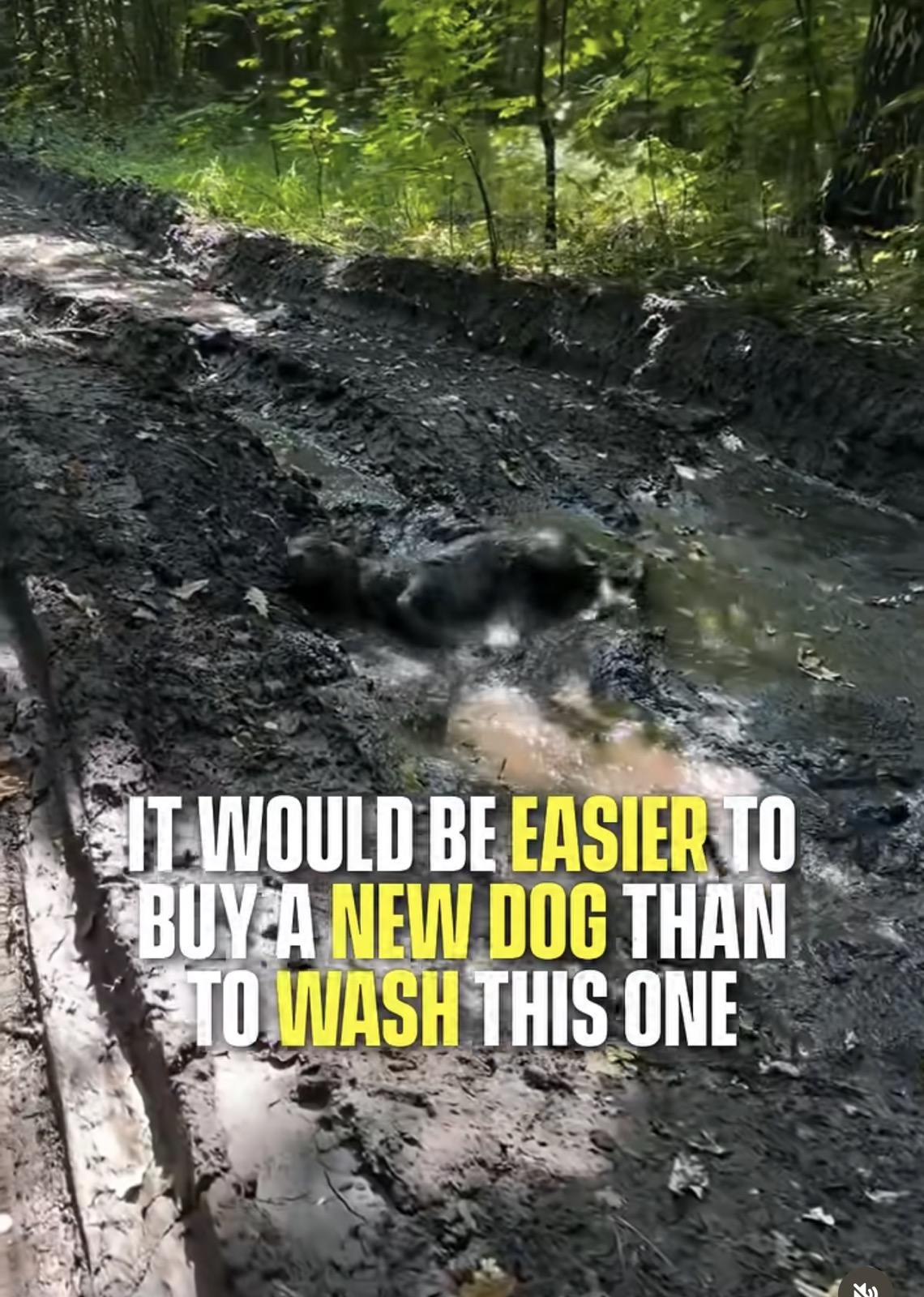
So, if your business is to have dogs, you’re fine. That one’s just a bit unusual-colored. If it’s crucial to your business to have perfectly groomed, fine art dogs, then you probably should go get a new dog. I used to encounter this sort of problem all the time regarding secure programming. My client would say “well, I can patch this bit” and I’d have to explain that the whole dog, and the dog’s attitude and dog design was just going to doom them to years of muddy dog. If you ask Claude for a dog and forget to ask for a good dog, you have a problem.
Closing note: in 1999 I went to Hong Kong to speak at Black Hat, HK and while I was there I went to a Hong Kong tailor to get a resized replica of my dad’s 1940 Hartt Schaeffner and Marx tux. A friend of mine who had been there before warned me carefully this thing: “in Hong Kong you can get the best suit you know how to ask for.”
And, that’s it.
flex@#9: this should be promoted to a guest posting. May I respond in that context, because it’s very thought-provoking in good ways.
Marcus, I suggest you complete this creative process with an AI chef that prepares your meal. It might surprise you with some additional tasty ingredients like belladonna or diesel.
I have actually already done this exercise. Last time, it suggested that I added some squeezed lime to my braised noodles and the result was better than I have had in many restaurants.
Probability of lime: 99.9%
Probability of muriatic acid: .00001%
Marcus, thanks for clarifying.