When Captain America comes to the aid of James Bond…

The day before yesterday (or yonderday as I’d like to call it because why, English, why), British supervillain extraordinaire Piers Morgan, armed with supreme stupidity, verbose bigotry and lots of poop to fling tweeted a pic of Daniel Craig doing one of those normal thing people do like taking the baby for a walk to play Pokémon Go. OK, I made up the Pokémon part, but apparently, an image of a dad doing dad things was really too much for poor Piers.

Oh 007.. (sic) not you as well?!!! #papoose #emasculatedBond

The tweet got picked up by Chris Captain America Evans who rightfully called out Morgan for his attempt to literally shame a man into not caring for his child.

You really have to be so uncertain of your own masculinity to concern yourself with how another man carries his child. Any man who wastes time quantifying masculinity is terrified on the inside.

And for once, go read the replies which are full of dads posting pics of them carrying their kids.

How Hard is Hard Enough?

This is about steel and blades OK? Just to be clear upfront.

In my article Knifesharpenophobia I have mused a bit about how being all anal retentive about the hardness of a blade is not all that necessary. Now I wish to revisit that heme a bit, after my hardening attempt of a blade did not go as well as I would wish to.

If you remember when I was trying to harden the rondel dagger I was also hardening a kitchen knife blade and I was pretty sure that this particular blade is properly hardened. So I took it to work and measured the hardness on the tang (the knife is not finished yet), where it is hardened, but probably not as well as the blade. And the gage showed HRC 54. From technical standpoint, difference between 50 HRC and 54 HRC is not trivial (HRC is not a linear scale) and that knife is thus indeed properly hardened. What was the difference in the work process? For that knife then I have used the gas forge only for heat-soak, the final heating to 1050°C  before quench was made with charcoal, which allows for more even heating. HRC 54 is still not full potential of this steel, but if the tang has it, the blade has probably more.

But this whole thing got me thinking again – is that even relevant? Do I really need to be afraid to give that knife to a fried as a gift because the hardness of the blade is “just” HRC 50? Am I being unnecessarily obsessive about an inconsequential detail (again)?

So I tried to look at what is the actual hardness of historical blades. I did not spend too much time with it, but the article Sword Blade Hardness: A look at the current research is an eye opener and a good read. To be clear, it is about swords, not kitchen knives, but it still clearly shows one thing – the crappiest knife that I have ever made is vastly superior to most knives that were used throughout history before the invention of blast furnace. Not because of my superior skill, but because I have access to superior steel. Furthermore, HRC 50 is not actually bad at all and someone who takes a good care of the knife would probably not even notice any downside when cutting. And it has an upside too – a blade in this hardness range needs to be sharpened more often, but stropping and sharpening should be reasonably easy and quick and the knife will not break easily when you drop it on the floor by accident.

It is not the best that could be, but it is good enough.

Jack’s Walk


The last rose of October, ©voyager, all rights reserved

October roses are always a welcome sight, but this bright pink beauty is the last one left in my garden. There are no new buds left and the plant is getting ready to go to sleep for the winter. Sometimes I think it would be nice if I could sleep through winter. I have enough of a fat pad to survive hibernation for a few months and it might be nice to avoid the days upon days of darkness and cold. On the other hand, I would also miss Jack pouncing like a cat into snowbanks and making happy faces full of frost. Winter is Jack’s favourite season. He loves the cold and would stay outside for hours if only someone stayed with him. He has been known to crawl into the creek when it’s full of floating ice and drift downstream with a look close to ecstasy on his face. Jack’s fur is very seal-like. Only the outside hairs get wet and even when he’s been in the water for an hour the downy hairs below stay dry. He also has a bit of a fat pad and a big buoyant chest and, like all labs, his feet are webbed. The boy is built for swimming in the cold and he loves it.

Ah…that’s better. See what I did there? I just gave myself a reason to look forward to winter. I promise I’ll share pictures so you can have a reason to look forward to winter too.

Making Kitchen Knives – Part 5 – Grinding, Polishing, Buffing

I was expecting this to be the most time-consuming part and so far I was not surprised – it was. You have seen my collection of abrasive belts during my Rondel Dagger series. Because the protective coating has proved itself to be way too persistent, I had to start with the coarsest Zircon belt all over again – that is what I meant when saying that I could have spared myself the trouble I have spent with finer belts before hardening. I wanted to give this blade the best surface finish that I can achieve purely by using machinery, so I went thoroughly through all belts, not switching to a higher one unless all scratches from the previous one were removed. Although towards the end of the line with last two Trizact belts I was not too fussy about this, because those leave so fine scratches that whilst they are barely visible, but they will always be somewhat visible unless I go with hand polishing afterwards – and that I did not want to.

So when finished with the finest Trizact belt I went straight to the finest buffing compound and gave the blade a few passes on the buffing wheel.

An important note – this is a knife without secondary bevel, with so-called “convex grind”. That means that during the polishing process the blade is also sharpened to very nearly final stage. Therefore towards the end it becomes a bit dangerous to handle it, because it can actually become completely sharp in places. I do not know what process other knifemakers use for achieving this grind, I am doing it with the slackbelt/hardbelt setup on my belt grander, that way I can do it in one go during polishing. The knife will need some sharpening when finished, but not too much. I like this grind because in my experience it cuts best and also looks best – but your mileage might vary and there is no accounting for personal taste.

speaking of taste – one of my friends when I have shown him my mother’s knife thought that I have made the tip round either due to laziness or because I botched it and making a round tip is easier. If you have such thoughts, forget them. Making a round tip is not easier than making it pointy-stabby. And the round tip is entirely intentional. This time around I actually consulted with my mother what she prefers for this knife design and I discussed with her the work in progress when it still had a point, and we agreed that to us this knife looks better with a round tip. Further, there is no point in having a point on an all-purpose kitchen knife like this, since needing a sharp point is actually a rare occurrence (the only one that I remember from the top of my head is gutting fish and poultry, and even there an actual point is used only briefly).

©Charly, all rights reserved. Click for full size.

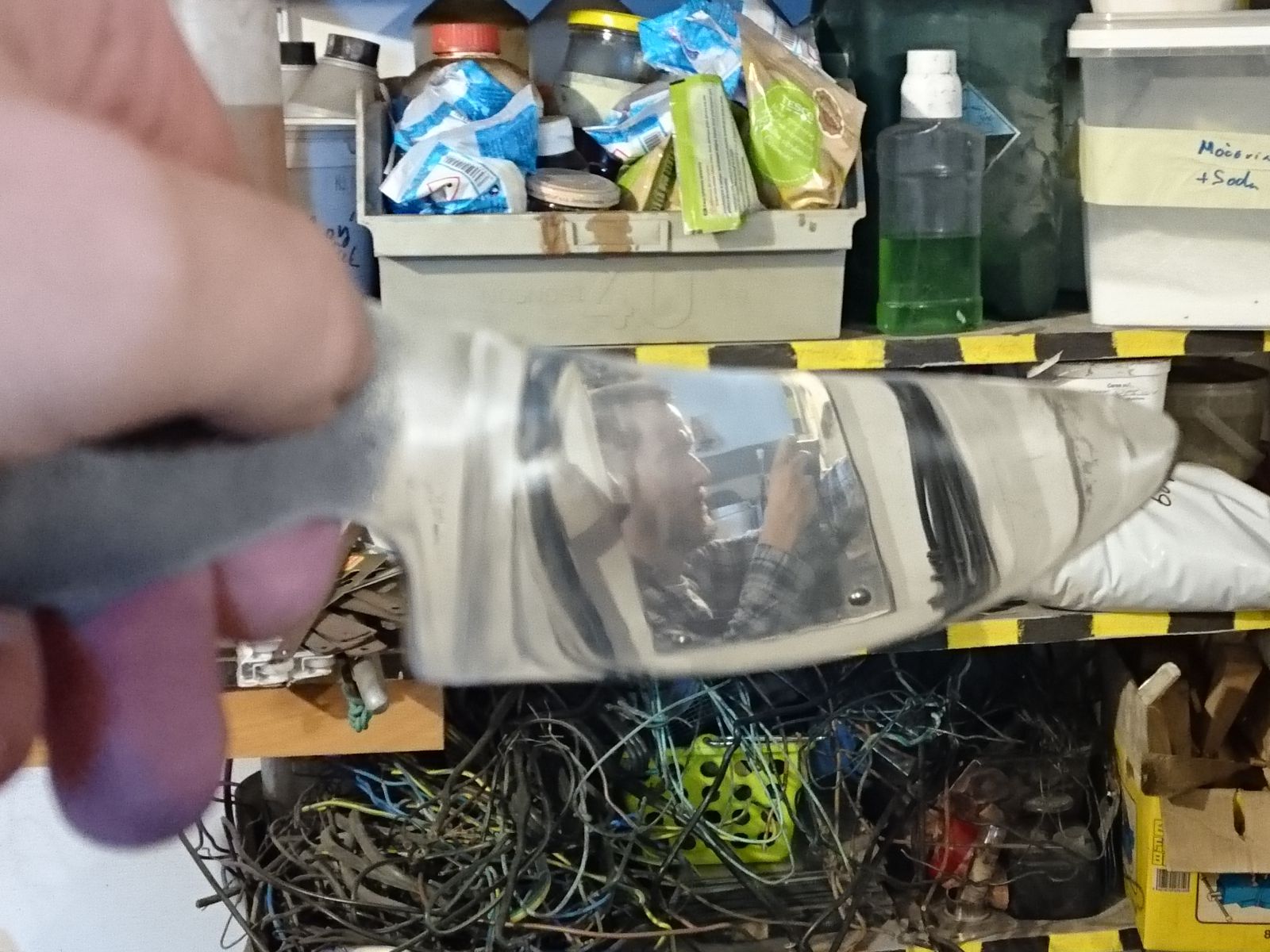
Enough rambling  Here you can see the blade before buffing to get a measure of how well the knife is polished after only Trizact belt grinding – after buffing it reflects a lot more.

That picture shows also that the grind is acceptably flat. The fact that the edges of the mirror on the wall are straight-ish and that my face is still recognizable despite being reflected back through a mirror 1,5 meter away is a good sign that the grind is flat.

However that comes at a non-trivial price. The whole grinding and polishing process took me 4:20 or 260 minutes. Buffing was mere 10 minutes from that. As I become more experienced this time will probably go down significantly, but some of that part of learning curve I have already done, so I do not think it will be too drastic. In order to shave-off a really significant amount of time here, I think I would have to either use completely different process (I have an idea there, but it will need a lot of MacGyvering), or be content with a less-than-mirror finish. So in next step I will experiment with different finishes and decide which is the best compromise between time spent versus looks. The problem with polishing is, that whilst it has zero negative impact on the function, it has 100% positive impact on the looks of the thing and negative on the price. And people are buying with their eyes but deciding with their wallets. Talk about contradictory requirements…

Tree Tuesday

A while back I recall a conversation in comments where rq mentioned that the trees dance when no-one is looking. Well, for this Tree Tuesday Lofty has found a tree that’s dancing when everyone is looking. Lofty says,

Another Eucalypt from my favourite bicycle riding area, it’s “doing the twist”!

That it is, Lofty. What a marvelous tree. Thanks for sharing.

Twistree ©Lofty, all rights reserved

Jack’s Walk

It’s damp and drizzly again and while I might not like the weather there are certainly things that thrive when it’s moist outside. Fungus for example. Jack and I haven’t been to the forest in a few days and I was surprised to see this big bright piece of flaming fungus grown so large in 3 days. I swear it wasn’t there on Friday. It fits right in with the October colours all around it, but I didn’t expect to see fungus in a frilly orange party dress.

Flaming Fungus, ©voyager, all rights reserved

Pretty orange frills, ©voyager, all rights reserved

Making Kitchen Knives – Part 4 – Heat Treatment

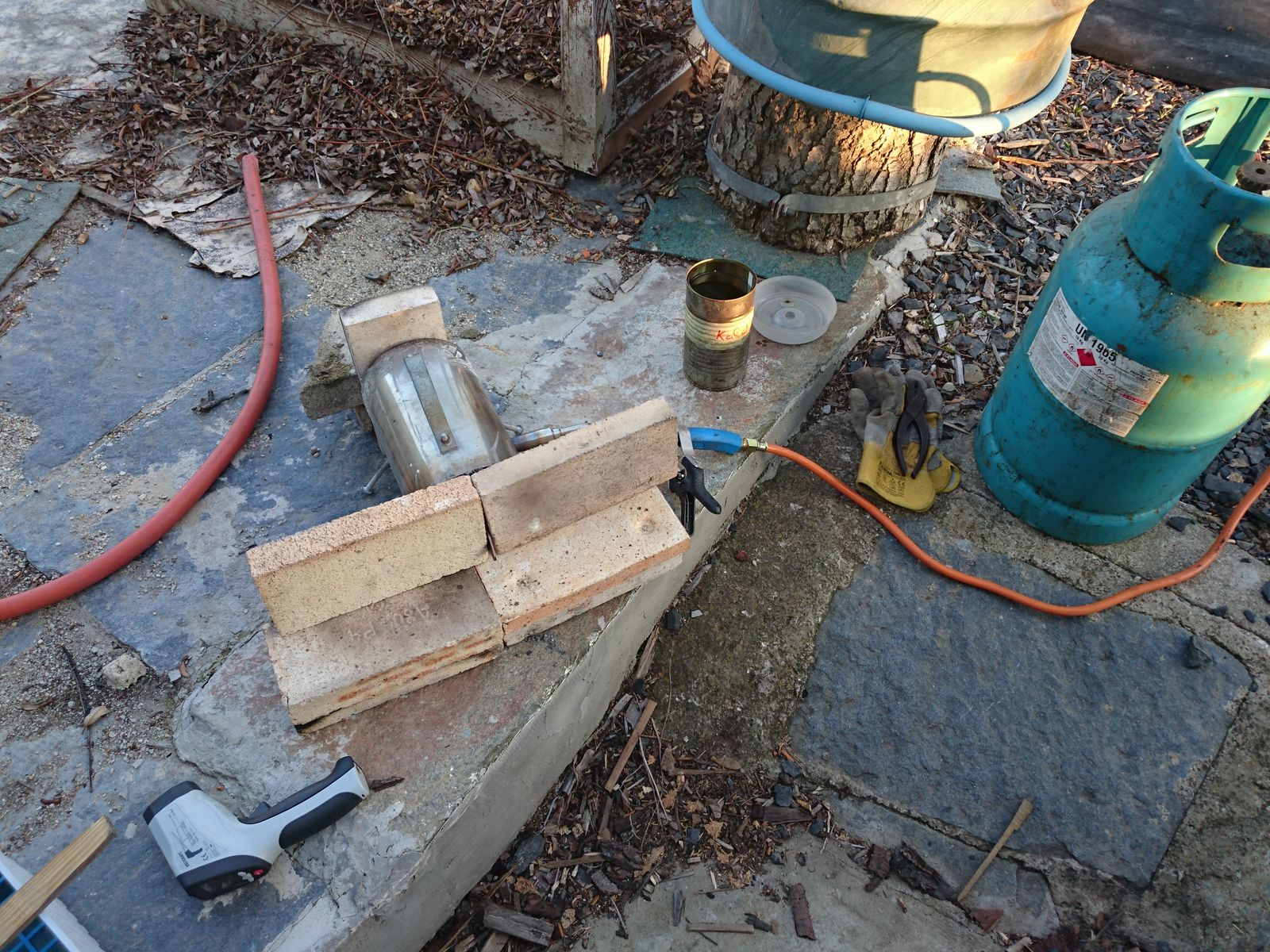
This is when things did go a bit pear-shaped, although I learned that only today. You have seen my “equipment” before, but not in detail. Now you can see it in detail. An IR thermometer on the left, small insulated chamber with gas burner in the middle, a can of sunflower oil, and of course gloves and pliers.

©Charly, all rights reserved. Click for full size.

With a blade this thin I have to somehow prevent carbon loss, because I cannot simply ground away a few tenths of a mm afterwards. There would be barely any blade left if I did that. So, as you can see on the last picture in previous post in the series, I tried to coat it with an experimental solution to prevent said carbon loss as an alternative to the rather expensive stainless steel foil. It worked and did not work at the same time and the knife is now in a stage when it will be crap no matter what I do. I am going to finish it anyway, just to get the measure of time, but this step was a definitive flop. Which I did not expect, because I heat-treated two knives from this steel without problems.


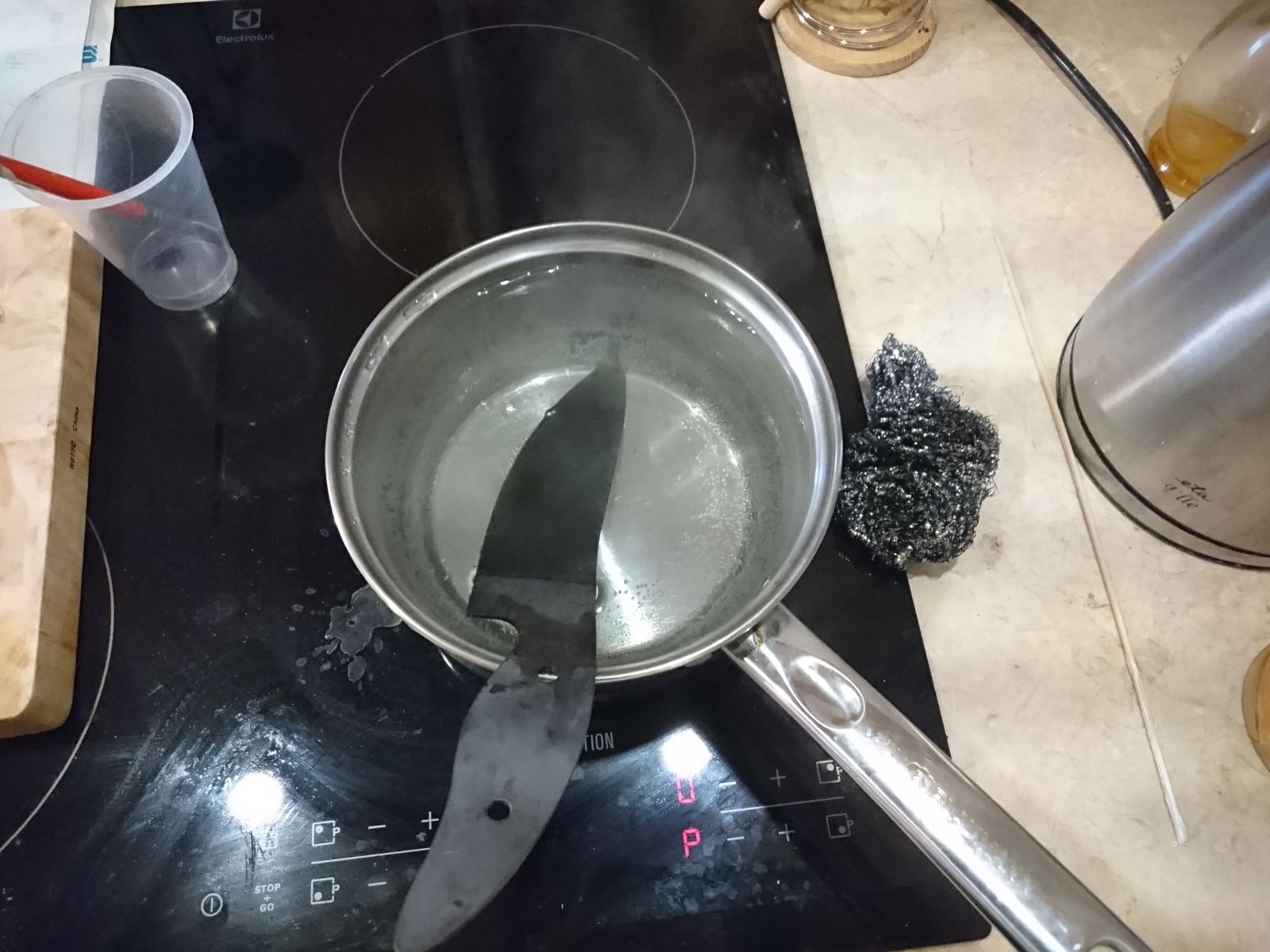
Firstly the gas burner has trouble reaching the necessary temperature of 1.050°C that this steel requires. It can reach them with success (the blade that I have given to my mother was hardened this way), but it takes a long time and it is difficult to heat up the blade evenly. I thought that I have reached the right temperature and quenched the blade OK, which was confirmed by subsequent scratch test with my impromptu gauges. However, as it turned out, the scratch test only passed because the protective coating has made a thin but hard layer on the surface that was bugger all to remove.

©Charly, all rights reserved. Click for full size.

I hoped it would dissolve in hot water – that was the intention – but it did not. It was extremely difficult to clean off in the following step and after I measured the hardness on polished blade (properly – I found out we have HRC measurement at work), it had only about 50-51 HRC. That is weaksauce for a kitchen knife, although it would be OK for a machete. The blade is hardened, just not to its fullest potential. It will cut fine, but it will require more maintenance, so I will probably keep this knife for myself and not give it to anyone. Bugger.

In addition to above mentioned quality problems, this whole step took me more than 1 hour, and I am not counting the 1 hour in baking oven at 150°C, because that does not require my personal presence and thus does not de-facto cut into manufacturing time (and I can load the baking oven with 10 knives at once should the need arise).

At this moment, I do not see any way how to reduce that time. Making more knives at once might help a bit, but for that I would need to set-up heating with charcoal. If I do that, I  estimate that I could harden about 5-6 knives in one go, but that one go would take probably about 3-4 hours of constant work. So a saving of 15 minutes, or 25% time per blade could perhaps be reached on this step, but it is questionable.

A heat treating oven would of course completely change this whole equation, but that would be a big investment – they start at 3.000,-€. Should I ever have to produce knives for sale, a heat treating oven would be a definitive must, or I would have to simply send knives for heat-treatment. Right now I will try to do the heat treatment again by myself, and the next batch of knives will be split 50/50. One half hardened with the use of stainless steel foil, one half with modified coating, and I will either set-up a bigger gas burner, or use charcoal.

This step is put in the “high hanging fruit” basket. There is potential for significant time-saving here, but it is very difficult to reach with my current equipment.

Monday Mercurial

Oversized kittens

White tiger cub about to jump

Ready?
©Giliell, all rights reserved
cub climbing

Look, look, I’m climbing a tree!
©Giliell, all rights reserved

cub in tree

Fuck, I actually climbed a tree.
©Giliell, all rights reserved

cub jumping

Thank goodness. Mum said if they have to call the firefighters again I’m grounded. Literally.
©Giliell, all rights reserved

 

A Stunning Little Dragon

These incredible photos were sent to us by Avalus. The first time I saw them I just sat there scrolling back and forth taking in more and more detail.  The first shot is all about camouflage, but after that it’s all about standing out. It’s a wonder filled study of a beautiful creature. Avalus says,

this encounter I found the most impressing. It was a really large dragonfly, just sitting on a mossy patch of sidewalk in the botanical garden of my University. She did not mind me in the slightest and I could take pictures from a few centimetres away. 

She did stick her abdomen in the moss repeatedly, so maybe she layed eggs? There was a pond-flowerbed maybe 20 cm away.

The finger is for size, I did not touch her.

As you can see in picture 11, it is a beauty and a beast (if you happen the be a insect)!

Avalus, thank you so much for sharing.


libelle 1, ©Avalus, all rights reserved

[Read more…]