
So, the end of the growing season is nigh. I have started digging out the potatoes, although I have stopped for now, since most of them still have not died back. But I am continuing to expand the usable area of my garden. And to do that, I have to use the double-dig method for tilling soil.
© Charly, all rights reserved. Click for full size.
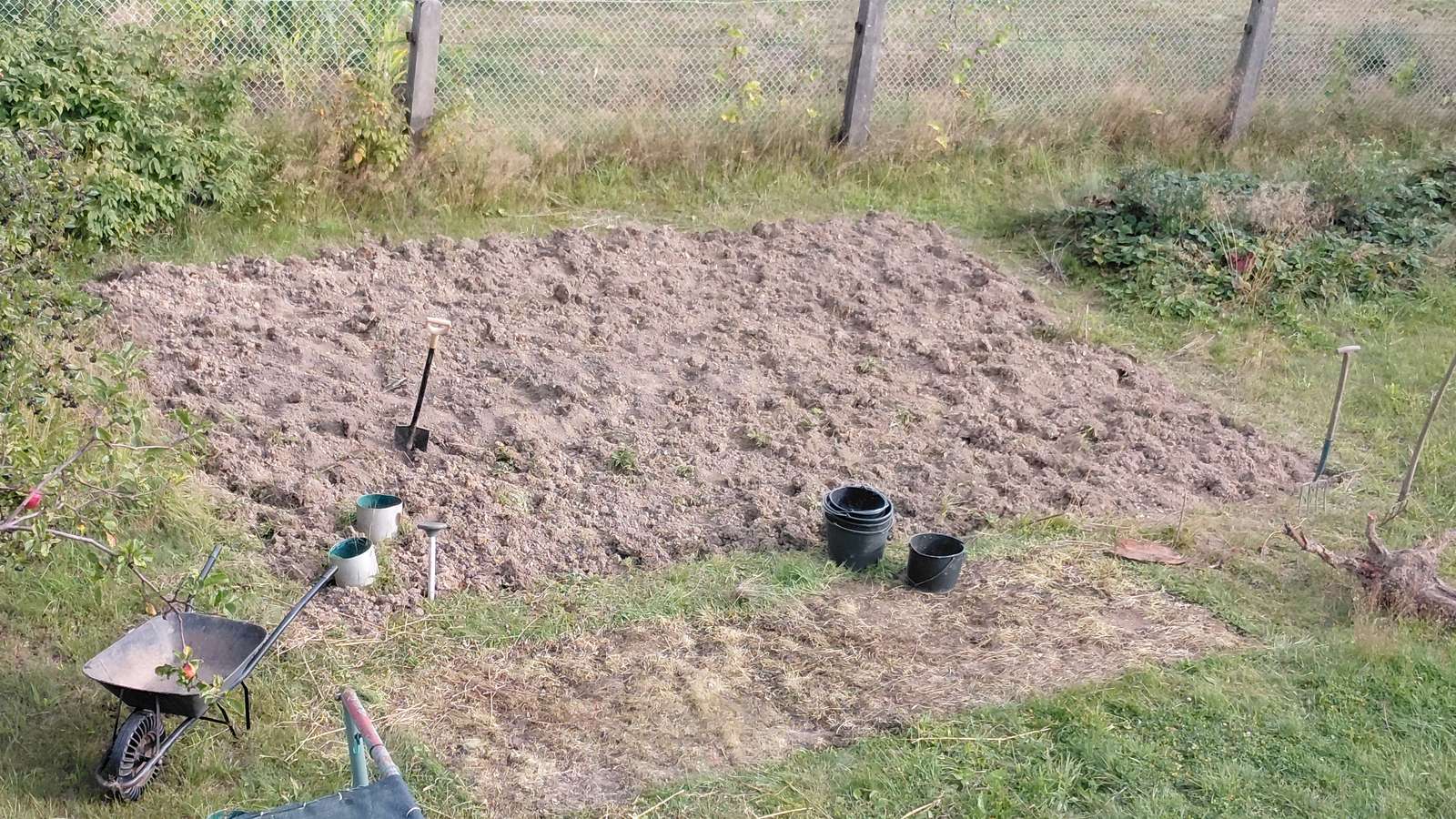
For example, I tilled the patch on which I grew oats, and as I expanded it, I also removed the dead stump of my late apple tree. But doubling the size of the patch is not what double-dig means.
I took the garden fork to the whole area, and with the first shove I removed and turned the turf. And after I moved a whole row of turf aside, I took the fork again to the same spot, dug it as deep as it would go, and turned the underlying clay too. That way I aerate the soil up to 30 cm deep and I also had the opportunity to remove a lot of stones.

© Charly, all rights reserved. Click for full size.
I removed 5 small buckets (about 25 l overall) of stones from that patch, including one half-brick and one ceramic tile. Next year, I will probably only grow peas on this piece – first green peas for food, then yellow peas as green fertilizer. That plan might change depending on the weather forecast in the spring.

© Charly, all rights reserved. Click for full size.
I ploughed the alfalfa field, and it was difficult. Not because of the alfalfa, though. One difficulty was ryegrass, which creates underground runners that are tough like ropes. The second difficulty was the weather – it did not rain quite enough to soften the clay. I am not done with this piece yet; I will have to run it with the plough across this run later on. But I have to get a bit of rain before that; otherwise, it will be like trying to plough concrete.
In the top left of this picture, you can see that I am currently tilling this year’s potato patch, where the Ruth Stout method successfully killed the grass again. I am using the double-dig method too, and it is exceptionally difficult. Not only is the topsoil layer even thinner than in other places in my garden – only about 10 – 15 cm- but the underlying clay layer is very stony and, above all, compacted. I am now taking a break from all manual labor, because I am totally exhausted.
And here is one of the possible reasons why some parts of my garden are so difficult:

© Charly, all rights reserved. Click for full size.
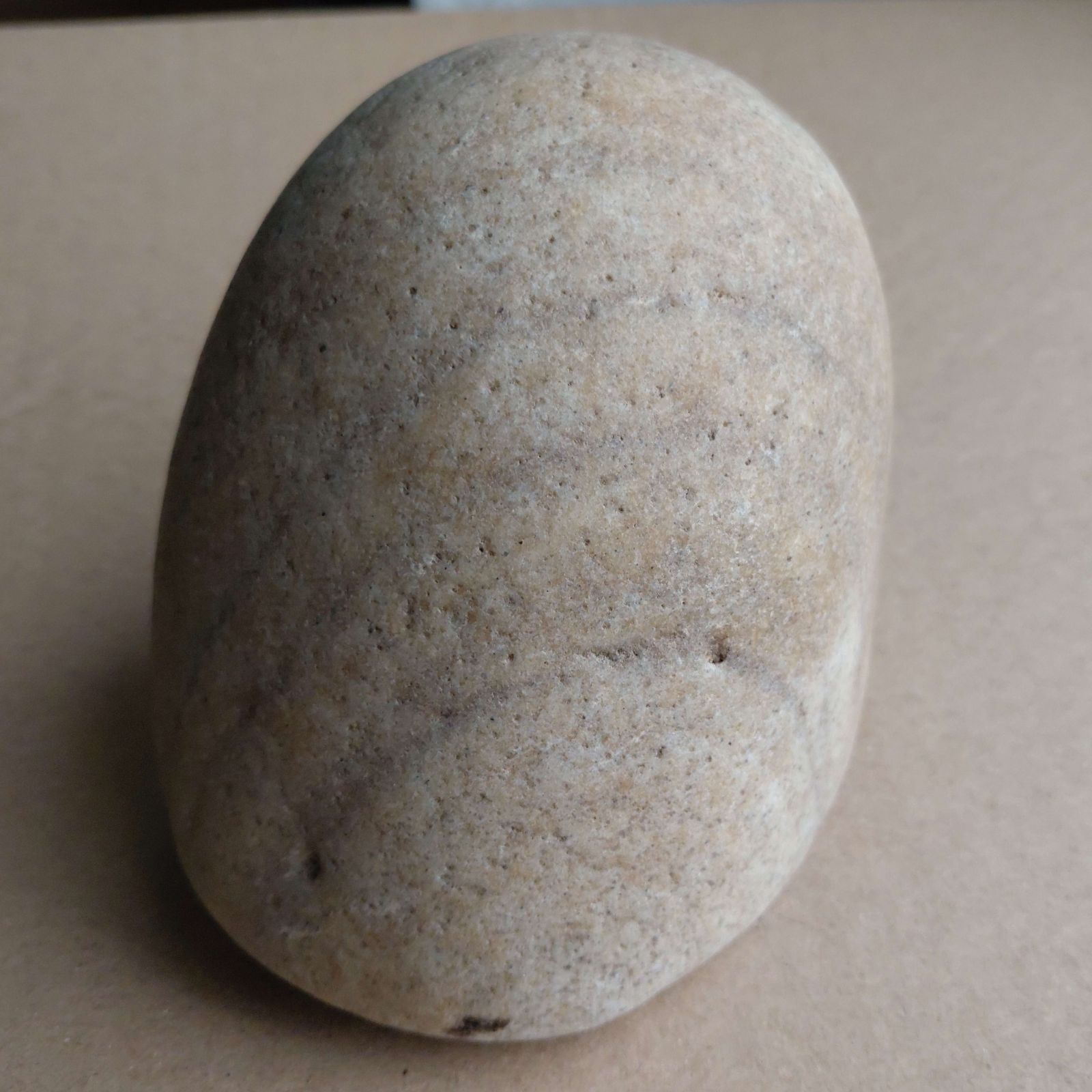
I dug this out yesterday evening in the potato patch. It is a quartz cobble, and it looks a bit like a potato in this picture. In fact, I did mistake it for a potato for about half a second. But the most interesting things about its history were revealed when I washed it.
© Charly, all rights reserved. Click for full size.

© Charly, all rights reserved. Click for full size.
Looks quite nice, doesn’t it? And it is the perfect size for a paperweight or a decoration, which is why I took it home and washed it. But why do I keep writing about a stone? Let’s look at another two quartz stones of similar size from my garden.

© Charly, all rights reserved. Click for full size.
Even a layperson sees that these all look quite dissimilar to one another. To my knowledge, they have very different geological histories, albeit with some similarities – they all started as sedimentary rocks. (Any actual geologists are welcome to point out any errors that I might make).
The cobble started as sedimentary sandstone that was subjected to immense pressure over millions of years until it mostly fused. But the layers and pores of the original sandstone are still very much visible. Then the massif was broken up by some geological process, and the resulting gravel was churned by running water long enough to make the stones essentially ovoid. This particular stone was then broken again and churned some more until the sharp edges were slightly rounded. And that way the stone arrived at its current shape – round top, flat-ish bottom.
The other two stones look dissimilar to each other, but they both share the same original story. They started as shale, but instead of just pressure and time, it was subjected to prolonged, intense heat from an underground magma flow. As the magma cooled into granite, the shale underwent partial melting and metamorphosed – some parts of it retained the layered structure of the shale, but with changed mineral compositions. This new rock is called phyllite, and it is the blue-greyish parts of the right stone. But some of the shale underwent so much heat that quartz completely separated into nearly pure chemical, albeit not as a pure crystal. And that is the stone on the left and the white parts of the stone on the right. These stones were never subjected to river flow; they were slowly broken off the bedrock by erosion via temperature changes and plant roots. The phyllite was thus slowly transformed into clay again, with large chunks of hard quartz in it. That is why these stones do not have the sharp edges of a rock shattered through impact, but neither do they have the rounded shape of a cobble.
It is evident that these two types of stone cannot originate in the same area naturally – and it is the first one that does not belong here. I am nowhere near a river, in fact, I am near the crest of a hill. It is the phyllite that is the bedrock here. And the cobble is evidence that this particular piece of land is not fully natural topsoil. It is possible that there was a building, a walkway, or a road there where imported cobblestones were used as filler. Or there was a heap of unsieved river sand used when building the houses.
There is no way to know exactly, but this entirely natural stone is just as much evidence of unnatural topsoil as the half brick and ceramic tile are.
Leave a Reply
You must be logged in to post a comment.