Raturday.

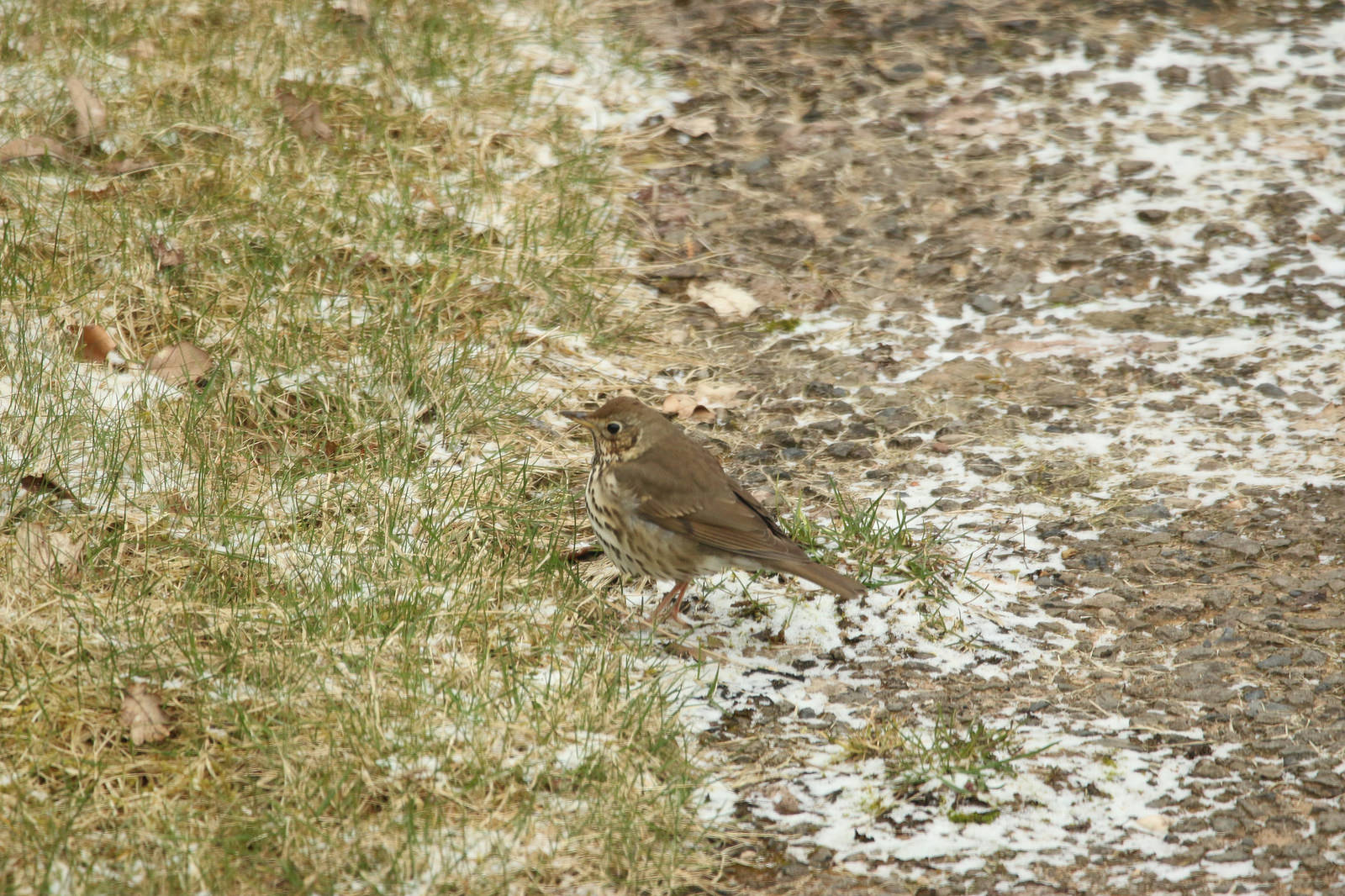
Revisiting the original crew, they were 16 days old in these photos. I’ll try to name as best I can. And today’s music is something of a tie-in. :D

The front, l-r, Gytha, Oliver, Chester, Beatrice. At the very back, Giles, Agnes, Amelia, and Vasco, who are sitting on top of Neville. I think.

Basil. I think.

l-r, Giles, Agnes, Vasco, and the last two could be Oliver, Chester, Theo, Neville, or Dexter.

l-r, Amelia and Beatrice. Amelia was cute overload from the start.

Chester and Amelia.

© C. Ford, all rights reserved.

The Beautiful Town Idstein – Part 1 – Town Square.

I avoid business travel like the plague, but it is unavoidable sometimes. This week thursday I have spent in the beautiful town Idstein. Most of the day was of course spent with traveling to the location and then spending a few hours with the actual business, but we managed to finish at about 4 p.m. so we had still plenty of time to have a look around the town.

I knew I have to expect some splendid medieval architecture, but I did not take my camera with me because… reasons. So I had to do with my phone which luckily is up to the task of making passable pictures in good light. And the light was splendid. The spring did not come this year, winter morphed directly into summer. Only shadows were a little long because of the time of day, but I think you will all enjoy the architecture nevertheless.

For starters here is the town square near the hotel at which we resided.

Idstein Town Square

©Charly, all rights reserved. Click for full size.
Z Is For Zuge.

Zuge.

Zuge is Helsinki slang for a train. In standard Finnish train is juna and in standard Swedish tåg. The z is pronounced ts in Finnish, like in German, but a bit more lazily.

Helsinki slang takes its vocabulary from many sources. Some words come from Swedish, English or Russian. Zuge comes probably from the German word for train, Zug. Old Helsinki slang was to a great extent a mixture of Finnish and Swedish, which was understood by both Finnish and Swedish speaking working-class youth. Now the slang is much more influenced by English.

I’m not really in the slang speaking demographic, being a bit too old and not born and raised in Helsinki.

All the train pictures here are electric multiple unit trains, with no locomotive. Except for the Pendolino high-speed train leaving Helsinki Central Railway station in a cloud of snow, all are regional trains operating in the Capital Region and its surroundings. The Pendolino is a long-distance train with a somewhat troubled history. The Italian technology has had a lot of problems with snow and frost.

The red train is an old Sm2 regional train made by Valmet Lentokonetehdas (Valmet Airplane Factory). The other train photographed from the same place on the Linnunlaulu bridge is a Sm4 regional train used for longer regional lines. In the summer picture from Vantaankoski station in Vantaa, the train is a Sm5, which is used for the shorter lines in the Capital Region.

Click for full size!

© Ice Swimmer, all rights reserved.

Making a Rondel Dagger – Part 3

All of my garden has woken up, but none of the figs or pomegranates have shown even a budding leaf. I got so disheartened at this that I had to go and do something fun. So I went to work on the dagger to lift my spirits at least slightly.

I have decided to grind the bevel higher up to the spine, but not the same way along the whole blade – I ground less towards the tip so it remains strong. This has meant that the blade has a bit complex geometry which meant I could use hard belt most of the way, but I had to switch to slack belt for the tip. Luckily I have kept the option of half hard/half slack belt setup on my improved grinder.

I also ground the spine at approximately 45° angle to take off some weight. But again not all the way to the tip, so the tip is reinforced.

After I ground this basic shape It took me about an hour to get through four ceramics belts (60, 80, 100, 120) and the final was a zircon 120 grit where I stopped. This is actually a fairly difficult and delicate process and it is still possible (nay – easy) to mess up the lines and irreparably ruin the blade geometry, so easy does it. Because I am not too experienced with the belt grinder yet I had a few heart-stopping moments, but I managed to correct all the blunders in the end. From my previous works I know I have to be extremely careful up to approx 600 grit. After that messing up the lines in hand is not possible. But on my previous dagger I found out that on belt grinder that level moves up to 1000 grit, possibly 1200.

A lot of eyeballing was involved. After certain point I could no longer use the masking blue color and scribing tool, so to check whether my grind is symmetrical I used a folded piece of paper that I cut with shears to two aligning points. When I folded it around the blade  I could see whether the lines are in the same position by putting the point on one side of the blade  on the line and checking the point at the other side. After the final grind I scrubbed the blade lengthwise a bit with coarse abrasive pad to remove the quickly building rust and to scratch through the grind marks.

Ground blade shape.

©Charly, all rights reserved.

The future cutting edge is now approx 1 mm thick. Next step will be hardening the steel. For this I had to check whether this file was carbon steel throughout or case hardened. That I have done before polishing the whole shape by dabbing the spine and one side of the blade approx 5 cm from the tip with  ferric chloride because in this area is preserved steel that was near the surface of the original  file as well as steel that was deep inside. If the file was case hardened, the steel that was originally near surface should turn grey, while the steel that was deeper should be shinier. If the file is carbon steel throughout, it should all turn grey.

It has all turned monotone grey, so it is carbon steel throughout. That is good since it makes the hardening process easier. It is possible to make a cutting blade from case hardened file, but it requires to perform again case hardening, which takes more time and resources.

The Sleep Paralysis Of Nicolas Bruno.

© Nicolas Bruno, all rights reserved.

© Nicolas Bruno, all rights reserved.

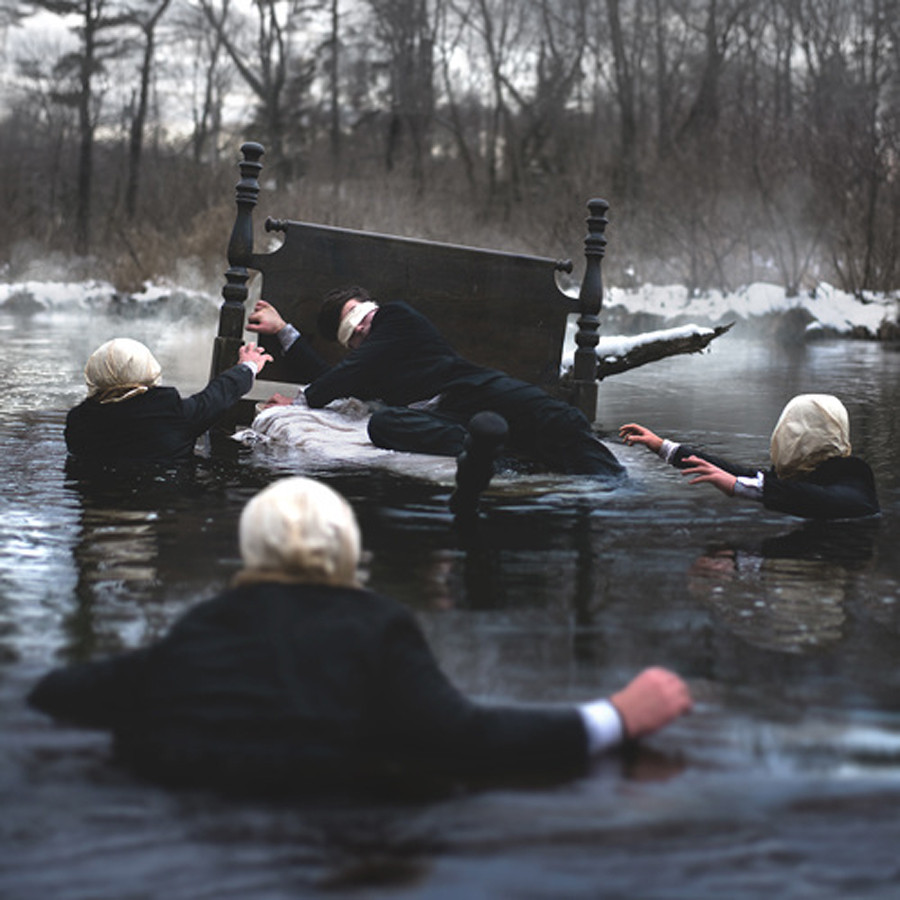
The matters of our psyche and our dreams, in particular, permeate the work of Nicolas Bruno not only as a phenomenon but moreover as the articulation of personal experience. The allusive, surreal and haunting works he creates are embodiments of the state in between waking and sleeping. They are an effect of the artist’s torment; the situation in which he is constrained to embrace the subconscious and its perils while being paralyzed in bed. Although the works of Nicolas Bruno are quite personal and might seem hush, bizarre and even violent, they are explicitly suggestive and are calling the observer to participate in the sense of enrolling their own associations or perhaps dealing with their own anxieties and fears.


© Nicolas Bruno, all rights reserved.

© Nicolas Bruno, all rights reserved.

Photography As Therapy.

Nicolas Bruno was born in 1993 in Northport, New York, a small harbor community located on Long Island. He studied at Purchase College and received his BFA in Photography in 2015. His studio is located in Northport, so practically all of the preparations for the shoots are taking place there, as well as postproduction. Since all of his practice is very much devoted to the symbolic of dreams, the artist keeps the dream journal and starts each new series by analyzing previous experiences. As a matter of fact, his creative process begins with in-depth planning, but the very shoot is far more spontaneous and open to experimentation.


© Nicolas Bruno, all rights reserved.

© Nicolas Bruno, all rights reserved.

The Sleep Paralysis of Nicolas Bruno.

The foundation of his photographic experimentation lays in Bruno’s struggle with the sleep paralysis, from which he has been suffering for almost ten years. It is a common phenomenon occurring in between wakefulness and sleep, in which the body becomes immobile and it often causes severe hallucinations. This state of inescapability forced Nicolas Bruno of finding some sort of solution and with the advice of a therapist he found it through creative expression. Therefore, he started working on surreal self-portraiture as a therapeutic translation of night tremors in order to cope with these fears and simultaneously share these familiar emotions of anxiety, suspense, uncertainty, and danger.

© Nicolas Bruno, all rights reserved.

© Nicolas Bruno, all rights reserved.

Nicolas Bruno’s works are haunting, evocative, and terribly poignant. They not only express the explicit fears brought to Mr. Bruno in his paralyzing sleep, they also express implicit fears and anxiety of people in general. Each photograph is a masterpiece of unspoken fear, and when viewing, you simply cannot help but to feel, in a very small way, what the night and sleep is like for Mr. Bruno. Sleep Paralysis is not common, and unfortunately, not well understood either. Many people do have an isolated incident of sleep paralysis. I had a period in my teens into my early twenties of sleep paralysis, and it’s terrifying, to say the very least. Nicolas Bruno has come up with a unique way of dealing with it, and I think he deserves a much wider audience for this amazing work.

You can read and see more of Mr. Bruno’s bio here, and his portfolio here. There’s also this all too brief video:

Feathering Nests

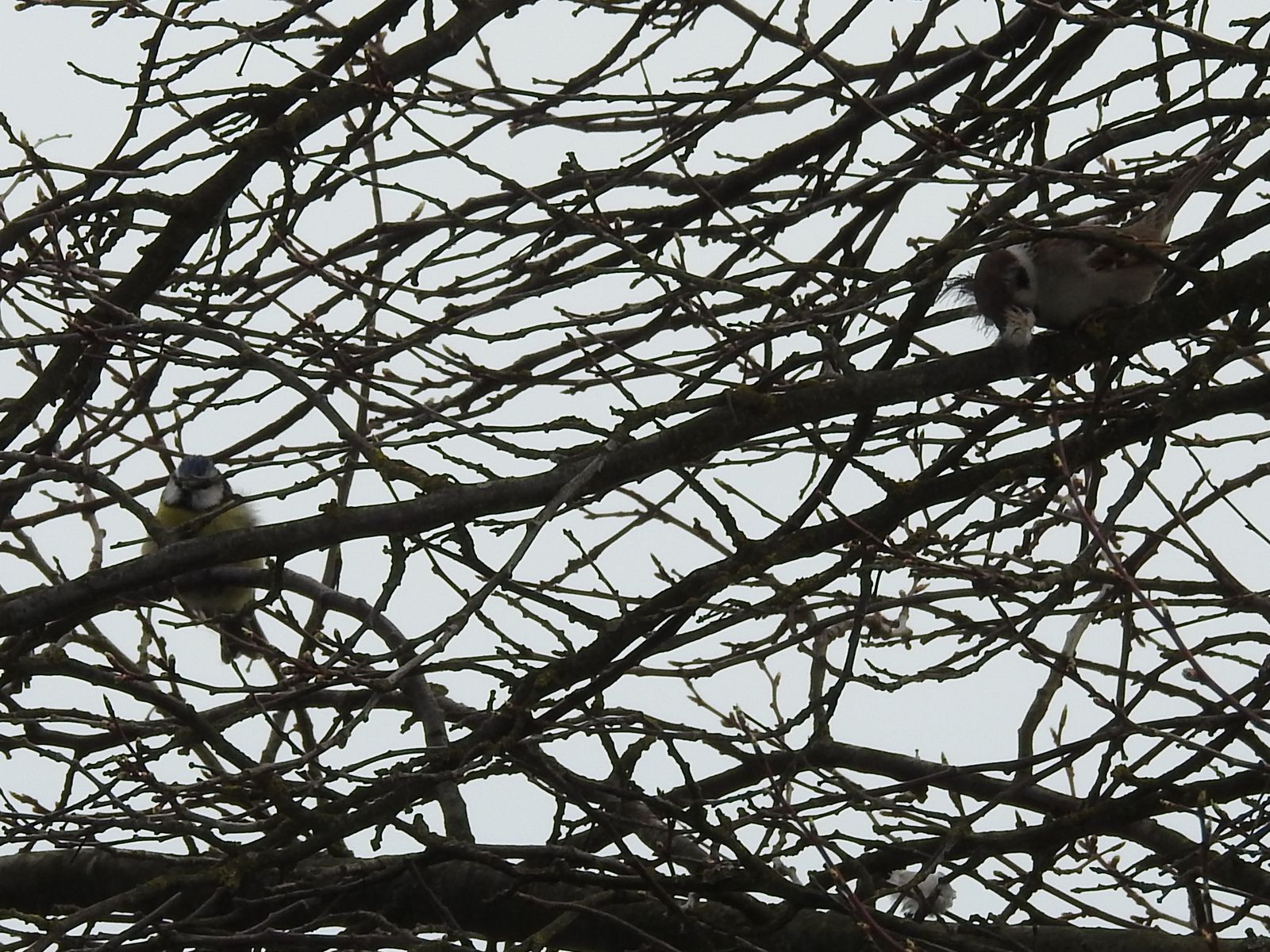
The blue tits seem not to mind that I fell the cherry tree and hung the nesting box on the plum. I see them daily there and they sing in the tree, so I think they are nesting there even though I have not seen them entering the box. What was my surprise then when I looked at this picture and I saw one blue tit and one field sparrow with a bunch of feathers in his beak. A few moments later I heard some squabbling and the fluff floated down from the tree. Maybe the sparrow was stealing bedding from the tits?  These tiny birds are pretty mean to each other so that would not be surprising.

Birds on a tree

©Charly, all rights reserved. Click for full size.

And a first daisies came out.

Daisy

©Charly, all rights reserved. Click for full size.

Y Is For Yachting.

Yachting.

This sailing boat was on the sea in May 2016. I took he photo on an evening sightseeing cruise to the Helsinki Archipelago.

The bonus picture is about the long off-season for yachting. These boats must have been sitting in the dry from late autumn. The sea ice could have broken them so they had to be lifted from the sea. The photo was taken in late March 2018.

Click for full size!

© Ice Swimmer, all rights reserved.