What May Be Worst Anti-LGBT Bill Yet

Rev. Chris Donald calls for the Senate to defeat HB 1523 on March 23.

Rev. Chris Donald calls for the Senate to defeat HB 1523 on March 23.

Mississippi is one vote and one signature away from enacting what may be the strictest anti-LGBT law yet.

The state Senate passed House Bill 1523, the so-called Protecting Freedom of Conscience from Government Discrimination Act, Wednesday by a vote of 32-17, The Clarion-Ledger of Jackson reports. Thursday morning the Senate took a second vote, sending the bill on to the House for concurrence, as the version passed by the Senate differs slightly from the one adopted by the House in February, reports BuzzFeed. If the House votes to concur, which is expected next week, the bill will go to Gov. Phil Bryant for his signature.

The act states that the government cannot penalize an individual, organization, or business for acting according to the following “sincerely held religious beliefs or moral convictions”: that “marriage is or should be recognized as the union of one man and one woman”; that “sexual relations are properly reserved to such a marriage”; and that “male (man) or female (woman) refer to an individual’s immutable biological sex as objectively determined by anatomy and genetics at time of birth.”

The bill would therefore allow businesses to turn away customers or prospective employees by citing such beliefs, without repercussions. It would allow employees of county circuit clerks’ offices, which issue marriage licenses in the state, to refuse service to same-sex couples if they object to the marriage on religious grounds, also without repercussions. It could be used to discriminate against single parents and even conceivably allow employers to fire female workers for wearing pants, as it protects employers’ and schools’ right to maintain “sex-specific standards or policies concerning employee or student dress or grooming.”

Sen. Jenifer Branning, a supporter of the bill, argued to her colleagues Wednesday that the measure was designed to protect providers of wedding goods and services who oppose same-sex marriage, and denied that it had broader implications.

There’s more on this monstrosity of a legislation at Buzzfeed.

TDOV

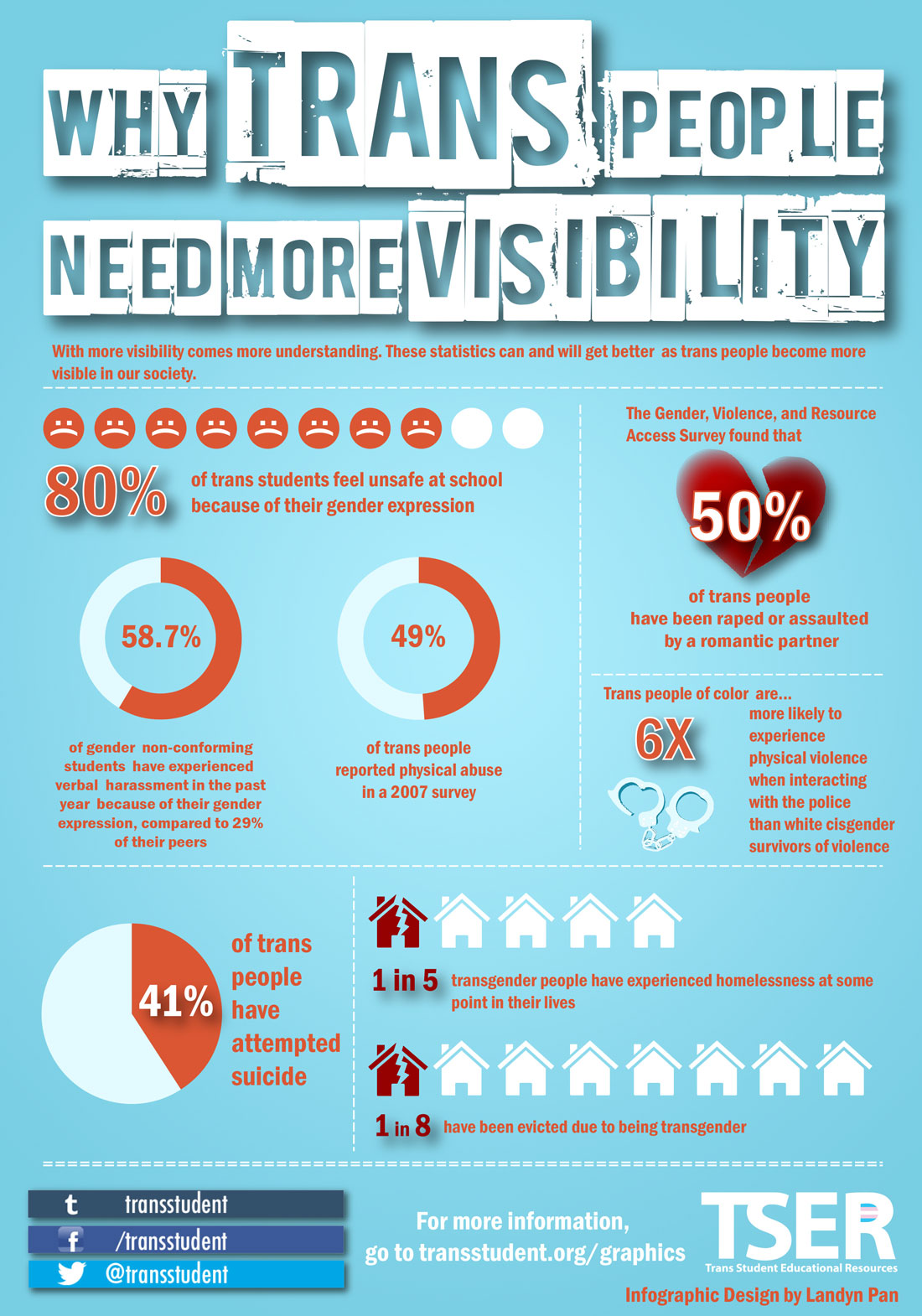
Today is the Transgender Day of Visibility.

tdov2016

What is the Transgender Day of Visibility?
TDOV is a day to show your support for the trans community. It aims to bring attention to the accomplishments of trans people around the globe while fighting cissexism and transphobia by spreading knowledge of the trans community. Unlike Transgender Day of Remembrance, this is not a day for mourning: this is a day of empowerment and getting the recognition we deserve!

When is TDOV?
TDoV is on March 31st every year!

Where is TDOV?
Everywhere! We encourage you to create panels, talk to friends, and spread knowledge about the trans community no matter where you are! You can also join our Facebook event and use hashtag #tdov on social media. We also have a list of events on our website.

What is this year’s theme?
More Than Visibility (#MoreThanVisibility). This recognizes that while visibility is important, we must take direct action against transphobia around the world. Visibility is not enough alone to bring transgender liberation. Some people experience violence due to their visibility and some others don’t want to be visible. However, we can use visibility as a vital tool for transgender justice.

transvis

‘Trans Pose’ exhibition a study of transgender women and their journeys

“Transgender women are often the subject of prejudice and violence, and (can) lead shorter lives due to suicide and their struggle with employment, housing and acceptance from their families,” said Sarah Chaffee of McGowan Fine Art in her blog atmcgowanfineart.com.

“‘Trans Pose’ is portraits of transgender women exploring their unique experiences.”

“Trans Pose,” an exhibition running through April 22 at McGowan Fine Art, 10 Hills Ave., Concord. Gallery hours are Tuesdays to Fridays from 10 a.m. to 6 p.m., Saturdays from 10 a.m. to 2 p.m. and by appointment. For more information go to mcgowanfineart.com.

Two Bangladeshi Artists Are Giving Transgender Issues a Global Spotlight

In March 2015, on the streets of the Bangladeshi capital, Dhaka, a blogger was murdered. It was but one killing in a spate of bloody attacks in the country by Islamist radicals on writers who mocked and criticized extremist elements of the religion. Predictably, the combination of brutality and religion attracted the fickle attention of the West. But the story was remarkable for another reason that has been less examined in the media: Two of the three assailants were caught thanks to the actions of Labannya Hijra, a transgender woman who witnessed the killing and retrieved the shirts of the blogger’s fleeing murderers.

In Bangladesh, members of the transgender community—some of whom go by “hijra,” the South Asian word for those born male but who identify as female—are thought to number somewhere between 10,000 and 500,000. They are roundly marginalized, facing poverty and legal and societal discrimination, though they recently won the right to officially identify as a third gender. But, notes British-Bangladeshi writer Tahmima Anam in her sobering op-ed in the New York Times, “it would be premature, to say the least, to pronounce the troubles of the hijras over.”

d7hftxdivxxvm.cloudfront.net

Mahbubur Rahman, Transformation (ongoing performance 2004-2014), 2004. Photo by Tayeba Begum Lipi. Courtesy of the artist.