
Only 3% of transgender adults regret transitioning.
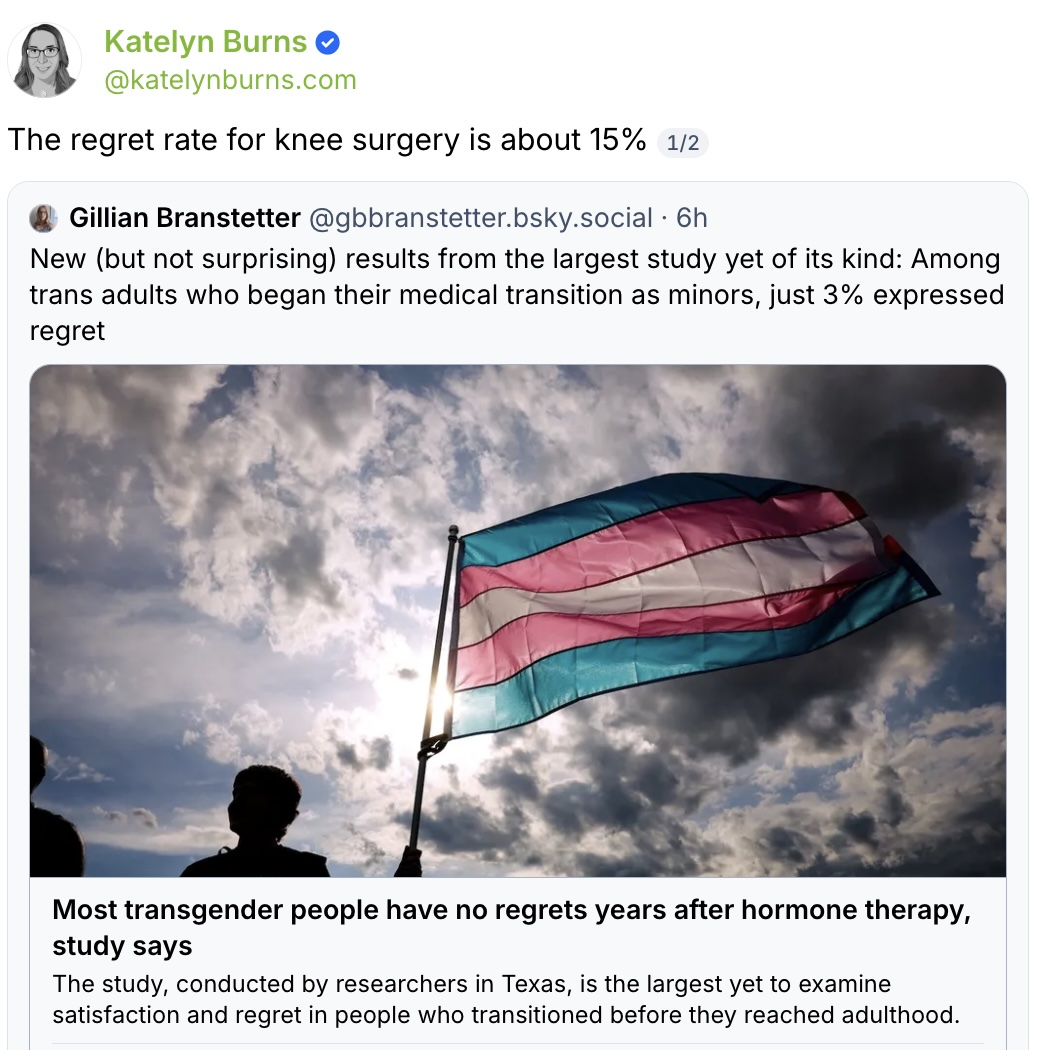
I don’t have any personal experience with that. The part I relate to is all the people who regret knee surgery — I had knee surgery, I don’t think I was harmed by it, but it didn’t help at all. I could have spared myself weeks of time in bed and all that therapy if I’d just stayed home.
With those odds, though, I’d transition, if only I weren’t mostly satisfied with the body I’ve got.

this science will convince no one. simply put, if 3 in a hundred people regret something that was irreversible! irreversible! then it still shouldn’t be allowed, because what ifffffff? what if it was yooou? i don’t know the best way to navigate that conversation so i usually stay out of it. children’s rights are a huge part of it, and we’re even farther from achieving those than trans rights. vanishingly few parents trust their children to have any autonomy whatsoever.
I note that 3% story never gives some of the reasons WHY they ‘regret’. For some, it is the ostracism, public abuse, lack of legal recognition, and loss of relationships including family, rather than actually deciding they should have stayed what they were because they feel were that all along.
and i note, if they make transition surgery illegal because someone might regret it…well, how many women can’t get hysterectomies when they want them (especially women whose reproductive systems cause severe pain, or have decided they absolutely will remain ‘child free’) because the doctors all push back repeatedly that someday they may meet someone and change their mind about having a kid.
A future man who may not ever exist would exert control over a woman’s decisions in the present. Banning trans surgery over potential ‘regret’ would open this dreadful practice up to becoming law.
Yeah. Weak as anything.
Good tack, but.
(https://mccrindle.com.au/article/tattoos-in-australia-perceptions-trends-and-regrets-2/)
Acroyear @2
That’s my question too. What are their actual regrets?
I had knee surgery in my late teens and can’t say I regret it. My knee was swelled with bloody fluid. Was there a better option?
In the past year, being in my late 50s I got too aggressive with body weight squats and fucked my knee for a while. It bounced back, ironically maybe with seiza. I worried I would need surgery. My back and
and hips have given me grief too though discovering hardcore stretches and dumbbell RDLs may have fixed that?
I’m glad to hear the largely non-existent lack of regret for trans hormone therapy and/or surgery which I think is a situation different to me just fighting against the depredations of old age before it really comes for me in the next decade.
In the real world, regret is ubiquitous and part of life.
Who doesn’t have a long list of things and decisions they regret?
Some of the common ones.
.1. Marriage.
The divorce rate in the USA is around 50%.
That is high for a major life decision.
.2. Children.
Between 5% and 14% of parents regret having children.
And, this is also theoretically an irreversible decision.
Some parents regret having children so much that they reverse it anyway by killing their kids.
I hate to make it once again known, but I advised against the procedure based upon the very article you cited in that regard.
raven @7
Is it possible to regret being had as a child, who has no actual choice in the matter. Parents rarely contemplate that.
A 2020 review in the journal Aesthetic Surgery Journal looked at multiple studies covering over 100,000 patients. It found that:
– Breast augmentation had a regret rate of 20 to 40 percent depending on timeframe
– Rhinoplasty had a revision request rate of 5 to 15 percent
– Facelifts had a regret rate of around 15 percent in studies tracking patients past five years
Was that 3% with “transition regret” people in Kansas that suddenly had their driver’s license pulled by GOP fascists?
Thinking about it more, my main regret about transition was the lack of support and the dodgy information I had available. Things would have been better if I had experienced people to guide me through it, but it was still better than pretending to be a dude
My regret about surgery is that the surgeon screwed up, in a minor way, and i have the feeling he didn’t care for his patients. But i needed that. It could have been done better, but given the choice of what i had and nothing i would choose what i had again
So regrets? Yes, but mostly that society forced me to go through it all with so little support
Sent many patients off to surgery, all different types. After about 10 years I started educating my patients that surgery isn’t going to fix the problem, it changes it with the goal of reducing the symptoms (pain). Removal of the Gall Bladder for instance, the pain from the gall stones will dissipate because they took out the gall bladder (cholecystectomy). After removal the doctor connects your bile duct directly to the small intestine. So instead of the gall bladder storing the bile until it is needed, the bile is continuously being dumped into the small intestine. This can cause common GI symptoms including cramping, bloating nausea and diarrhea.
I have a huge herniated lumbar disc, very painful. While discussing options (surgery) with my pain management doctor I mentioned in my 40 years of practice I felt back surgeries were a 50/50 proposition. He responded by saying it is even less than that, maybe as low as 30%.
There’s this concept in disability rights called “the dignity of risk.” It refers to the right to self-determination and to take reasonable risks with one’s own life. A lot of disabled people under guardianship are denied the ability to make decisions about where they’ll live, how they’ll spend their own money, what kind of healthcare they’ll receive, etc. — stuff that most adults take for granted — in the name of protection. Transphobes want to deny trans people the dignity of risk, too: there’s so much legislation, proposed and on the books, that restricts the rights of legal adults to receive gender-affirming care. Meanwhile, many of the same treatments that are supposedly too dangerous for trans people to get are given to cisgender people all the time, and nobody objects.
Hemidactylus:
No.
By definition, ‘regret’ means a negative emotion where one feels sad, sorry, or disappointed about a past choice one has made.
In short, regret requires having had personal agency. It is a self-referential emotion.
One cannot regret a choice one did not make!
“AH see! Your emotions are wrong by Definition! I am so smart”
I get that a lot.
Me knowning stuff and answering questions is too much for some to cope with.
Not exactly a braniac thing to know what words mean, or to know words and emotions are in different categories.
(Your ressentiment is duly noted, dangerousbeans, and I cannot regret that)
I’m not sure whether this is the study in question, but it’s worth noting that they did not find an age effect on levels of regret–that is, the young people who transitioned at an earlier age were not more regretful about their decision.
It’s also notable that nonbinary participants were more regretful on average. So if parents don’t want their kids to transition, maybe they should encourage them to step outside the gender binary instead–but of course conservative parents don’t want that either.
My only personal acquaintance who detransitioned did so because she moved to a more progressive area and decided that a more expansive definition of femininity allowed her to be a woman after all. But she also didn’t regret having transitioned in the first place.
@acroyear #2,
This review article cites a study that suggests that about half of those who “regret” do so because of social pressure or because a nonbinary identity fit them better. Another study indicated that most people who detransitioned did so for social reasons: harassment, discrimination, and parental pressure.
In fairness, regret rates may be somewhat higher than most of these studies indicate, because detransitioners are more likely to drop out of longitudinal studies. Still, they don’t seem anywhere near as high as the regret rates for marriage and having children and so forth–and they also need to be weighed against the extremely high rates of regret in transgender people that they couldn’t transition earlier.
Oh a couple more comparisons: around 10% of American males wish they hadn’t been circumcised, and around 40% of parents who authorized genital surgery on intersex infants regretted doing so. Again, the pressure to follow restrictive social gender norms seems like a much bigger problem than letting trans folks do what they want with their bodies.
OP links.
WaPo – Most transgender people have no regrets years after hormone therapy
Satisfaction, regret, and harm after hormone therapy in youth (2026)
A different much larger survey of adults.
National Center for Transgender Equality – 2015 U.S. Transgender Survey Report (pdf, p111)
Factors leading to “detransition” among transgender and gender diverse people in the United States (2021)
@ 17 Morales
Captain, you did not answer a question. That was all in your mind. X-D