Making a Rondel Dagger – Part 4 – Hardening

Today, after finishing with my bonsai trees for now, I got an hour or so to use and get a shot at hardening the blade.

I was so stressed from working almost non-stop the whole weekend and trying to manage to replant all my outdoor bonsai trees that I forgot to take pictures of the process and only could take pictures afterwards. So here is a picture of my setup. I was hardening two blades.
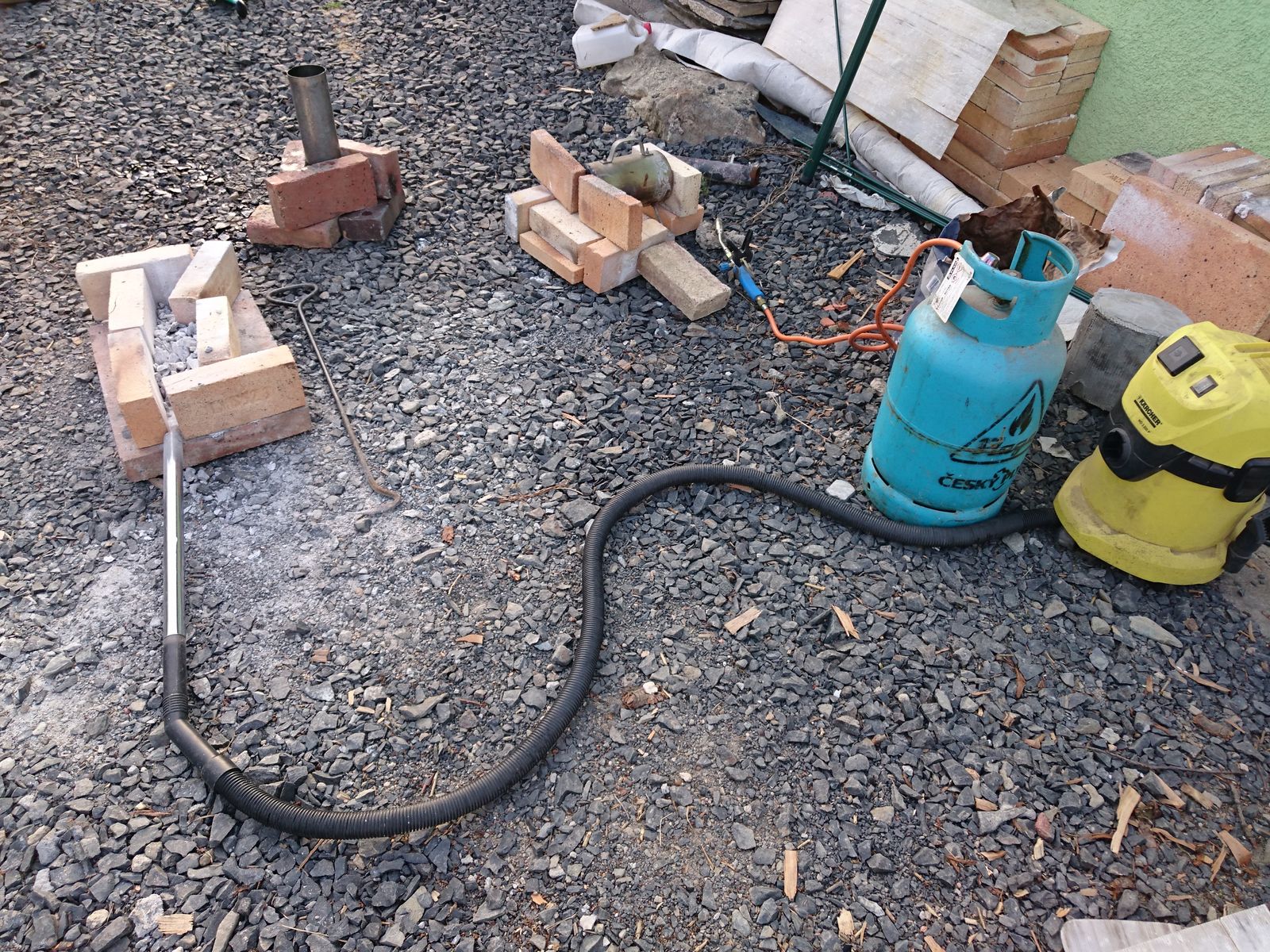
Blade hardening setup

Blade hardening setup.

Slight  contrast with Marcus’s fully equipped workshop I guess :-). On the right is gas mini-forge where a future kitchen knife was heated up most of the time, on the left is a charcoal fire between fireclay bricks for the dagger and in the middle is quenching oil. This is the main reason why I cannot harden blades in bad weather – I have to go outside to do it.

And here are the blades after hardening and before tempering, covered in burned oil and, in the case of the dagger, slag and scale.

Blades after quench.

Blades after quench.

I am not all together sure It was a complete success. I am sure it was a 50% success. I definitively successfully hardened the kitchen knife. Which is slightly strange, because the kitchen knife is made from N690 steel that is allegedly difficult to harden in impromptu settings, whereas the dagger is simple carbon steel that should have been easy-peasy. The kitchen knife is completely without deformation, the dagger got a very slight bend that I was able to correct after tempering the blades in kitchen oven at 150°C for an hour. In fact, it was maybe too easy to correct. File skids on the kitchen blade like on glass, but it is possible to make a shallow bite with it into the dagger.

The problem might be that I tried to coat the dagger with an experimental anti-scaling solution that unfortunately did not work as intended. Back to the drawing board there I guess. So it might be that the blade is hardened, but a few tenths of a mm on the surface have slightly lowered  carbon content due to decarburization. The N690 steel blade was not covered in the solution, but was covered with stainless steel foil that burned through towards the end.

I have no way to measure the hardness of the steel, and I am probably not going and try to re-harden the blade. I will proceed and we will see what comes out of it.

Russia – Famous Graves

The most prestigious cemetery in Russia lies on the other side of Lenin’s tomb, directly in the Kremlin wall necropolis. That is where the greatest of Russians lie.  There you will find Stalin, Brezhnev, Chernenko and astronaut Yuri Gargarin. Very few are up to this highest of honors, though, so where do the rich and famous of Russia go when they die? The answer is likely the Novodevichy Cemetery in Moscow.

The cemetery is large and active with many visitors, some to visit specific graves and others to view the entire site as an outdoor gallery filled with history and graced by the best of Russian art. Despite large numbers of people the cemetery maintains a quiet, reflective quality. Some graves have small chairs for guests. Many graves have small offerings of fruit or sweets. Many more have fresh flowers and there is, conveniently, a florist’s shop at the front gate. There are several graves that I photographed that I was unable to locate information about. They are so beautiful that I include them anyway. I really wish I’d had more time here. Lots more time. What a very special place. (I apologize about the quality. My real camera broke and I was using an old spare)

First, I’ll start with the well-known graves.

Boris Yeltsin


Nikita Krushchev


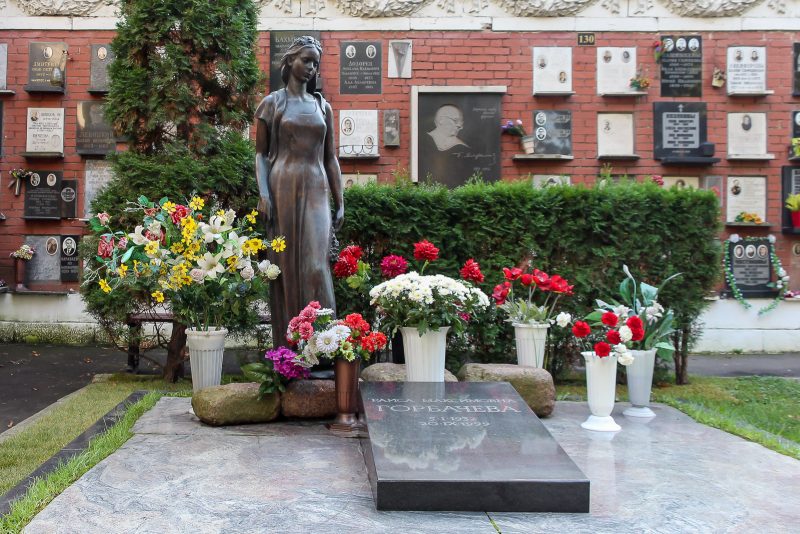
Raisa Gorbechov, wife of Mikhail Gorbachov


Anton Checkov


Yuri Nikulin, beloved actor and clown with his dog


General A Lebed

And now for the beautiful graves I could not identify. The last is my favourite. But first, the flower shop. (note: some names have been added to the original post. See below.)

Florist, Novodevichy Cemetery


Russian entertainer Boris Brunov


Cat lover Valentina Reinholdovna Gliere


Come and sit


Russian singer


Someone to keep watch, Yelizaveta Kairova


Agony


Young lovers


Living tree

©voyager, all rights reserved

Edit note: Thanks to meaderborn and Ice Swimmer for helping me fill in a few names on my unidentified list. I have added their names in respect.


Link to previous Post – Russia –  The Novodevichy Nunnery


Sunday Facepalm: Deep State, Witches & Warlocks, Oh My!

Frank Amedia and his Potus Shield clown circus are back at it, just praying their little red noses off. If you aren’t familiar with Mr. Amedia, you can pretty much find out all you care to know in his recounting a miracle he performed: the resurrection of an ant. Today, they are all trembling over the “deep state”, witches, warlocks, and the antichrist.

“I think we need to be wise to understand that this presidency is going to be taken to the edge of destruction by evil forces, by deep state forces, by a conspiracy that has already been named,” Amedia warned. “We know it’s coming. We need to withstand against that. We need to be the watchmen that say, ‘Don’t take your eyes off, the storm is coming.’”

“We prayed for the Lord to just stir up that storm,” he continued. “Stir up that storm of that president. We declare right now, in Jesus’ name, stir it up. Stir him up like a tornado, don’t let him stop. Let everything fly out that needs to fly out, let everything be exposed, don’t let anything be put back into a place that could come back and linger again.”

That’s a veritable treasure chest of filthy jokes, just waiting to be made. Speaking for myself, I don’t want to see anything flying out of the Tiny Tyrant, and I most emphatically don’t want to see anything exposed. :shudder: Okay, now that my mind has jumped out of the gutter, as far as exposure goes, the Tiny Tyrant and his crew of incompetent cronies are doing a fine job of that themselves. No assistance is required.

Amedia, Mark Gonzales of the U.S. Hispanic Action Network, and Bishop Harry Jackson then initiated a spiritual warfare prayer against Trump’s enemies and critics, with Jackson taking specific aim at the “witches and warlocks” who have cursed the president.

“We lift up witches and warlocks who have been a part of this assignment,” Jackson said, “as they have gathered in numbers almost immeasurable to curse this specific president. We cancel, we bind their authority, we bind their curses, we lift up your word that says you shall not revile the gods and neither shall you bring a curse upon the rule of God’s people. We declare those assignments null and void and we claim the souls of many of the witches and warlocks.”

The Gods? Hmmm. Anyroad, I think we need a serious rule here. This is the 21st century, and people with views that are the same as those prevalent during the inquisition and witch trials? They have no place in a modern society. What they do need is a nice re-created 13th century village, lots of land surrounding, where they could play at witch hunting all they liked, and they could leave the rest of us in the current century alone.

The whole regressive mess is at RWW.

Scandinavian Letters: Å.

Å.

Å is Swedish for river. These pictures are from the two biggest rivers flowing in Helsinki. Vantaanjoki (Vantaa river, the Swedish name is Vanda å) and Mätäjoki (rotten river, the Swedish name is Rutiån). Mätäjoki was the original channel through which Vantaanjoki flowed into the sea, west of Helsinki peninsula, but about 3000 years ago, Vantaa changed its course eastward and started to flow into the sea east of the peninsula.

Mätäjoki is more like a brook, even though it’s called a river, a few kilometers long, flowing in its oversized channel. Vantaanjoki, on the other hand is 101 km long and a proper river.

The first two pictures are from Vantaanjoki at the Vanhankaupunginkoski (old town rapids, the modern Swedish name is Gammelstadsforsen). The city of Helsinki was originally sited near the rapids at the moutgh of the river in Helsinge parish (the name is a Swedish name, the population was mostly Swedish speaking).

The third is a picture of Mätäjoki flowing through a park in Pitäjänmäki, Helsinki.

The fourth is Vantaanjoki a bit upriver from Vanhankaupunginkoski.

The fifth is from the same park as the third and the sixth is a bit upriver from the park, Mätäjoki is flowing between a street and a residential area.

In the seventh and eighth it is again Vantaanjoki at Vanhankaupunginkoski. There’s an island in the river at the rapids. The western channel has been dammed and there’s a power station there (nowadays a museum, but it produces electricity), but the eastern channel has been restored closer to the natural state and the salmon and trout can swim through the eastern channel upriver to breed in the river.

The letter Å is one of the so called Scandinavian letters. It originates from late medieval Swedish and is nowadays used in Danish and Norwegian as well. It is used in words which used to have long a A in Old Norse but the pronunciation changed to an O (think of Latin or Standard German wovel sounds, not English).

More photos under the fold, click for full size!

[Read more…]

Behind the Iron Curtain part 4 – Healthcare

These are my recollections of a life behind the iron curtain. I do not aim to give perfect and objective evaluation of anything, but to share my personal experiences and memories. It will explain why I just cannot get misty eyed over some ideas on the political left and why I loathe many ideas on the right.


Content warning, graphical description of illness.


Ever since childhood my health was not great. I was allergic to almost anything one can be allergic to, I got sunburned in an instant and to add insult to injury I was wearing glasses. Twice I got blind due to allergy – once when mosquitoes bit my face and it has swollen so much that I could not open my eyes, and once when we were outside with school class and the teacher has allowed us to go into a field of rye. Where a piece of awn got stuck under my eye and again caused my lids to swell to the point I could not see. I had to be led out of the forest by my classmates, and we had to keep in shade because light has made my eyes hurt like hell.

That was not the worst of it. At early age I have developed chronic tonsilitis. It could be treated with antibiotics, but it did not work in the long run. The illnesses came more and more often and a pattern has developed – two to maybe three weeks of relatively normal life, then suddenly my neck tonsils got swollen and I vomited pus and congealed blood during the night wishing I die. Then I developed fever and I could barely eat for a week during which I was on the antibiotics. After the antibiotics (penicillin mostly) have done what they could I was weakly for another week and I had to abstain from any physically challenging tasks and I was excused from gym classes.

Thus about two years have passed in this rhythm. My growth was stunted and I was not behind in school only thanks to my high intelligence and a help from our neighbour’s sister, who was a teacher and tutored me one year during my illnesses.

The problem was of course that I should have been sent for tonsilectomy after the second or third bout of antibiotics at the most. The children’s physician for our district insisted on not doing this because it might, in her words, cause asthma later on. So when the antibiotics did not seem to work in the long-term after years of torturing me, she tried to prescribe a “preventional” course of penicillin, where I was taking half a pill each day. Needles to say this did not work at all, quite the opposite. I developed an allergy to penicillin and another antibiotic had to be used from then on.

She also tried to send me for a month on a recuperation vacation stay in the mountains. Something that was intended for children living in smog-covered cities. Needless to say it was useless for a country kid and I was sick during that vacation too.

My parents have only vocational education and they lacked the knowledge to challenge the physician’s authority. They did the right thing – they delegated the problem to the expert. Unfortunately the expert was an idiot. I do not blame my parents in the least, but I refuse to greet the physician on the rare occasion I meet her although she seems to think I should like her. She should have known better.

I had a stroke of luck in that I almost died and when my parents had to call an ambulance, the arriving doctor was the general practitioner for our district. And he was competent so he explained to them that the antibiotics are now doing nothing for me and are only de-facto poisoning me. And that tonsilectomy is the only viable long-term option. After I got tonsilectomy, the last in a long string of tortures, I could not eat properly for a few weeks, and I had to avoid some foods for a few years, but the wounds healed, one tonsil even grew back, and I only had tonsilitis once or twice ever since and never as serious as it once was.

My story highlights both the strengths and the weaknesses of the system.

First strength was accessibility. Each district had a general practitioner, gynaecologist, dentist and children’s physician that rarely were more than two bus-stops or half an hour walking distance away. Hospitals were relatively regularly dispersed, so the travel to one was not too long either. Getting to a doctor was usually not a problem. The same for apothecaries. Whenever I was sick, we could mostly just walk to the doctor and pick the medicaments on the way back.

Second strength was availability. My parents did never need to worry about the costs of any of this. Everything was paid for in taxes, and everybody had available all the care they needed (even the dentist). And they got paid leave to take care for me whenever needed. That does not mean there were no economical decisions made – some rare illnesses might not be treated because the costs were too high for the state to afford. But nobody had to worry about slightly complicated flu bankrupting them, or having their teeth pulled out because they cannot afford the repair.

But the weakness was that people had their assigned physicians and there was no real choice. There was no “second opinion” really available and people did not even know that such thing exists. So if your physician was an idiot, you were foobared.

But I still think that this is one of the things the regime actually got mostly, even though not completely, right.

Idioms & Expressions.

Have you ever been happily reading, and come across an idiom, expression, or turn of phrase you’re familiar with, and suddenly the absurdity of it strikes you? Came across one yesterday in one of Jim C. Hines’s Princess series, The Mermaid’s Madness. (Re-reading, they have become comfort reads).

“That earned another chuckle. “He’s prince of Lorindar. He’s not used to feeling powerless.” He climbed to his feet.”

Climbed to his feet. That means to stand up, but it’s a damned silly expression. The more I think on it, the sillier it becomes. I used to have a bunch of these absurdities in my head, but naturally I can’t think of any of them now. Out of curiosity, does anyone else have favourite absurdities of expressions? Or peeves?

Saving A Tree, One Drip At A Time.

IV treatment helps Pillalamarri live another day. Courtesy of District Administration, Mahabubnagar.

IV treatment helps Pillalamarri live another day. Courtesy of District Administration, Mahabubnagar.

An amazing story, this.

If the roughly 800-year-old banyan tree in Mahabubnagar, India, could talk, it would probably tell you the IV inserted in its branches is saving its life. Termites infested the tree, reportedly one of the oldest in India, and gradually chipped away at its wood until the poor banyan was near the brink of death. Last December, some of the tree’s branches fell down because of the infestation, resulting in officials closing the attraction to the public.

Known as Pillalamarri because of its many interweaving branches, the banyan tree measures 405 feet from east to west and 408 feet from north to south, according to Mahabubnagar District Forest Officer Chukka Ganga Reddy. The crown of Pillalamarri extends to 1,263 feet and the tree is spread across nearly four acres. Underneath the tree stands a small shrine that supposedly dates back to the year 1200, but the tree’s exact age is unclear. Nevertheless, calling the Ficus benghalensis a great banyan tree would be an understatement.

Pillalamarri’s branches bend close to the soil. Courtesy of District Administration, Mahabubnagar.

Pillalamarri’s branches bend close to the soil. Courtesy of District Administration, Mahabubnagar.

Such greatness attracts 12,000 tourists per year from every corner of the country to awe at its sheer vastness, but this tourism has also caused some troubles for the tree. According to Telangana Today, when Pillalamarri turned into a tourist attraction nearly a decade ago, the state government cut down branches and built concrete sitting areas around the tree for tourists. Tourists picked at the leaves, climbed on the branches, and carved names into the bark. Furthermore, to keep the area clean, the grounds team burned fallen leaves, which was bad for the soil. A recently installed dam on a neighboring stream restricted water flow to the tree.

I will never understand the pointless destructiveness humans indulge in. A 700 year old living being should, at the very least, garner some respect.

…Officials initially injected the trunk with the pesticide chlorpyrifos, but saw no improvement. So they tried another method to prevent decay: hundreds of saline bottles filled with chlorpyrifos, inserted into Pillalamarri’s branches.

“This process has been effective,” Reddy told the Times of India. “Secondly, we are watering the roots with the diluted solution to kill the termites. And in a physical method, we are building concrete structures to support the collapsing heavy branches.”

…Despite the tree’s stable prospects, the public won’t be seeing Pillalamarri any time soon. When they do visit in the future, “this time people have to see it from a distance away from the barricades,” said Reddy. For now, drip-by-drip, the banyan tree’s health is returning to its former glory.

What a shame that all those who would show proper respect won’t be able to do so anymore. I’m impressed and happy that a way to treat Pillalamarri has been found, and profoundly sad and disappointed by the people who were so damn destructive. It doesn’t speak well of humans at all.

Atlas Obscura has the full story, and lots of links.