The Rich Forks

#RichForks (The Beginning of an exhibition touring our unequal world)

#RichForks (The Beginning of an exhibition touring our unequal world)

4d44532374d8cd54c8d812a8cee1cdb5

Endless high quality food and drink, silver service and luxury hotel rooms adorn the daily routines of the idle rich these days more than ever. It’s no surprise that this occurs when only 62 people own as much wealth as the poorest 3.6 billion people on this planet. Luxury items including 5/6 star hotel food and wine is always at the finger tips of the extremely wealthy. And they don’t lift a finger when it comes to washing the silverware, setting the tables or cooking the exorbitantly priced food. Thousands of hotel workers (waiters, chefs, stewards/dishwashers, laundry workers) bend over backwards, working ridiculous hours to bring food and wine to the mouths of the world’s extremely wealthy. And many of these workers can barely afford housing, let alone food on a daily basis. But this daily routine of the world’s obscenely rich – having access to free, high quality cuisine while attending corporate functions,  is hidden from many of us.

What if artefacts from this political/cultural activity of the wealthy class were taken from under their noses and displayed to the public? This exhibition is a result of that exact task. Taking something back. Re-appropriating a tiny piece of the vast amount of wealth stolen from us (recall the trillions of public money used to bailout the banks post GFC?). So, this is an exhibition for the people, by people. It’s a small gesture, but symbolically and perhaps artistically, it can mean the world.

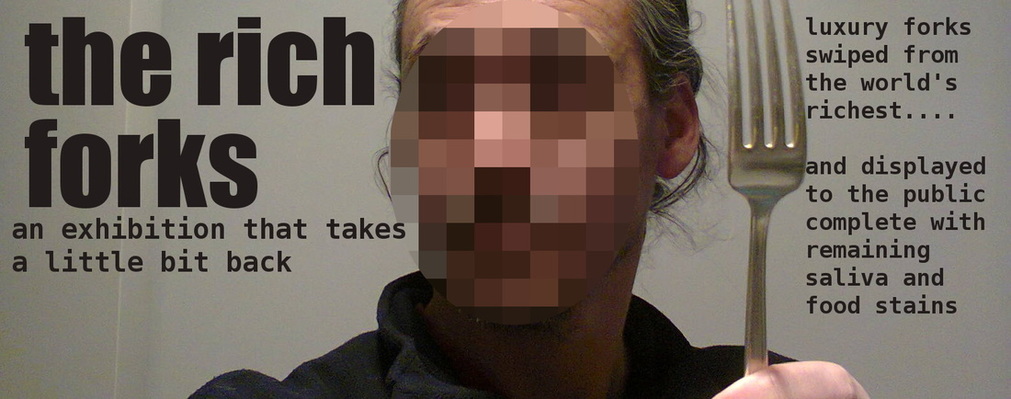
Luxury dinner forks have been collected over a 15 year period, complete with the saliva and food stains of their users, and will be displayed in public/community spaces.

This exhibition at Footscray Community Arts Centre’s Gabriel Gallery will be the first in a series of #RichFork exhibitions touring the world in the years to come. It is no accident that the venues chosen for this touring series are venues ostensibly run by local communities, labour groups and/or publicly funded spaces.

There is more about Van T. Rudd’s current work here.

And with this post, I’ll be leaving you for the day, I have to go into town to see my neurologist. Have fun, and don’t burn the blog down while I’m gone. Stealing forks is okay.

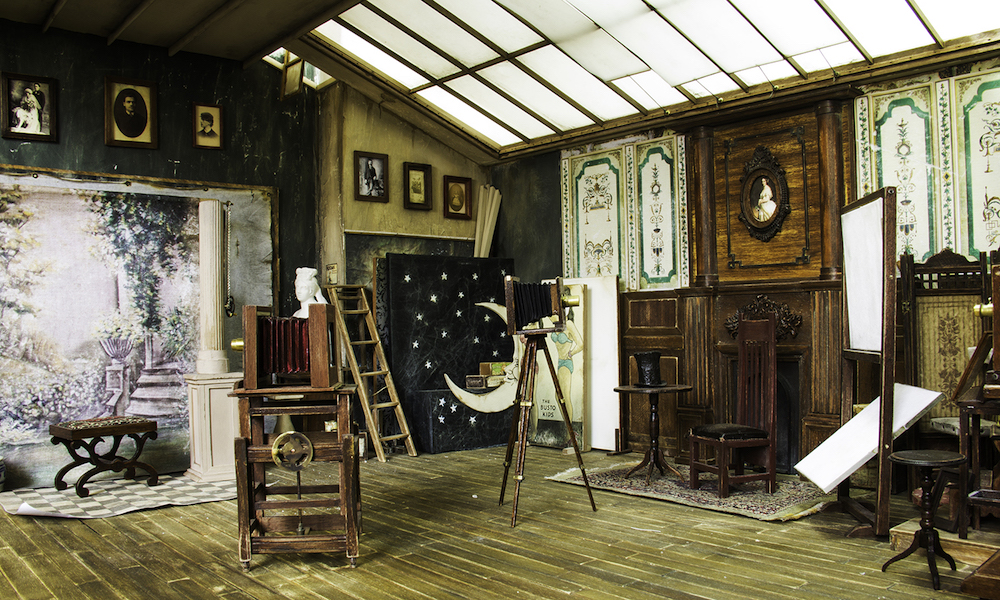
19th Century Photo Studio Built in 1:12 Scale.

AliAlamedy_02

AliAlamedy_015

Absolutely astonishing work by Ali Alamedy.

Turkey-based artist Ali Alamedy had been building miniature sets for seven years when he came across documentation of Charles Miner’s photography studio from the early 1900s. Inspired by the way sunlight was used to illuminate studio sets, Alamedy decided to build his own version in 1:12 scale. The project took him over nine months, using hundreds of feet of wood, and building more than 100 miniature objects designed specifically to fit the era.

Due to few images being available of photography studios at that time, Alamedy read extensively to figure out what tools, techniques, styles, and colors were used within the studios (all images were in black and white). One of the hardest challenges during the completion of the model was the camera, as each fold in the bellow in real life is just 3 cm. The final 1:12 scale camera has 124 2 mm folds that were all meticulously created by hand.

Via Colossal Art, where there are many more photos of Alamedy’s work.

Hair

Hair

Hair1

I can do some very odd things when I desperately need to play. No, I didn’t cut my hair, the current growth is longer. I came across an old ponytail I didn’t know I had – I thought they had all been donated.

© C. Ford.

Art Exhibition Reeks of Cultural Appropriation.

Courtesy Douglas Flanders and Associates An art exhibition in Minneapolis, Minnesota, is causing a stir over the artist's use of Native American imagery.

Courtesy Douglas Flanders and Associates
An art exhibition in Minneapolis, Minnesota, is causing a stir over the artist’s use of Native American imagery.

For over 200 years, non-Natives have appropriated Native American culture for their own intents and purposes. The sphere is wide when it comes to the misuse of Native American culture; appropriation can be seen in sports mascots, fashion and design, product logos; the list goes on and on. The problem with this current mainstream model is that it denies Indigenous people the right to represent their own lifeways and worldview.

The show “Scott Seekins, the New Eden” at the Douglas Flanders and Associates Art Gallery, is being touted as Seekins response to the “Great Sioux Uprising of 1862.” Seekins’s “body of work as an alternative to Minnesota’s tepid 2012 150-year remembrance,” as the gallery touts on its website, is problematic in its interpretation, as it reeks of Native appropriation, and lacks a Native voice.

Scott Seekins, a mainstay of the Minneapolis art scene, is best known for his eccentric dress and demeanor as opposed to the quality of his work. This particular collection of Seekins’s work imitates historic Plains style of drawing (erroneously referred to as ledger art), where he replicates scenes, moves the images around, and inserts himself in a sort of Forrest Gump manner. To be clear, Plains style drawings were a warrior’s record of bravery against the enemy, hunting scenes, courtship, and ceremonial life, these accounts were drawn in accountant ledgers and sketchbooks.

Seekins’s work is the quintessential example of cultural appropriation.

In Seekins’s painting, a clear replica of John Casper Wild’s “Watercolor Painting of Fort Snelling,” (1884), Seekins portrays himself guiding a non-Native woman holding a baby, in the background there are tipis and the fort on the bluff. In another drawing created in the historic Plains graphic style, a Native man has defeated an enemy Calvary, while Seekins, wearing his iconic suit, stands with his arms raised. By placing himself in these historical scenes he positions himself as a mediator and witness. By doing this he disregards the Native American narrative. Considering that this is one of the worst tragedies between the United States Government and American Indians, the U.S. Dakota War of 1862 and its aftermath has had a long lasting impact on the descendants of the Dakota that died. Many Dakota died at Fort Snelling and on the gallows in Mankato, their descendants carry the spirit of their Ancestors with them, they live among us, they are part of us, they are an important part of the Minnesota narrative.

You can read the rest of Joe D. Horse Capture’s article at ICTMN.

Woah.

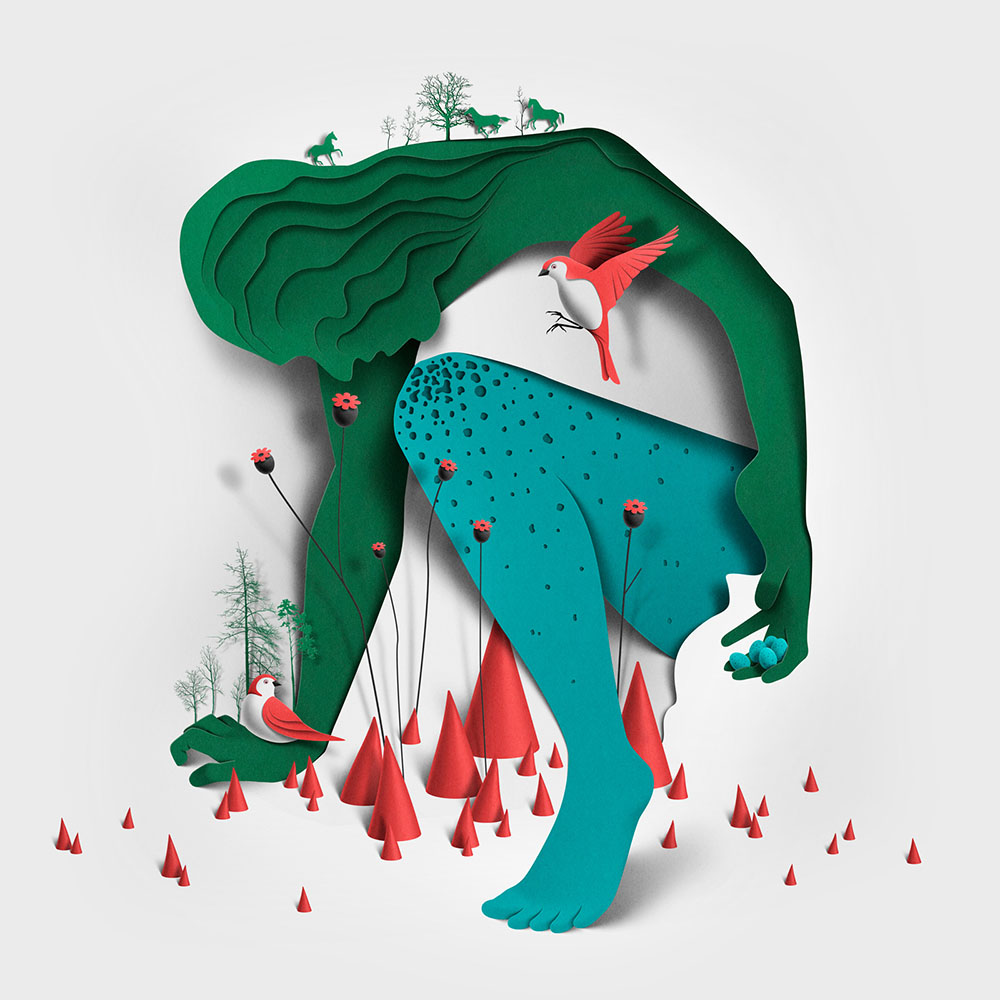
Myths, Eiko Ojala.

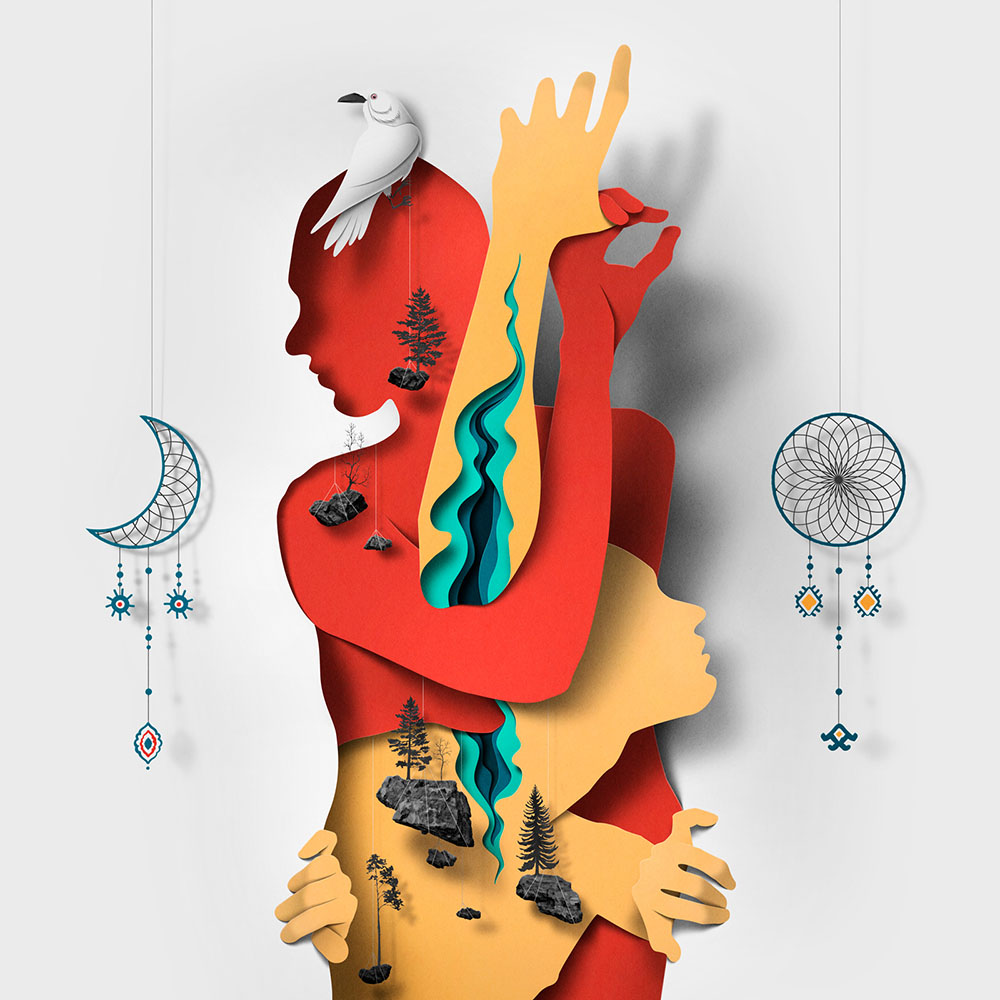
Myths, Eiko Ojala.


Myths, Eiko Ojala.

Myths, Eiko Ojala.


Myths, Eiko Ojala.

Myths, Eiko Ojala.

Blown. Away. There’s much more of Ojala’s work at http://ploom.tv/ and Behance.

Estonian illustrator Eiko Ojalabrings a fantastic sense of depth and texture into his editorial illustrations by using carefully arranged layers of cut paper and shadows. The works are all assembled digitally, but the artist often incorporates his own photos to achieve the desired effect.

Via Colossal Art.

Cool Stuff Friday

Louie’s Jurassic Park:

In his off-duty time, NASA Astronaut Don Pettit experiments with the physics of
water in the weightless environment aboard the International Space Station:


McAvoy goes full Stewart:

25 Contemporary Artists Reimagine the African Mask.

Nandipha Mntambo (South African, born 1982). Europa, 2008. Exhibition print, 31 ½ x 31 ½ in. (80 x 80 cm). Photographic composite: Tony Meintjes. Courtesy of the artist and STEVENSON, Cape Town and Johannesburg. © Nandipha Mntambo. Photo: Courtesy of STEVENSON, Cape Town and Johannesburg

Nandipha Mntambo (South African, born 1982). Europa, 2008. Exhibition print, 31 ½ x 31 ½ in. (80 x 80 cm). Photographic composite: Tony Meintjes. Courtesy of the artist and STEVENSON, Cape Town and Johannesburg. © Nandipha Mntambo. Photo: Courtesy of STEVENSON, Cape Town and Johannesburg.

Click the link for more photos, and the full story.

The Selfishness of Selfies

I’m not a “selfie” person, and I shudder when I see “selfie sticks”, those things look like cattle prods to me. I don’t see the virtue in constantly taking photos of yourself, but if that’s what makes you happy, go for it. Just leave the art out of it. A great deal of art work gets damaged by those seeking selfie perfection in the never-ending I can top that! selfie competition.  The latest victim to selfie-ism is a statue of Dom Sebastiao, who ruled Portugal from 1557 to 1578, at Lisbon’s Rossio train station.

The statue of Dom Sebastiao before it was destroyed. Courtesy of Peter Burka, via Flickr Creative Commons.

The statue of Dom Sebastiao before it was destroyed. Courtesy of Peter Burka, via Flickr Creative Commons.

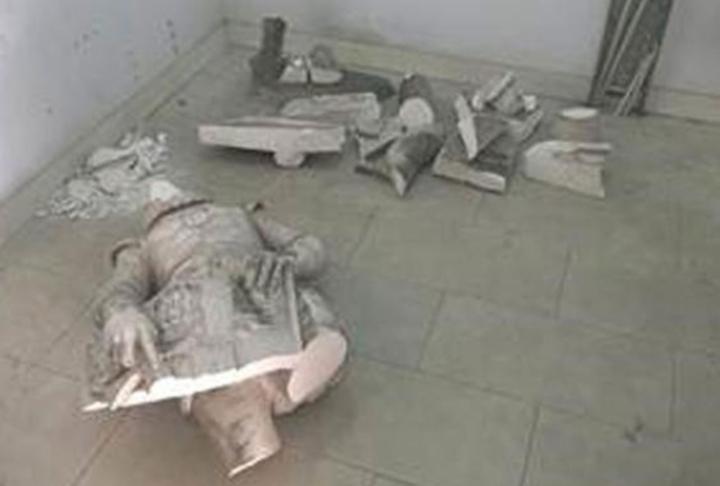
The statue of Don Sebastiao was broken by a young man taking a selfie. Courtesy of Infrastructure Portugal.

The statue of Don Sebastiao was broken by a young man taking a selfie. Courtesy of Infrastructure Portugal.

The 126-year-old statue shattered after a 24-year-old man reportedly knocked it over while climbing on it to take a photograph. The suspect, who has not been named, is said to have attempted to flee the scene before being apprehended by police.

A spokesperson for Infrastructure Portugal told the Daily Mail that he did not know when the statue would be repaired. Before the unfortunate incident, the sculpture was perched in a niche between two doorways at the station, which is a protected monument.

[…]

Sadly, this is not an isolated incident. Last May, a pair of tourists damaged a statue of Hercules in the northern Italian city of Cremona while taking a photograph with it. In 2014, an Italian student tried to pose sitting in the lap of a 19th-century cast of an ancient work at Milan’s Academy of Fine Arts of Brera, only to smash the sculpture in the process.

Some museums have taken steps to protect their art by banning selfie sticks, which extend the reach of the photographer, and may increase the likelihood of inadvertently striking a work of art. (Even without selfies, accidents happen, like the boy who lost his balance and punched $1.5 million painting, or the woman who tripped and smashed an ancient Greek vase.)

Artnet has the full story.

Trompe l’oeil Mural

Lots of wows here, amazing work by Collin van der Sluijs. Van der Sluijs was most recently in Chicago where he completed a tremendous mural in the south loop as part of the Wabash Arts Corridor that depicts two endangered Illinois birds amongst an explosion of blooms. He also opened his first solo show in the U.S. titled “Luctor Et Emergo” at Vertical Gallery, featuring a wide range of paintings and drawings. You can follow more of his work on Flickr.

collin-1

collin-3

Via Colossal Art.