
Today should end the worst heatwave in recorded history in CZ. It was horrendous because my house does not have AC. Normally, I would not need it either; the thermal mass of well-insulated thick brick walls generally ensures a pleasant indoor climate even when it is hot for a few days outdoors. Not when there is persistent heat without even a slight breeze for two weeks, though. These last three days, the heat got so bad that I was completely unable to do anything, literally except lie in bed with a wet towel directly on my skin to cool me off. Luckily, my parents live on the first floor, and temperatures in their bedroom did not exceed 26°C, which is OK for them. I, on the other hand, had to endure 29°C from afternoon til almost midnight.
Before the heat got this bad, I managed to transplant my beans. So let’s talk about them a bit.

© Charly, all rights reserved. Click for full size.
Beans do not make a strong taproot; they make a short and stubby one that very quickly starts to split into thin and fragile roots that do not like to be disturbed. I never had problems replanting them, though, because I always take care to not disturb the rootball during replanting. And this is one area where my clingy clay soil actually helps, because when I let the soil dry a bit before replanting, the whole rootball hardens somewhat and keeps its shape well. I also generally do not let the plants grow too long – I try to plant them outdoors just before they develop their third or fourth leaf.

© Charly, all rights reserved. Click for full size.
I transplanted some pole beans near the hedge between my and my neighbor’s garden (with my neighbor’s consent), and for the rest I put some poles near my second walnut tree. These are beans “Konstantin” which have pods without the paper layer, so even if they do not manage to ripen fully, I should get some edibles out of them.

© Charly, all rights reserved. Click for full size.
I was worried that the heatwave might harm the freshly transplanted beans, but almost all of them survived for several days, and they already start climbing. Only one pair died the very next day, and that was entirely my fault – when transplanting them, I dropped the rootball, and it shattered. That disturbed the roots too much, and in this weather, the plants had no chance. And one pair was eaten by something, probably voles.

© Charly, all rights reserved. Click for full size.
Bush beans from the new supplier did not have as good a germination rate as my own pole bean seeds, but they fared much better than those that I tried before. So I planted them around the Painted Mountain Corn patch as planned. They are still alive four days later, so the transplanting probably succeeded too.
My garden copes with the weather relatively well so far, although I had to pour over two thousand litres of water into it to keep it alive. I even had to water the oats so they do not start dropping flowers. I hope we get enough rain to replenish my reserves.
© Charly, all rights reserved. Click for full size.
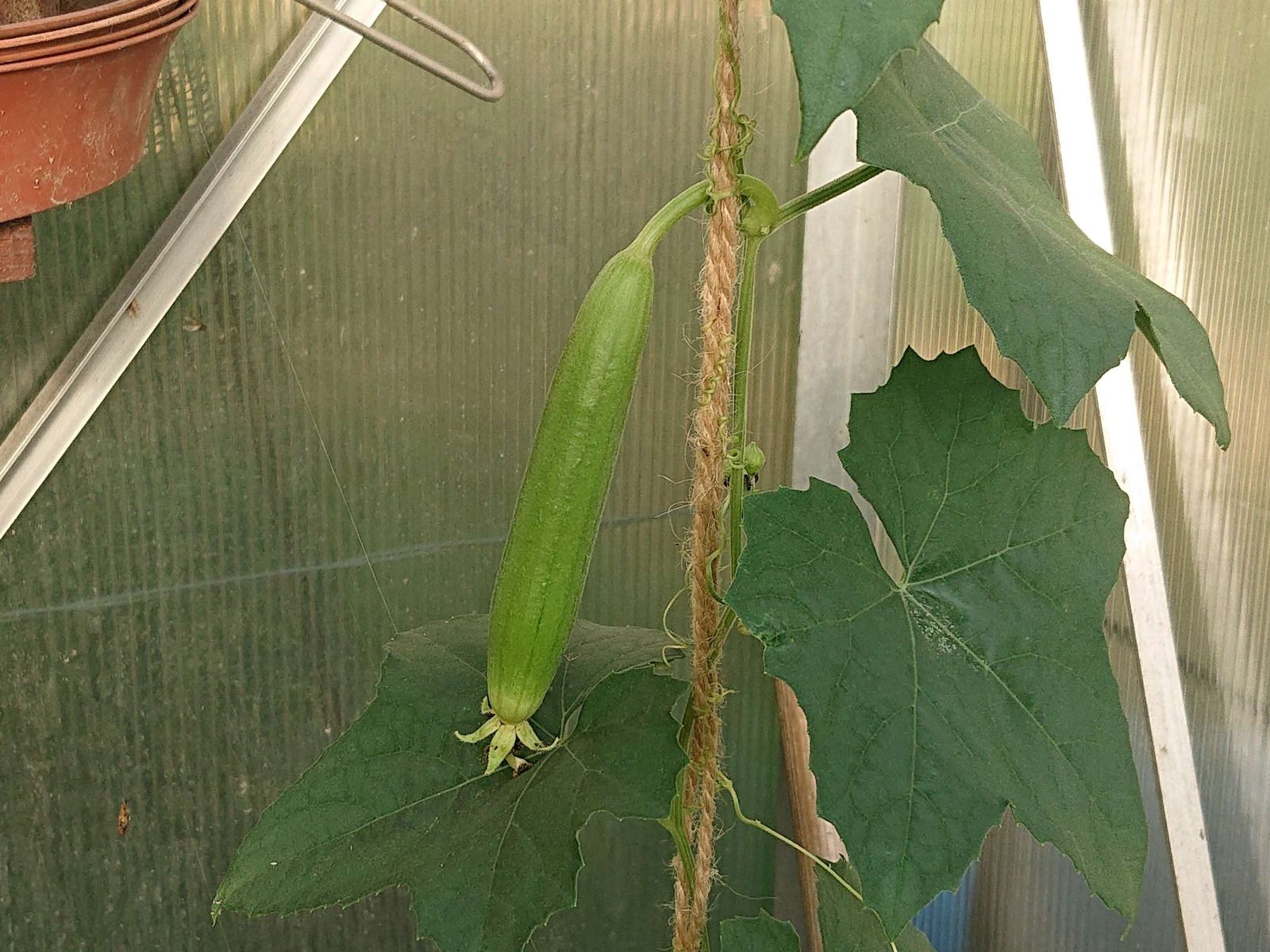
Lufas love the weather. I have my first fruit growing. This plant started flowering much earlier than the others, and it started with female flowers. By sheer luck, the third female flower started closing at just the same time that the first male flower opened, so I tried to pollinate it. And surprisingly, it worked. The other three plants did not start flowering at all yet, but I do hope they will.

© Charly, all rights reserved. Click for full size.
There are indeed new flowers in the making, although this one does not look female from this angle at all. Hur, hur, hur… Sorry.

© Charly, all rights reserved. Click for full size.
Figs and grapes, of course, love the hot weather too. I might get a decent harvest this year.

© Charly, all rights reserved. Click for full size.
Tomatoes are a mixed bag. I did something wrong this year (I do not know what), and the seedlings were generally small and sickly when I was planting them. In the greenhouse, they recovered and are already starting to flower. Outdoors, however, most of them are still way too small, and there is a huge question mark over them.
© Charly, all rights reserved. Click for full size.
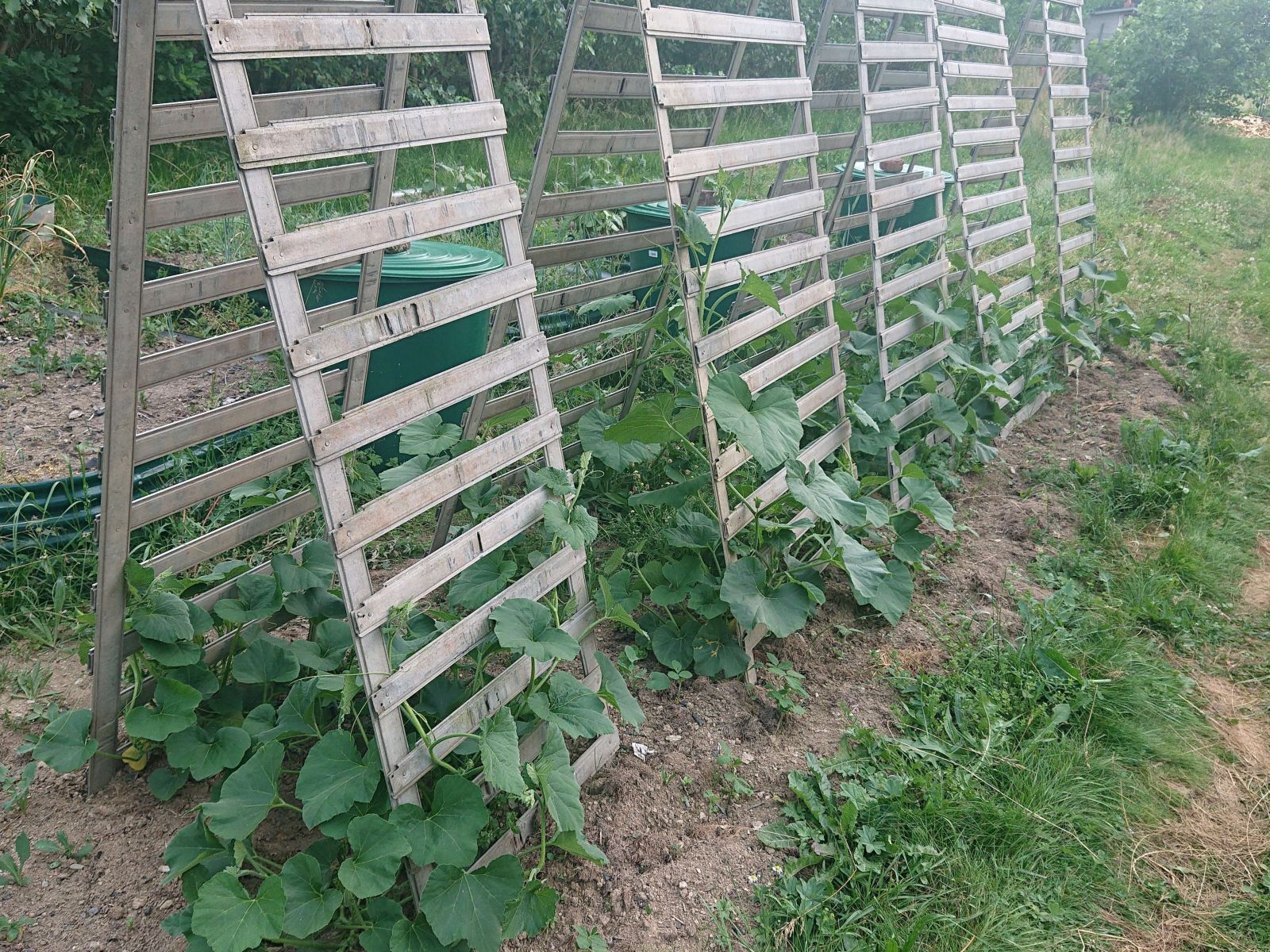
Of all the pumpkin species and variants that I planted, only butternuts look really promising. None of them were ravaged by slugs, and now they are growing fast. They are not flowering yet, but they started forming plenty of flower buds. Last year, I got the first female flower in the last week of August, and I still got a usable harvest. So this year, it could be really good. And btw., the only butternut squash that fully ripened last year remained perfectly fresh for five months; they store really well. I am hopeful they will compensate for the total failure that my Hokkaido and Zucchini are very likely to be.
haha. green weenis.
Huh. That reminds me of a supposed cooling solution I’ve never tried. Something known as a swamp cooler. In it’s simplest form its a wet towel in front of a window. As the water evaporates it pulls heat from the room. Of course, the longer the towel stays wet the better it works, so when looking it up I found some designs which use a drip-feed to continue to moisten the towel (and sometimes fans to help the towel dry).
I’ve never seen one work, and the climate I live in is moderated by the huge amount of water around us (there are some benefits to living in Michigan), so we rarely get above 35C and it almost always cools down in the evening. But I’ve already be interested in the physics behind it.
Anyway, I’m sorry to learn about your tomatoes. I thought they were pretty heat-tolerant, so if there is a problem it’s likely a sign of something else. I have no ideas, and I’m sure you’ll figure it out.
I know that time means nothing when writing a comment, but I had to take a quick break before posting this as mama wild turkey just came by with her chicks. So cute. Two days ago we saw mama deer with her two fauns. Late spring, early summer is one of my favorite times of year.
Swamp coolers: a fan and some kind of mist maker or sprinkler. Ours has the mister built into the fan, mist comes out nozzles on either side of the fan body. Had a neighbor once with a stingy husband who refused to get air conditioning in Washington DC, where August was typically 90 degrees F and 90% humidity. He went to his air-conditioned work, she sat in the basement in front of the fan all day.
the walmart i once worked at in wa state had swamp cooling. hot days were muggy and gross.
The heat wave broke last night, but if the models are correct, we’ll get one week of temperatures around 30° and then it’s back up to 35, 36. Still not 40, but bad enough.
We’re so getting an ac. Our roof produces more than enough energy, so I’ll have zero qualms about its consumption. But it shows again that those who have the means can mitigate the effects, while the heat reords are consistently broken in areas where poor people live
@flex, I do not think a swamp cooler would work particularly well. The temperature outdoors was 7°C higher than indoors, so opening a window was a big no-no during the day. The air humidity indoors was still around 40%, and outdoors 30%. So if the air were cooled by adding more moisture to it, it would become really, really humid. Right now, the outdoor climate is 18°C / 94%R.H., and indoor 27°C / 55% R.H. The heatwave broke with a huge rainstorm, and the humid air is still a bit uncomfortable, or as Bébé Mélange says, “muggy and gross”.
Possibly still better than roasting, so I might try to rig up something when the next wave comes this summer, but I do not have high hopes. Buying any cooling solution (even a simple fan, which is about as much as I can afford) right now is impossible; everything is hopelessly sold out. I might experiment with an indoor clothes drying rack and a fan (when I get one), combining two practical effects into one.
Here in the northeastern USA, we’re supposed to get very hot temperatures later this week, but only for a few days, and not as hot as a lot of Europe got.
Stay as cool as possible everyone, wherever you are.
After writing my comment I went looking for swamp cooler designs and while I’m no physicist, I think many of them are missing the concept.
As I understand it, evaporative cooling happens as water is forced by moving air to phase change into a gas. Because of this phase change, the remaining water, and thus the material under the water, loses heat. Blowing a current of air through a wet cloth would not accomplish this as any cooling is mitigated by the air going through the cloth. To me that feels like you will just be raising the humidity in the air, not cooling it. Which isn’t what you would want at all.
Instead, I can envision some ductwork with both ends open to the outside and a fan pushing air through (unless you are lucky enough to have a decent wind most of the time and can orient the ducts to capture it). Then, in the middle of the ductwork, inset into the bottom of the duct, an aluminum pan of water which the air continually blows across. As the airflow pulls the water into a gas, it will pull heat out of the water, and the aluminum pan itself will get cooler. The air under the aluminum pan will also drop in temperature and sink, creating a convection flow which will cool the space underneath. All of this could be automated, the fan could be on a thermostat and the water flow could use the municipal pressure to auto-fill the pan with a float valve to prevent it from filling too much. The ideal amount of water in the pan would be small, probably less than a centimeter, to get the most efficient cooling impact.
Now I’m not going to attempt the thermodynamic energy calculations which would show how much heat can be extracted this way. I haven’t done those since collage, and I’m certain to get them wrong. For all I know the calculations may show the cooling effect is small enough that it is not enough to bother with. But simply blowing air through a cloth does not seem likely to be very effective. Even in a dry climate where evaporation occurs rapidly, any cooling of the cloth or the air would be mitigated by the air being forced through the cloth. The cooler air will be blown away as rapidly as it is generated. Maybe if there are tubes embedded in the cloth with fluid moving through them to release their heat and cool the fluid, there may be an effect. As for the fan with a mist generating attachment mentioned above, that seems to be designed to coat a surface with a thin layer of water which then evaporates, simulating human sweating. It will work better the lower the relative humidity the air is, and any cooling effect would be on the surface it is evaporating from, not a general cooling of a room.
Obviously, all forms of evaporative cooling work better in places with lower relative humidity, the more rapidly the water can evaporate the more rapidly the heat is pulled out. If the air cannot fold more water, no evaporation, and thus no heat transfer, can occur. So, based on the RH you’ve reported, this may not be a good suggestion after all.
@flex, I am not a physicist either, but learning some physics is part of learning chemistry. And I know one thing for sure: it is impossible to lower the temperature in a room with a device that has no connection to the outside. It is a thermodynamic equivalent of lifting oneself into the air by pulling on their own collar.
I actually remember this one question in a physical chemistry exam that I took at the uni:
If there is a running refrigerator with an open door in a perfectly isolated and closed room, will the temperature in the room a) fall, b) rise, c) stay the same?
The correct answer is b). The electricity needed to run the device adds energy to the insulated room, and since said energy has no way to escape, the temperature in that room must increase no matter what the device is doing.
Even the cheapest AC needs to have a connection to the outside in order to cool the air in the room.
@Charly,
I get that. Maybe I wasn’t clear. The two ends of the ductwork are connected to the outside. Air flows from the outside through the ductwork, evaporates the water in the tray, and exits to the outside. The energy to evaporate the water cools the water and the tray, and the cool tray cools the air below it. The only internal part is the bottom of the aluminum tray. As long as the outside air can accept more water vapor, it seems to me like it should work. But I have no idea how efficient it would be.
@flex, I understood what you meant; I wasn’t criticizing; I was nodding along.
Physicist here. It is possible to cool a room without a connection to the outside by evaporative cooling (humidity goes up, temperature goes down). Think of how much heat you need to add to a boiling pot of water to turn it all into a gas. Evaporative cooling is this in reverse, and it is the basic physics of a swamp cooler. If the humidity is already high this will be increasingly ineffective, and the increase in humidity can make the air extremely uncomfortable. In a climate where it is hot and dry swamp coolers are great, because you want both the cooler temperatures and the higher humidity. In a humid climate swamp coolers are worthless because they are barely effective at decreasing the temperature and they make the humidity so high that it becomes unbearable and way too friendly for mold.
@12, tbrandt, so from a thermodynamic standpoint the energy it takes to create water vapor has to come from somewhere, and it can come from the heat other objects contain.
@11, Sorry Charly, I’ve been trying to give myself heat exhaustion the last few days I missed that you were nodding along.
After writing above that it rarely gets above 35C in Michigan, it’s hit 37 for the last few days and will for the next couple. Me and my big mouth. I’ve been trying to complete a project I’ve been working on for the last two years; refinishing our front doors. Now before anyone thinks, “Whoa, and I thought took me a long time to put up those cabinets….” Our front doors include two doors, each a little less than a meter wide, they are 8 cm thick, and made of oak. They each include twelve windows, nine small ones and three large ones, all with framing around them. Each door weighs roughly 80kg.
Two years ago I took down and refinished the screen doors. Also oak, but I could take my time. Last year I took a week off work and did the secondary door, which entailed removing the glass, breaking down the pieces where the glue was failing, sanding, re-gluing, varnishing with a UV protectant, marine-grade varnish, and the rehanging and replacing the large glass panels with double-pane glass to reduce heat loss. This took about two weeks, but my wife wasn’t working so she could stay at home to ensure no one just wandered in because we didn’t have one of our front doors.
Last Saturday I took the last door down, and took it to my workshop. The last four days I’ve been sanding, gluing, and I just put the first coat of varnish on an hour ago. I have a week off work this week, and I need to get the project done by Monday as my wife is working. I’m drinking a lot of tea and doing okay. The next few days will simply be light sanding while I keep putting more coats of varnish on. I’m glad to be done with sanding the old varnish off, that was a real chore even with four different power sanding tools.
It also annoys my wife that we can’t turn on the AC because we don’t have a front door. Honest, I didn’t plan it this way.
It’s 5:00 here, I’m done for the day. My wife is stopping to pick up supper so I don’t have to cook. Time for a drink. A G&T I think will hit the spot nicely. Cheers!