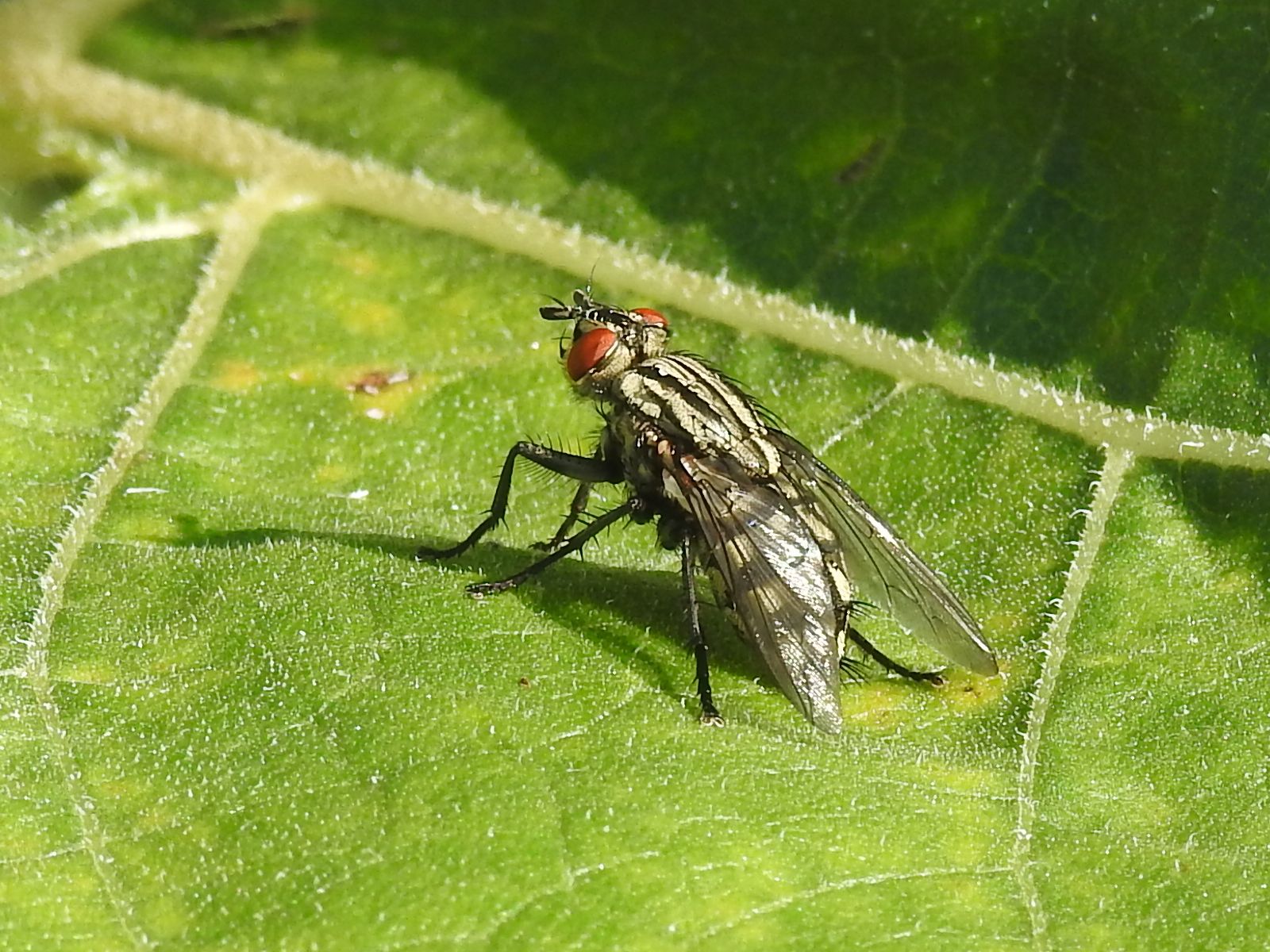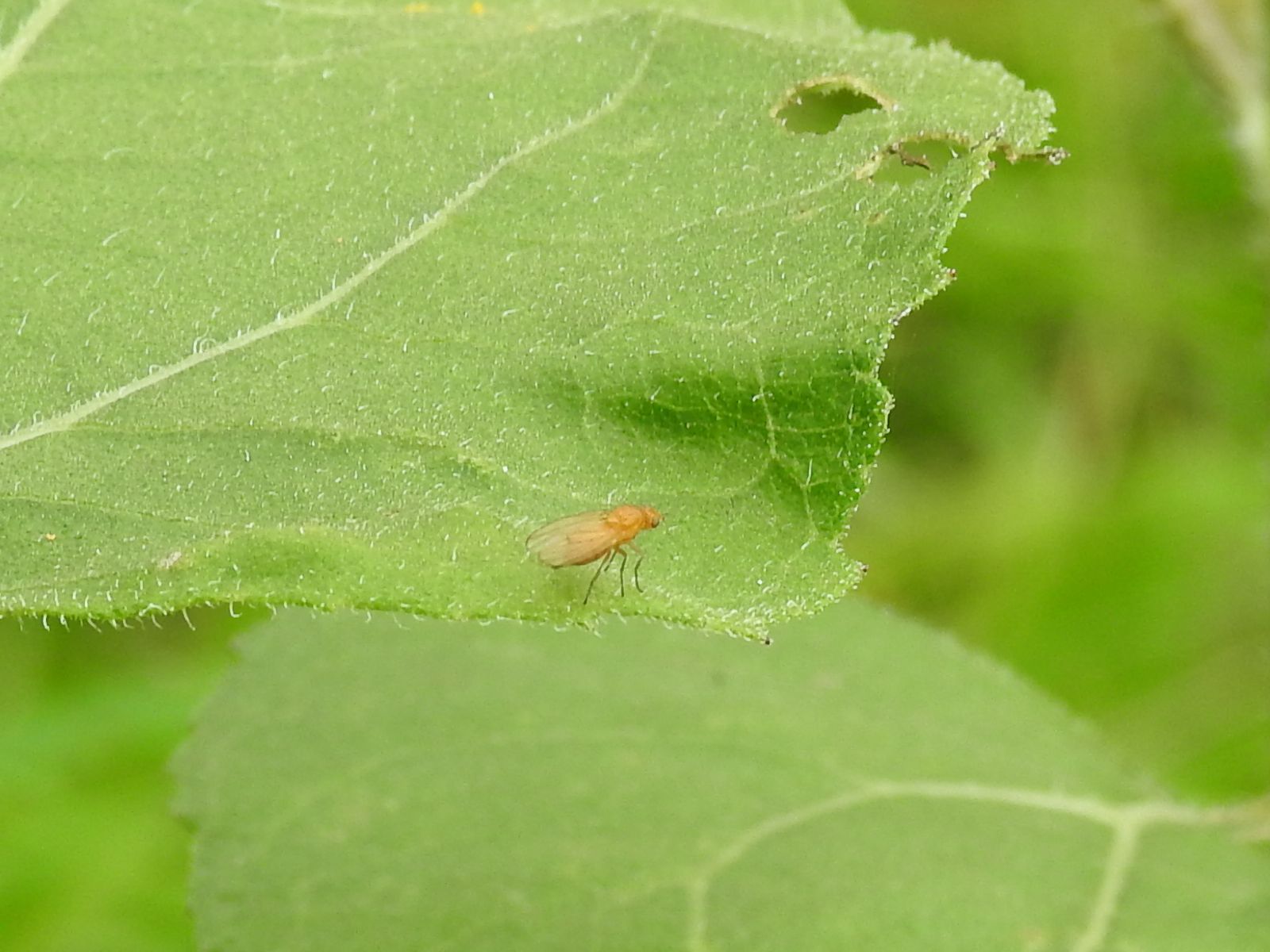
Sunflower Residence – Some Green Fly

This one is very green and very hairy. I do love the metallic sheen. It would be lovely if that kind of color could be replicated on a real metal surface, especially if that surface were steel. But it can’t.

© Charly, all rights reserved. Click for full size.

© Charly, all rights reserved. Click for full size.

Fungi Friday

An unusual set of fungi photos from Avalus, full of rich colour and character.

… two crazy fungi. They look more like watercreatures. As one can see with the moss, they also were really tiny.

©Avalus, all rights reserved.

©Avalus, all rights reserved.

©Avalus, all rights reserved.

©Avalus, all rights reserved.

Midsummer Afternoon – Part 1 – Visit to Harakka Island

Guest posts by Ice Swimmer


It was a hot afternoon just after Midsummer. I went to downtown Helsinki to take some photos.

In the first photo, you can see a jackdaw walking at the Market Square tram stop. I took the picture while waiting for the tram.

A jackdaw walks by © Ice Swimmer, all rights reserved. Click for full size.

The second photo is an “aerial photo” of a family of mute swans, two adults,

and five little cygnets. I’m on the shore end of the pier, from which the boat to Harakka picks up passengers.

I think the leftmost cygnet has some Cladophora around the base of the neck, at least I’m hoping it’s that and not plastic (I noticed the green stuff when looking at the edited photo). The green algae, which has a Finnish name ahdinparta, beard (parta) of the old Finnish god of the sea Ahti, is rather ubiquitous in shallow waters here and there’s a lot of it on the underwater stones in the picture.

Swan family dinner. © Ice Swimmer, all rights reserved. Click for full size.

I took the boat to Harakka. The digitalis was in bloom and there were wild strawberries. It could be that when the Imperial Russian army was using the island before Finnish independence, they planted strawberries and other berries, as I’ve heard stories that it was their way to prevent the soldiers in fortress islands from having scurvy.

Digitalis and strategical strawberries.  © Ice Swimmer, all rights reserved. Click for full size.

This red-leaved rose was growing in a forested area on Harakka. I like how simple and unpretentious it looks.

Red-leaved rose with green leaves. © Ice Swimmer, all rights reserved. Click for full size.

Most of Harakka is ruled by dinosaurs in the summer. This gull seemed to be above any ergonomic considerations.

Common gull forming an animal puddle. © Ice Swimmer, all rights reserved. Click for full size.

My visit to Harakka was cut a bit short by the low battery charge level of my phone. I had neglected to take an emergency charger (“sähköpossu”/”electricity piggybank” as I like to call them) with me.

Having come back to the mainland from Harakka, I saw these crows on a sign (warning about the underwater cable AFAIR) on the pier. They were “singing”. There’s a Finnish saying “Äänellään se variskin laulaa.”, which could be translated as: “Even the crow will sing with its own voice.”

Crows singing with their own voices. © Ice Swimmer, all rights reserved. Click for full size.

I did take more than these pictures on Harakka and there could be material for further posts.

Women Artisans on YouTube – Woodworker – Ashley Harwood

I haven’t watched any other of her videos yet, and I must say that I do not like her choice of accompanying music very much*, but her handiwork is beautiful.

  • I do in fact enjoy woodturning videos most when they only have the sound of the lathe and the chisel crunching the wood. I do not know why.

Bumblebee Ride

Avalus had a little run-in with a bumblebee and was so kind to take pictures.


I was walking from the bus stop to work and saw this bumblebee, just sitting on a vetch leaf. I got my cam out and began photographing. The bee was stumbling around and looked kinda lost.

© Avalus, all rights reserved. Click for full size.

And then she leaped at the camera and started crawling on my hand, eagerly searching. (These pics were taken with my phone).

© Avalus, all rights reserved. Click for full size.

© Avalus, all rights reserved. Click for full size.

© Avalus, all rights reserved. Click for full size.

She was not extending and waving with a middle leg, which is usually a sign for „please mind your distance, thank you or I’ll sting you“, so I carefully juggled her onto my left hand and took her to the nearest batch of flowers. These were of some crownvetch (Securigera varia) and regular bees were bustling around. My passenger-bee was at first not interested, only noticing the flowers as I moved her head directly in front of it.

© Avalus, all rights reserved. Click for full size.
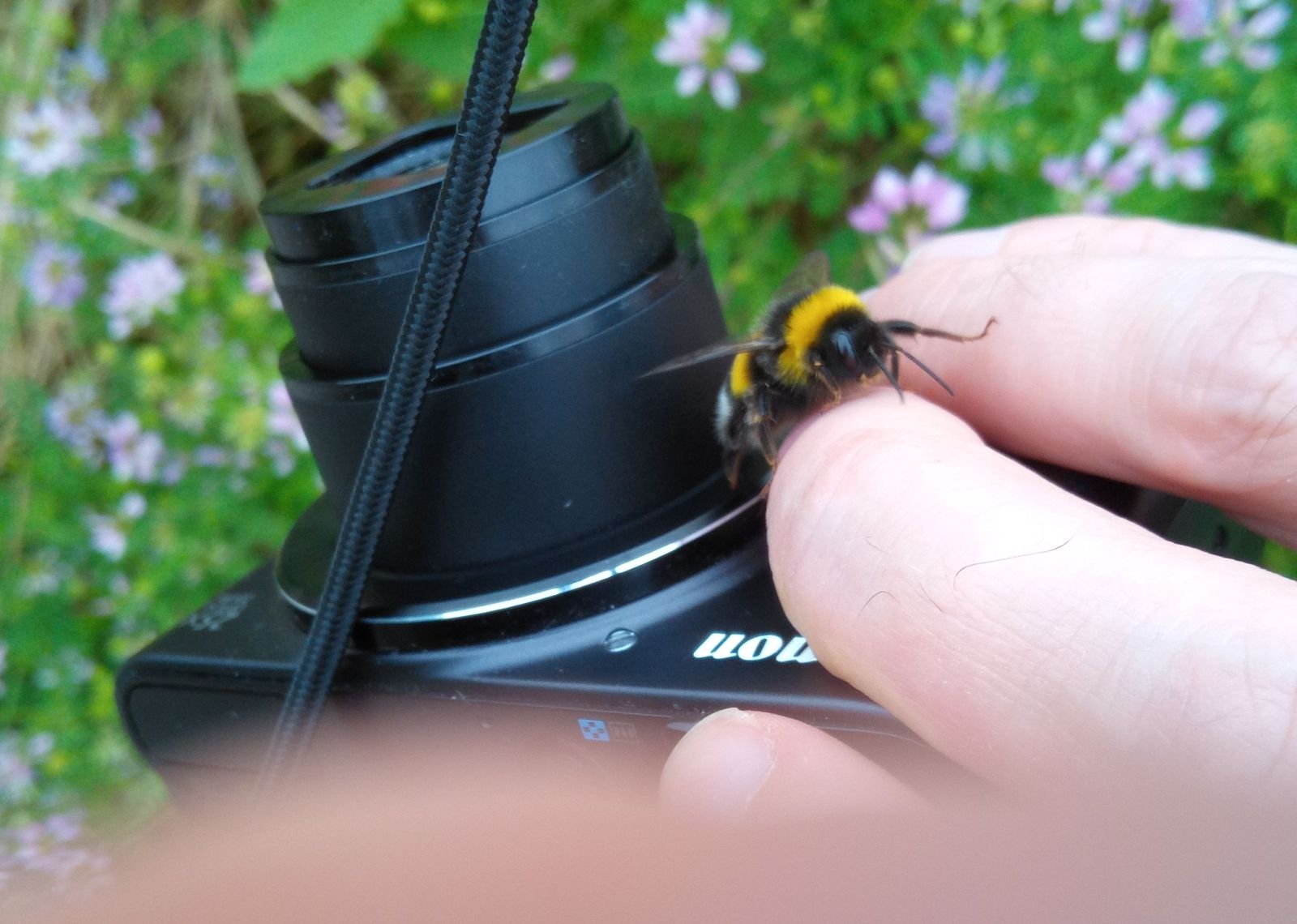
© Avalus, all rights reserved. Click for full size.

She then tried drinking nectar but she was too clumsy and just pierced through the flower with her tongue. Irritated, she crawled a bit over the flower, but always kept a leg on my finger.

© Avalus, all rights reserved. Click for full size.

© Avalus, all rights reserved. Click for full size.

You can see the tip of her tongue, sticking out of the back of the flower.

Then she lost interest, crawled back, and just sat at my hand.

© Avalus, all rights reserved. Click for full size.

My original plan then was to take her to my office and get her a drop or two of freshly made sugar water to nurse her to strength and then put her back in the field I found her in. But underway I found a thistle with many freshly opened flowers that were at ground level (It looked like the plant was crushed by a car in the past but went on to grow anyway, but the flowers were all within 2 cm of the ground). This looked like a suitable spot for my shaky passenger, so I offered her a place in a thistle flower which she took up immediately, thrusting her tongue deep in. I stayed for a few minutes and observed her, as she drank, she stopped the shaking so I think she got all right.

© Avalus, all rights reserved. Click for full size.

© Avalus, all rights reserved. Click for full size.

So good luck, big bumblebee!

I like bumblebees, they are co-cute.

Mice: a Modern Fairy Tale

In olden times, the fairies would come to people’s houses and clean up for them, in exchange of a little milk or some other food. But over the centuries, the fairies noticed that this created a dependency on part of the humans. Therefore they decided to help the humans to help themselves and turned into mice.

A small mouse biting the wire of a life catch mouse trap

©Giliell, all rights reserved

This is the 15th time I caught a mouse in the cellar in the last two weeks. There is no way we had 15 mice in the cellar. I know what a mouse nest in the cellar looks like: tons of droppings, shredded fabric and paper, as well as the stink. I’ve been cleaning the cellar and so far I haven’t found more than a tiny bit of droppings. They ate the wax and wood barbecue lighters and the soap, but the rest of the food is rodent proof in boxes. But I also haven’t found their way in yet. We’re trying to mouse proof all the potential entrances, but no luck so far. We’re also putting them out further and further away.

But well, we are not tidy people. We are people who put things into boxes, put boxes into corners and then proceed to ignore the boxes, so in a way the mice are doing us a favour by making us clean.


EDIT: We found a small lair. Let the cleaning continue

Tiny Spider Eating Tiny Prey

This tiny little jumping spider was munching on a fly on my house’s wall, nearly in the same spot where I took a picture of a wasp spider a few days ago. Unfortunately, these little buggers are at the very limit of what I can photograph free hand and I did not dare to go for a tripod/monopod because it would probably bugger off.

Pictures below the fold. [Read more…]

Argiope bruennichi (Wasp Spider)

This species is not native where I live, it migrated all the way here from the Mediterranean late in the 20th century. I have never expected to see it in my garden since it still requires a generally warmer climate than what used to be normal here. I guess we can chalk that up to global warming – and this year’s summer was uncharacteristically humid and cold, almost like it used to be when I was a kid.

Pictures below the fold, beware of an intimidating and beautiful spider. This specimen is not particularly big – the abdomen is just about 7-8 mm in length.  Maybe she is not fully grown yet. [Read more…]

T’was Tool Making Day

I did not feel like working on knives today, so I have decided to make the measuring pin from brass. It took me rather longer than I expected because I had to work out several things on the fly and there were therefore several failed attempts and repairs. But I managed it in the end and the result looks kinda cool. And it works just as well as the wooden one, in addition to being ever so slightly more precise.

© Charly, all rights reserved. Click for full size.

The bent brass pin on the right is screwed and glued into the lower half of the pin and goes through a hole in the upper half where it has slight (several tenths of a mm) clearance.

© Charly, all rights reserved. Click for full size.

Here you can see the upper jaw, where a ground wood-screw holds the spring tightly in place. In combination with the bent brass pin, this holds both jaws fixed against each other so the tips do not misalign (too much) when used.

© Charly, all rights reserved. Click for full size.

On the underside is no screw. Originally I thought that two bent brass pins in the back portion will do the trick. But it did not work at all, it turns out that make something like that precise enough by hand is impossible (for me at least). When you look closely at the pictures, you will see that there are plugged holes where that second pin was. If I were making another one, I would try to ditch the guiding pin altogether and fix both jaws to the spring with a screw. Whether it would work better or not I do not know, since I stopped tinkering as soon as I got a working product.

And the second tool that I have made today is a center scribe.

© Charly, all rights reserved. Click for full size.

It is a piece of black locust wood onto which are fixed two small ball bearings. The axes are just press-fitted both into the wood and into the ball bearings. Black locust is strong enough to hold and if it splits, I will make the body from aluminium, this was just a proof of concept.

© Charly, all rights reserved. Click for full size.

Here you can see the other side. The wood-screw goes all the way through and just the tip pokes out between the ball bearings. Should it turn out necessary, I will eventually replace the screw with a re-ground drill bit, but for testing, a screw was a readily accessible and easily applicable piece of hardened steel.

© Charly, all rights reserved. Click for full size.

To scribe the center on a flat bar (in the future on an outlined blade) it is simply inserted between the ball bearings so it rests firmly on both of them and on the screw tip. When dragged through (for example downwards on the photo, assuming the tip of the tang is down), the screw tip inscribes a line that is very close to the center. Not perfectly, but I can also scribe a second line by dragging the piece of steel through the assembly in the other direction (putting the tang up in the photo and dragging that way). These two lines very close to each other are sufficient enough for me to grind the blades symmetrically, after all, it is better than what I have used so far.