Jack’s Walk

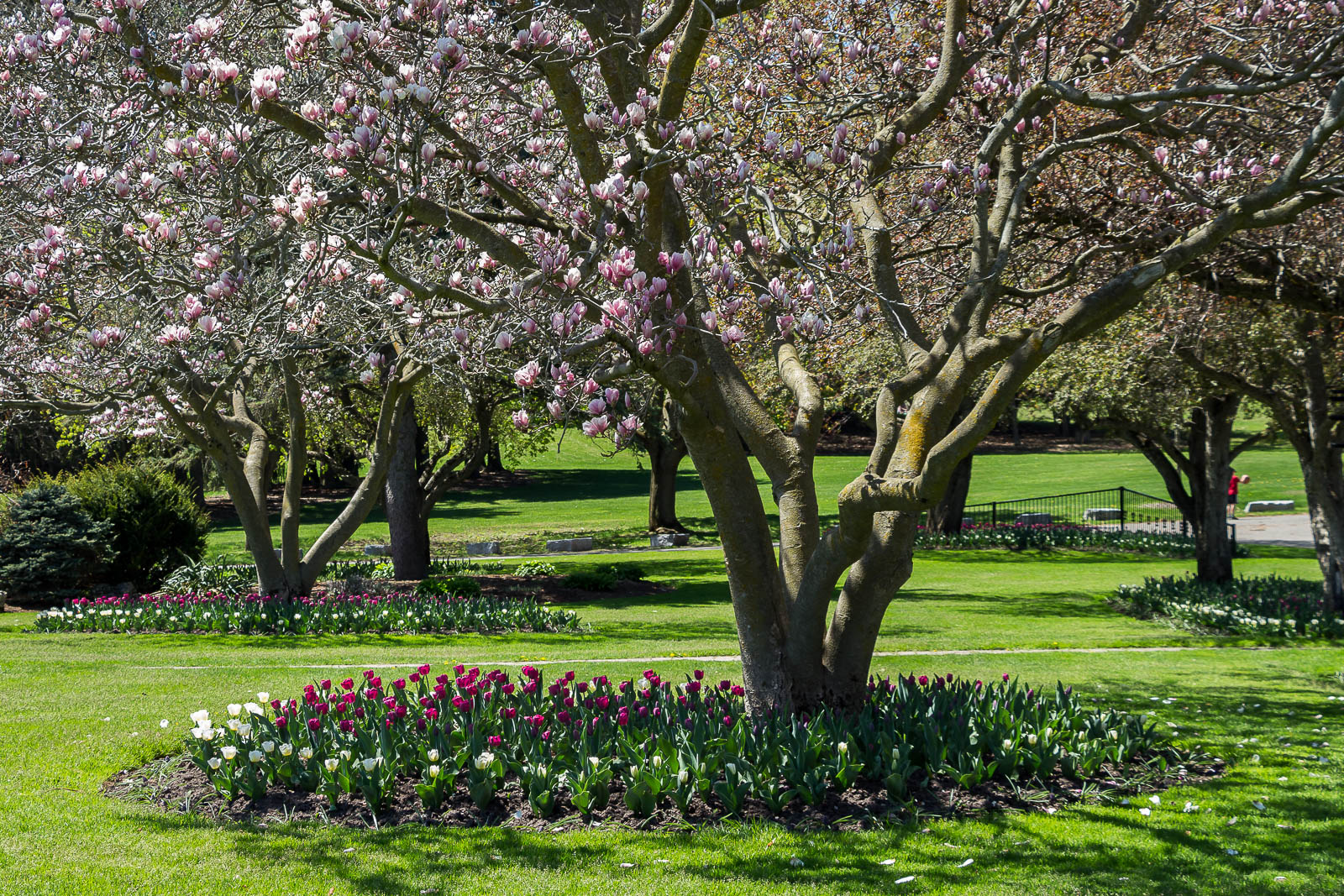
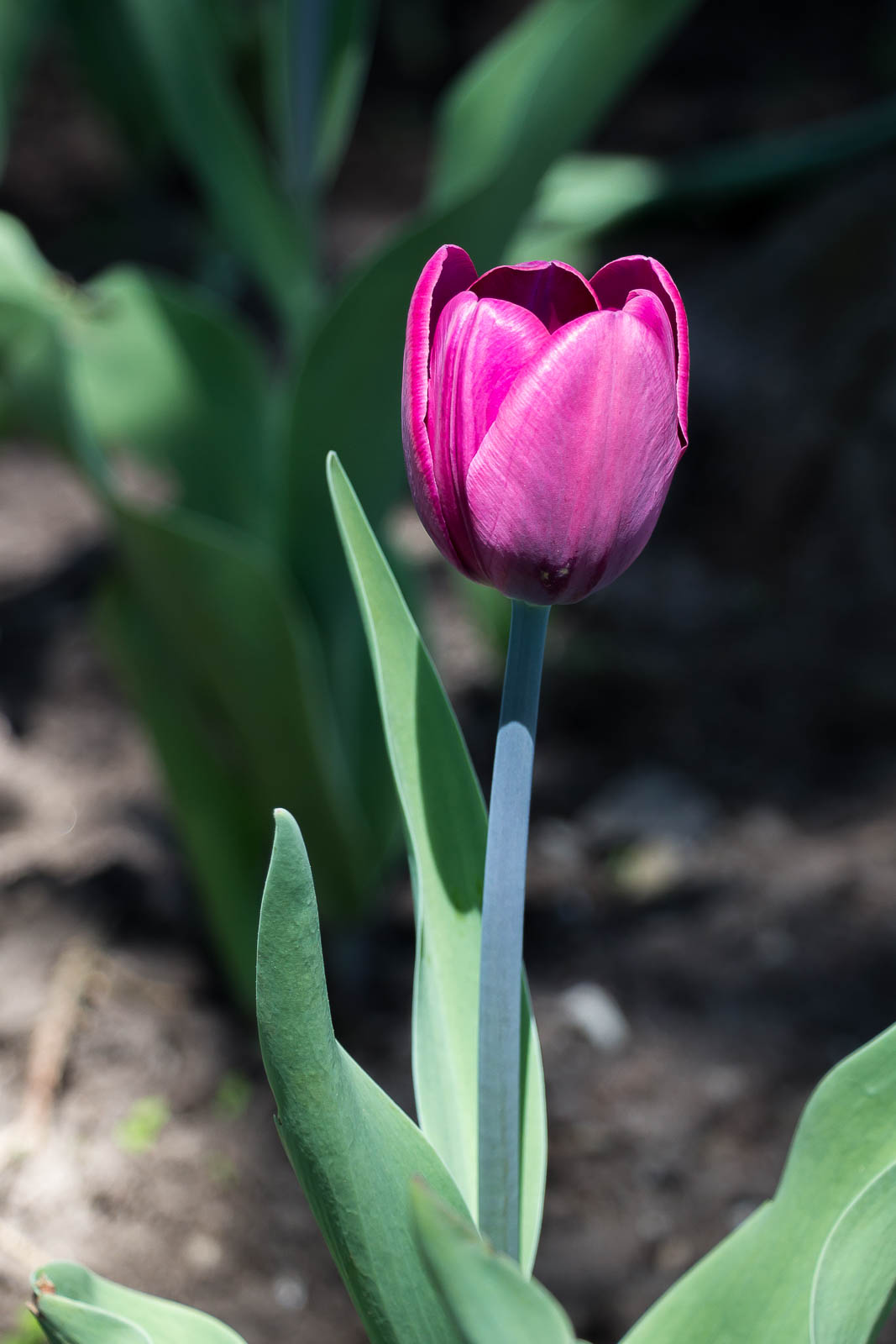
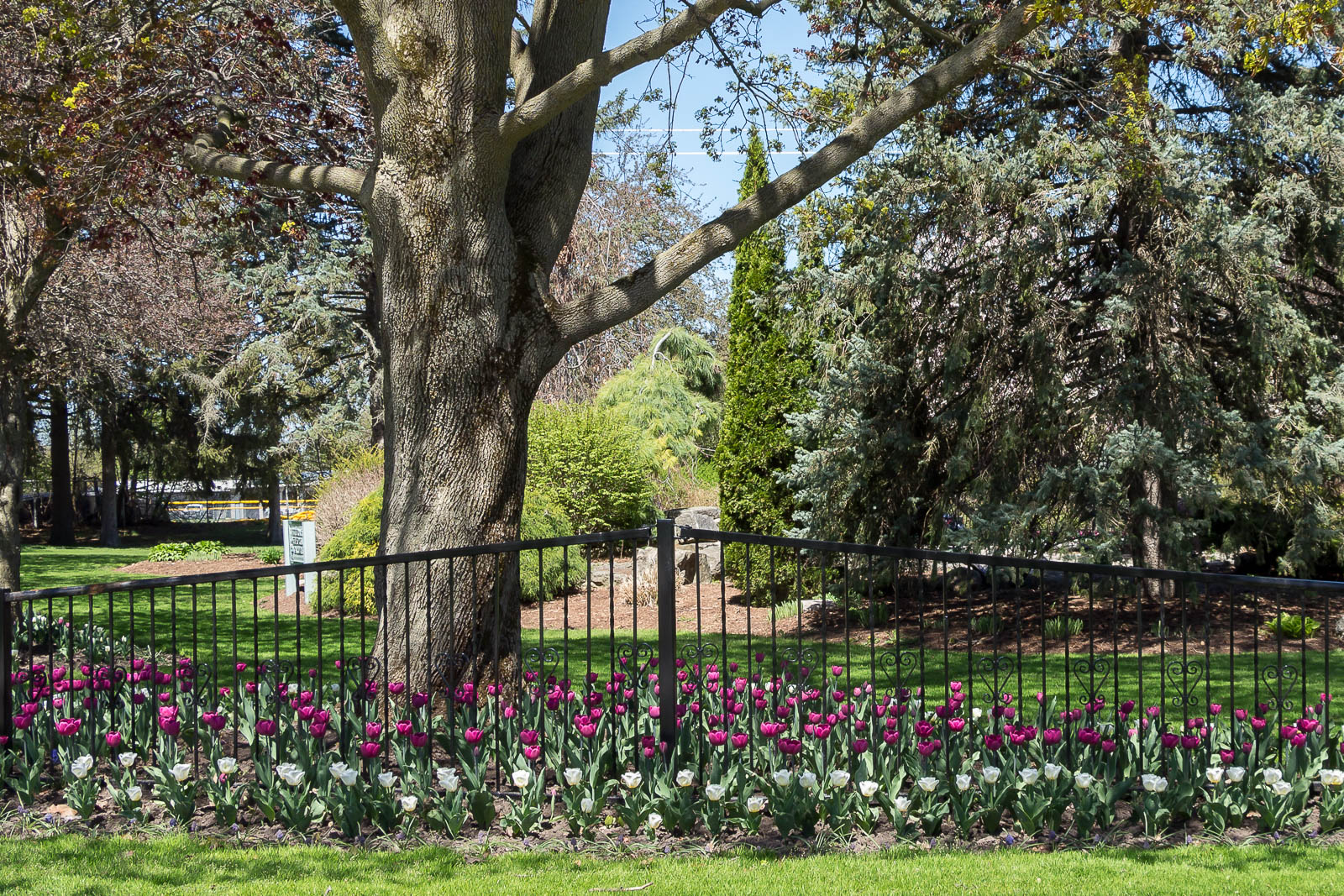
Jack and I strolled through the tulips at the park today. Our city plants thousands of bulbs every fall and they vary the colour from year to year so it’s always a surprise in the spring to see what opens up. This year it’s purple, my favourite, and the best part is that once they’ve finish blooming the city will sell all the bulbs at a good price. They start again with new bulbs in the fall and local residents get the pleasure of more tulips around the whole city.
©voyager, all rights reserved

Oh, It’s That Day.

It’s “mother’s day”. Yet another manufactured holiday, and yet another manufactured holiday I loathe. I wrote all the reasons last year, and I don’t feel like rehashing it all again, I have art in my head, and want to run off  with it today, so here’s what I have to say about this day: https://freethoughtblogs.com/affinity/2017/05/14/mums-day/

The Healing Arts: Consultation de Medecins & Les Grimaces.

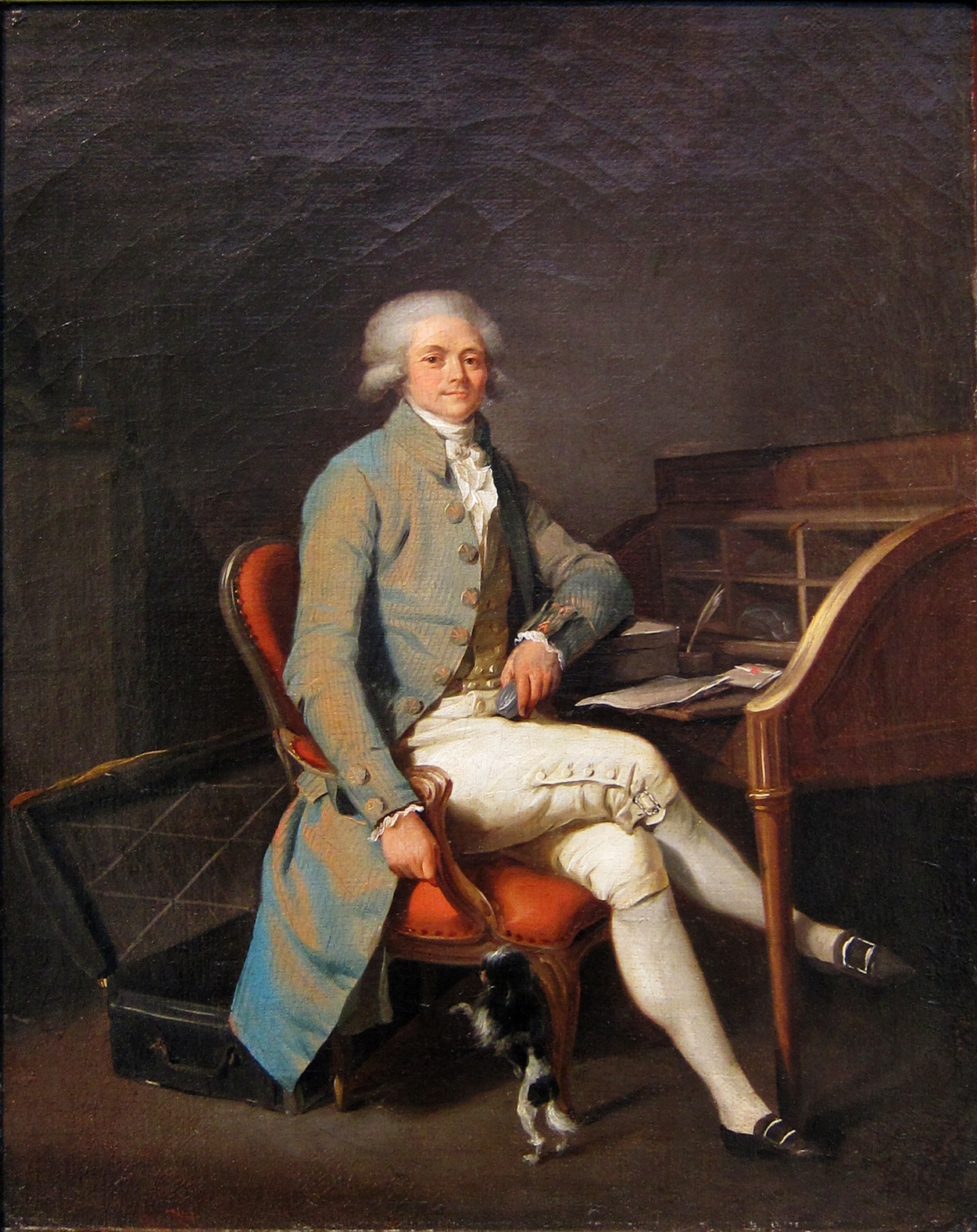
I’ll be indulging in a highlight of Louis-Léopold Boilly the next day or three. Boilly was an incredibly talented artist, with an extraordinary gift for portraiture. Looking at his paintings, you get a strong sense that you should not be staring in the window, looking at these people, because there is a profound intimacy in his paintings. The Geography Lesson (Portrait of Monsieur Gaudry and His Daughter) is a good example of this intimacy. I also think his portrait of Robespierre is the absolute best. Boilly was a prolific painter, producing a great many small portraits as well as full scale paintings. When it comes to Les Grimaces, I like Les Grimaces 3 best. I think. All images, click for full size!

Consultation de Medecins. 1760, Lithograph, Louis-Léopold Boilly.

Consultation de Medecins. 1760, Lithograph, Louis-Léopold Boilly.

Les Grimaces 1, Louis-Léopold Boilly, 1823.

Les Grimaces 1, Louis-Léopold Boilly, 1823.

Les Grimaces 3, Louis-Léopold Boilly, Lithograph, 1823.

Les Grimaces 3, Louis-Léopold Boilly, Lithograph, 1823.

Les Grimaces 8, Louis-Léopold Boilly, Lithograph, 1823.

Les Grimaces 8, Louis-Léopold Boilly, Lithograph, 1823.

Q Is For Quercus.

Quercus suber.

Quercus suber is the scientific name for the cork oak, a remarkable tree. Unlike the aforementioned Eucalyptus, the cork oak is native to southwest Europe (and northwest Africa). Interestingly, both trees are classified as pyrophytes, plants that are adapted to tolerate and resist fire. But while the Eucalyptus is considered an active pyrophyte that promotes the spread of forest fires through the production of inflammable oils, the cork oak is a passive pyrophyte that resists the passage of fire through its thick and insulating bark (cork). The canopy burns, but the trunk doesn’t and the tree quickly regenerates. If the tree doesn’t burn, every 7-10 years cork can be extracted in a process that doesn’t harm the tree and will promote the regrowth of a new layer of cork. Cork extraction is a sustainable practice and cork oak forests, minimally intervened for cork extraction purposes every decade or so, support unique and rich ecosystems.

This photo shows a relatively young oak tree from which cork has been recently extracted for the first time (this is called “virgin” cork and is of less quality than the one obtained in subsequent extractions). Below, the bark layer left after cork extraction that is of a gorgeous russet colour, and above it the cork of the upper trunk and branches that has been left.

All I have to say is WOW! Click for full size!

© Nightjar, all rights reserved.

Behind the Iron Curtain part 5 – Feminism

These are my recollections of a life behind the iron curtain. I do not aim to give perfect and objective evaluation of anything, but to share my personal experiences and memories. It will explain why I just cannot get misty eyed over some ideas on the political left and why I loathe many ideas on the right.


I grew up in a household where a lot of the work was shared between both parents. There was division of labor between them, but it was never presented to me as the “right” thing to do. So while my mother has done indeed most of the washing, cleaning and cooking and my father has done the repairs around the house and the gardening and husbandry, I was never discouraged from doing anything on the basis that it is “unmanly”. And it was not uncommon for my father to do the dishes or cooking. Especially since my mother had higher ranking and better paid job than my father, so mostly when I was sick it was my father who took care of me (which was a lot).

Neither do I remember any such thing from school.

That is not to say that patriarchal ideas were not present or prevalent. They were both. Most party officials were old men, with all the baggage that carries with it. Thousand years of history cannot be denied or ignored, so the ideas about things proper and improper for a woman were still propagated and confirmed to the old stereotypes. It was expected that a woman takes care of the household while the man takes care of most of the income. It was expected tha men will do most of the leading and women will be mostly lead. There were jobs that were considered to be for men and jobs that were generally considered to be for women.

But, even in retrospect, I think a progress was made, and the regime did not approach the issue altogether falsely.

Firstly women were not officially discouraged from any job, with perhaps the exception of the army. Unfortunately the gender pay gap was there (and got further exacerbated after the fall of the iron curtain), but it was not uncommon to see women in leadership positions. Women were officially recognized as a big potential working force. The official stance was to encourage women to take on any job they wish and the regime boasted this officially and a great pride was taken in having the first woman astronaut for example etc. This of course had to work against the aforementioned cultural drag.

Secondly in media there was an effort made at making movies and TV series that either were centered around women, or at least contained some gender parity in both heroes and villains. One of the most popular TV series from my childhood that I remember had the main protagonist and one of the main villains both women. But of course here too was hindered by the enormous cultural inertia.

But the things the regime I think got definitively right (that I knew of at the time) were these two: maternity leave and divorce.

At the time of my life maternity leave was nearly three years and the regime took great pride in that. The reasoning was that taking care of the children is an important work for the society as a whole and should be recognized as such. Low or unpaid maternity leave in some western countries was always presented as one of the most backwards things.
Divorce was also legal and available pretty much on demand, even if it was not swift and there were legal loops to go through. The reasoning here was that to keep a woman in a marriage she does not wish to be in is a form of slavery and as such does not belong in modern society.

In retrospect I think the Iron curtain stopping more progress being made on this front was more in people’s heads than in the regime’s ideology.

The Healing Arts: Mary Toft, Stones In The Head, Elephantiasis.

A new series! The Harvey Cushing/John Hay Whitney Medical Library has an absolutely astonishing collection of old prints and drawings, all to do with medical matters. There are exquisite anatomical drawings, drawings of hospitals, and the like, but I won’t be posting those. There are wonderfully satirical prints, interesting characters, and depictions of certain maladies, etc., of which, many tickle my fancy. We’ll start with Mary Tofts, who drew a great deal of attention, from on high to low in her day, for giving birth to rabbits. (All images, click for full size.)

Mary Tofts of Godelman the pretended Rabbit Breeder, mezzotint, John Laguerre, c. 1726.

Mary Tofts of Godelman the pretended Rabbit Breeder, mezzotint, John Laguerre, c. 1726.

Moving on to…head stones! :D

Loopt loopt met groot... [Operation for Stones in the Head], Laid, Claes (Nicolas) Jansz Weydtmans.

Loopt loopt met groot… [Operation for Stones in the Head], Laid, Claes (Nicolas) Jansz Weydtmans.

I’m not at all sure what this is all about, it doesn’t look quite like trepanning, but who knows? One very interesting thing about this is that it leads to a painting by Hieronymus Bosch, called Cutting The Stone, aka The Extraction of the Stone of Madness. It’s quite clear that Bosch is not being complimentary to the medical profession. The Band Wire did a song about the painting, called The Madman’s Honey.

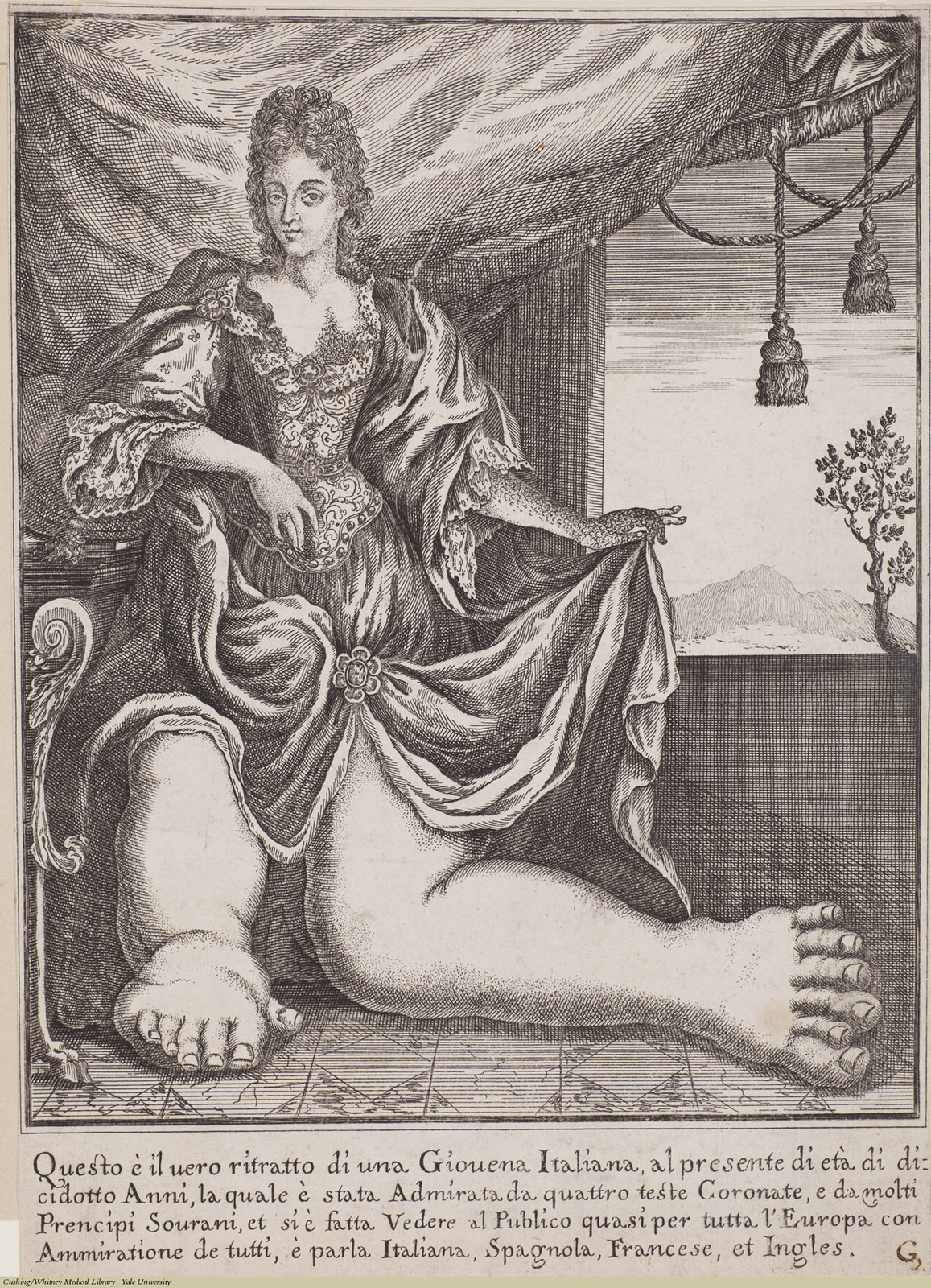
Finally, we have a scary look at Elephantiasis, [Warning: A very graphic photo at that link.] a most dread disease back in the day. Note that the woman depicted has 6 toes on each foot.

Woman with Elephantiasis, Laid, Anonymous, Italian, 18th Century.

Woman with Elephantiasis, Laid, Anonymous, Italian, 18th Century.

Making a Rondel Dagger – Part 6 – Polishing

The long pause was no pause at all. I worked on the blade every evening and but I could not give it more than half an hour to one hour a day, so the progress at this stage was very, very slow.

After the hardening came tempering, which is rather easy and dull process. I wanted the blade to be primarily tough, not overtly hard, so I gave it two half hour courses at 200 °C in the baking oven. This has removed a lot of the hardness and almost all of the brittleness. It should be easy to sharpen and maintain sharp but it should not snap when hitting something hard. With a kitchen knife I would lower the temperature to 150 °C or perhaps perform differential tempering.

Abrasive beltsNext step is polishing. This is by far the most time-consuming and dull part of making a knife. Here are all the belts on my belt hanger. Before hardening I went all the way from left where the  pink ceramics belts are (P40-P120) through middle blue-green zircon-corund (P120-P320). After hardening I gave it one more pass with zircon-corund P320. Very thorough pass, because the blade was slightly pitted from the failed hardening attempts. After that came the last third of the belts, which are Trizact belts (A65-A6, which is equivalent of P300 to P2500). There are six Trizact belts, and each took approximately one hour. Had I more experience I could perhaps speed it up by 30-40%, but it would still be a lot of time – I want the blade to be as near perfect as I am able to make it. So at each stage it is important to remove absolutely all scratches made by previous belt.

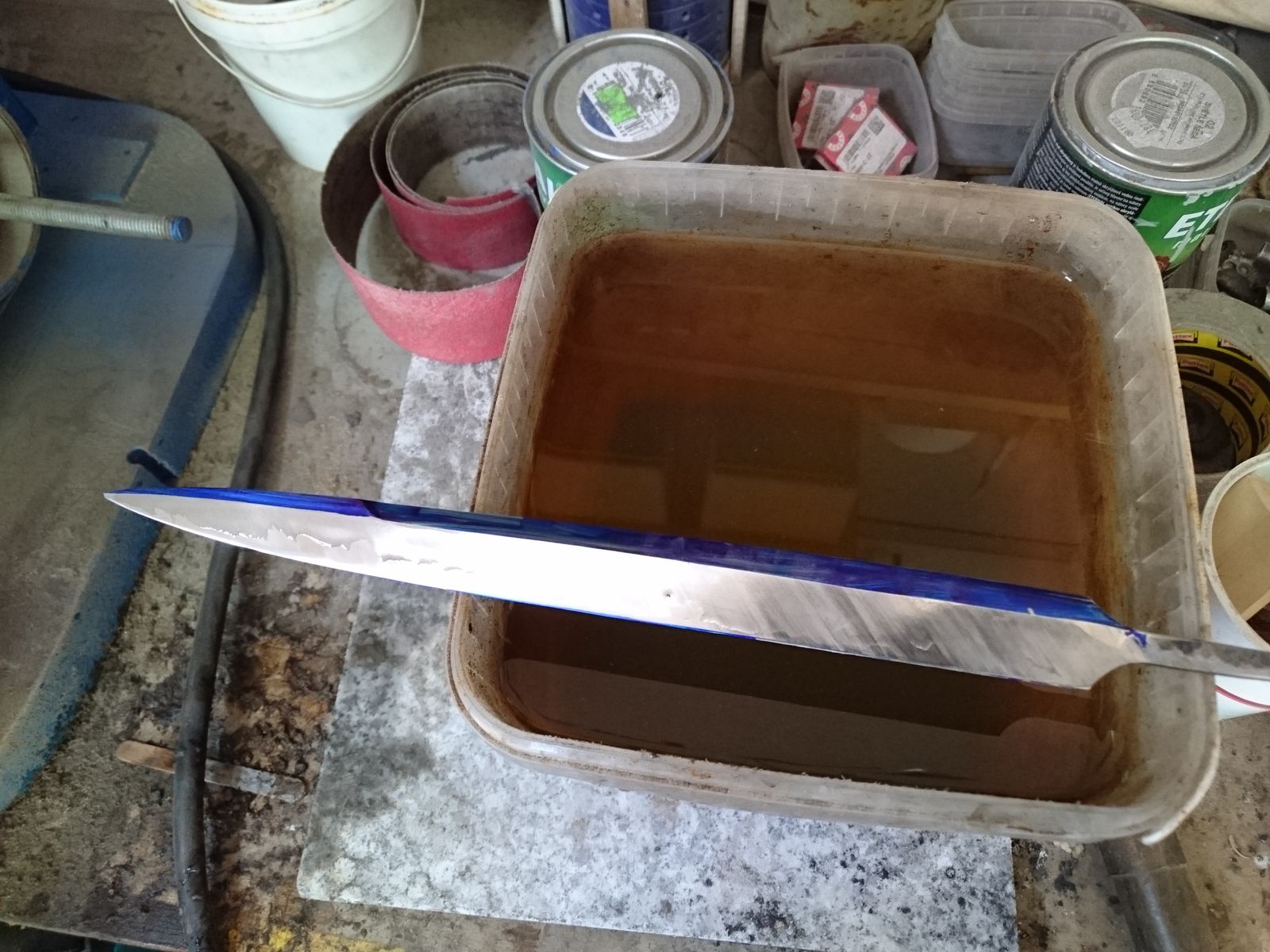
Dagger blade polishingOf course thick blue marker helps here as well, because otherwise I could get easily confused about which facet I am working on. As I learned when doing my previous dagger. To be able to see the marks from previous grind, one does alternate the angle – that is for this facet for example I was grinding diagonally with the point down, so next step will be with point up. Were the facets perfectly straight and not wobbly at all from the beginning, the process would be fast. Alas they were wobbly and I made them wobbly in the process in decreasing degree of wobbliness untill I reached nearly straight towards the end. What I learned here is that I really, really need speed control for my belt grinder, because during polishing slower speed of the belt would speed up the work – I would get better control of the blade and most importantly, the edges of the belt would not make divets and scratches so fast as they do. However even as it is it is working well, but requires a lot of skill that I do not yet have. A lot of eyeballing was involved.

Holder for sandpaperToday I finished on the grinder but I am still not done. For a mirror-finish more work is needed. Kitchen knife would get a few passes on a buffing wheel at this point and that would be it. That would give it nice mirror finish but the scratches from the trizact belts would still be somewhat visible. For this one though now comes  excessive use of elbow grease. I will work my way through a series of wet polishing papers P2500 all the way to P7000. For this I use my trusted gizmo that has seen me through multiple blades already. A piece of hardwood board held in a vice, with leather strap glued on it. On the leather I can lay a strip of sandpaper. Sometimes I rely on the adhesion between the wet leather and the sandpaper to hold it in place, sometimes I hold the paper in place with the help of two springs and something made from fence wire I cannot put a name to.

After that I will be done with this phase and I will be able to perform the last step in making a blade – signing it.

I still have not resolved how to do that. I used to have my own maker’s mark consisting of my stylized initials. It was very easy to etch or engrave and I would love to continue to use it. But by purest of coincidences that very same mark was a few years later independently designed as Bluetooth logo. We’ll see what I come up with.