
This is what standard runner beans from plants with red flowers look like:
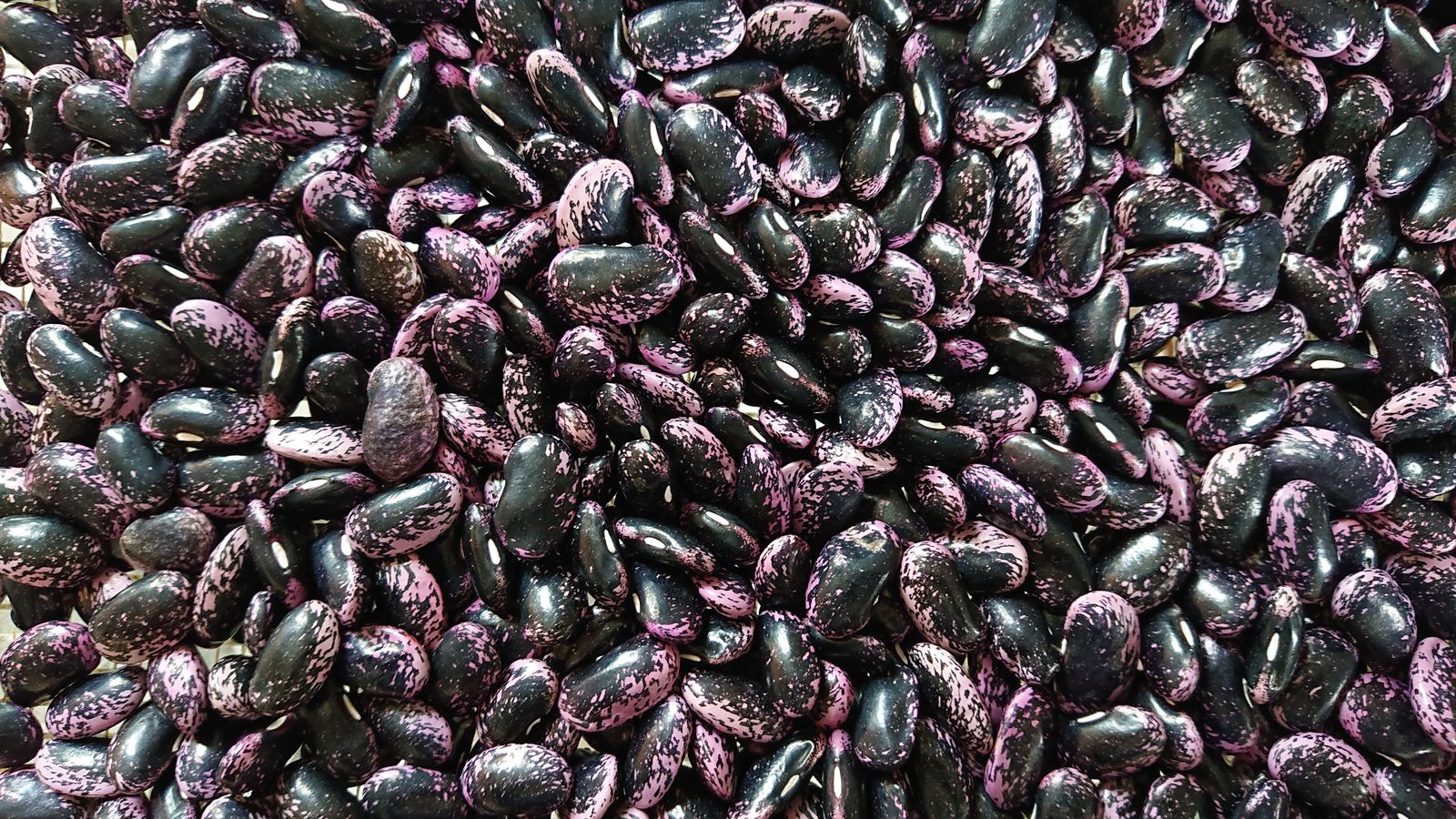
© Charly, all rights reserved. Click for full size.
There is also a variety with white flowers and pure white beans. I tried to grow a few of those last year, but the germination rate was very poor, and I got barely fifty white seeds to plant this year, hoping to get more for the future. However, as readers will remember, last year I was growing the ordinary variety too, to fill the empty space due to the aforementioned poor germination of bought seeds. I was aware that I would get some hybridization, because I had that before. The result of hybridization last time was plants with half red, half white flowers, and seeds that looked just like the standard, except the pink/lilac colored parts were light brown/beige.
This year, I only planted white seeds, and I was surprised to get some plants with full red flowers from them. Well, I am even more surprised now.

© Charly, all rights reserved. Click for full size.
So far, I got a handful of “standard” lilac-black seeds, a lot of pure white seeds, and a bunch of pure black seeds. I have never seen pure black runner beans before, so I asked Google. Varieties with this color do exist, but on a cursory search, they are only grown in the UK and not sold in CZ.
Which is curiouser and curiouser. If I get enough black seeds, then next year I will sow only them, and we shall see what comes of it. I will probably have enough white seeds to save for the future. I also might try to grow all three varieties at once, each in a different part of the garden. That will reduce cross-pollination, but it will not eliminate it. It is a bugger. I wanted to grow two runner bean variants – white and red – in alternate years. And now I have one pure red strain in the cellar, white seeds that are somewhat unpredictable mongrels, and an intriguing new black variety that will probably throw some unexpected curveballs too.
I know that my pure red strain should remain viable in the jars in the cellar for at least two more years, so there is no big rush to renew those. I think I can afford to experiment. Especially since no matter what I do, the remaining beans will be perfectly edible. The worst that can happen is I won’t get pure color strains, but a technicolor seed roulette.
Shall we call you Mr Mendel?
@ Giliell, laughing, so thank you.
@ Charly, do the different colours taste or cook differently? Either way it will be interesting to see what turns up next year.
@Giliell, I am not a monk, but I am certainly intrigued by the strange genetics of runner beans. I certainly did not expect to get so many black beans from pure white seeds.
@Jazzlet, as far as taste or method of cooking goes, I do not think there are significant differences, not for me at least. The difference is in the aesthetics of the final cooked meal. The white beans have no effect on the color, so they can be used with tomato sauce, etc. The ordinary runner beans make things like soups and sauces darker because the color is caused by water-soluble anthocyanins. The black beans are much richer in these anthocyanins, so I expect their effect on coloring the sauces/soups/pureés will be even more pronounced. So if cooked in tomato sauce, they could make the final product look like shoe polish. On the other hand, the high concentration of anthocyanins could have positive health benefits in comparison to the white variety.
@Charly, I thought so, but the reason I don’t buy black beans, despite them apparently being ‘correct’ for various recipes I cook, is that I can’t use them for most of the other recipes I cook using dried beans for just the reason you mention -- the way they affect the colour of the final dish. Grey soup for instance is not appealing!