I get email

Sometimes it is even informative. I was sent a data dump on official Catholic doctrine regarding sexual relations — it is rather revealing. I don’t recall requesting it, though, but sure, I’ll take it. And grimace.

I was informed of an inquiry you made some 7 months ago concerning the morality that must be preserved in the relations of the bed.

Church laws teach that spouses must fight against or quiet libidinal pleasure when they have relations or else they commit a fault for seeking to enjoy the libidinal pleasure. In Her laws and practices the Church has condemned the belief that spouses can have relations for lustful pleasure and not commit any fault or sin. The March 4, 1679 Holy Office decree on the errors of various moral subjects condemns spouses who have relations for libidinal pleasure. Canon Law 1013 teaches that the secondary motive for the marital act is mutual aid but does not mention mutual love or indulging in libidinal/lustful pleasure. Pope Pius XI’s Enyclical Casti Connubii’s teaching on the quieting of concupiscence rules out seeking to enjoy libidinal pleasure. He teaches that the purpose of marriage is the procreation and rearing of children and that the secondary purpose is companionship and friendship through the struggle of life. He also says couples should pray in order for God to help them conquer temptations. The Church Fathers are unanimous on the necessity to fight against lustful pleasure during intercourse. The Church Fathers teach that spouses sin when they have relations for lustful pleasure. And some compare it to using one another as whores and prostitutes:

Lactantius, Divine Institutes, 6:23:18: “The genital [‘generating’] part of the body, as the name itself teaches, has been received by us for no other purpose than the generation of offspring.”

St. Jerome, Against Jovinian, 1:19, A.D. 393: “But I wonder why he [the heretic Jovinianus] set Judah and Tamar before us for an example, unless perchance even harlots give him pleasure; or Onan, who was slain because he grudged his brother’s seed.Does he imagine that we approve of any sexual intercourse except for the procreation of children?”

St. Augustine, The Morals of the Manichees, 18:65, A.D. 388: “This proves that you [Manicheans] approve of having a wife, not for the procreation of children, but for the gratification of passion. In marriage, as the marriage law declares, the man and woman come together for the procreation of children. Therefore, whoever makes the procreation of children a greater sin than copulation, forbids marriage and makes the woman not a wife but a prostitute, who for some gifts presented to her is joined to the man to gratify his passion.

St. Augustine, Against Faustus, 22:30: “For thus the eternal law, that is, the will of God creator of all creatures, taking counsel for the conservation of natural order, not to serve lust, but to see to the preservation of the race, permits the delight of mortal flesh [i.e. the conjugal act] to be released from the control of reason in copulationonly to propagate progeny.”St. Augustine one of the greatest Church Fathers in Church History points to the fact that at times it does happen that a couple will climax. He points out that if this comes to pass and one did not seek it in any way: then there is no fault on the part of the couple. If for some reason the spouses or a spouse does reach the climax- which is the instant that the flesh is released from the control of reason and the flesh (body) at that moment follows commands of its own by moving involuntarily — it is not sinful when it occurs by accident. It must never be sought after and if it occurs when one does not seek after it — it is an accidental happening: and this accidental happening God permits for the sake of trying to procreate — and will not charge a person with sin who did not seek after it (i.e climax). Lustful pleasure must be hated with a perfect hatred. It does happen at times that men feel pleasure during the conjugal act. This is not sinful of itself but only when they don’t fight against it or if they seek it. If they seek pleasure and or if they don’t fight against it — they are guilty of the sin of Lust. A Manual of Moral Theology, by Rev. Thomas Slater, 1925, Chapter 2, The Capital Vices: On Lust: “Lust is an inordinate appetite for the pleasure which has its seat in the organs of generation. A wise and provident Creator has taken care that those actions which are most necessary for the individual or for society should be accompanied by great pleasure in order that they may be exercised more certainly and more readily. If there were no pleasure connected with eating and drinking, few men would trouble themselves about those necessary actions. The great pleasure felt in the act of procreation induces men to do what is necessary for the preservation of the race which otherwise would excite only shame and disgust. This, however, can only be done lawfully in wedlock. “

“And calling the multitude together with his disciples, he said to them: If any man will follow me, let him deny himself, and take up his cross, and follow me. For whosoever will save his life, shall lose it: and whosoever shall lose his life for my sake and the gospel, shall save it. For what shall it profit a man, if he gain the whole world, and suffer the loss of his soul?” (Mk. 8:34-36)

Catholic Encyclopedia, “Lust, by Joseph F. Delany, 1910: “The inordinate craving for, or indulgence of, the carnal pleasure which is experienced in the human organs of generation.The wrongfulness of lust is reducible to this: that venereal satisfaction is sought for…. at any rate, in a manner which is contrary to the laws that govern marital intercourse.(Nihil obstat: Remy Lafort, Censor. Imprimatur: + John M., Archbishop of New York.)

And within marital intercourse one must not seek for pleasure. If pleasure occurs accidentally: it is not a sin before God since it is something out of their control. The laws which govern the marital act demand that the act be consummated as quick as possible, with the lights off and the spouses fully dressed — with the only areas of their body needed for connection uncovered somewhat. In that short space of time: if the couple did not seek for pleasure then they are without fault even if they might have felt pleasure.

St. Thomas Aquinas condemns lustful kisses and touches for married and unmarried people alike as mortal sins in Summa Theologica, Second Part of the Second Part, Q. 154, Art. 4:

Objection 2: Further,fornication is stated to be a mortal sin as being prejudicial to the good of the future child’s begetting and upbringing. But these are not affected by kisses and touches or blandishments. Therefore there is no mortal sin in these.”

[St. Thomas Aquinas]Reply to Objection 2: Although kisses and touches do not by their very nature hinder the good of the human offspring,they proceed from lust, which is the source of this hindrance:and on this account they aremortally sinful.”

That is why St. Thomas even rejects in the same section (Q. 154, Art. 1) as lascivious and unlawful “acts circumstantial to the venereal act, for instancekisses, touches, and so forth“. St. Thomas Aquinas writes: “We may also reply that "lasciviousness " relates to certain acts circumstantial to the venereal act, for instance kisses, touches, and so forth.” (Summa Theologica, II-II, Q. 154, Art. 1) And so it is clear that St. Thomas taught that all non-procreative and unnecessary indecent acts are sinful and against nature.

Oral and waste-organ stimulation is intrinsically evil and against the natural law

St. Barnabas,Letter of Barnabas, section 10:8, 74 A.D.: “Moreover, he [Moses] has rightly detested the weasel [Leviticus 11:29]. For he means, ‘Thou shalt not be like to those whom we hear of as committing wickedness with the mouththrough uncleanness [oral s*x]; nor shalt thou be joined tothose impure women who commit iniquity with the mouthwith the body through uncleanness.'”

St. Augustine,The Good of Marriage, section 11-12, 401 A.D.: “But that which goes beyond this necessity no longer follows reason but lust…. they [must] not turn away from them the mercy of God….by changing the natural use into that which is against nature, which is more damnable when it is done in the case of husband or wife. Of so great power is the ordinance of the Creator, and the order of creation, that….when the man shall wish to use a body part of the wife not allowed for this purpose, the wife is more shameful, if she suffer it to take place in her own case, than if in the case of another woman.”

Very simply the mouth and the organ of the human disposal system have a purpose. Nature tells us that God made the mouth for the intake of food and drink: and the human disposal system for the disposal of waste. Moreover nature tells us that if we begin to use the mouth and the human disposal system organ in improper ways then bodily infection or disease and death may be the result.

The mouth and the human disposal system were not made to stimulate the g*nital organs. Nothing could be more evident than this fact. Catholic Tradition and the Natural Law clearly teach us that oral and human disposal system organ stimulation are sinful lustful acts and deviant s*xual behavior. Those who promote such perversions or believe them to be not sinful are guilty of the mortal sin of heresy for denying the Natural Law and as such are outside the Catholic Church.

Women must never wear jewelry, make-up, tattoos, body painting, and fingernails longer than one-eighth of an inch. Their hairstyles must never be ostentatious, they are not allowed to dye their hair, and they must wear a veil when praying or going to visit a holy place like a church or if they go to see an ecclesiastic. They must also have a veil when they hear a sermon in whatever place they might be. They are not allowed to wear transparent fabrics, laces, nets, organdy, nylon, etc and flesh colored fabrics. They are not allowed to paint their nails either. A violation of any of the aforementioned rules is mortal sin at best and heresy at worst. It is an abomination for women to wear pants. It is a heresy for which women were burned at the stake. Women must wear dresses and feminine apparel that covers them at least beginning from just below the pit of the throat to all the way half way below the knees (inclusive). As for the arms they must be covered with sleeves passing at least the half way mark after the elbows. Another issue is appropriate undergarments. In fact there are instructions for what type of knickers women are to wear and what fabrics to avoid under pain of mortal sin and possibly heresy. Since some fabrics are masculine.Also it is heresy and an abomination for women to wear pants. In fact St. Joan of Arc was burned at the stake on the mere suspicion of the heresy of wearing pants. She was falsely accused before and given a free pass twice but when the accusation happened a 3rd time she was killed (in the first accusation/trial there were some false witnesses who testified against her as well as the 2nd trial and so she already had a strike 2 strikes against her; false witnesses testified against her again for the 3rd trial). This particular heresy is called ‘the monstrous dress’ (difformitate habitus). For having 3 strikes against you would indicate to the judges of a relapse into heresy- for the accused.

Pierre Cauchon the Bishop of Beauvais was an unscrupulous and ambitious man who worked for the English and was the mover and shaker of the false accusations and trials against St. Joan who had defeated France. He and the English were determined to have her blood on some pretext. They were always sad when they failed upon the previous occasions to secure the death of St. Joan at trial. It is alleged a trap was deliberately laid by her jailers with the connivance of Cauchon (for this had happened before). Joan- either to defend her modesty from outrage or because her women's garments were taken from her or perhaps simply because she was weary of the struggle and was convinced that her enemies were determined to have her blood upon some pretext: once more put on the man's apparel (not wearing it but just covering herself with it like a bed sheet) which had been purposely left in her way.She was deliberately (illegally) put in a jail (in the Castle of Rouen) tended by male guards (profligate English soldiers) even though there was one much closer that catered to females (she bitterly complained of the indecent mistreatment she received from them before). She was also treated harshly being chained by her neck, hands, and ankles(for she had attempted to escape by desperately throwing herself from the window of the tower of Beaurevoir because of the unspeakably indecent activity of the men- the judges at her trial called this act of hers reckless). So in all there were 4 trials concerning St. Joan . The first one concerned her visions and then the last 3 concerned the accusation of her wearing men’s apparel/pants.

Sports undergarments suppress the bustline to a degree but are also unhealthy for daily wear, especially by women who are of childbearing age because they are made of elastic and suppress the delicate tissues and structures needed for nursing.

The size of the blouse is determined by the size of the bustline. That size, in turn, determines how wide to make the neckline and armholes and how far from the neckline the armholes should be. Example: If I were to wear a top one or two sizes larger than my size, the neckline would gape open in the front and not lay against my chest (unless it was a turtleneck) and the sleeve seams would hang down the upper part of my arm, giving me a baglady look and also allowing curious eyes to peer down my blouse when I bent forward or was lower than the onlooker, such as when genuflecting. Women who are amply endowed need supportive undergarments or else they suffer from back problems. These supportive undergarments must be constructed in such a way as to support the weight being held and therefore they give shape which you simply cannot avoid except by layering your clothes (a sweater draped over your top or blouse) which is impractical and dangerous to your health in a warm or hot climate and often does not solve the problem. The weight of the fabric, the style of the pattern, the size of the bustline, the style of the waistline and the undergarments all affect how a top/blouse looks upon a woman. This blouse has a nipped-in or tucked-in waist so you cannot expect it to hang straight down which would thus less emphasize the bustline. Also, if a top/blouse is tucked into the skirt (as opposed to hanging over it), the bustline is more emphasized. However, the point of drape is still the bustline.

It is a sin for women to wear pants (even those designed specifically for females) or drive cars. It is a sin for girls to wear lace underwear. The rationale is the preservation of Catholic Dignity. For Pope St. Pius X said. “There is only one human dignity: and that is Catholic dignity.”

http://www.youtube.com/watch?v=OFSQrKrrQqw&list=PLD841087C099E5B90 NFP: A Birth Control Deception 68 mins

http://onetruecatholicfaith.com/Roman-Catholic-Video.php?vid=254&vid_title=Michael+Takes+The+Bad+Man+Away&page=7

http://www.onetruecatholicfaith.com

It is amazing that the Catholic Church lasted for any length of time at all, but then I started thinking…women have always been a major proponent of religion, including Catholicism — they accepted these rules. In a world where men had total power and rape was a constant risk with little recourse for justice, and what sex there was was entirely focused on the man’s pleasure, a collection of rules that strongly discouraged sex might be seen by women as an important way to protect other aspects of their autonomy. If putting on the Armor of God means admitting that you are corrupting filth, well, that might be a small price to pay to get relief from abuse, and to have an institutionally supported way to fight back against those base, depraved men who want to touch your dirtybits.

This is what you get when the dudebros run rampant: women find repressing sex altogether more appealing and a more viable strategy than trying to find respectful partners.

Christians setting a bad example

Every year, Minnesota Atheists participate in the gay pride event in Minneapolis — they don’t go in to make “conversions”, but to show support for our fellow citizens. There is no flaunting of trophies afterwards, no singling out of gay folk who Suddenly! Turned! Atheist! because of our godless proselytizing, because that’s not what it’s all about. In particular, the purpose isn’t to steal attention from the real goals of the event, which are all about equality and rights for same sex couples.

I expect there are also liberal Christian groups that participate as a show of support, rather than as an attempt to convert. But that’s not the case for Trinity Works, which sent evangelical teams to Twin Cities Pride, and afterwards bragged about bringing 80 people to the Lord (knowing how these groups play fast and loose with the numbers, they probably just got the Christian gawkers to reaffirm their prior beliefs).

Another devious ploy: they set up a free corn feed booth. It was a bait-and-switch, offering corn and serving loathing instead.

Trinity Works held a corn feed at 11th Street and Hennepin Avenue along the Pride parade route. According to OutFront, the support team had to counsel dozens who mistakenly thought it was part of Pride activities. “Pride-goers who went in, assuming it was LGBTQ-friendly, were surrounded by Trinity works people who said they would burn in hell because of their sexual orientation,” OutFront’s Monica Meyer said in a statement. “Our support team counseled more than a dozen people who unknowingly went in and left the corn feed shaken, crying and traumatized.”

I bet a lot also left furious and upset — emotions that aren’t part of the intent of the event.

I don’t get how people who are so into dictating other people’s proper sexual behavior can simultaneously be so into rat-fucking.

They know

Ally Fogg makes a really good point about those blithe excuses people make for having sex with the very young, that they’re frolicking hedonistically and simply can’t tell that someone is underage. Yes, you can tell.

Not screwing children really isn’t that difficult, if you are any kind of decent human being. Even when they are dolled up in party gear and make-up, you can tell. Even when you’re shitfaced on the finest pharmaceuticals Hulme has to offer, you can still tell. Had any one of us grown men taken one of those girls to our bedrooms – even with her apparent consent – we would have known exactly what we were doing. I simply refuse to believe that teenagers in the 1970s were so very different that one couldn’t tell.

In my job, I deal with people in the 18-22 year old age range all the time, and we notice this every year: the incoming students are all so young, and the graduating students are fully grown, mostly responsible independent human beings. This is an age range over which most people grow up phenomenally, going from high school kid on the edge of childhood to mature adult. It’s one of the pleasures of this job that we can see our students grow emotionally, intellectually, and physically on our watch, and we get to pretend that we’re partly responsible (realistically, we know they’d mature even without our help).

The excuse that “I didn’t know she was only 15!” doesn’t wash. You knew. That was probably one of the attractions of taking advantage of her.

Face it. Our problem isn’t naive young men who are confused about responsibility and consent. It’s active sexual predators who see innocence as a weakness to exploit, and pretending befuddlement as a way to escape the consequences. Or, in some cases, not even pretending to be unaware.

The manosphere is full of blatant parasites who specifically target young women who aren’t yet aware enough to recognize their vulnerability. For instance, here’s a truly repulsive guide to taking advantage of women at anime conventions.

This new breed is young attractive women with mental issues. Women have jumped on to the anime bandwagon. Most of them joined because they’re the second tier of attractive women. They can’t compete with the front runners because of a flaw or two (they might have the body but the nose is way too big). These women would be considered Bargain Bin to regular society. However, to anime loving nerds, these are the new 9′s and 10′s for the anime world. Women love it, because they have a ton of beta orbiters and some creepy omegas. They get to rule over and be the queens of anime conventions. I decoded the code for an alpha guy to go to these conventions and make that second string duchess bow down to your manliness.

They know exactly what they are doing. And these are the same scumbags who will whine about false rape accusations and that it’s the women who are hypogamous exploiters of their precious seed. It’s not their fault, it’s those women who are entirely responsible for seducing virtuous men.

Then there’s Elam’s 2010 post about women who go clubbing, accept drinks, make out, and enter a man’s apartment, who end up “victims” [quotation marks his] of rape. “In the most severe and emphatic terms possible the answer is NO, THEY ARE NOT ASKING TO GET RAPED .. They are freaking begging for it. Damn near demanding it.”

The next paragraph goes on to claim that women get raped because they are stupid, arrogant, and narcissistic.

Really, the men know exactly what they are doing. This modern distortion of what ought to be a legitimate men’s rights movement is all about rationalizing the disgusting behavior of a number of men by trying to place all of the blame on women.

Bread and circuses…well, circuses anyway, not so much bread

Michael Shermer indulges in some shabby Libertarian statistical games to wave away American economic inequality. Sure, there are inequities, he argues, but they’re not so bad — the poor are also getting slightly richer.

The rich are getting richer, as Brookings Institution economist Gary Burtless found by analyzing tax data from the Congressional Budget Office for after-tax income trends from 1979 through 2010 (including government assistance). The top-fifth income earners in the U.S. increased their share of the national income from 43 percent in 1979 to 48 percent in 2010, and the top 1 percent increased their share of the pie from 8 percent in 1979 to 13 percent in 2010. But note what has not happened: the rest have not gotten poorer. They’ve gotten richer: the income of the other quintiles increased by 49, 37, 36 and 45 percent, respectively.

I have a few problems with this. First, in an article titled “The Myth of Income Inequality”, he’s doing a bit of bait-and-switch: it doesn’t matter if the baseline is rising, the question is about the disparity. Income disparity is greater now than it was before. His own numbers show that.

This argument is basically a version of the “Well, the poor all have cell phones!” dismissal. They’ve also got refrigerators and TVs, therefore, you should just ignore the fact that the wealthiest are sucking up all our prosperity to fund luxuries and frivolities. We should just pretend that we’re all getting the benefit of a rising tide, and never mind that yacht towering above your dinghy.

But there are other funny things going on in this economy. Look at this chart: the costs of TVs and toys and cell phones (the latter at least is essential now; but it’s a new cost for the poor, even if it is dropping) are plummeting, but the stuff that really matters for upward income mobility, like child care, health care, and education are going up. Especially education. We are saddling new graduates with overwhelming amounts of debt.

poorcosts

Another interesting game Shermer plays is to ignore the difference between income and wealth. It’s good that the poor are getting some increase in income, but if you’re using it to make ends meet or dig out from under a pile of debt, you’re not going to be accumulating any wealth — you can still get poorer. Meanwhile, the rich don’t have to worry about covering essential living expenses, and can invest and get richer. It’s useful to be able to see the distinction, so here’s a handy table of wealth and income in the US.

Income, net worth, and financial worth in the U.S. by percentile, in 2010 dollars
Wealth or income class Mean household income Mean household net worth Mean household financial (non-home) wealth
Top 1 percent $1,318,200 $16,439,400 $15,171,600
Top 20 percent $226,200 $2,061,600 $1,719,800
60th-80th percentile $72,000 $216,900 $100,700
40th-60th percentile $41,700 $61,000 $12,200
Bottom 40 percent $17,300 -$10,600 -$14,800
From Wolff (2012); only mean figures are available, not medians.  Note that income and wealth are separate measures; so, for example, the top 1% of income-earners is not exactly the same group of people as the top 1% of wealth-holders, although there is considerable overlap.

Here’s another sneaky trick. When the concern is inequality, let’s ignore the most extreme and instead focus on perceptions.

One reason for the controversy is that people overestimate differences between the rich and poor. In a 2013 study published in Psychological Science entitled “Better Off Than We Know,” St. Louis University psychologist John R. Chambers and his colleagues found that most people estimate that the richest 20 percent make 31 times more than the poorest 20 percent (it is 15.5 times), and they believe that the average annual income of the richest 20 percent of Americans is $2 million, whereas in fact it is $169,000, a perceptual difference of nearly 12 times. “Almost all of our study participants,” the authors concluded, “grossly underestimated Americans’ average household incomes and overestimated the level of income inequality.”

That’s beautiful sleight of hand. First, as previously mentioned, talk only about income, not wealth (and most of us already have poor intuition about the difference; notice also that if you look at the table above, the guesses pretty much hit the mark on wealth, rather than income). Then talk only about the top 20%, rather than the top 1%. And then make much of the fact that people’s guesses about rich people’s incomes are wrong. Har har, the proles guessed that managers make 31 times as much money as they do, when it’s really only 12 times.

Really? Try this exercise: imagine that you got paid just 10 times as much as you do now. “Just” 10 times. How much of a difference would that make in your life? I’m in a comfortable position; optimistically, I’m probably somewhere in the bottom of the 20%, so I don’t have to worry much about making ends meet, and give me an order of magnitude more money and I’d just be socking it away in a bank. But if you’re poor, if you’re struggling to cover child care and rent and keep the family fed, that’s an immense difference.

And of course the other factor is that the 20% aren’t actually working any harder than the 80% — their labor may require more training (which we’re trying hard to lock poor people out of with skyrocketing education costs), but they’re not actually working any harder than you are. My father was often working two jobs in order to keep spinning his wheels in poverty, so I’ve seen this inequality at work, and am well aware that I’m on the lucky side of the rich-poor divide.

But set aside all the squinty-eyed statistical games, and simply ask the fundamental question: Who owns the country? Where is the product of 315 million people’s labor going?

In the United States, wealth is highly concentrated in a relatively few hands. As of 2010, the top 1% of households (the upper class) owned 35.4% of all privately held wealth, and the next 19% (the managerial, professional, and small business stratum) had 53.5%, which means that just 20% of the people owned a remarkable 89%, leaving only 11% of the wealth for the bottom 80% (wage and salary workers). In terms of financial wealth (total net worth minus the value of one’s home), the top 1% of households had an even greater share: 42.1%.

That’s the inequality that we’re concerned about, that a mere 1% own well over a third of the wealth of the country, and it’s increasing — they use that wealth to manipulate media and politics to steal even greater quantities of our work. We are becoming a kleptocracy.

But never mind that. Look! Over there! There’s a poor person with an Xbox!


But wait! Even that claim that the poor have gotten richer may be dodgy: this analysis of reported incomes shows that we’ve been experiencing a decline.

There’s the leak in the pipeline

We’re always talking about this curious phenomenon, that we see lots of women at the undergraduate and graduate level in biology, but large numbers of them leave science rather than rising through the ranks. Why is that? It seems that one answer is that elite male faculty in the life sciences employ fewer women, that is, the more prestigious, well-known labs headed by male faculty with great academic reputations tend not to hire women for the next level of training.

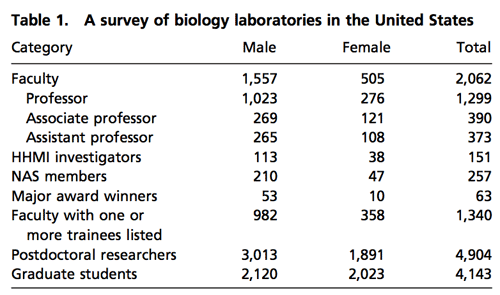
Women make up over one-half of all doctoral recipients in biology- related fields but are vastly underrepresented at the faculty level in the life sciences. To explore the current causes of women’s underrepresentation in biology, we collected publicly accessible data from university directories and faculty websites about the composition of biology laboratories at leading academic institutions in the United States. We found that male faculty members tended to employ fewer female graduate students and postdoctoral researchers (post-docs) than female faculty members did. Furthermore, elite male faculty—those whose research was funded by the Howard Hughes Medical Institute, who had been elected to the National Academy of Sciences, or who had won a major career award—trained significantly fewer women than other male faculty members. In contrast, elite female faculty did not exhibit a gender bias in employment patterns. New assistant professors at the institutions that we surveyed were largely comprised of postdoctoral researchers from these prominent laboratories, and correspondingly, the laboratories that produced assistant professors had an overabundance of male postdocs. Thus, one cause of the leaky pipeline in biomedical research may be the exclusion of women, or their self-selected absence, from certain high-achieving laboratories.

These statistics were obtained by sampling a large number of labs across the US. The leaky pipeline is rather obvious in this table: note that we have parity at the graduate student level, but that it falls off dramatically at the next level up.

surveytable

This is a problem. One (not the only one!) of the criteria used to select academic hires is the reputation of the lab they came from — some labs are just really good at cranking out the data, publishing publishing publishing, and new graduates coming out of those labs are likely to continue that pattern. Coming out of a well-known lab provides a real leg-up for an academic career. But what this paper found is that women were less likely to find themselves in those labs.

We found that female trainees were much less likely to work for an elite PI, particularly at the post-doctoral level. Combining faculty of both genders, men were about 17% more likely to do their graduate training with a member of the NAS, 25% more likely to do their postdoctoral training with a member of the NAS, and 90% more likely to do their postdoctoral training with a Nobel Laureate. Thus, the gender skew in employment results in fewer women being trained in the laboratories of elite investigators.

Get with the program, Nobelists!

My first thought was that maybe this was a product of an older generation — that more senior faculty are going to be much older and perhaps unfortunately traditionalist, so all we have to do is wait for them to die off and be replaced. No such luck. When the data are carefully dissected, the correlation isn’t with age, but with elite status (as defined by membership in prestigious organizations). Young male investigators are just as unlikely as old male investigators to hire women.

As expected, among male faculty, elite status was negatively correlated with the percentage of female postdocs in a laboratory (P < 0.0001). This relationship remained true even when several other explanatory variables were added, including faculty rank, years since a faculty member had received his or her PhD, and total number of trainees in a laboratory. As a single independent variable, years since PhD was moderately negatively correlated with the percentage of female postdocs in laboratories with male faculty members (P < 0.045), but this effect disappeared when other variables were included in the model. This observation suggests that a faculty member’s age is not a significant determinant of the gender makeup of their laboratory, and both young and old elite professors employ few women. Laboratory size was also negatively correlated with the representation of female postdocs both as a single variable and in multivariable models. Regression against the percentage of female graduate students in each laboratory revealed similar, although less robust, results. In multivariable models, elite status was associated with a significantly lower percentage of female graduate students trained by male faculty. However, years since PhD correlated with an increasing representation of female graduate students, whereas laboratory size was not significantly correlated in either direction. Finally, we constructed equivalent linear models for female PIs, but we failed to find a single variable that was significantly associated with differential representation of female trainees in these laboratories.

The paper is careful to point out that they don’t know the direct causes of the differences, whether it’s exclusion, conscious or otherwise, by faculty men, or reluctance of women to apply to those labs. We should probably try to figure that one out, since that’s how the problem gets fixed…but it’s probably a combination of all of these factors.

Irrespective of the cause of the gender disparities in elite laboratories, its consequences significantly shape the academic ecosystem. Our data show that these laboratories function as gateways to the professoriate: new generations of faculty members are predominantly drawn from postdocs trained by high-achieving PIs. However, these feeder laboratories employ a disproportionate number of men. According to the theory of cumulative disadvantage, persistent inequalities in achievement can result from small differences in treatment over a prolonged goal-oriented process. In controlled studies, women in academia receive less favorable evaluations, receive lower salary offers, and are ignored by faculty more frequently than men. Access to training in certain laboratories may be another level at which women are disadvantaged. The absence or exclusion of female trainees from elite laboratories deprives them of the resources, visibility, networking opportunities, etc. that could facilitate their professional development. These differences may contribute to the leaky pipeline by shunting women toward laboratories that provide fewer opportunities for advancement in academic science.

I’m certainly not at one of those elite laboratories, so I can’t do much at that level — but I am training swarms of undergraduate women and stuffing them in at the base of the pipeline. One thing we can do here is encourage our graduates to be ambitious and push hard to get into the labs they really want…and to prepare them for the institutional biases that will get in the way.

I will not call on you to demand Anthony Cumia be fired

Anthony Cumia of the Opie & Anthony show has a long history of public awfulness. He’s a sexist pig and a creep.

But I don’t think you should call Sirius XM and complain.

His latest episode was a flamingly racist tirade against a black woman (only he didn’t restrain himself to merely call her a “black woman”). He wanted to shoot her because she slapped his camera away when he was taking creepshots.

He’s an appalling human being. But why bother demanding his dismissal?

Many media outlets are howling about his violent racist fantasies. He’s scum.

But he’s just the erupting pimple of the problem. The real issue is that somewhere in the corporate headquarters for Sirius XM, there is a nest of verminous, amoral, soulless corporate drones who saw a racist misogynist loudmouth as a pile of dollar signs. Fire Anthony Cumia, they’ll still be there. Fire Cumia, his audience of sympathetic racist misogynist cowards will still be there. Treating the repugnant excrescences without digging deep to the root of the disease is not enough.

If you want to do anything, cancel your Sirius XM account. Not conditionally, not if they don’t fire Cumia, but just plainly and simply cut them off. Punish the executives. Do you know anyone who listens to that Opie & Anthony crap? Repudiate them, publicly and unabashedly. Let them know that they are also terrible human beings for giving an audience to racists.

Firing Anthony Cumia is just the icing on the cake. Demand more.

If your only justifications for sexism are stupid, you should maybe stop making them

Once again, we get stupid answers to a good question. A a guest post on the Curious Wavefunction decides that Larry Summers was right, there are innate differences between men and women. (Curiously, this is the same blog that posted a positive review of Nicholas Wade’s book — strange how sympathy for racism and sexism go hand in hand). It starts off well by pointing out a real phenomenon, the different sex ratios found in different scientific disciplines.

Here are statistics on the sex ratio among graduate students. The order here is by level of analysis (with computer science thrown in somewhat arbitrarily next to physics). The first number is men; the second number is women.

Physics:   1694: 448
Computer Science:  1465: 380
Chemistry:  1520: 897
Biology:  3936:4494
Psychology   1047:2566
Anthropology:  186: 360:
Sociology: 230: 400
Political Science: 422: 303

Why is that, you might wonder…and of course, the answer we’re going to get is that there’s something about the Y chromosome or the hormonal environment that predisposes one to like computers vs. cells, or experiments with lab rats vs. electronic gadgets. Which, simply on the face of it, is complete bullshit.

I’ve noticed that these arguments often prefer to show a current snapshot of the statistics to make their point: looking at historical trends tends to screw up their assertion of a biological difference. A century ago, virtually none of these disciplines had a preponderance of women enrolled in them, and women professors were extremely rare. I guess there has been a remarkable degree of selection extinguishing all those stupid women from the population in the last 100 years. It’s simply not possible that cultural factors might strongly influence the pattern.

Similarly, we could ask questions about aptitude. Women just don’t like those disciplines with low female enrollment, because ladybrains. But how do we account for historical shifts in ability? Look what’s going on in the British school system.

The relative improvement in girls’ performance in examinations at 16 has been achieved over the last ten years. In the l960s, boys outperformed girls by about 5%; for the next fifteen years, boys and girls were performing at almost equivalent levels. However, from 1987 only about 80 boys to every hundred girls achieved 5 high grade passes at 16+. Boys lost their advantage in terms of school leaving credentials and are now struggling to keep up to girls’ success rate. In the mid l980s, girls turned the tide of credentialism, even at least temporarily, in their favour.

Oddly, no one seems willing to advance the bold hypothesis that maybe boys’ genes and hormones make them less scientific. It’s always the other way around, that women are less capable, because ladyparts…even in defiance of the evidence that women are performing better than men.

OK, well I promised we’d have some good questions. I lied. This guy asks stupid questions.

This brings us to two related questions: Why is the percentage of women somewhat proportional to the “socialness” of the science?

WHAT THE HELL…? Look at the list up above. Can you tell me which of those disciplines is more “social” than the others? Science in every discipline is an extremely social enterprise — if you’re going to succeed in it, you have to be able to engage with your colleagues, present your work publicly, collaborate, teach, and work in committees. If you think you can crawl into a basement and do computer science without bathing for 5 years, well, you can…but you won’t get a job afterwards, and you won’t be able to be a significant team member. Really, I know computer scientists. They do bathe regularly, and they can be friendly and engaging.

This assumption is a classic example of circular reasoning. Women are more social; some disciplines have more women than men; therefore, biology must be more social than physics; and the evidence for that is that biology has a higher proportion of women graduate students than physics. Ta-daa. QED. Guys win.

And why don’t women choose academic careers after they finish graduate school? To answer these questions, it’s worth looking at Steven Pinker’s contribution to the post-Larry Summers debate at Harvard.

Wait. That’s a different question, and it’s informative that the distinction isn’t addressed. Women are succeeding in greater numbers in graduate school than they are in post-doctoral careers. That’s revealing! By getting through graduate school, which is a pain-in-the-ass and a major sacrifice of time and money, these women have already shown a strong interest and ability in science. They are full-on dedicated scientists.

What’s the difference in the transition from life as a graduate student to the professoriate? More expectations for teaching, networking, committee work, grant writing, and collaboration. More of those “social” skills we’ve just been told women are naturally better at. As usual, none of this argument makes any sense, and consists entirely of sloppy attempts to rationalize prior biases.

We are promised evidence that women are simply less suited to working in science. Let’s see the list.

The full debate is also worth reading in full—and I apologize for giving Elizabeth Spelke, Pinker’s opponent, short shrift here–but this is Pinker’s summary of the psychological differences between men and women:
1. Men, on average, prioritize status, while women weigh status and family equally.
2. Women, on average, are more interested in people; men are more interested in things and abstract rule systems. 
3. Men are by far the more reckless sex.
4. Men, on average, have a superior ability to do three-dimensional mental transformations.
5. Men, on average, are superior at mathematical reasoning.
6. Men have more variability than women across traits, which means that men are over-represented in the upper and lower tails of ability distributions.

Jebus. Those are just assertions. Who says women don’t “prioritize” status? How was that measured? Do women just sit around content to be egalitarian? Has anyone considered the possibility that status-seeking is going to be entirely culture dependent, and that there are different ways for different people to achieve high status? (I know they have, but those complexities are always jettisoned by the advocates for male superiority — the parameters of male dominance are naturally and obviously the only ones that matter, and they are objectively independent of societal constraints.)

I’m not going to was time going through these bald assertions one by one, but let me just say, they don’t apply. We’re already looking at a fairly rarefied subset of human endeavor occupied by people of largely above average socio-economic status, from families with an already above average emphasis on education. You can’t derive the properties of an already select subset from generalizations about the population as a whole, or you’d have to conclude that most scientists are blue-collar and service workers. We already know that there are strong cultural and familial influences that bias some women to pursue careers in science — factors that are not present for most women. Or most men. So even if their generalizations about the abilities of women were valid on the whole (and I don’t agree that they are; #2, 4, and 5 are clearly influenced by social conditioning, and #3 is statistically true but again probably influenced by social expectations), you simply can’t use them to talk about a small population that is both self-selected and strongly constrained by socioeconomic opportunities.

But #6…oh, #6, how I despise you, and how I constantly hear it trotted out as a justification. Look at the structure of that argument. We can clearly show that more men than women have mental disabilities and illness, therefore, we should expect that more men should show a greater range of high intelligence.

WHY? That makes no sense. It’s some kind of weird appeal to statistical fairness — that for some reason, Nature must balance every curse with a blessing, that every curve must be a perfectly symmetrical bell shape. But that is not true. There is no reason to expect it to be true.

It’s also selectively applied. I noted up top that the same people who argue for differences in intellectual aptitude between the sexes also like to argue for differences in intellectual aptitude between races. Yet for some reason, you’ll never see them suggest that since black people have a higher frequency of criminals and ignorant, uneducated men (I’d suggest that poverty and discrimination play a strong role in that, but you know these guys — they say it’s objective evidence of genetic inferiority), they must therefore also have a greater proportion of saints and geniuses in their populations.

It would be only fair, you know. Everything has to balance.

Or we never see this interesting proposal: malnutrition also increases the variability in a population. Therefore, if we want more supergeniuses, we should starve children — sure, we’d get a lot of death and illness, but the ones who thrive are going to be tough and brilliant.

I find myself endlessly exasperated by these transparently stupid justifications. They aren’t even internally consistent.