Books, Wonderful Books.

nn

I’ve recently read these three books by Nnedi Okorafor (and Binti, of course, but that was earlier.) Reading is a good occupation in between bouts of ‘not-quite-conscious’ periods of being concussed. It’s with relief and familiarity, laced with deep comfort that I sink into Ms. Okorafor’s books. As far as I know, I have no connection to any part of Africa, and while it can take time to get the rhythm of some works, such as Lagoon, it’s the indigenous mindset I sink into with ease. Like too many other people, I am beyond weary of stories with the same rapacious, colonial mindset, populated with the ever ubiquitous straight white males. Even authors who don’t mean to write in that mindset tend to slip into it, because we’ve all been trained that viewpoint is best, it’s good, it’s great, pat on the head, now sit down and be quiet. Ms. Okorafor’s protagonists are all too human, even when they aren’t quite human. They suffer with their flaws, and struggle to cope with them, as we all do. Her protagonists are often women, which is yet another comfort. I don’t have to struggle with often squirmy, unwelcome moments when a protagonist character is male, and does something cringe inducing and deeply embarrassing. This isn’t to say there aren’t such moments in these books, there are, because there are people like that all over the place, and we all have to deal with them. They are better in the background though, where we can’t always relegate them in real life.

These books coincided with my camp life, and a strong theme through all of them is the same one at the center of the protection going on here in Ndakota: Water Is Life. Aman Iman. Mni Wiconi. There’s a natural spirituality suffused throughout the books, and I find that familiar and comforting also, because it’s the spirituality of indigenous people all over the world. She understands the need to keep traditions alive, and the fight to remain community based while embracing the wider world. This leads me into contentious territory, but I don’t see a conflict, and I don’t see the need for one, either. People were having a good talk about these issues in this thread, and while I’ve had thoughts swirling about in my shaken brain, I haven’t felt the coherence needed to tackle it. I’ll complain yet again at what a remarkably lousy language English is when it comes to certain concepts. Even when it doesn’t suck, terms are so loaded with baggage that a great many people simply can’t move past the baggage to even try and understand.

I don’t believe in gods. I don’t believe in an afterlife. I believe in the physical world, I believe in the universe, and I believe in life. There’s plenty of room in that for spirituality, and without any need whatsoever to worship anything, or be a Crystal clear running rainbow unicorn summer rain star type of person. Atheists often bring up Carl Sagan, and he always struck me as a very spiritual person, who often spoke of the numinous, a word used in an attempt to get away from the overly laden ones, like sacred or divine. Sagan was science based, but he also lived a life in appreciation and awe of life, all life. He got it, he grokked what was important – the connection of all things, of all life; the importance of all life, and the need for responsibility, care, and respect. Indigenous people believe we are obligated to care for our earth, and it’s a responsibility which has always sat seriously albeit lightly on the shoulders of indigenous people. That responsibility has become a terrible burden ever since colonialism came into the picture, bearing down with a ruthless brutality and no respect at all, for anything. If anything, the colonial attitude and way of being has become increasingly rapacious, with care for nothing except money-filled pockets. Those of us without money-filled pockets find ourselves constantly bruised from being tossed about by marketing and the propaganda screech of always needing more, more, more, more. More and more people find themselves in living situations where they have none to little contact with nature in any way, and have no sense of community, either. There are whole generations now who don’t have the slightest idea of what a community is like. That came up a lot at camp. I met people from all over the U.S. who did not want to leave, as they had never experienced anything like the camp, the community which has grown there. They were blown away by how community works, and many people were fired up and determined to go back home and start building a community there. I saw people who had definitely felt they had been missing something, but didn’t know what. When they came to the camp, they found it – community. So, can you have a sense that’s there’s a hole in you somewhere? Yes, of course you can. Will being part of a community fix everything? Nope. It will sure as hells help though, and simply being part of something larger can help to heal much of what ails people. Being a bunch of communityists is good for our non-existent souls.

There’s every reason in the world to work on a spiritual connection to our earth. When you have that, when you understand that all life is sacred, important, and connected to you and all other life, respect happens. When you have respect, you have care, awareness, mindfulness. When you have respect, you have thankfulness. Thankfulness for the energy the sun provides, for the light and the warmth. Thankfulness for the water, which is life. Water to drink, water to bathe yourself, water to cook, water to create. Thankfulness for the air, and all the plants and trees which give us so very many gifts. Thankfulness for the earth, which provides us with a foundation, and the means to grow and nourish ourselves. Thankful for all the species we are related to and their gifts to us. When you have respect and gratitude, sustainability and care are built in. It’s part and parcel of your everyday beliefs and actions. When you have that spiritual connection, you understand that you need to give at least as much as you take. A balance must be kept. This does not mean you need to turn yourself into a credulous, babbling critter. It does mean you are aware of life, all life, and the connectedness and importance of that life. Indigenous people don’t find themselves afflicted with a sudden societal based mania to poison the land they live on to destroy dandelions, or decide to pour poison all over to get rid of groundhogs. That’s because there’s a deep understanding of how things work on our earth, and they aren’t removed or disconnected from it, the way many people are now. It’s not wrong to question these idiocies, like having to maintain a golf course lawn, or why anyone would want to do that in the first place. Allowing native plants to grow is good for many other beings, like all the pollen gatherers and transporters, who in turn, help to nourish our crops so we can feed ourselves. It’s one tiny chain among many which  maintains health in all of us.

Sometimes, sitting on the sidelines and listening to people talk (translation: reading along without commenting), I’m often bemused by the atheist voices I’m part of. Over the years, it’s been increasingly popular for atheists to adopt a dictionary only not in the least emotional stance. I’ll admit to being befuddled by that, because it seems a sterile isolation to confine oneself to, for no particular reason. If that really makes a person happy, okay. I have my doubts about that making anyone happy though. I’m an atheist who finds the dictionary only argument to be utterly idiotic, and it’s seriously not my thing. I want things to be better. I want people to be better. I want people to be content, more self sufficient, more thoughtful, more community based. I want people to care, and I want to effect change. That means changing myself, too. I don’t see the attraction in sitting around, sniffily denouncing this, that, and the other, while claiming not to give a damn about anything at all. I don’t see the point of that, either. There’s already enough resigned apathy afflicting people, and I don’t see any virtue in promoting that as a way of being. It’s not impossible or wrong to be spiritually connected as your way of life, your way of living.

I know this will get its fair share of sneers, disdain, and bad ‘jokes’. If that’s all you have in you, go for it. I have more inside myself, and I am not ashamed to care and expect others to care as well. I think it’s perfectly possible to be an atheist and to be spiritual as well.

I recommend reading Chief Arvol Looking Horse on the current situation we all face, the constant assaults on our earth, and the increasing destruction going on everywhere. I had the honour of listening to Chief Looking Horse at the camp several times. I first read the linked piece some time back on ICTMN, and wanted so much to share it, but I gave into fear because it is deeply spiritual, and all I could think about was mockery from those who would read, and I let that fear rule me. No more. This sickness must stop, and I must fulfill my responsibility to our earth. One of the lawyers currently working on the pipeline problem here and in Iowa has a good column up at ICTMN, which includes an excerpt from Bemidji Statement on Seventh Generation Guardianship:

“Who guards this web of life that nurtures and sustains us all?

Who watches out for the land, the sky, the fire, and the water?

Who watches out for our relatives that swim, fly, walk, or crawl?

Who watches out for the plants that are rooted in our Mother Earth?

Who watches out for the life-giving spirits that reside in the underworld?

Who tends the languages of the people and the land?

Who tends the children and the families?

Who tends the peacekeepers in our communities?

*******

We tend the relationships.

We work to prevent harm.

We create the conditions for health and wholeness.

We teach the culture and we tell the stories.

We have the sacred right and obligation to protect the common wealth of our lands and the common health of our people and all our relations for this generation and seven generations to come. We are the Guardians for the Seventh Generation.”

For anyone who has missed the basics of what’s happening, Kyle Powys Whyte has an excellent article here.

God’s Not Dead, but Unwelcome at RNC.

A short while back, I posted about the FFRF billboard going up at the RNC.  The makers of the movie God’s Not Dead 2 wanted to put up an advert too, a rather large one:

What convention attendees won’t see is an even larger sign with a pro-religion message that would have advertised the DVD release of God’s Not Dead 2. That’s because, after two months of back-and-forth with the movie’s distributor, the billboard company, Orange Barrel Media, may have deemed the Christian-sounding messaging needlessly provocative.

The sign, which would have measured 32 feet by 60 feet, would have draped down one side of a large building in downtown Cleveland and was to feature a picture of Melissa Joan Hart, who plays a teacher in trouble for invoking scripture in the classroom. Alongside the image of the actress was the text: “I’d rather stand with God and be judged by the world than stand with the world and be judged by God.”

Cleveland_Billboard_God_Not_Dead_EMBED_2016

That is truly a monster sized ad. It’s even huuuuuuuuuuuge.

Orange Barrel told Pure Flix, the distributor, it didn’t like the “judged by God” message, calling it “too political” and “way too incendiary,” according to emails obtained by The Hollywood Reporter. On another occasion, insiders said the billboard company complained that even the title of the film was considered problematic.

Early on, Orange Barrel cited Republican National Committee rules barring “scandalous” signage, though Pure Flix argued that the RNC would have no problem with their message, especially since former GOP presidential candidate Mike Huckabee is in the movie. In fact, the GOP has partnered with Pure Flix for a worship service the night prior to the start of the convention, followed by a screening of the movie (with food provided by Chick-fil-A).

No word right now on whether or not the ad will eventually find a home at the RNC, but the FFRF has another ad up:

FFRF_Atheist_Poster_EMBED

Via Hollywood Reporter.

Saint Reagan vs RNC.

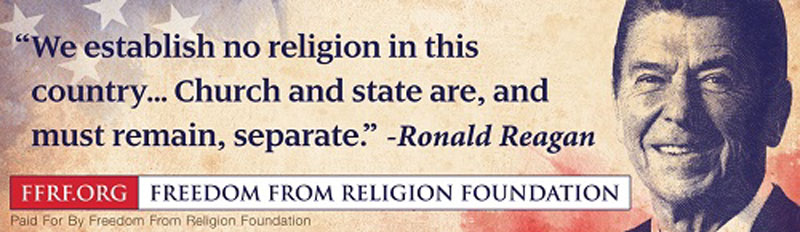
FFRFRNCProof

Former President Ronald Reagan’s son and namesake Ron Reagan is literally the poster-person against religion. While the younger Reagan has been doing ads on news channels for the Freedom from Religion Foundation, it will be his father’s words that will hover over the Republican National Convention in Cleveland, Ohio in July.

“We establish no religion in this country… Church and state are, and must remain, separate,” the billboard will read.

[…]

“The RNC needs to be reminded that our nation is predicated on a godless and entirely secular Constitution,” she said. “The fate of our Establishment Clause hangs in the balance of the election. We’re not voting for the next president — we’re voting for the next Supreme Court justice.”

The local chapter director, Marni Huebner-Tiborsky, agreed that the message is an important one for Republican leaders to remember. “This billboard couldn’t be any more timely, and is definitely needed to remind our political leaders and the public that political campaigns should stick to a secular platform, where real change can happen,” she says.

Full Story Here. While I do think this might turn some heads, I doubt it will make a serious impact at this late date in the game. I also think the current crop of repubs is simply too far gone to consider this seriously, although it will hurt to see St. Ronnie going against their constant screed.

Atheist Perspective in Times of Tragedy.

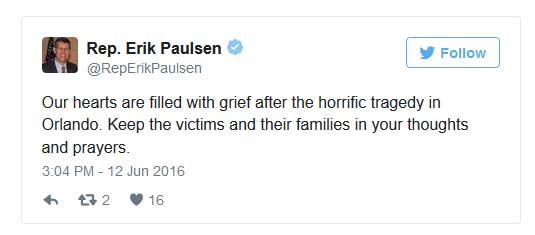
Alternately, Thoughts and Prayers # 896,367.

AP

The aftermath of our all too regular mass homicides follows a familiar pattern. “Thoughts and prayers” are with survivors, victims’ families and the affected city. There are defiant assertions from the horror­struck that, “We will not tolerate this any longer.”

Some politicians call for an end to hate and better coordination between law enforcement agencies. And others, when there’s a whiff of Islamic heritage involved, play the “enemy is here” card, recklessly injecting accelerant into the roiling emotions of the moment.

For the media, standard reaction reporting involves transcribing pretty much all of the above. In the case of the Boston Marathon bombing, the Ft. Hood shooting, Paris, San Bernardino and now Orlando, it’s also standard practice to log the response from leaders of various religious faiths, most of whom encourage restraint and emphasize that Muslims themselves are collateral victims of these atrocities. The good, dutiful notion being to develop a body of sympathy that reflects solidarity among the broader local religious community.

While the Strib and the PiPress haven’t gone the latter route yet, at least when I called Monday, National Public Radio was hitting all the customary notes.
And all that is fine insofar as the objective is to register the solidarity of the community at large. But if the intention is ever to discuss the “perversion of religion,” a common enough refrain today and in past incidents involving radicalized Muslims, there’s at least one group, silent but no longer all that small or irrelevant, that the media rarely draws into these discussions, such as they are: atheists.

[…]

“I think we were called once, some time after 9/11,” says August Berkshire. “And no, no one else has called today.”

Berkshire is the founder and past president of ​MinnesotaAtheists​ . He’s been active in the cause of challenging the belief systems of organized religions since the mid­-1980s and jokes that current membership in the state is “probably around 250,000, although most haven’t paid their dues yet.”

Humor aside, Berkshire, a local delivery truck driver by day, is serious about the value of inserting an atheist perspective into conversations about religiously inspired violence. “Look, prayer didn’t do anything to stop this latest attack and prayer won’t do anything to stop this kind of violence from happening again. All it may do is make some people feel good for a while.”

[…]

But if the point is to engender an honest debate, you’d expect the atheist view to at least have a seat at the media table in moments like this. “Look,” says Berkshire, “at their origin, all three of the Abrahamic religions — Christianity, Judaism and Islam — preach and warn against homosexuality. They’re anti­gay. A lot of their followers today may be cafeteria Christians, Jews and Muslims, picking and choosing what they want. But I’m talking at their scriptural origins. We reject that. Atheists reject the teachings of religions for a lot of reasons, but among them is the lack of respect for science. Atheists, if I have to point it out, are very accepting of gay equality and other minority issues. We understand that.”

With ​23 percent of Americans in 2014  ​describing themselves as “nones,” which is to say having no religious affiliation, a nearly 50 percent increase since 2007, the atheist, or agnostic or “nothing in particular” perspective would seem to warrant at least as much regular reporting as what we get on priests, ministers and rabbis, certainly more than the “almost never” Berkshire describes.

[…]

Perhaps the problem with pulling atheists into a conversation about the “perversion of religion” is that spokespeople like Berkshire lack the curriculum vitae of traditional religious leaders. I mean, a guy who drives a truck cheek by jowl in a discussion with a priest, a minister and a rabbi?

But maybe the real issue is that the taint of taboo that still hangs to word “atheist.” Conventional journalism is partial to conventional wisdom and despite the steadily slumping numbers in church/synagogue/mosque attendance — and the rapid increase in those tuning out traditional religious messages — conventional journalistic wisdom has not yet reached a comfort point with overt atheism. Until that point is reached, speculation here is that mainstream news organizations will continue to treat it like a semi-­reputable curiosity.

Full Article Here.

Atheists are cowards and the police ignore the law.

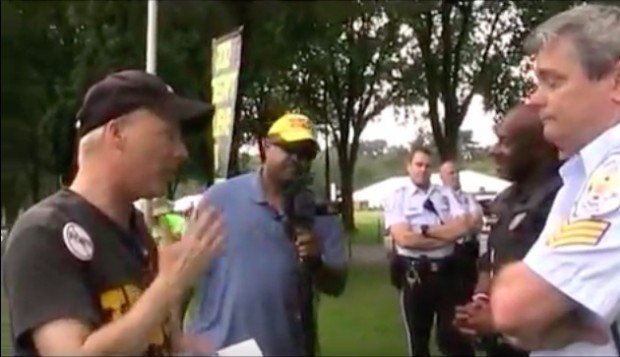
Christian street preachers clash with authorities (YouTube/Buddy Fisher)

Christian street preachers clash with authorities (YouTube/Buddy Fisher)

Naturally, Christians showed up at the Reason Rally to do some preaching. It takes time to get to the clash between the U.S. Park officers and the preachers (around the 9:00 minute mark), so I listened to a fair amount of the standard nonsense, mostly about hell, but there was one interesting bit. The preacher (who is, I assume, Buddy Fisher) is carrying on about us decadent atheists, how we love our sin, our drunkenness, our sex outside marriage, our…muff diving. The preacher seemed to realize that he may have skittered off the rails a bit with that one, and quickly moved to a different tack. Back to more of the same old, if we’re just a bag of chemicals, there’s no love, yada, yada, yada, some odd stuff about Hemingway being an authentic atheist because he killed himself, and before long, the park cops show up. They are quiet, and polite, and explain that the preachers have a choice of two different locations to where they can move. Oh no. No, no, no. Preacher whips out this paper, and explains this court case, and that they have The Heckler’s Veto! You can’t make us move! Magic Court Papers! (I think the court case was Bible Believers v. Wayne County.) They keep arguing, the video ends.

Oh look, here comes the continuation! A description on the second video reads: ”Part 2 of unlawfully being removed from the Reason Rally 2016 in Washington DC. Officers Burnett and White unlawfully remove Christians from an event that is free and open to the public being held by a group of atheists with a non-exclusive permit. Their permit allows them to set up the stage, amplifiers, etc, but does not give them the authority to remove us from public property. Atheists are cowards and the police ignore the law.”

Via The Blaze.

The End of Absolutes: America’s New Moral Code.

Barna_Morality_charts_v42

Christian morality is being ushered out of American social structures and off the cultural main stage, leaving a vacuum in its place—and the broader culture is attempting to fill the void. New research from Barna reveals growing concern about the moral condition of the nation, even as many American adults admit they are uncertain about how to determine right from wrong. So what do Americans believe? Is truth relative or absolute? And do Christians see truth and morality in radically different ways from the broader public, or are they equally influenced by the growing tide of secularism and religious skepticism?

Again with this “oh no, Christianity is on the very brink of extinction!” The hell it is. If that were the case, then why are constant attempts to legislate Christian bigotry happening every 5 bloody seconds? Why is there a never ending fight against Christian based hatred of this group, that group, every group but the Christian one? All this wailing and weeping over nothing.

While most American adults agree that culture plays some role in establishing moral norms, a majority also agrees “the Bible provides us with absolute moral truths which are the same for all people in all situations, without exception” (59%). There is broad agreement across age groups, which is surprising when one considers the notable generational differences on other questions related to morality. When it comes to faith groups, practicing Christians (83%), as one might expect, are much more likely to agree with the statement than others, especially those with no faith (28%). In fact, more than half of practicing Christians strongly agree (56%).

I am sick to death of Christian ‘morality’. There’s no such thing. What there is, is Christian hate. What passes for Christian morality is patriarchal privilege, sitting in judgment and ruling over every tiny aspect of others’ lives. If that patriarchal privilege is eroded even by the smallest amount, the wailing, weeping, gnashing of teeth, and panic sets in.

Americans are both concerned about the nation’s moral condition and confused about morality itself. As nominally Christian moral norms are discarded what, if anything, is taking their place? Barna’s research reveals the degree to which Americans pledge allegiance to the “morality of self-fulfillment,” a new moral code that, as David Kinnaman, President of Barna argues, has all but replaced Christianity as the culture’s moral norm.

Emphasis is mine. Once again, the fuck it has. Mr. Kinnaman, is the president of Barna, supposedly a non-partisan organization, who has written a book about faith and being a good Christian. So, we continue with the stream of melodramatic glurge from those who insist that Christianity is dying, slain by secularism.

The morality of self-fulfillment can be summed up in six guiding principles, as seen in the table below.

Barna_Morality_charts_v43

“The highest good, according to our society, is ‘finding yourself’ and then living by ‘what’s right for you,'” says David Kinnaman, president of Barna Group in Good Faith: Being a Christian When Society Thinks You’re Irrelevant and Extreme. “There is a tremendous amount of individualism in today’s society, and that’s reflected in the church too. Millions of Christians have grafted New Age dogma onto their spiritual person. When we peel back the layers, we find that many Christians are using the way of Jesus to pursue the way of self. . . . While we wring our hands about secularism spreading through culture, a majority of churchgoing Christians have embraced corrupt, me-centered theology.

There’s much more, including more graphs and charts, here.

Ray Comfort & The Reason Rally, Part II.

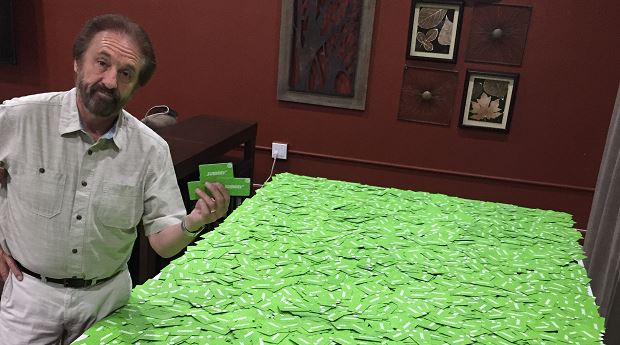
Ray Comfort and Subway gift cards that had been intended for Reason Rally attendees (Image courtesy Ray Comfort)

Ray Comfort and Subway gift cards that had been intended for Reason Rally attendees (Image courtesy Ray Comfort)

Remember Ray’s plan to invade the Reason Rally, and sway black, atheist hearts with cheap Subway gift cards? Well, Washington police have nixed his grand plan:

Ray Comfort is reluctantly canceling plans to give books and gift cards for Subway sandwiches to atheists at a coming rally in Washington. Police forced him to cancel, he explained to WND, because of the size of his contingency. More than 1,000 Christians had volunteered to help hand out the gifts to atheists who will be attending this year’s Reason Rally. […] The huge number of people who volunteered to join him apparently caused concern among Washington police. “To the D.C. police,” he said, “that constituted a protest and therefore we needed a permit to gather. We would have to stay at the other end of the National Mall, and they said that if we persisted to approach atheists to speak with them we would be arrested.”

He still plans to be there with a crew of 17 people.

[…]

“In what is so often a cruel world, we tried to show a little kindness and it didn’t work. So it now looks like we will be eating Subway sandwiches for the next 40 years,” he said.

A little kindness? Oh, ever the liar, Ray. You were grandstanding again, looking to feed your ego, rather than doing something truly kind, like feeding people who are desperately hungry. It seems even when your planned arrogance is quashed, you still can’t manage that simple act of kindness.

Full Story Here (be warned, it’s mostly a praise and link dump all about Ray, Ray, Ray.)

Schoolboard Says No to “In God We Trust”.

InGod

On Tuesday night, the Waynesboro [Pa] Area School Board voted on a motion to accept a gift of several plaques that say “In God We Trust,” and put them up in the lobbies of six district public schools. Local businessman Tom McCloud officially offered the plaques as donations to the county’s public schools back in March.

Several supporters of the national motto spoke up at Tuesday’s school board meeting, in favor of installing the plaques. “It’s such a positive story, it’s such a uniting force,” said Pennsylvania State Representative Rick Saccone (R-Allegheny and Washington). “Our kids need that…sorely need that today.”

Not everyone agrees, however – atheist groups in Pennsylvania have already come out against it. While most who spoke at the school board meeting support the plaques, one Navy veteran, who called himself a “proud Christian,” took the podium to oppose the plaques.

“Many members of the community – Christian, Muslim, Buddhist, atheist – all pay taxes and support,” said John Bryan, a resident of the Waynesboro area. “They might not wish their child to see that in the school, and I believe the proper place for it is in church or in the home.”

[…]

On the other hand, critics said “In God We Trust” only gained popularity during the Cold War era. The words became the national motto in 1956, during the “Red Scare” toward Soviet Russia and communism.

“There is absolutely no mention of God in our founding documents, and there is a reason for that,” Bryan added. “E pluribus unum – out of many people, out of many cultures, out of many religions – we come together as one people.”

Way to go, Mr. Bryan, and thank you. Full Story Here.

Dawkins: I’ve Given Up Twitter.

_89774482_gettyimages-459925796

Richard Dawkins. Getty Images.

Some of the professor’s most heated recent spats have unfolded on social media. He has qualified some of his Twitter remarks and lamented that medium’s lack of nuance, but embraces it nonetheless.

Or at least, he used to.

“I’ve given up Twitter,” Prof Dawkins says quietly but curtly. The tweets that appear in his name, apparently, are the work of the staff at his Foundation for Reason and Science.

“I occasionally ask them to post something, which they do, but I’ve given up doing it myself.”

It’s about time. Source.

University of Miami Establishes Chair for Study of Atheism.

 Louis Appignani, a retired businessman, endowed a chair “for the study of atheism, humanism and secular ethics.” Credit Max Reed for The New York Times.

Louis Appignani, a retired businessman, endowed a chair “for the study of atheism, humanism and secular ethics.” Credit Max Reed for The New York Times.

With an increasing number of Americans leaving religion behind, the University of Miami received a donation in late April from a wealthy atheist to endow what it says is the nation’s first academic chair “for the study of atheism, humanism and secular ethics.”

The chair has been established after years of discussion with a $2.2 million donation from Louis J. Appignani, a retired businessman and former president and chairman of the modeling school Barbizon International, who has given grants to many humanist and secular causes — though this is his largest so far. The university, which has not yet publicly announced the new chair, will appoint a committee of faculty members to conduct a search for a scholar to fill the position.

“I’m trying to eliminate discrimination against atheists,” said Mr. Appignani, who is 83 and lives in Florida. “So this is a step in that direction, to make atheism legitimate.”

Religion departments and professors of religious studies are a standard feature at most colleges and universities, many originally founded by ministers and churches. The study of atheism and secularism is only now starting to emerge as an accepted academic field, scholars say, with its own journal, conferences, course offerings and, now, an endowed chair.

The Full Story is Here.

No Religion on the Rise in England and Wales.

A near-empty church. Photograph: Kumar Sriskandan/Alamy.

A near-empty church. Photograph: Kumar Sriskandan/Alamy.

The number of people who say they have no religion is rapidly escalating and significantly outweighs the Christian population in England and Wales, according to new analysis.

The proportion of the population who identify as having no religion – referred to as “nones” – reached 48.5% in 2014, almost double the figure of 25% in the 2011 census. Those who define themselves as Christian – Anglicans, Catholics and other denominations – made up 43.8% of the population.

“The striking thing is the clear sense of the growth of ‘no religion’ as a proportion of the population,” said Stephen Bullivant, senior lecturer in theology and ethics at St Mary’s Catholic University in Twickenham, who analysed data collected through British Social Attitudes surveys over three decades.

“The main driver is people who were brought up with some religion now saying they have no religion. What we’re seeing is an acceleration in the numbers of people not only not practising their faith on a regular basis, but not even ticking the box. The reason for that is the big question in the sociology of religion.”

[…]

The new analysis will fuel concern among Christian leaders about growing indifference to organised religion. This year the Church of England said it expected attendance to continue to fall for another 30 years as its congregations age and the millennial generation spurns the institutions of faith.

According to Bullivant’s report, Contemporary Catholicism in England and Wales – which will be launched at the House of Commons on Tuesday, both the Anglican and Catholic churches are struggling to retain people brought up as Christians.

Four out 10 adults who were raised as Anglicans define themselves as having no religion, and almost as many “cradle Catholics” have abandoned their family faith to become “nones”.

Neither church is bringing in fresh blood through conversions. Anglicans lose 12 followers for every person they recruit, and Catholics 10.

The vast majority of converts come from other Christian denominations, rather than non-Christians or people with no religion. “There’s a kind of denominational musical chairs,” said Bullivant. “No one is making serious inroads into the non-Christian population.”

[…]

A spokesperson for the Church of England said: “The increase in those identifying as ‘no faith’ reflects a growing plurality in society rather than any increase in secularism or humanism. We do not have an increasingly secular society as much as a more agnostic one.

“In a global context, adherence to religion is growing rather than decreasing. Christianity remains the world’s largest religion with over 2 billion adherents. In the UK the latest census found the overwhelming majority of people to have a faith.”

Full Article, Charts and Graphs Here.

Atheists are just pre-Christians.

(Photo: Screenshot/KSFY-TV) Atheist billboards in Sioux City, South Dakota.

(Photo: Screenshot/KSFY-TV)
Atheist billboards in Sioux City, South Dakota.

Pastor Jeff Hayes of Faith Temple Church responded to 20 atheist-themed billboards in his city that display messages such as “God didn’t create man” and “prayer doesn’t work,” by telling local news station KOTA-TV that atheists who criticize religion might just be “pre-Christian people” who need prayer to experience a personal spiritual awakening.

“I think it’s good for Christians to have a reaction and we can be negative toward the Free Thinkers but I think we should just pray for them and just believe that, wow if there is a God, is He big enough to reveal Himself to them,” Hayes added.

“Pre-Christian”. Is this like “Pre-Owned” and “Pre-Born”?

Full Story Here.