From Comedy Central, we have a new trend of Mall Jesuses to take back Christmas from the Mall Santas so that the true meaning of Christmas can be taught to children.
Mano Singham
Just another Freethought Blogs site

From Comedy Central, we have a new trend of Mall Jesuses to take back Christmas from the Mall Santas so that the true meaning of Christmas can be taught to children.
I am not a big Star Wars fan, so take my review of the final act with a grain of salt. (I mean the final act of the original nine-episode storyline of course. This lucrative franchise will be milked with spinoffs until the next millennium.) I enjoyed the first trilogy (episodes 4, 5, 6), absolutely hated the first film of the second prequel trilogy (episode 1), so much so that I completely skipped episodes 2 and 3. The first film in the final trilogy (episode 7) got good reviews, enough that I went to see it and quite enjoyed it. I then watched episode 8 and was disappointed again and was now ambivalent of seeing the latest release but decided to do so due to a combination of staying with people who were going to see it and curiosity about how the story line would end. We ended up seeing it at 8:45 on Christmas day morning which had the benefit of the theater being largely empty even though we were watching it on an iMax screen.
(Q: Why were the nine films made out of order? A: In charge of scheduling, Yoda was.)
[Read more…]
As I have mentioned before, I am partial to watching British police procedural shows on TV. They tend to eschew graphic violence and chases in favor of more genteel story telling. One of the most venerable of these shows is the series Midsomer Murders that has just released its 21st season. Over time, the series has developed a slightly campy, tongue-in-cheek feel because of the sheer implausibility of so many murders taking place in quaint little villages and rustic settings in one small English county. With each season, the way that the murders occur have become steadily more outlandish so that I now often laugh out loud when people have been killed in bizarre ways and their bodies are found in the most incongruous places. (In one episode a few seasons ago, the victim was a cricketer killed by the mechanical bowling machine used for practice that had been adjusted by the killer to rapidly fire high speed balls at his head.)
[Read more…]
I wrote recently about how disconcerting it was when watching a film when the audio and video are not synchronized, so that the spoken words do not match up with the mouth movements of the speaker.
I recently watched a film where this problem was even more pronounced. It was an Italian film but they had dubbed it into English. Dubbing is usually bad and rarely done these days. When I was young in Sri Lanka, I recall seeing a number of so-called ‘spaghetti western’ films that were made in Italy that had one American star (like Clint Eastwood in the Man With No Name trilogy) or with Steve Reeves as various mythical heroes like Hercules, with the rest of the cast being Italian. So the star would speak in English but all the others in Italian with their voices dubbed in English. They were pretty bad.
[Read more…]
Some of you may remember my review of the hilarious short (45 minutes) film The Last Hangover by a Brazilian comedy troupe Porta dos Fundos that that has a reputation for skewering religion, politics, culture and other hot-button topics. That earlier film envisaged the Last Supper as a massive drunken blowout that resulted in the apostles waking up the next day to find Jesus missing and having only the vaguest notion of what had happened.
The troupe has returned with an even funnier short film (45 minutes) The First Temptation of Christ that is being streamed on Netflix. The central premise is a surprise 30th birthday party for Jesus thrown by his parents Mary and Joseph when he returns from spending forty days in the wilderness. But things start to go awry because Jesus (played here by the same actor who played Judas in the other film) has brought a friend Orlando with him whom he met during his desert sojourn. God (whom Jesus has known all his life as just his Uncle Vittorio) also turns up and he and Joseph and Mary have to tell the oblivious Jesus the truth about his real parentage, that he is the Son of God with miraculous powers, and what his mission in life is to be. We also have cameos by the Buddha, Shiva, and other gods who all get their share of barbs thrown at them.
[Read more…]
The multi-talented Miller died yesterday at the age of 85. His obituary describes the wide range of activities that he was involved with in his life, including being a doctor, writer, and theatre and opera director.
I first came across him as one of the four people (along with Peter Cook, Dudley Moore, and Alan Bennett) that made up the sketch comedy team whose performance of Beyond the Fringe broke with traditional British comedy and set the stage for later acts like Monty Python.
[Read more…]
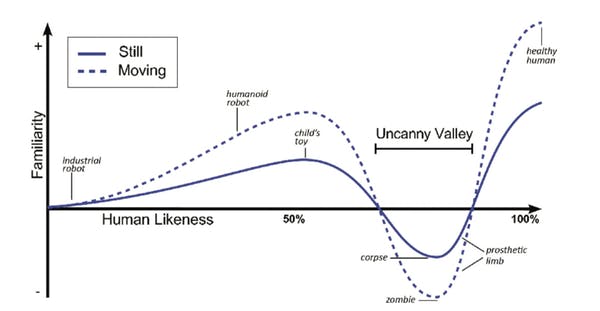
Computer generated graphics now enable some pretty amazing visual effects in films. In particular, it has been able to make animations look extremely lifelike. But interestingly, when it comes to depicting humans, there turns out to be a problematic element. As the animation gets more and more lifelike, audiences respond positively, getting more empathetic and engaged, but once it gets pretty close but is still not perfect, audience approval drops sharply and people tend to see the humans as creepy until the animation reaches close to 100% of being lifelike, as shown in this graph. The dip is known as the ‘uncanny valley’.
I saw this film yesterday that is based on real events and found it to be very gripping. It stars Adam Driver as Daniel Jones, a member of Senator Diane Feinstein’s staff, who was assigned by her to investigate reports of torture by the CIA. Despite the fact that the CIA refused to cooperate with him, over five years he and a small team painstakingly built up a dossier of all the illegal and immoral actions and war crimes that were committed under the justification of ‘keeping us safe’. They produced a comprehensive torture report that the CIA and the White House of Bush and Obama tried to avoid releasing.
[Read more…]
What happens if the Last Supper of Christian lore is combined with the 2009 comedy film The Hangover featuring a group of friends who wake up after a drunken bachelor party and find the bridegroom-to-be missing? What you get is this comedic short Brazilian film (about 45 minutes long) that has the last supper being a drunken revel that ends with everyone in a stupor who wake up groggily the next morning to find Jesus missing, and struggle to reconstruct what happened the previous night from the fragmentary recollections of each of the disciples.
It is a film with many funny moments and a very different take on the relationship between Jesus and Judas, and explicitly mentions the lesser-known disciples such as Thaddeus, who is largely ignored even in the Gospels, so much so that very few would be able to name him as one of the twelve
If you know Portuguese, you can watch the trailer below that has no subtitles. The film on Netflix has English subtitles and if you click here it takes you to the Netflix site where the same trailer has English subtitles.
It is interesting that this film was released in Brazil, a Catholic country, just before Christmas in 2018. I wonder whether the reaction was as outraged as it was for Monty Python’s Life of Brian.
I can vividly recall my strong negative reaction to Joseph Conrad’s highly acclaimed novel Heart of Darkness. Its racism appalled me as I wrote in a blog post ten years ago.
I remember the first time I read Joseph Conrad’s Heart of Darkness, hailed by critics as a masterpiece. I was appalled at the blatantly racist portrayals of Africans and could barely get through the book. Many years later, I re-read it. The shock and anger that the original reading had aroused in me had worn off and I could see and appreciate Conrad’s skill with words in creating the deepening sense of foreboding as Marlow goes deeper into the jungle in search of Kurtz.
Ironically, Chinua Achebe gave a talk criticizing the book and saying that Conrad’s novel, whatever its other merits, perpetuated African stereotypes. The talk attracted a lot of attention and Conrad’s many admirers leapt to his defense, saying that Conrad was a product of his times and merely reflecting the views then current and that his book was actually a critique of the evils of colonialism.
Maybe so, but the racism was still there and still bothered me even on the second reading.