
microRNAs and cancer

I’m trying to raise money for the The Leukemia & Lymphoma Society, and I promised to do a few things if we reached certain goals. I said I’d write a post microRNAs and cancer if you raised $7500. And you did, so I did. I kept my clothes on this time, though, so here’s a more serious picture of yours truly: this is what my students see, which is slightly less terrifying, nicht wahr?

seriously

If you want more, go to my Light the Night fundraising page and throw money at it. If we reach our goal of $10,000, I’ll organize a Google+ Hangout to talk about cancer. Note that we’re also getting matching funds from the Todd Stiefel Foundation, so join in, it’s a good deal.

It’s all epigenetics. Now I’ve gone and done it: I’ve used the “e” word, epigenetics. Nothing seems to fire off well-meaning misconceptions from otherwise sensible pro-science folks than epigenetics — it’s a major new revolution in evolution! It changes everything! It’s a way to get inheritance of acquired characteristics!

Nope.

Epigenetics is routine and has been taken for granted by cell biologists for at least 6 decades. It is simply a principle of gene regulation — switching genes off and on — that persists over multiple cell generations. You aren’t surprised that when liver cells divide, they produce more liver cells, are you? They’ve simply inherited transcription factors and patterns of modification of DNA from their parent cell that restricts their cell fates. There are also patterns of gene expression induced in gametes within parents that modulate initial patterns of gene expression in the fertilized zygote — that is, the state of the parental cells affects the state of the embryo’s cells — which is exactly what you’d expect.

What seems to set people off is that it is an effect of the environment on the state of the genome, and there is this bizarre bias floating around that that can’t happen. Of course it can! Every summer when you get a tan, every winter when you put on another five pounds, every time stress at work makes you prone to get sick…those are environmental factors influencing your biology.

In previous installments of this series, I told you about oncogenes, genes that when over-expressed or over-active switch on cellular processes (like proliferation) that promote cancer, and tumor suppressor genes, which protect against cancer, and which in cancers, are often found to be inactivated or down-regulated. Over-expressed? Down-regulated? That sounds like the sorts of things epigenetic changes can do.
transcription-translation

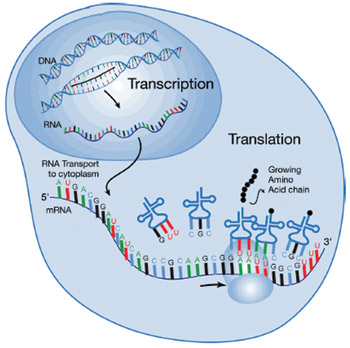
Further, here’s an interesting observation. Everyone knows the standard pathway: genes in DNA are transcribed into RNA which is then translated into protein. One might naively imagine, then, that the amount of RNA produced would be roughly correlated with the amount of protein produced. It’s not. In analyses of cancers, only 20% of the mRNAs involved showed any correlation between the quantity of mRNA and the quantity of protein — there is something else that is modulating either the amount of translation or the turnover of proteins in the cell, and the fact that 80% of the genes playing a role in cancer show such variation tells us that these kinds of regulatory effects are important.

There must be something stepping in and interfering somewhere between transcription of the gene into messenger RNA, and translation of messenger RNA into protein. One of the somethings is microRNA.

These are tiny little snippets of RNA, typically 22 nucleotides long, that have complementary sequences to their target gene mRNA — they bind to matching RNAs and inhibit translation. Thousands of these microRNAs have been discovered in the last few years, and they’ve also been found to play important roles in regulating gene expression in blood cell lineages, brain activity, insulin secretion, and fat cell development…and in cancer.

As you might guess from the previous articles in this series, there are obvious ways microRNAs could promote cancers. A microRNA that blocks tumor suppressor genes from being expressed could be modified to be produced at a higher level, or a microRNA that would hamper an oncogene’s activity could be mutated to be unable to recognize its target. Easy! Simple! Well, except that this is biology, and nothing is simple in biology (trust me, if you don’t enjoy problems blowing up in your face and getting harder and harder, don’t become a biologist.)

One reason this is complicated is that there are so many details to be worked out — swarms of microRNAs are involved, we don’t know the majority of them, and we don’t know what we’ll learn as we discover more. As Weinberg says,

…the discovery of hundreds of distinct regulatory microRNAs has already led to profound changes in our under- standing of the genetic control mechanisms that operate in health and disease. By now dozens of microRNAs have been implicated in various tumor phenotypes, and yet these only scratch the surface of the real complexity, as the functions of hundreds of microRNAs known to be present in our cells and altered in expression in different forms of cancer remain total mysteries. Here again, we are unclear as to whether future progress will cause fundamental shifts in our understanding of the pathogenetic mechanisms of cancer or only add detail to the elaborate regulatory circuits that have already been mapped out.

But also, we’ve learned that it’s not simply a matter of a few short bits of RNA getting transcribed and dumped into the cytoplasm — there is a whole elaborate cellular apparatus dedicated to microRNA processing. Behold!

oncomirs

Don’t panic, I’ll hold your hand and we’ll walk through it. miRNA genes are first transcribed into RNA by RNA polymerase II; notice that the transcript, which is called a pri-miRNA (or primary microRNA) contains some long stretches of internal complementarity, and that the RNA folds into a hairpin loop. This RNA is grabbed by an RNA binding protein, Pasha, and an RNA cutting enzyme, Drosha, which snips off some excess bits to produce a smaller stem-loop structure about 70 nucleotides long, which is partially double stranded RNA. It also gets a new name: Pre-miRNA. Pre-miRNA is then exported out of the nucleus and into the cytoplasm by a channel protein, Exportin-5.

Once in the cytoplasm, another RNA cutting enzyme, aptly named Dicer, snips off a few more bits to reduce it to two very roughly complementary RNA strands, now called the miRNA:miRNA* duplex. One of these strands is then loaded into a set of proteins to form the miRNA-associated multiprotein RNA-induced silencing complex, thankfully called miRISC for short.

The short, 22-nucleotide long strand of RNA in the miRISC is what gives it specificity — the miRISC proteins carry it along as a template to match against messenger RNAs they encounter. If the miRNA makes a perfect match to some unfortunate strand of messenger RNA, the miRISC cuts up the mRNA to destroy it. If it’s an imperfect match over just some significant fraction of the 22-nucleotide sequence, it it just locks up the RNA and represses its translation.

The way these can affect cancer is illustrated below. If a microRNA that inhibits an oncogene is mutated (b), that oncogene will increase the amount of protein produced from the available RNA; the oncogene could even be normal in sequence and function, and just the boost in its signal could contribute to tumorigenesis. Alternatively, a mutation in a microRNA gene that affects a tumor suppressor could amplify its production (c), producing a greater inhibition of a healthy gene that acts to prevent tumorigenesis.
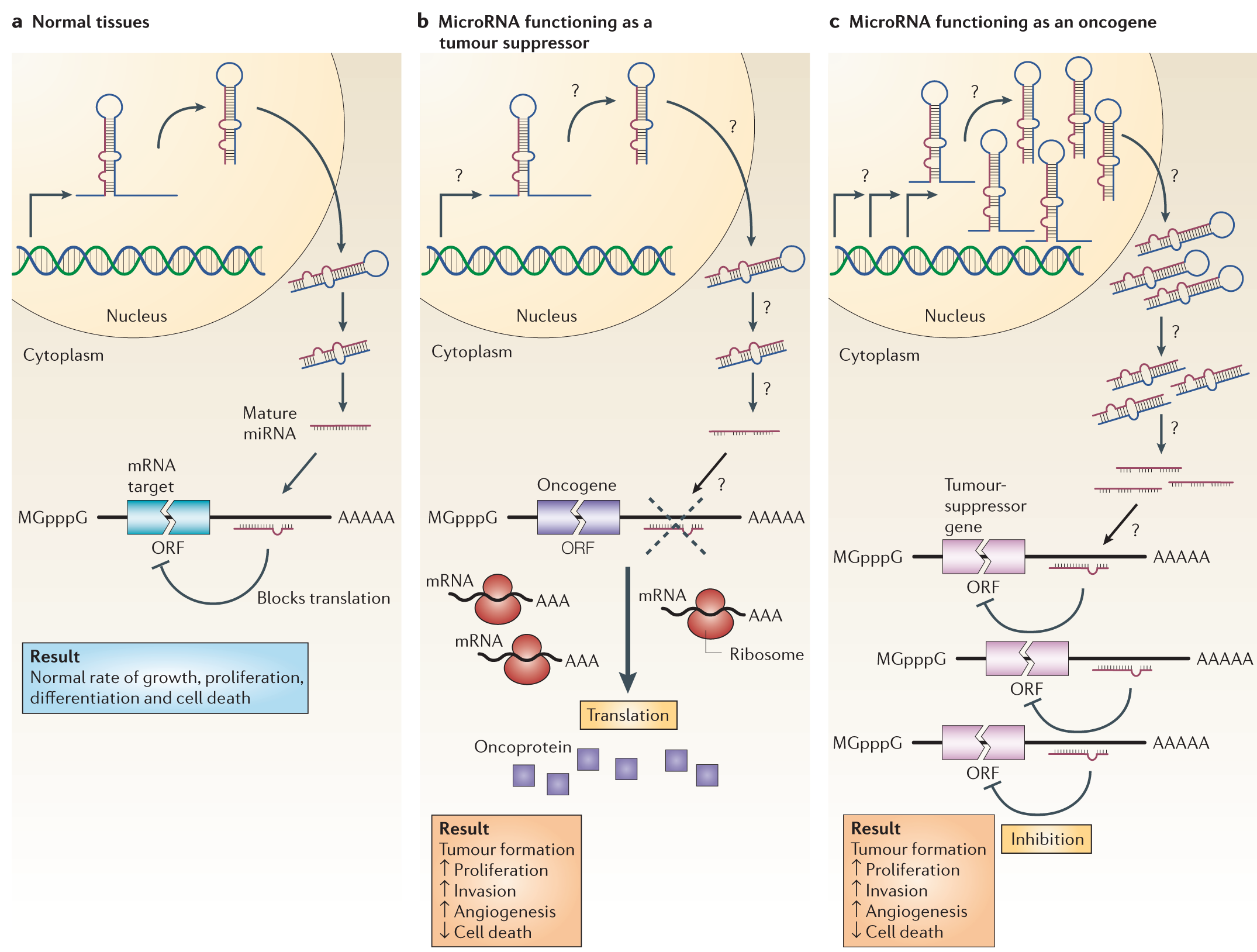
MicroRNAs can function as tumour suppressors and oncogenes. a | In normal tissues, proper microRNA (miRNA) transcription, processing and binding to complementary sequences on the target mRNA results in the repression of target-gene expression through a block in protein translation or altered mRNA stability (not shown). The overall result is normal rates of cellular growth, proliferation, differentiation and cell death. b | The reduction or deletion of a miRNA that functions as a tumour suppressor leads to tumour formation. A reduction in or elimination of mature miRNA levels can occur because of defects at any stage of miRNA biogenesis (indicated by question marks) and ultimately leads to the inappropriate expression of the miRNA-target oncoprotein (purple squares). The overall outcome might involve increased proliferation, invasiveness or angiogenesis, decreased levels of apoptosis, or undifferentiated or de-differentiated tissue, ultimately leading to tumour formation. c | The amplification or overexpression of a miRNA that has an oncogenic role would also result in tumour formation. In this situation, increased amounts of a miRNA, which might be produced at inappropriate times or in the wrong tissues, would eliminate the expression of a miRNA-target tumour-suppressor gene (pink) and lead to cancer progression. Increased levels of mature miRNA might occur because of amplification of the miRNA gene, a constitutively active promoter, increased efficiency in miRNA processing or increased stability of the miRNA (indicated by question marks). ORF, open reading frame.


MicroRNAs can function as tumour suppressors and oncogenes. a | In normal tissues, proper microRNA (miRNA) transcription, processing and binding to complementary sequences on the target mRNA results in the repression of target-gene expression through a block in protein translation or altered mRNA stability (not shown). The overall result is normal rates of cellular growth, proliferation, differentiation and cell death. b | The reduction or deletion of a miRNA that functions as a tumour suppressor leads to tumour formation. A reduction in or elimination of mature miRNA levels can occur because of defects at any stage of miRNA biogenesis (indicated by question marks) and ultimately leads to the inappropriate expression of the miRNA-target oncoprotein (purple squares). The overall outcome might involve increased proliferation, invasiveness or angiogenesis, decreased levels of apoptosis, or undifferentiated or de-differentiated tissue, ultimately leading to tumour formation. c | The amplification or overexpression of a miRNA that has an oncogenic role would also result in tumour formation. In this situation, increased amounts of a miRNA, which might be produced at inappropriate times or in the wrong tissues, would eliminate the expression of a miRNA-target tumour-suppressor gene (pink) and lead to cancer progression. Increased levels of mature miRNA might occur because of amplification of the miRNA gene, a constitutively active promoter, increased efficiency in miRNA processing or increased stability of the miRNA (indicated by question marks). ORF, open reading frame.

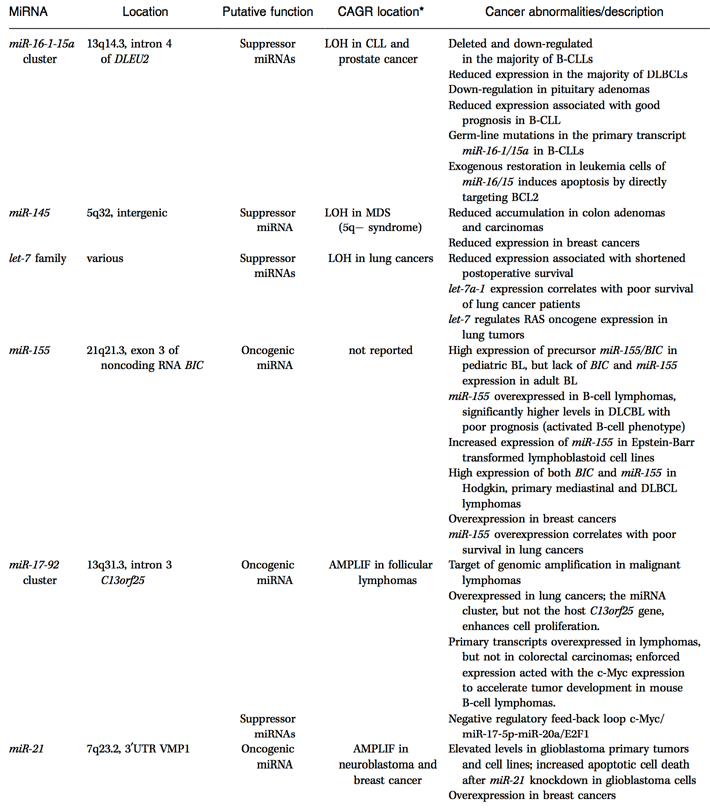
This is not simply a hypothetical possibility, either. Dozens of miRNA genes have been implicated in human cancers — they show abnormal variations in expression in specific cancers and also have known oncogene/tumor suppressor targets.
miCancer

These microRNAs are a relatively new scientific phenomenon — they weren’t even a blip on the radar when I was a graduate student, and when I did start hearing about them in the 1990s, they were thought of as a weird mechanism found in highly derived nematodes. Now we’re seeing them everywhere, and beginning to recognize their importance in controlling all kinds of genes. The process of developing tools to control miRNAs is underway in the laboratory, but it has a long way to go before we have effective clinical tools to combat cancer with miRNAs or antagonists to miRNAs. At the very least, it’ll be another tool we can use.


Calin GA, Croce CM (2006) MicroRNA-cancer connection: the beginning of a new tale. Cancer Res. 66(15):7390-4.

Esquela-Kerscher A, Slack FJ (2006) Oncomirs – microRNAs with a role in cancer. Nat Rev Cancer 6(4):259-69.

Hanahan D, Weinberg RA (2011) Hallmarks of cancer: the next generation. Cell 144(5):646-74.

Interesting recruiting technique

The editor of biology online went off looking for new bloggers to join his group. I’ve been there, on both sides now — the usual approach is to tell the blogger you’re interested in their work, think they’d be a valuable addition to the roster, and here’s what we offer you: there’s usually some share of revenues, a list of the other people you’d be rubbing shoulders with, an altruistic appeal to sharing your ideas with the world.

Ofek the editor didn’t do that when he went courting DNLee. The only card he played was to say that they got 1.6 million monthly visitors — a respectable number, although I suspect most of their traffic is driven by their forum, which consists largely of people asking for help on their biology homework — and when asked, offered no remuneration at all. The whole exchange was very polite, until DNLee turned him down.

DNLee runs a blog on the Scientific American network called The Urban Scientist. She’s a working biologist, she already has a public platform for sharing her ideas, and it’s a bit higher profile than a network that gets 25,000 visitors a day. Ofek didn’t offer her anything but extra work, so here’s what she said:

Thank you very much for your reply.

But I will have to decline your offer.

Have a great day.

That’s all very professional. Here’s how Ofek replied.

Because we don’t pay for blog entries?

Are you an urban scientist or an urban whore?

Wow. You’d have to be nuts to want to work with that guy. And the news is spreading everywhere about biology online and their aggressively insulting editor, so I think he has just managed to destroy any interest other potential participants might have in his network. It’s too bad, too, since he already has a few people writing for it, who aren’t going to deserve the opprobrium that Ofek has just earned.

Another cancer story…tomorrow

You people have been marvelous, and our cancer fundraiser has reached over $8300 — and I said I’d tell you about oncomirs, micro RNAs involved in cancer, when we reached $7500. But it’s been a very long week, I’m going to go pass out, so it’ll have to wait until tomorrow.

If you throw more money at the Leukemia & Lymphoma Society while I’m sleeping, you’ll make me feel even more guilty about not getting the article to you promptly. Go ahead, make me suffer.

Good news?

The Washington Monthly has ranked UMM as a ‘standout school’.

UNIVERSITY OF MINNESOTA, MORRIS (MN)

Predicted grad rate: 60%

Actual grad rate: 60%

Net price: $9,255

Reason it made the cut: One of the only public liberal arts schools in the nation, UMM ranks just behind cash-rich Amherst and Williams for bang for the buck among schools of its type.

Morris students, a third of whom are first-generation college-goers, shoulder the lowest debt burden in the University of Minnesota system, and among the lowest in the Midwest. The public school price tag, in tandem with a low student-to-faculty ratio of 15 to 1 and other private/liberal arts school attributes, makes Morris a unique value proposition. And if a liberal arts degree may not seem like the most efficient ticket to social mobility in a depressed economy, consider this: 94 percent of recent Morris grads either went on to pursue advanced degrees or found employment within a year of leaving school, which they attribute to the resources, reputation, and connections that the campus enjoys as part of the University of Minnesota system. In addition to being able to choose from thirty-five different liberal arts majors, Morris’s 1,900 students can select from eight preprofessional programs like engineering and nursing, as well as an online learning program—reminders of that public school status and network despite the school’s small size and capacity.

I’m tempted to say, though, that you shouldn’t come here. We’re really, really good, but we’re also full up with students. All the faculty in biology are stretched thinly to keep up with everything — I don’t know that we could handle any more workload.

So unless you’re absolutely brilliant, ambitious, and enthusiastic about getting an amazingly good broad education in the liberal arts, you shouldn’t apply here. Maybe you can go to the University of Minnesota Twin Cities instead? It’s a perfectly nice second choice.

If you can’t get in here, I’m sure you’ve got some acceptable safety schools, like Harvard or something.

Another ridiculous poll

The Montgomery, Alabama police have pious plan to send out priests along with the police on emergency calls. “Trained” priests, apparently, which means they’re going to be spending money on completely unqualified people who can provide no material assistance to tag along with the police. Why? Because it makes someone in the chain of command feel good, I suppose.

Do you think police should send out trained clergy to violent crime scenes?

No, there should be a separation of religion and government  66.64%

Yes, police and victims need all the help they can get.  29.98%

I don’t care either way.  2.45%

Not sure  1%

The only virtue I could think of is that maybe they’d put a check on the police and prevent them from shooting innocent people, but you don’t need to be a priest to do that.

Validating religious symbolism…with a poll

This is a cross in Middleboro, Massachusetts. It’s on public land in the town.

middleborocross

Would you believe that the people of the town stupidly looked at that and decided there was no conflict at all between a great big Christian symbol that says OBEY WORSHIP and secular government? None at all. Let’s just pretend that that is a secular message.

They have a poll, of course. It was apparently going very much the wrong way yesterday, but Cuttlefish has had his minions shredding it. I’m just coming along to administer the coup de grace.

What’s your take on the Middleboro cross?

It’s a religious symbol that has no place on public property 53%

It’s an appropriate expression of religious freedom 46%

Adjust your image of cave painters

You may have heard that men and women have some subtle differences in morphology — there is considerable variation and overlap, of course, but there are discernable patterns. It’s not just the obvious breasts and shoulders and hips, either, but, for instance, slight differences in the hands. Men tend to have ring fingers that are longer than their index fingers, while those two fingers in women are of approximately equal length. Which makes it interesting that many Paleolithic cave paintings include tracings of the artists’ hands.

hands

You can see where this is going. We should measure digit lengths in these stencils!

Archaeologist Dean Snow of Pennsylvania State University analyzed hand stencils found in eight cave sites in France and Spain. By comparing the relative lengths of certain fingers, Snow determined that three-quarters of the handprints were female.

"There has been a male bias in the literature for a long time," said Snow, whose research was supported by the National Geographic Society’s Committee for Research and Exploration. "People have made a lot of unwarranted assumptions about who made these things, and why."

There need to be massive caveats to the interpretation of the data. In modern populations, variation and overlap means that assessments of sex from digit lengths only has 60% accuracy, which is terrible — I checked out my own hands with a crude visual inspection, and by my right I’m a woman, by my left I’m a man, and both have very slight differences. Their sample size is also very small: 32 hands that were clear and sharp enough to measure. But at the same time, they report that the degree of sexual dimorphism in the hands was much greater than is seen in modern populations Well, maybe: I’d like to see the dimorphism data for modern hunter-gatherer populations, in particular from African populations with their greater genetic diversity. Also, you can’t call it sexual dimorphism if you don’t have an independent measure of the sex of the handprints. Maybe there was greater non-sexual variation in hand shape and, for instance, women made all of the stencils, but 15,000 years ago 25% of women had “man hands”.

Still, at least the data says that the cave painters were more diverse than expected, which fits better with a hypothesis that both men and women were active participants in these surviving, visible aspects of Paleolithic culture.

Yell at ’em until they believe!

Wow. Glenn Beck really is an authoritarian tool. Watch this clip; he’s ranting at the microphone at children, insisting that they must learn that their rights come from god.


Push them. Well, they’re going to cry, I’ll hurt their feelings. PUSH ‘EM!, because if you don’t do it now, it’s going to be much worse when they’re pushed and they’re shoved and they’re shot. Push them! Teach them! The need to know the truth and the need to be pushed up against the wall once in a while so they know they can defend themselves. They know they can survive. They don’t run around like little girls crying at the drop of a hat. Push them!

You’ll be relieved to know that his tirade is directed only at little boys. You little girls out there are free to laugh at his magic god and recognize that your rights represent privileges and responsibilities conferred by your fellow human beings.

And I hope that the rest of you all see that bullying kids into guilt is also a bad thing. You don’t want to be like Glenn Beck, do you?

Darwinian bookery

We’re doomed. Evolution is an ineluctable process; once it gets started, it’s not just an optional alternative, it becomes unstoppable, short of nuking the planet from orbit (and even then, all it takes is one surviving bacterium for it to begin again). Charlie Stross has noticed that books have crossed the threshold and are now poised for an adaptive radiation.

An epub ebook file is essentially an HTML5 file, encapsulated with descriptive metadata and an optional DRM layer. The latest draft standard includes support for all aspects of HTML5 including JavaScript. Code implodes into text, and it is only a matter of time before we see books that incorporate software for collaborative reading. Not only will your ebook save your bookmarks and annotations; it’ll let you share bookmarks and annotations with other readers. It’s only logical, no? And the next step is to let readers start discussions with one another, with some sort of tagging mechanism to link the discussions to books, or chapters, or individual scenes, or a named character or footnote.

We already share highlighting — I get a little annoyed when I’m reading on my kindle and suddenly there’s a block of text with a dotted underline — other people thought that section worthy of notice and have shared their emphasis with the world.

I’ve also noticed that the books I’ve bought through Amazon suddenly pop up with a ranking and suggestions page when I reach the end. It used to be you’d finish a book and close it satisfyingly and put it back on the shelf…but no, now it yells at you “Did you like me? Buy more of me!”

As Stross points out, the next dreadful steps, since a book has become code, will be the incorporation of malware and agents to sabotage competing books in your library and insert new ads around the place, or even replicate more of the authors’ works. I’ve downloaded some of those cheap or even free books into my epub library, and some of them are so bad that I suspect they are already intrinsically malware.

Our future:

Books are going to be like cockroaches, hiding and breeding in dark corners and keeping you awake at night with their chittering. There’s no need for you to go in search of them: rather, the problem will be how to keep them from overwhelming you.

Doomed, I tells you. I am squinting at my iPad right now. I think it’s plotting to get me.