
A few days ago, I got sucked into a weird vortex of a YouTube category. I watched ONE (1) video about climbing Mt Everest, and then of course the algorithm started feeding me more and more Everest videos, specifically Everest Disaster videos, and wouldn’t stop. I’m currently going cold turkey on anything about mountain climbing, rejecting every video the system offers me, to try and break the cycle. I’ll probably be offered videos about Everest until I’m 900 years old.
But I did learn a few things, and one of the reasons I kept watching them was a sense of horror. Sure, there were skilled mountaineers who trained and trained and brought deep physical and mental abilities to the mountain, and I have to respect that. Everest has become a carnival attraction for “influencers” and business people who just want the glory of being able to say they climbed the tallest mountain. They spend hundreds of thousands of dollars to book sherpas to lead them on a grueling march, and to probably carry them to the top and back down again, all so they can gloat on Instagram.
And many of them die for this dubious distinction.
Three out of every 10 expeditions to Annapurna result in a casualty. That rate is slightly lower for Kangchenjunga (29.1%) and lower still for K2 (22.9%). Everest only comes in at sixth place, with a casualty rate of 14.1%.
Of course, that rate is so much lower because so many more people are tempted to climb Everest. Each one, no doubt, a highly motivated individual.
They’re dying, and for what? There are lines, as if this is a Disneyland ride. They stack up on guide ropes, planted by the long-suffering sherpas, and may have to stand and shuffle for hours as the mob is led up, one by one, to the summit. It’s insane.
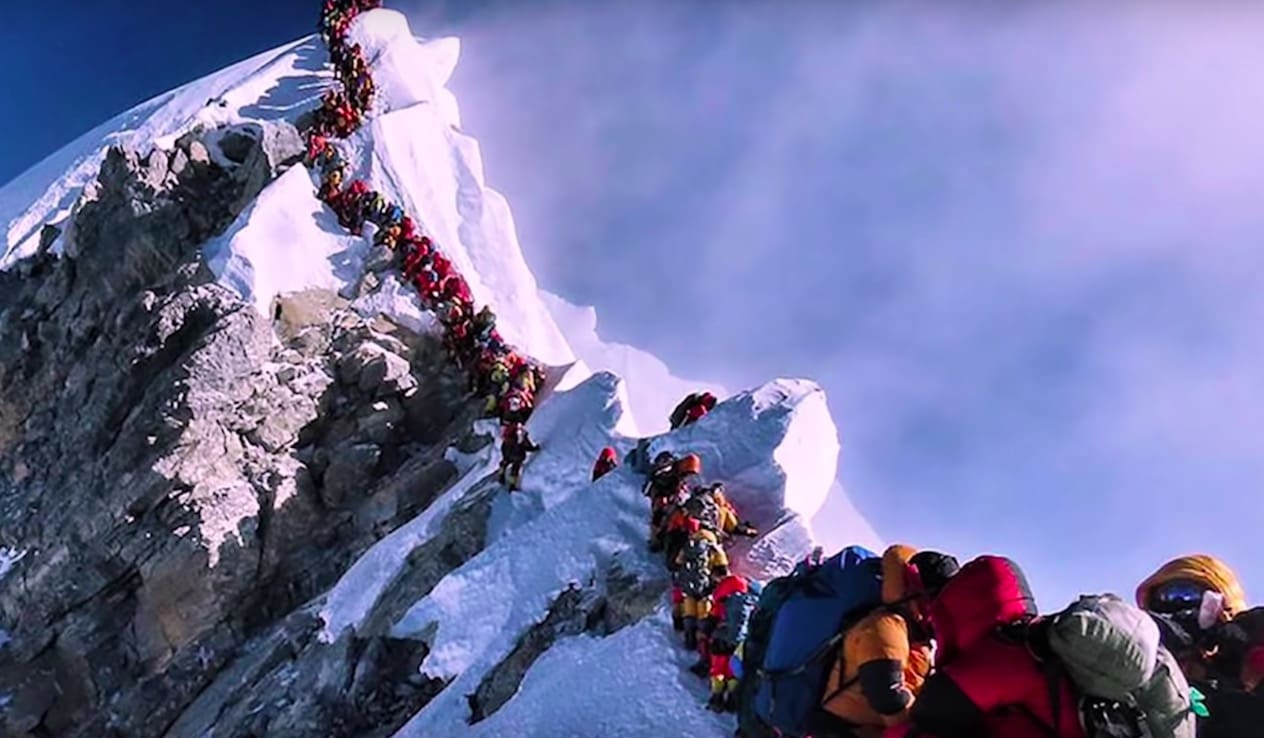
The whole thing is an extreme test of physiological endurance…and money. They climb above the “death zone,” so called because no human being can survive at such low oxygen concentrations for long. You enter the “death zone,” and you start inevitably dying slowly (or quickly), and what you have to do is get to the summit and down as rapidly as you can, so you can get back down to the altitude where the atmospheric pressure is high enough that your body can repair itself after its exposure to lethal deficiencies of air. Did I already say it’s insane? It’s madness.
People die in this vain endeavor, and their bodies get left on the mountain.
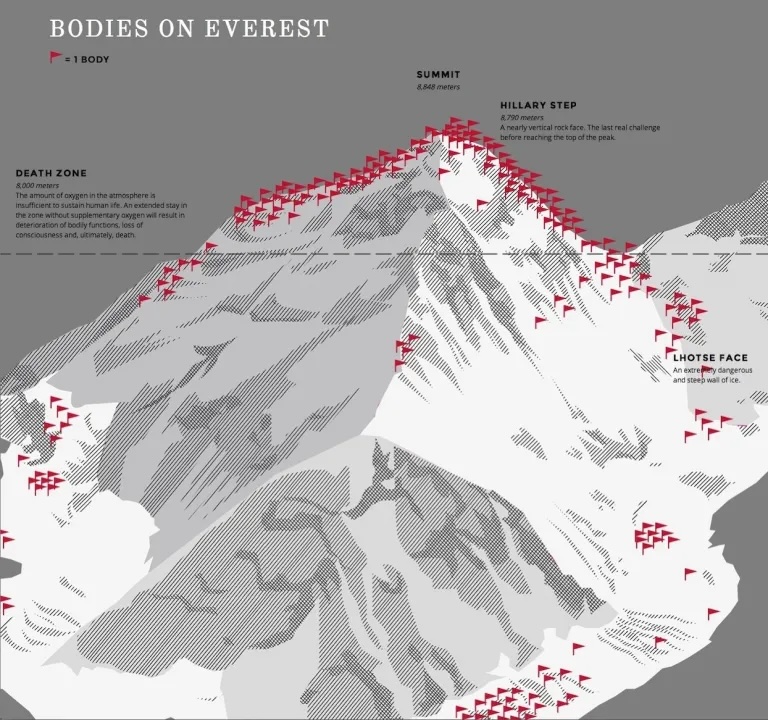
Some of the frozen, dessicated bodies are used as landmarks.
Green Boots, arguably the most famous body on Everest, has been identified as Tsewang Paljor, Head Constable of the Indo-Tibetan Border Police (ITBP), though some think it might be his colleague, Lance Naik (i.e. Lance Corporal) Dorje Morup. Both were members of a three-man ITBP climbing party that perished in the infamous blizzard of May 1996, which also took the lives of five other mountaineers.
…
Some bodies are known landmarks, as Green Boots used to be: “The German” on the second step of the north face route, the “Saluting Man” near the south summit, the “Icefall Body”, in the Khumbu glacier field, and “Sleeping Beauty” on the southeast ridge, until she too was removed from view in 2007.
What a fate. And it’s all in service to a lethal tourism industry, where people are killing themselves to expose themselves to a physical challenge. I’m sorry, but if you tell me you climbed Everest, I’m not going to be impressed — I might just feel pity for your deluded ambitions.
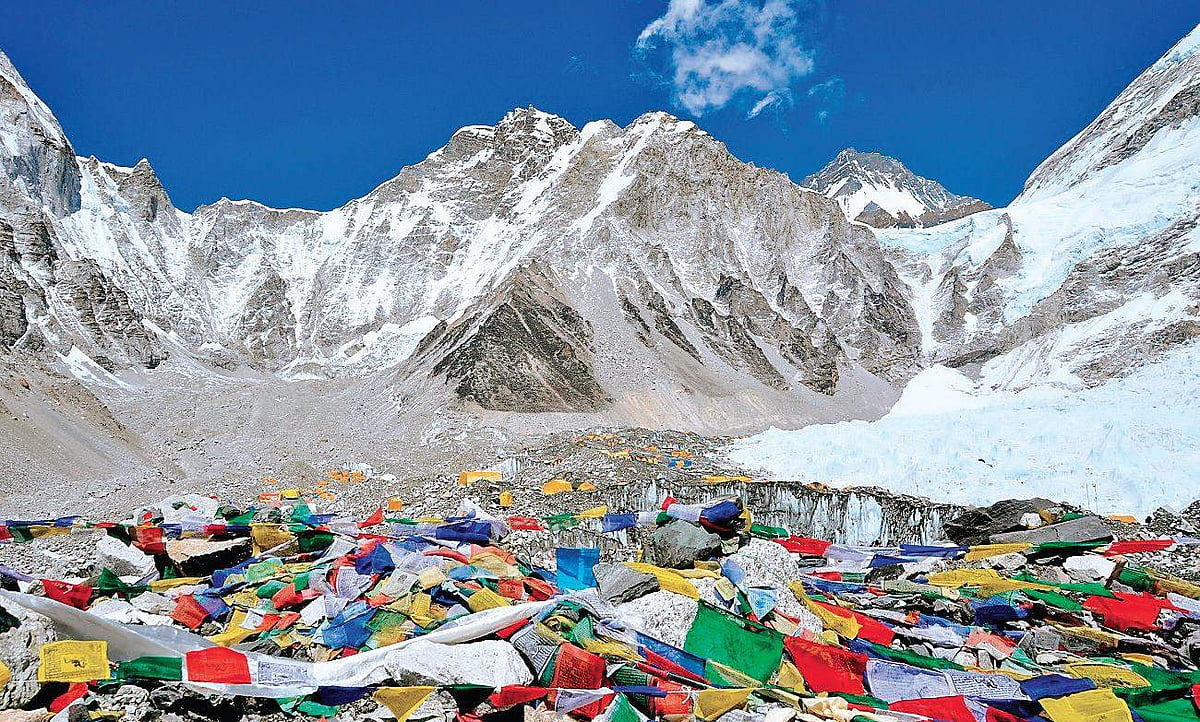
One of the consequences of this wasteful enterprise is a mountain littered with dead bodies, ropes, colorful nylon tents, and stacks of empty oxygen bottles. More people are willing to risk their lives for a photo op than are willing to risk their lives to clean up the horrible mess of debris they leave behind.
That did get me wondering, though. Ötzi was a wonderful discovery of a 5,000 year old corpse of a Copper Age man, with artifacts of his time, that has stirred up a lot of curiosity about what he was doing in the Alps, how he died, how was all his gear used. Why was he climbing those mountains? I’m wondering how future anthropologists in 7000 CE would feel on discovering this treasure trove of a 21st century high-altitude garbage dump/graveyard, and what questions they might ask. Why were all these people in bright nylon clothing up there at 6-8000 meters anyway?
I’d just say they were glory-seeking idiots.

Bold of you to assume there will be any future sapient life, much less a civilization.
At this stage, human extinction would be a mercy.
5000 years is time enough for a total civilization collapse followed by re-emergence of a radically different culture.
Human extinction is unlikely. Humans being reduced to a thin population of hunter-gatherers is a better possibility.
I believe the item found on Everest and other mountains that is most likely to cause confusion to future anthropologists as to its purpose will be the selfie stick.
FWIW I recommend reading Joe Simpson – of Touching the Void moivie and book fame – on what we’ve done to Chomolungma / Mt Everest and the ugly, nasty horros of it all in one of his books* or parts thereof.
See : https://en.wikipedia.org/wiki/Joe_Simpson_(mountaineer)
Technical in parts esp onmountianeering gear and techniques etc.. and yet very fascinating, philosophical at times and a thoughtful,ethical writer who has literally been there and done that.
.* Umm, maybe the This Game of Ghoists one? Read yeras ago and rea dquite a few of his -buta long time ago.
Note that a fair number of Sherpas die in these attempts, too.
I was reading Into Thin Air, by a journalist who went on one of these expeditions. In addition to the inevitable dangers involved in scaling such a peak, there’s a certain amount of folly. As a general rule, when climbing any mountain, there is (or should be) a turn-around time — a time when you head back down, regardless of how far you got, but on that expedition, a number of the guides (not sherpas!) insisted on going on, even hours after the turn-around time, because they didn’t want to disappoint the people who had spent thousands of dollars to be led to the top (and presumably back down, too!)
And even if you turn around at a reasonable time, there’s the problem of all the other climbers coming up and blocking your way back down.
From what the book said, the Nepal government has considered trying to limit the number of people, and they charge hefty fees to anyone who wants to climb, but Nepal is not rich and the climbers bring in lots of hard currency, so there’s a strong incentive not to clamp down too hard.
BTW. Mountain slopes don’t make for good fossilisation chances if memory serves.
Avalanches may bury stuff but theyalso erode down and don’t tend to be good places of preservation.
For Ötzi I can say, that he was found close to a pass that is still in use today to drive sheep from the Schnalstal to the Rofental. I myself have sampled aquatic insects in the glacial streams up there. Since he apparently was shot with an arrow but not looted, he probably fled the pass uphill and perished at the glacier.
@lasius Otzi was shot, but the arrow pierced his subclavian artery, and he likely died in a couple of minutes. So he wasn’t walking uphill or moving at all after he was shot. Which makes the fact that he was NOT looted of his 97.7% purity copper axe even more mystifying. You could make a movie about Otzi (and I believe the Europeans have).
@5. Allison : There was a movie or doco about the plight of the Shepas and Nepal generally – see Sherpa – Official Trailer by DocPlay running for 2 mins 23 seconds.
Plus see : https://sherpafilm.com/about/synopsis/ :
Plus for those who’ve forgotten or never saw it, here’s the trailer for the Touching the Void movie. (1 min 45 secs.) Extraordinary true survival story & recommend seeing and reading the books again too.
@8 Hairhead
I didn’t necessarily imply that he was shot before fleeing. Just that he probably was taking the pass, but then fled uphill from pursuers.
I’ve been running into my own algorithm induced issues, such as well after I blocked Huberman from my YT feed he pops up under different channels. F that guy!
As far as a future with a depleted humanity, Cormac McCarthy’s The Road gives one scenario. Hard to imagine humans alone surviving something catastrophic that took out all flora and fauna, leaving roving bands left to survive on rusty canned goods or other people. The basement scene!
Yet that bleak post-apocalyptic life would be preferable to Mars as would Everest.
Useless fact No. 1468786761461284748
Sir George Everest pronounced his name Eve-rest. I found that in Rachel Hewitt’s Map of a Nation
Darwin will never tire of handing out well deserved awards. If some gullible fools let spacex send them towards mars, theyll get theirs as well. Any reasonably run country would outlaw the industry.
It makes me cross that the people who do these things endanger others who feel obliged to go and try to rescue them.
It makes me cross that the people who do these things endanger others who feel obliged to go and try to rescue them.
They will infer something spiritual.
https://freethoughtblogs.com/pharyngula/2026/05/25/the-fallacy-of-inferring-the-spiritual-superiority-of-our-ancestors/
Science fiction is littered with stories about collapsed civilizations. Obviously, its members didn’t go wholly extinct or there wouldn’t be a story. One of the best I can recall is Earth Abides by George Stewart. A disease has wiped almost the entire world’s population. The few survivors must attempt to, first, find each other, and then, rebuild some sort of civilization.
In a few thousand years, “young earth creationists” would use the presence of human remains on the mountain as evidence of Noah’s flood much like they use sea shells in the stones at the top of the mountain.
Why would YT’s algorithm feed our esteemed host anything other than arachnovids?
I have been to see Everest (NOT to climb it) three times, two in Nepal and one in China, as the Tibetans have been taught to call it. There is a mystique that touches some souls; go to Kala Patthar, the view of Everest is excellent. The real benefit of the trip was the time spent walking from Kathmandu among the indigenous people, a couple of weeks of meditative beauty; the walk back was easier, of course, and differently delightful … but that was in the 70s and 80s, before electricity reached the villages and folks started staying up late and burning more wood. I expect and hope they figured it out.
On my last trip, I did see a photo of Jimmy Carter in Namche, where they loved him, not least because he out-walked his Secret Service detail. They thought that was most amusing. Me too.
That “line of death” seems suspiciously precise. Shouldn’t it flutter up and down with barometric pressure?
The inevitable tracking of my own recent historical research has now fed through to YouTube and resulted in me being presented with multiple videos of people who are fortunately not dead from either cold or altitude, although it seems some of them might have tried.
Location: Snowy forest, frozen lake or exposed icy hillside above fjord.
Presenter (male or female, speaking perfect English with a clear Scandinavian accent): “Now that it’s midday and the temperature has risen to -12C, I’m going to show you how a Viking man/woman would dress. First I put on my undershirt, which is made of unbleached linen so that my sweat does not stain any woollen layers, and almost immediately I feel warmer.”
Thanks, Bjorn. Do you know Margrethe? You might have met at the same re-enactor club, or in the mental hospital they send you all to after you’ve spent too much time outside with a camera in winter.
“One of the consequences of this wasteful enterprise is a mountain littered with dead bodies, ropes, colorful nylon tents, and stacks of empty oxygen bottles.”
And human waste. Don’t forget the tons of human waste left up there. Although a lot of it does make its way down to lower levels, what with glaciers being rivers of moving ice.
I’ve watched a whole lot of those same videos. I find that mountain oddly fascinating, like it’s a place I want to know in detail. Fortunately, I’m way too old and smoke too much to ever consider going there.
But for the people who try it, it does seem like a whole lot of them are seeking some kind of personal validation, like their lives will be essentially meaningless unless they conquer the world’s highest peak. “I did the hardest thing there is to do.” Which it actually isn’t.
A lot of people get caught up in the “Seven Summits” quest, which is climbing the highest peak on each of the seven continents. It turns into a bucket list kind of thing. Although a lot of real mountaineers will tell you that a harder challenge would be to climb the second highest peak on each continent, many of which require more technical climbing skills; as Jon Krakauer put it, Everest is more about enduring pain.
I also have some issues with the idea that nature is something to be “conquered.”
One reason why I do not have a YouTube account. No feed.
I believe I read, in Jon Krakauer’s book, that the great majority of people who’ve died on Everest were Sherpas. They do the dangerous work so that rich Westerners can coddle their accomplishment fantasies.
I’m sure you’ve seen the lines of people who wait for hours at places like the Hilary Step, etc., on the way up. Imagine paying $60,000 and enduring all that and endangering the local people so that you can endanger yourself and everyone else by standing in line for hours as if you were at an airport.
Luckily, I’ve read that the Khumbu glacier is melting rapidly, making the Khumbu Falls, the most dangerous part of the route and one which climbers must cross, even more dangerous. Many more Sherpas, who set up the ladders across the Falls for the tourists to cross, will die, but so will some tourists, and eventually the Falls will be impassable. Rich people who will do anything to try to feel something will have to find something else (submersibles, anyone?)
Pyramids are mountain-shaped things with the detritus of rich people’s lives that they have paid others to cart along inside with them. In potlatch, you destroy wealth to show that you have it to destroy.
Chomolunga is a pyramid potlatch.
I’ve had a fascination with Everest ever since I read John Hunt’s book as a kid. Then there was a National Geo expedition in the mid-60s, then a British cousin got a job as Chris Bonington’s secretary, so every Christmas for a while we got an autographed copy of his latest book, some of which were about Everest expeditions. I also did a little bit of rock climbing when I was in high school and university (though nothing since) so it meant that I took an interest in mountaineering at the time. This was all way before the place became the macabre tourist trap for the financially over-endowed that it now seems to be.
Going through my YT feed I notice way too many diet and exercise videos, some AI generated, but that flesh and bone crazy Aussie deep squat lady is still haunting me. Some requisite tornado chasers of course because I like them…
Wait…the Patrick Cc: channel popped up has “Mount Everest is Everything Wrong With Society”. Was that how it started for PZ? I had to click merely to confirm I’m already subscribed to Patrick Cc:. Hope that act didn’t fuck my algo!
You gotta tweak the algo by watching other stuff or once in a while nuking your watch history. I’m currently in exercise and diet hell and Aussie lady keeps encouraging me to do everything from a deep Asian squat, even perhaps purging the algo while in her preferred posture. At least she’s not Mick Taylor!
Yeah if I could do this I might flaunt it too. I was inspired by her last year and she still haunts my algo. Not blocking her like I did Huberman though. Aspirations!
https://www.youtube.com/shorts/jmwOziEYUY8?si=GixcF9aNNHFC_pXm
It would be a maassive mega-engineering project but I wonder how much it would cost and how easy it would be to put in an underground tunnel with a lift / elevator from below the death zone to the summit? Or a ski lift with chairs or an escalator to the top of Sagarmāthā / Chomolungma / Everest? At least point they almost might as well.
Or perhaps they could simply use explosives and rock mining construction gear to knock the peak off and lower it to a safe level to deter the mad(dening / maddened?) crowd?
Of course, that would hurt Nepal’s economy from loss of tourists and so that likely won’t happen because its a poor nation thatt badly needs the steady stream of $$$. Incidentally, there was a time when Nepal didn’t allow climbers there as noted in the summits wikipage so climbers went via the Tibetan side.
One more book recommendation albiet on Nepal more generally :
Source : https://fantasyliterature.com/reviews/escape-from-kathmandu/
Again one I read years ago and if folks know KS Robinson then you’ll know is really well researched, progressive and pretty intresting reading. Recommend -and it bonus, it won’t affect your algorithms!
@25. garnetstar : They’ll find another way around or build a bridge or something over it. Probly.
^ Clarity fix : At this point they almost might as well. Or one of those mountain railway track things.
Recommend – and bonus, it won’t affect your algorithms!
@30 StevoR
You think large-scale vandalism of nature seems like the right approach, Stevo? Everest isn’t the only eight-thousander — you’d have to demolish a fair portion of the Himilayas and Karakoram ranges.
Volunteer your own local landforms in Australia for destruction first. Then we’ll see if you’re serious about it.
@ ^ Trump helping bad faith troll beholder : Whatever makes you think I was ever serious about those obvs tongue-in-cheek suggestions in #30?
Ye non-existent gawds your reading comprehension is poor!
The line :
not clear enough for ya clearly.
Assuming your comment was made in good faith which I doubt.
Incidentally, I’ve been to Uluru before the climbing ban came into place – and I chose to respect the wishes of our Indigenous Aṉangu people and NOT climb it as did everyone else in my group.
Fertility ritual obvs.
The Conversation – Why do male chimpanzees throw rocks at the same trees for more than a decade?
CA7746, I get your attempted drollity, but throwing rocks at a tree is not exactly a deadly hobby.
This is about doing deathly endeavours for the joy of it.
(Also, not like poor people can do it, is it? Unless they are Sherpas ;)
@ ^
You might want to check with the tree about that. ;-)
@Hairhead
I think the current hypothesis is that he was murdered from someone in his community where that axe would have been instantly recognisable.
“Our esteemed leader Ötzi vanished while crossing a dangerous pass, oh my”: a tragedy
“Our esteemed leader Ötzi vanished while crossing a dangerous pass, and suddenly his long standing rival has an axe that looks exactly like Ötzis”: we’re not THAT stupid, bro
Well, I certainly won’t go. I’ll hopefully find myself a hill of moderate size to survive the climate change deluge on.
Miracle on Everest: Guide believed dead spotted crawling down ice
I’m flattered I’m getting so much attention in these comments!
otzi @41: You spelled ‘flattened’ wrong. Oh dear, too soon?
Nah, after 5,300 years, nothing much bothers me (him). I saw Otzi in person last summer – he’s actually looking pretty good. Otzi spends most of his time now in a preservation chamber at the South Tyrol Museum of Archaeology. The museum design is genius – you can’t get to the chamber until you’ve gone through the entire museum (devoted to Otzi and the Copper Age). Even on vacation I can’t escape learning!
@ ^ otzi : Cool and cool nymn.
But why would anyone want to escape learning?
Their website is here BTW folks : https://www.iceman.it/en
The sentiment is that one can’t escape it, not that one seeks to escape it.
(Yes, I know you were trying to be jocular)
OK, reality sometimes surprises: https://www.theguardian.com/science/2026/jun/05/scientists-sourdough-bread-yeast-strains-mummy
↓
Scientists make sourdough bread using yeast found in 5,000-year-old mummy
Team now plans to see if they can use yeast strains harvested from Ötzi the Iceman to brew beer too