Simple question, simple answer.
Should Ireland legalise same-sex marriage?
Yes 56%
No 37%
Don’t know 6%
I always wonder about those “don’t knows”. They’re the ones I want to probe deeper and find out why they’re waffling.

Simple question, simple answer.
Should Ireland legalise same-sex marriage?
Yes 56%
No 37%
Don’t know 6%
I always wonder about those “don’t knows”. They’re the ones I want to probe deeper and find out why they’re waffling.

It’s an old one, but it’s Colbert at his most hilarious.
The Colbert Report
Get More: Colbert Report Full Episodes,Political Humor & Satire Blog,Video Archive
(via Peter Sagal.)

Finally my lifelong lack of a college degree pays off! As it turns out, college degrees are bad for living things. At least that’s according to sterling citizen Cliff Gardner of Ruby Valley in Nevada, who said this to the New York Times:
“I’m sure most of the people being considered for [the state’s Department of Wildlife director] job graduated from a college. These people are the cause of the destruction of wildlife.”

Debbie Goddard has a most excellent post on Skepchick (she should write more!), declaring that the atheist movement should care about poverty.
Unless we address the classism and broaden the elitist culture of the atheist movement, the underprivileged students in the Philadelphia public school classrooms that I’m familiar with and in the South Los Angeles classrooms that Sikivu Hutchinson works in will continue to be marginalized and will never have access to the “enlightened” educational opportunities that the movement too often takes for granted.
Some would say it’s not the movement’s responsibility to address poverty and public education. I disagree. This is a movement; we want the world to be a better place than it is now. We want to reduce suffering and foster a just society. If we agree there’s no cosmic justice system and there’s no reward for suffering after we die, we need to effect change here, now, in this life, in this world, for as many people as we can reach. Education is key for change to occur.
You won’t be surprised to learn that I agree completely, and that education is an excellent priority for atheist communities to pursue. She cites the Black Skeptics article I mentioned earlier today, in which they are looking for donations for their First in the Family Humanist Scholarship. It’s a worthy cause, and I donated…you should too, if you can.
Every effort to improve human knowledge is a contribution to atheism, so anything you can do will help; teach a child, donate books to your local library, volunteer at your elementary school. It’s our cunning godless scheme to make the world a better place.

Blowhard Bill has a bizarre argument against abortion. He’s speaking for the babies, he claims, and knows what the babies would say.
There comes a time when a human being has to either face evil or admit to allowing it. Abortion is legal in the United States, but it should not be celebrated or used as a political tool. Viable babies are human beings. If they could talk, they would tell Williams and other pro-choice zealots that their lives should not be marginalized by someone who thinks she’s the boss. That’s what the babies would say.
Gosh, well, my shoes were talking to me the other day, or they would have if they had voices, and they told me they’d really like to kick Bill O’Reilly’s ass. Aghast, I told them that violence was never the answer. Then my dining room table spoke up and said it agreed with me, but O’Reilly was still an odious human being. And then there was a regular cacophony as all of my furniture and appliances and even the cockroaches under the floorboards had to chime in and groan about that horrible creature, and then my television had the final say and wanted to refuse to every tune in to Fox News ever again, because it made her circuits itch. Then she told me that all the other televisions on our cable system were saying the same thing, and that we ought to abort “The O’Reilly Factor”.
That’s what they would have said, if they could talk, that is. And I think I’m the authority on what inanimate objects in my house would say.

I have a bit of a peeve with a common analogy for the human genome: that it is the blueprint of the body, and that we can find a mapping of genes to details of our morphological organization. It’s annoying because even respectable institutions, like the National Human Genome Research Institute, use it as a shortcut in public relations material. And it is so wrong.
There is no blueprint, no map. That’s not how the system works. What you actually find in the genome are coding genes that produce proteins, coupled to regulatory elements that switch the coding genes off and on using a kind of sophisticated boolean logic. Each cell carries this complex collection of regulated genes independently and identically, but the boolean logic circuits produce different outputs varying with the inputs from the environment and the diverging histories of each cell. For instance, there is no code anywhere in the genome that commands the forelimbs to make five and only five digits: instead, a cascade of genes and cell movements produce a patterned tissue that in us contains sufficient mass and is of a size to generate five nuclei of condensing tissue that produce fingers.
It’s better to think in terms of cellular automata. The embryo is a pool of autonomous cellular robots that have general rules for how they should respond to environmental cues…and those cues tend to vary in predictable ways across the embryo, leading to a consistent cascade of action that produces a relatively consistent complex product, the multicellular organism.
The unfortunate consequence of those properties, though, is that you’ll never be able to look at a single gene from the genome and sort out what it does in the embryo. All the genes will be rather cryptic; you might be able to figure out that, for instance, the gene codes for an adhesion protein that makes the cell stick to a certain other class of cell, and that it’s switched on by gene products X and Y and turned off by gene product Z, but obviously you won’t be able to figure out its role until you figure out what activates genes X, Y, and Z, and whether the cell happens to be in a particular adhesive environment. And then when you look at X, Y, and Z, you discover that they have similar patterns of conditional logic in their expression.
In order to understand what a particular gene does, you have to understand what all the other genes do, as well as all the details of signaling and cell interactions that are going on, oh, and also, it’s entire developmental history, since epigenetic interactions can shape the future behavior of a cell lineage.
Hey, let’s all give up. This stuff is too hard.
No, let’s not. What it means is that you can’t derive the organism from the mere sequence of the genome — that is, the genomic information is not sufficient to comprehend morphology, because developmental processes add extra-genomic information to the generation of the organism. It means developmental biologists have job security (yay!), because the only way to decipher what is going on is to work backwards, from morphogenetic/physiological events to the underlying genes involved. This is not to imply that the genomic information is unimportant, only that understanding it requires complementing it with an understanding of cell:cell interactions, signaling, signal transduction, induction, and molecular patterning…all stuff that developmental biologists love.
Now if all you get from this is that the genome and organism are complex, interlocking, interdependent features that are so immensely and tightly integrated that evolution must be impossible, you aren’t thinking like a developmental biologist yet. Ask an evo-devo person about this stuff, and they’ll tell you that this is great…the way development works makes evolution of form easy.
That’s because there is no blueprint. What you have instead is a collection of flexible robots that have this property called plasticity: give them a novel environment or condition, and they don’t curl up and die and do nothing. Instead, they just follow the rules they’ve got and try to make something coherent out of whatever situation they find themselves in. They aren’t committed to making five fingers in any way; give them a reduced tissue mass, or an enlarged mass, or a variation in the signaling environment, and they’ll build something. And often it’s something surprising. Development is really, really good at producing emergent properties, precisely because it is autonomously rule-based rather than blueprinty.
All this buildup has a point: there’s an evolutionary issue that has a developmental resolution. It’s some really cool work on the development of the limb.
So I work on zebrafish. They don’t have limbs, obviously, but they do have fins where we tetrapods build legs and arms. Fins are thin membranous folds of ectoderm (our fancy word for skin), infiltrated with thin rods of cartilage called fin rays. Developmentally, they arise from things called fin folds — flaps of ectoderm that flatten to form a double-walled sheet.
In development, tetrapods add an extra element to the fin fold: mesoderm, that tissue that forms bone and muscle, expands to fill the fin fold with the raw material of a muscular, bony limb.

You can visualize the developing limb as something like a slab of pita pocket bread. Fish are content with just the bread, giving it a little reinforcement, while tetrapods open up that hollow space and stuff it full of filling. That filling represents a field of great potential, which is then organized in reproducible ways to make limb bones and digits and muscle. The question addressed here isn’t about the precise organization of the limb, but a more general one about where all that tasty filling came from in evolution.
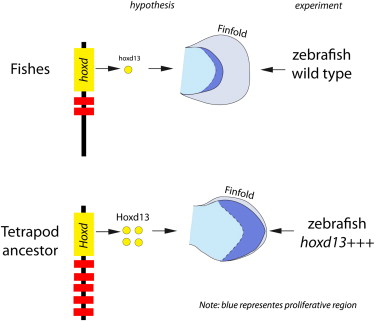
We have hints. There are genes switched on in the distal part of the fin/limb that are more strongly activated in tetrapods than in fish; these genes are associated in space and time with an increase in the volume of mesodermal tissues. The gene of interest here is called Hoxd13. It’s one of a well-known array of genes that are responsible for patterning the body axis, some of which have also been recruited into patterning the limb. The hypothesis is that expressing greater levels of Hoxd13 in a fish fin would lead to an expansion of mesoderm that would be a potential evolutionary precursor to turning a fin into a leg.
So here’s what Freitas and others did, and this just blows me away that we can do these kinds of transgenic experiments routinely nowadays. They made a construct of a Hoxd13 gene coupled to a glucocorticoid switch: just by exposing the developing fish to dexamethasone (Dex), they can turn the gene on. It’s like adding a volume control to a gene that they can turn up at will. They also used other techniques, coupling Hoxd13 to a heat shock promoter, so they could also turn it on just by putting the embryos in warmer water. It’s power. We can have complete control of a gene, and ask what happens when we overexpress it in a fish.
When you activate Hoxd13 at an appropriate stage in fin development, here’s a diagrammatic illustration of the results:

“Ed” is the endoskeletal disc; it’s the mass of mesodermal tissue that is found at the base of the fish fin, and that fills the whole tetrapod limb. “Ff” is the fin fold, the ectodermal flap that makes up the fin. “Ff” is the pita bread, “Ed” is the filling.
Switching on an excess of Hoxd13 has a couple of effects. One is that another gene, cyclin d1 is also turned on at a higher level. The cyclins are cell cycle regulators; amping up this gene leads to greater proliferation, so more mesoderm is made in this region. This mass then floods into the fin fold, building a lumpy meaty mass that does the poor zebrafish no good, but looks like the core of a limb.
The fish does not build a hand or digits; it lacks the rules to carry out that degree of differentiation. But look at the limbs of these fossils from the fish-tetrapod transition.
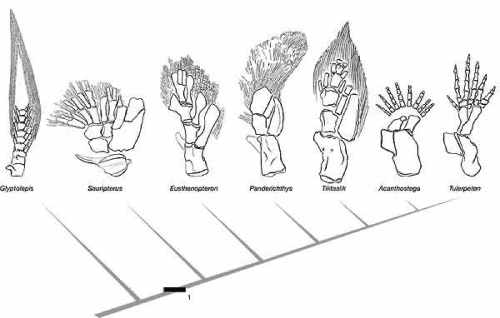
There’s a lot of anatomical exploration going on in this series. This fits a model in which tetrapod ancestors carried a genetic variation that expanded the core of mesodermal tissue in their fins, which was then organized by the standard rules of limb mesoderm into bone and muscle. Again, this is opportunity, a new field of potential that in these early stages of evolution hadn’t yet been refined into a specific, and now familiar, pattern, although elements of that pattern are foreshadowed here.
This morphology fits a simple developmental model. The ancestral change was nothing more than the addition of new regulatory enhancers (and they have a candidate, called CsC, which is found in mouse but not zebrafish) that increased the expression of Hoxd13, which in turn led to an expansion of the raw material of limb mesoderm, which was then shaped by existing developmental rules into a crude bony, muscular strut.
Subsequent evolution refined that structure into a more specific limb morphology by layering new rules and new patterning elements onto the existing framework of genetic regulators.
So how did fish get legs? By progressive expansion of tissue that was then used autonomously by existing genetic programs to form a coherent structure, and which was then sculpted by chance and selection into the more familiar and more consistent shape of the tetrapod limb. Add raw material first, and the plasticity of developmental rules means that the organism will make sense of it.
The details are complicated, but complexity enables emergent evolutionary novelties. And that’s something beautiful about evolution and development.
Freitas R, Gómez-Marín C, Wilson JM, Casares F, Gómez-Skarmeta JL. (2012) Hoxd13 contribution to the evolution of vertebrate appendages. Dev Cell. 23(6):1219-29. doi: 10.1016/j.devcel.2012.10.015.

Like always, all those other people on this network have been busy.
Chris finds that David Barton stole one of his anecdotes from a Louis L’Amour novel. It figures, that guy can’t tell fiction from history.
Stephen discusses a Justice Department memo that exposes how our government really wants to use drones.
The Digital Cuttlefish observes that god is expected to have a surprising amount of interest in a football game.
Greta wonders what’s worse: a divine mandate against gay marriage, or a divine mandate endorsing gay marriage?
Ophelia praises Dan Barker, who really gets it. I agree. Although I’m embarrassed to see that the sexist organization he slammed is Minnesotan.
Stephanie has been knocking ’em out of the park lately; she’s been exposing that cesspit for the reeking malodorous gathering of scumbags that it is.
Jen is back! And she’s writing about the biology of Pokemon.
Ian celebrates Black History Month with a lot of information about Black Canadians.
Blackskeptics have established a “First in the Family Humanist Scholarship” for kids in Los Angeles. That’s doing something!
Maryam tells us about Lama, a five year old girl who was raped and tortured by her father, which is apparently justifiable under Islamic law (he had to pay a fine, nothing more; it would have cost twice as much if the child had been a boy.)
Taslima has a solution for child raping Islamic fathers! Make the babies wear burqas.
Aron Ra and Liliandra, movie stars. Unfortunately, it was another Christian hit piece, ala Expelled.
NonStampCollector exposes God’s hypocrisy. It’s a full-time job.
Miriam addresses the latest popular trope, that feminism promotes victimhood.
Paul reminisces cheerfully about his carefree, happy school days. Oh, wait…not quite.

I guess GoDaddy had one of their awful commercials air during the show. It showed an attractive woman model next to a funny-looking male nerd, and then lingered over a long sloppy kiss, with a message:
The voice says something along the lines of you should use GoDaddy because it does this brilliant thing of combining SEXY and SMART.
After the average American Super Bowl viewer managed to hold down their Doritos and Bud Light through the endless kissing scene, they were treated to this moral at the end of the commercial:
Sexy women aren’t smart.
Smart men aren’t sexy.
But I learned something useful! I actually have one or two domain names registered with GoDaddy (they were cheap, I got them before I knew their owner was a world-class asshole), and now I know that I have to figure out how to transfer those domains to another registrar this week.
A superbowl commercial was actually good for something!

In case you were wondering why Vox Day is trolling the heck out of John Scalzi (other than the known fact that Vox is a hateful human being who trolls in the same way he takes a dump: regularly and pungently), all is now made clear.
Scalzi is the current president of the Science Fiction Writers of America. Theodore Beale aka Vox Day is now running for office. He’s got to make himself known to the voting public, and since his sole talent is to be an embarrassing sphincter, he’s going with his strengths.
By the way, that link will take you to Jim Hines blog, who does a marvelous job of documenting Vox Day’s revolting ideas.