A most unsatisfying resolution

The Warda and Han paper has been officially retracted, and the editor has made an official statement, as reported in the Chronicle of Higher Ed.

The paper has drawn a blizzard of criticism in the blogosphere about the peer-review process at the journal, Proteomics. The editor of the journal, Michael J. Dunn, a professor at University College Dublin’s Conway Institute of Biomolecular and Biomedical Research, told The Chronicle last week that the paper had passed peer review.

Today’s announcement says that the two authors of the article, who are scientists at Inje University, in South Korea, agreed to the retraction. Initially only one of the authors had asked for a retraction.

In the news announcement, Mr. Dunn said: “Clearly human error has caused a misstep in the normally rigorous peer review that is standard practice for Proteomics and should prevent such issues arising.”

The plagiarism is bad all right, but my main concern was that such a blatantly goofy paper made it through peer review. How? All Dunn is saying is that it did pass review, which suggests that somehow, someone read it and didn’t pull the alarm, and even approved it. Was it a lazy reviewer? Or was it some other kind of hole in the process? “Human error” is an awfully vague label.

We may not ever get an answer, but you know everyone will be scrutinizing Proteomics papers critically. Other journals, too, of course — a reader just sent me another freaky paper that I’ll describe tomorrow.

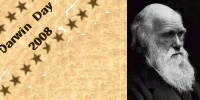
Happy Darwin Day!

i-8baee4ad08a3b8006934f5671c008cae-darwin_posse.jpg

The old man would be 199 years old today, so biologists and other science-supporting people are celebrating all around the world. Even in Morris.

I’m actually giving two lectures today. The first is a fortunate coincidence: I’m teaching an introductory biology course that emphasizes the history and philosophy of science, and today just happens to line up with my coverage of the late 19th century, and especially Darwin … so the freshman get a mini-biography of Charles Darwin. I emphasize something I think many of them can relate to, that Darwin was a young man once, who went off to college uncertain about what he was going to do with his life, and that the voyage of the Beagle was an event that changed his life. We’re so used to seeing Darwin portrayed as an old man, but he was 22 when he set sail.

The second lecture is a public lecture sponsored by our biology club tonight, at 7:00, in 1020 Science. Charles Darwin’s Origin is 149 years old this year, and although it is a very good book and well worth reading for the historical context and as an outline of the beginnings of a science, it is, well, 149 years old. There’s much more to evolutionary biology than Darwin. My talk is titled “Evo-Devo: the future of biology?”, and I’m going to be discussing new perspectives on evolution, why I think development is an essential component of our understanding of how organisms evolve, and giving several specific examples.

If you can’t make it to Morris tonight, though, that’s OK. This is a preliminary version of a keynote lecture I’ll be giving at GECCO, the Genetic and Evolutionary Computation Conference, on 12-16 July in Atlanta, so you could always sign up for that.

The height of anti-abortion logic

It’s been yet another long, long day — I was one of many invited speakers at a conference on Networks and Neighborhoods in Cyberspace at the Twin Cities branch campus of the University of Minnesota Morris, and I got to make an early morning drive there and a late afternoon drive back. Drive, drive, drive. It gets old. Especially on those mornings when it is -15°F (around -25°C for those of you who insist on more civilized measurements.) If you’ve seen the movie Fargo you know what the scenery is like: endless snow-covered fields, endless rows of posts for barbed-wire fences, a succession of teeny-tiny farm towns. There is one thing I watch for — and this is a measure of how boring the drive is — and that’s the anti-abortion signs.

[Read more…]

A transition at Oxford

Richard Dawkins is retiring from academia, but I’m sure he’ll still be involved in the greater culture, so this isn’t sad news at all. Now the search at Oxford begins for a new professor to take on the Charles Simonyi Professorship in the Public Understanding of Science, and from that manifesto, whoever it is will have to reach high.

Good luck to Richard and to whoever has to try and fill his shoes!

This is not a Polish joke

Doesn’t it make you happy to see people wanting to help other people?

“This is a service which is sorely needed,” said Jankowski, who holds a doctorate in spiritual theology. “The number of people who need help is intensifying right now.”

What service is Jankowski providing? That he claims to have a doctorate in “spiritual theology” is one clue. That he claims theological support from the Vatican and his Catholic archbishop is another.

Yeah, he’s an exorcist. A professional expert at casting out imaginary demons.

The article goes on to claim that this is a growth industry. They’re busy building a new Exorcism Center to treat the flood of people who need evil spirits dispelled.

I’m feeling a little sick myself — maybe I’ve caught a wee little ghostie.

One author responds

I’ve received email from one of the authors of that bafflingly bizarre paper on mitochondria. I’m still confused.

Dear Dr. Myers

First of all, I am very sorry for that trouble for you.
I found the serious mistakes in the paper during the process of edits, which I confused between the early drafts and the latest versions: I did not check the use of the sentences in the references (more than 200 references). Finally I made serious error to make the final version.
In order to rectify an error, I requested to retract the paper to the editorial office of Proteomics.
Thank you very much for indicating this carelessness.
Based on this good experience, I will study science and prepare a manuscript with caution.
Again, I am very sorry for that trouble for you.

With best regards,

Jin Han

The author is clearly not a native speaker of English, but I can’t criticize that — his English is far better than my Korean. The explanation that this was just a confusion of an early draft simply doesn’t work. We are talking about a peculiar title and a specific, grammatically correct assertion made in the abstract that is not supported in the text, except by a claim of a “mighty creator”. Where did that come from? One of the authors? Someone who assisted them in polishing the language? The instance of plagiarism are also left dangling.

It also doesn’t address the other concern here. If we accept the idea that Warda and Han made a clumsy mistake and submitted the wrong draft, one that was full of errors, we’re still left with the question of how that mess made it through peer review to the stage just prior to publication. Something broke somewhere, and one unfortunate consequence of the retraction of the paper by the authors is that we may not find out what.

The authors don’t need to apologize, especially not to me. All I’m interested in is tracking down how a paper that is so thick with warning signs could get so far through the review process.