Words Said and Unsaid

In the process of researching my last post, I stumbled on some excellent sources which didn’t fit but are worth sharing anyway. First up, a short but powerful read from Zenobia Jeffries on media whitewashing.

On Saturday, NBC said, “Charlottesville rally turned deadly.”  CNN said, “1 dead, 19 injured after crash near Unite the Right rally.” What took place was not a rally. Who wears paramilitary gear and carries automatic weapons to a rally? Who takes shields and helmets and pepper spray and bats and sticks to a rally? The car didn’t “crash”— it was driven at full speed into a crowd of counter-protesters.

What happened in Charlottesville was White nationalist extremists inciting a riot. We cannot unite, come together, overcome, Kumbaya, or whatever else, until we get some truth-telling. Media professionals need to get it right this time.

Next, Walter D. Greason set up a long Twitter thread on the history of white supremacist violence in the US, from the view of someone who taught the subject.

Fifteen years ago, I taught a course on collective racial violence in the US. It is the only course I decided to never teach again. #Thread

The students were traumatized by the weekly meetings, and I decided to break the material into multiple courses so it was easier to handle.

And finally, the Huffington Post has a long read about the current white supremacist movement, both who’s in it and their current tactics.

Yiannopoulos had exposed a rift between the Spencer and Anglin wings of the alt-right. Both are dedicated white nationalists, but they differ on how to achieve their goals. Anglin is a purist. Spencer is willing to work with people outside the movement’s core. For instance, there is the so-called “alt-lite”—more casually bigoted mischief-makers, who might bandy about the N-word but are more likely to be upset about PC culture than, say, the Jews. A broader circle still—you could call it the “alt-white”—encompasses a large number of Trump voters. Cas Mudde, a political scientist at the University of Georgia who studies populist movements, described these people as “not necessarily racist or consciously racist. They just think they have a right to things they used to have and they don’t realize that was in a racialized and fairly racist structure.” […]

Spencer wants to meld both the alt-lite and alt-white into a viable political force. “What we should do is basically ride [Yiannopoulos’] coattails,” Spencer said. “If I wanted to create a movement that was 1488 white nationalist, I would have done that. But I didn’t because I recognized that is a total nonstarter. No one outside a hardcore coterie would identify with it. The whole point about alt-right is it’s open. Different people can identify with it. I thought that was strategically wise.”

Unfortunately, their tactics seem to be working.

The alt-right’s efforts to contaminate the zeitgeist have, by many measures, succeeded. “Everywhere now on normie sites I see our ideas and memes being pushed,” Anglin said. Since 2012, American white nationalist groups have seen their Twitter followers grow by more than 600 percent, according to a September report by the Program on Extremism at George Washington University. An ADL task force found that between August 2015 and July 2016, 2.6 million anti-Semitic tweets, many of them from Trump supporters, generated an estimated 10 billion impressions. This torrent of hate, the ADL suggested, could “contribute to reinforcing and normalizing anti-Semitic language on a massive scale.”

Attacks like those on Ioffe and Schrode have become commonplace, particularly against members of the media. According to the ADL, at least 800 journalists, most of them Jewish, were targeted by anti-Semitic attacks in the 11-month period the task force examined. Twitter, in particular, has proved ill-equipped to prevent trolls from running amok on its platform. A banned troll can set up another anonymous account within minutes and keep on trolling. And the savviest ones know exactly how far they can go: No specific threats against specific people. Nothing that can be construed as “inciting or producing imminent lawless action,” the legal standard created by the U.S. Supreme Court. The FBI initiated a threat assessment of the incidents involving Ioffe and Schrode, but did not find sufficient evidence to open an investigation, according to FBI officials in San Francisco.

That last paragraph is good evidence against civility pledges and free-speech absolutism. Bigots will happily exploit both to advance their message, and the raw numbers show it works.

Building a Science Detector

Oh, let us count the ways

The Defense Advanced Research Projects Agency (DARPA) Defense Sciences Office (DSO) is requesting information on new ideas and approaches for creating (semi)automated capabilities to assign “Confidence Levels” to specific studies, claims, hypotheses, conclusions, models, and/or theories found in social and behavioral science research. These social and behavioral science Confidence Levels should rapidly enable a non-expert to understand and quantify the confidence they can have in a specific research result or claim’s reliability, reproducibility, and robustness.

First off, “confidence levels?” We’ve already got “confidence intervals,” and there’s been a decades-long push to use them in place of hypothesis testing.[1][2] This technique is fully compatible with frequentism (though over there it doesn’t mean what you think it does), and it even predates null-hypothesis significance testing! Alas, scientists find “we calculate a Cohen’s d of 0.3 +- 0.1” less satisfying to type than “we have refuted the null hypothesis.” The former shows a pretty weak effect, while the latter comes across as bold and confident. If those won’t do, what about meta-analyses? [3]

Second, these “confidence levels” would only apply to published research. Most research never gets published, yet those results are vital to understanding how strong any one finding is.[4] We can try to estimate the rate of unpublished works, and indeed over the decades many people have tried, but there is no current consensus on how best to compensate for the problem.[5][6][7]

Thirdly, “social and behavioral science?” The replication crisis extends much farther, into biomedicine, chemistry, and so on. Physics doesn’t get mentioned much, and there’s a reason for that (beyond their love of confidence intervals). Emphasis mine:

Even if you adjust the acceptable P value, a test of statistical significance, from 0.05 to 0.005—the lower it is, the more significant your data—that won’t deal with, let’s say, bias resulting from corporate funding. (Particle physicists demand a P value below 0.0000003! And you gotta get below 0.00000005 for a genome-wide association study.)

Just think on that. “p < 0.0000003″ means “if the null hypothesis is true, we would find a more extreme result in less than 1 in 3,333,333 trials on data like what we have observed.” If you wanted to see one of those exceptions, you’d have to do one experiment a day for 6,326 years just to have a better than 50/50 chance of spotting it. For comparison, the odds of a particular US citizen being struck by lightening over a year are 1 in 700,000; worldwide, the yearly odds of death by snake bite are about 1 in 335,000; and over the lifetime of a US citizen, the odds of them dying by dog attack are 1 in 112,400. p < 0.0000003 is a ridiculously high bar to leap, which means either a) false positives are easy to generate in physics, either via the law of large numbers or shoddy statistical techniques, or b) the field has been bitten so many times by results that can’t be replicated, even when they were real, that they’ve cranked the bar ridiculously high, or c) both.

Fourth, confidence isn’t everything. The Princeton Engineering Anomalies Research lab did studies where people tried to psychically bias random number generators. Over millions of trials, they got extremely significant results… but the odds of success were still around 50.1% vs. the expected 50%. Were they now confident that psychic abilities exist, or merely that luck and reporting bias could introduce a subtle skew into the data? Compacting those complexities into a number or label that a lay-person can understand is extremely difficult, perhaps impossible.

Basically, what DARPA is asking for has been hashed out in the literature for decades, and the best recommendations have been ignored.[8] They may have deep pockets and influence, but what DARPA wants requires a complete overhaul in how science is conducted across the globe, spanning everything from journals to how universities are organized.[9] When even quite minor tweaks to the scientific process are met with stiff opposition, pessimism seems optimistic.


[1] Gardner, Martin J., and Douglas G. Altman. “Confidence intervals rather than P values: estimation rather than hypothesis testing.” Br Med J (Clin Res Ed)292.6522 (1986): 746-750.

[2] Rozeboom, William W. “The fallacy of the null-hypothesis significance test.” Psychological bulletin 57.5 (1960): 416.

[3] Egger, Matthias, et al. “Bias in meta-analysis detected by a simple, graphical test.” Bmj 315.7109 (1997): 629-634.

[4] Rosenthal, Robert. “The file drawer problem and tolerance for null results.” Psychological bulletin 86.3 (1979): 638.

[5] Franco, Annie, Neil Malhotra, and Gabor Simonovits. “Publication bias in the social sciences: Unlocking the file drawer.” Science 345.6203 (2014): 1502-1505.

[6] Rosenberg, Michael S. “The file-drawer problem revisited: a general weighted method for calculating fail-safe numbers in meta-analysis.” Evolution 59.2 (2005): 464-468.

[7] Simonsohn, Uri, Leif D. Nelson, and Joseph P. Simmons. “P-curve: a key to the file-drawer.” Journal of Experimental Psychology: General 143.2 (2014): 534.

[8] Sedlmeier, Peter, and Gerd Gigerenzer. “Do studies of statistical power have an effect on the power of studies?.” Psychological bulletin 105.2 (1989): 309.

[9] Rawat, Seema, and Sanjay Meena. “Publish or Perish: Where Are We Heading?” Journal of Research in Medical Sciences : The Official Journal of Isfahan University of Medical Sciences 19.2 (2014): 87–89. Print.

All the President’s Bots

Trump appears cranky. It’s raining New Jersey, so he can’t golf work, which leaves him with no choice but to hate-watch CNN. Vets are angry with him, his policies are hurting his base, the polls have him at his lowest point since taking office, foreign diplomats view him as a clown, and he has nothing to show for his first six months.

He still has friends, though.

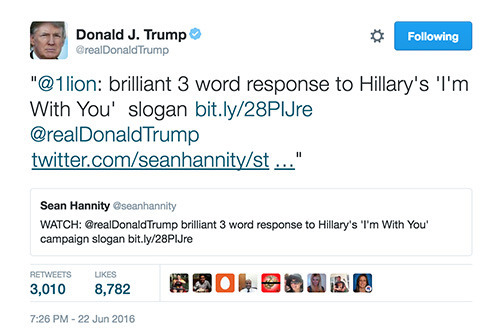
"@1lion: brilliant 3 word response to Hilary's 'I'm With You' slogan. @realDonaldTrump twitter.com/seanhannity/"Aww, at least one person likes Trump!

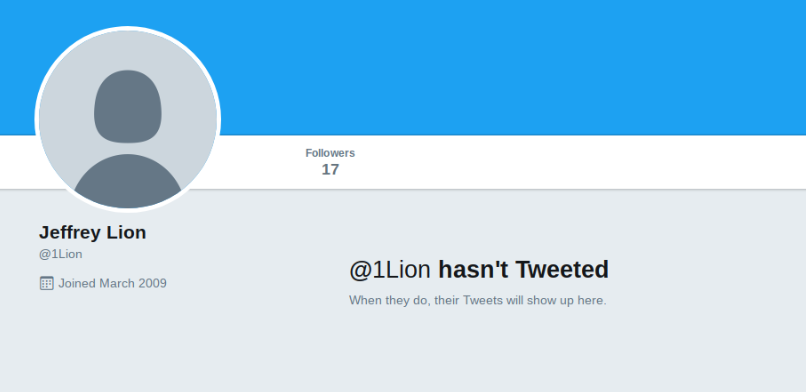
ilion on Twitter: STILL hasn't made a single Tweet.

… or maybe not? As an old Cracked article pointed out, Trump had a habit of quoting Tweets that didn’t exist, from people who just joined Twitter or were obvious bots. It was an easy way to make himself look more popular than he was, and stroke his ego. He put this to rest after winning the presidency, but that appears to be changing.

In a tweet on Saturday, President Donald Trump expressed thanks to Twitter user @Protrump45, an account that posted exclusively positive memes about the president. But the woman whose name was linked to the account told Heavy that her identity was stolen and that she planned to file a police report. The victim asserted that her identity was used to sell pro-Trump merchandise.

Although “Nicole Mincey” was the name displayed on the Twitter page, it was not the name used to create the account. The real name of the victim has been withheld to protect her privacy.

The @Protrump45 account also linked to the website Protrump45.com which specialized in Trump propaganda. All of the articles on the website were posted by other Twitter users, which also turned out to be fakes. Mashable noted that the accounts were suspected of being so-called “bots” used to spread propaganda about Trump. Russia has been accused of using similar tactics with bots during the 2016 campaign.

The “Nicole Mincey” scam was remarkably advanced, backed up by everything from paid articles pretending to be journalism to real-life announcers-for-hire singing her praises.

So the latest thing in the Trump resistance is bot-hunting. It’s pretty easy to do, once you’ve seen someone else do it, and the takedown procedure is also a breeze. It also silences a lot of Trump’s best friends.

If only we could do the same to Trump.

Transgender People, Sexuality, and Attraction

Shiv’s knocked it out of the park again. Her post is a long and thorough discussion of Laci Green‘s batshittery, and defies easy summation. Maybe this paragraph is representative of the whole?

Remember the earlier contrast between theory and practice when it comes to trans women’s bodies? Jones also does sex work. The primary audience for her porn is straight men. Jones has spent the past few weeks being inundated with abuse over the idea of anyone finding her attractive all the while people are shelling out cash for her sexualized pics and clips. Performative declarations about how unfuckable I am brush up against my reality, where I spend my weekends doing naked things that are illegal in many countries across the world (ifyouknowwhatimean). It’s two different conversations happening at the same time, and one of them looks–if you’ll pardon my French–fucking silly. “Ur ugly” is the discourse of children and playgrounds.

Hmmm, no. These two?

Hint number one that we’re dealing with an expression of prejudice: Green can’t decide who the subjects are, unless she’s suddenly started believing that (cis) lesbians and (cis) straight men are the same. Badly misapprehending Jones’ tweet would have at least supported her conclusion that trans women are trying to coerce straight men, but instead she comes out of left field by making it about (cis) lesbians. That she saw no contradiction in these premises suggests to me she is starting with her conclusion and working her way backwards.

Hint number two that we’re dealing with an expression of prejudice: Green uses “lesbian” as mutually exclusive with “trans YouTuber.” Neither cis lesbians that can be attracted to trans women, nor trans lesbians, exist. Apparently.

Nope, that’s worse. Tell you what, just read the thing. It’ll make you reflect on your views of attraction and sexuality, most likely, and that alone is worth it.

A Flurry of Science

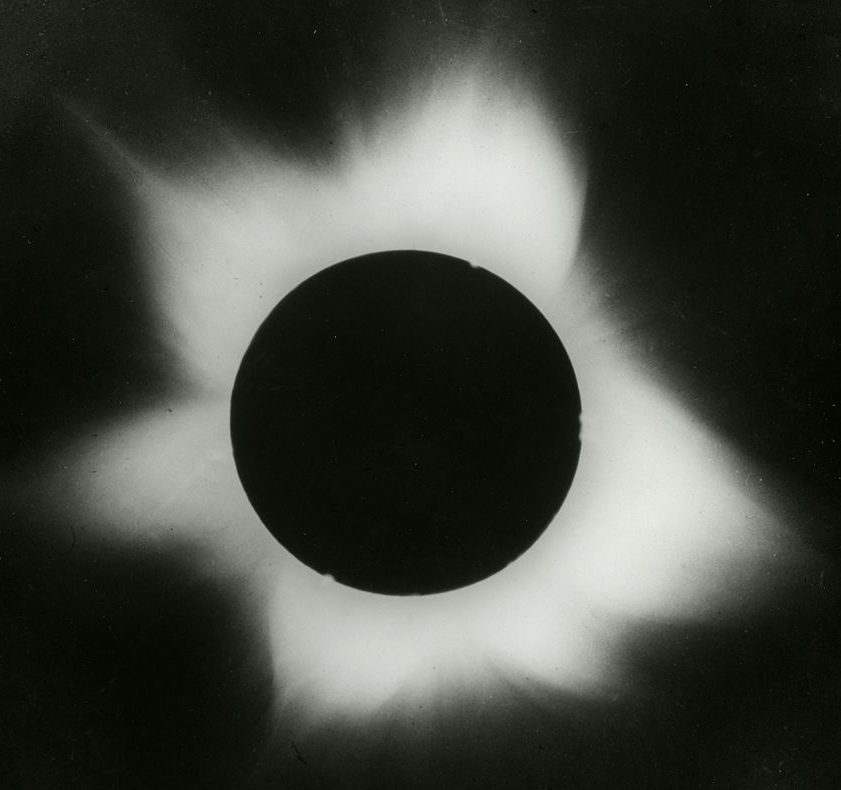
“Think about being able to do all these experiments on the ground, from airplanes, from balloons, with citizen scientists. It’s pretty breathtaking,” said Lika Guhathakurta, an astrophysicist at NASA. Guhathakurta will shepherd dozens of scientific projects on Aug. 21, including polarized images of the corona, which help scientists measure its temperature; measurements of Earth’s ionosphere — the charged layer of the atmosphere that gives us auroras; spatial disturbances in the atmosphere caused by heat changes; and a whole lot more. (You can get involved, too. With an app called GLOBE Observer and a thermometer, you can collect data during the eclipse and submit it to NASA. And Google and the University of California, Berkeley, are asking for video and images, which they’ll stitch together into an “Eclipse Megamovie.”) Other scientists will be studying animals — creatures as small as grasshoppers and as big as hippos have been documented reacting to eclipses — and us, too. Humans are sure to have a wide range of responses, as we have since time immemorial.

I’ll admit, this comes as a bit of a shock to me. I thought that coronagraphs permitted really good science provided a scientist could grab some funding. Not so, though.

… coronagraphs usually block more of the sun than astronomers would like. Typically, a coronagraph covers an area around 1.4 times the radius of the sun, obscuring arguably the most important region — the one closest to the sun’s surface.

“That is sort of the missing link, the region where space weather is formed, where the corona gets heated, where the solar wind gets accelerated. … So that’s where we want observations to be pristine,” Guhathakurta said.

Which means that my US readers have an excellent opportunity to do some citizen science in exactly three weeks (well, 21 days and 11 minutes from when I post this). In addition to the above links, Space.com has a good rundown of how to safely observe the eclipse and NASA has tonnes more charts and info.

And remember, a solar eclipse was once considered a bad omen for a king or ruler.

Objectively Biased

Enjoyed that inspirational break? Good, because it’s back to Depresso Land.

Astronomy and planetary science, as the fields concerned with celestial objects and processes, help shift human attention outward. Gazing at the stars is an accessible introduction to science, one that gets many young children dreaming of being an astronaut, astronomer, or planetary scientist one day. […]

At the same time, the accessibility and inclusive atmosphere within science, including astronomy and planetary science, has been called into question. Science syllabi use gendered language that not only can show women as incompetent but also normalizes masculine behaviors, belief systems, and priorities [Bejerano and Bartosh, 2015]. Several studies of Science, Technology, Engineering, and Mathematics (STEM) fields have found implicit bias, or the bias in judgment resulting from implicit attitudes that operates below cognitive awareness, related to both gender and race limits opportunities in mentorship [Milkman et al., 2015], hiring [Moss-Racusin et al., 2012], and opportunities in the classroom [Eddy et al., 2014, 2015; Grunspan et al., 2016], as well as workplace conflict [Williams et al., 2016] and experiences that map onto stereotypes of scientists’ racial-ethnic identification [Williams et al., 2014, 2016]. Women of color faculty in STEM are also more likely to experience the dominant culture of their disciplines as outsiders, with their views validated less than the dominant group [Rios and Stewart, 2015]. Further, the number of women of color science faculty has recently decreased, even while the number of white women science faculty has increased [Armstrong and Jovanovic, 2015]. These marginalities are further compounded by power differentials, as women of color are more likely to be junior in rank compared to those with majority identities [National Science Foundation (NSF), 2015].[1]

That much was known; left without examination, though was the extent that this sexism hits on a personal level. Now we have a study that covers that, and whoamygawd:

Women were more likely than men to observe remarks that they interpreted as racist, sexist, that one was not feminine or masculine enough, or disparaging someone’s physical abilities or mental abilities (Table 3, see supporting information Table S1 for all analyses). Women were also significantly more likely than men to report that they experienced both verbal and physical harassment because of their gender. When asked if they had ever felt physically unsafe in their current position, more women than men reported that they felt unsafe as a result of their gender (30% versus 2%, p < 0.001). Finally, women were also more likely than men to report skipping at least one class, meeting, fieldwork, or other professional event per month because they felt unsafe (13% versus 3%, p = 0.01). […]

Respondents of color were significantly more likely than white respondents to observe remarks that were racist (from peers and others, p = 0.0001 and 0.023) or homophobic (from supervisors, p < 0.0001, Table 4, see supporting information Table S2 for all analyses). Respondents of color were also significantly more likely than white respondents to report that they experienced both verbal and physical harassment because of their race. When asked if they had ever felt physically unsafe in their current position, more respondents of color reported they felt unsafe as a result of their race (24% versus 1%, p < 0.001). Respondents of color and white respondents reported similar frequencies of skipped classes, meetings, fieldwork, or other professional events per month because they felt unsafe (15% versus 9%, p = 0.08).[1]

There’s more bad news, and thankfully the paper is open-access so you can wallow in it yourself. Suffice to say, not only does this establish sexism and racism is pervasive within astronomy, there’s strong reason to suspect its killing careers.

An even stronger portrait emerges if we include the LGBTQA+ community. This relates to physics, rather than astronomy, but

About 15% of LGBT men, 25% of LGBT women, 30% of gender-nonconforming individuals characterized the overall climate of their department or division as “uncomfortable” or “very uncomfortable.” Also, 30% of trans individual regardless of gender identity characterized the overall climate of their department or division as “uncomfortable” or “very uncomfortable.” […]

Over 40% of climate survey respondents agreed with the statement, “Employees are expected to not act too gay,” and about 45% disagreed with the statement, “Coworkers are as likely to ask nice, interested questions about same-sex relationships as they are about heterosexual relationships.” […]

More than 20% of climate survey respondents reported experiencing exclusionary behavior in the past year, while about 40% reported observing exclusionary behavior due to gender, gender expression, gender identity, sexual orientation, or sexual identity. These numbers were significantly higher (49% and 60% respectively) for trans respondents. […]

Over one-third of climate survey respondents considered leaving their workplace or school in the past year.[2]

That last line is important; we’re excluding people from working in the sciences for reasons that have nothing to do with competence. This has to change, and as always awareness of the problem is the first step.

[1] Clancy, Kathryn B. H., Katharine M. N. Lee, Erica M. Rodgers, and Christina Richey. “Double Jeopardy in Astronomy and Planetary Science: Women of Color Face Greater Risks of Gendered and Racial Harassment.” Journal of Geophysical Research: Planets, n.d., 2017JE005256. doi:10.1002/2017JE005256.

[2] Atherton, T. J., R. S. Barthelemy, W. Deconinck, M. L. Falk, S. Garmon, E. Long, M. Plisch, E. H. Simmons, and K. Reeves. “LGBT Climate in Physics: Building an Inclusive Community.” American Physical Society, College Park, MD, 2016.

And Now For Something Completely Different

I’ve been a negative Nelly lately, haven’t I? How hate feeds into itself, why Boghossian is wrong, OMG TRUMP… I think it’s time for something more uplifting. Ever since including this link on one of the Boghossian articles, I’ve wanted to promote it to a full post. It’s Michael Kimmel talking about gender equality, and how it benefits men as well as everyone else.

Gender equality is good for countries. It turns out, according to most studies, that those countries that are the most gender equal are also the countries that score highest on the happiness scale. And that’s not just because they’re all in Europe. Even within Europe, those countries that are more gender equal also have the highest levels of happiness.

It is also good for companies. Research by Catalyst and others has shown conclusively that the more gender-equal companies are, the better it is for workers, the happier their labor force is. They have lower job turnover. They have lower levels of attrition. They have an easier time recruiting. They have higher rates of retention, higher job satisfaction, higher rates of productivity. So the question I’m often asked in companies is, “Boy, this gender equality thing, that’s really going to be expensive, huh?” And I say, “Oh no, in fact, what you have to start calculating is how much gender inequality is already costing you. It is extremely expensive.” So it is good for business.

When you know where to look, there’s actually quite a few videos in this genre. For instance, here’s Tony Porter (warning, he gets explicit about sexual assault)…

… we as men are taught to have less value in women, to view them as property and the objects of men. We see that as an equation that equals violence against women. We as men, good men, the large majority of men, we operate on the foundation of this whole collective socialization. We kind of see ourselves separate, but we’re very much a part of it. You see, we have to come to understand that less value, property and objectification is the foundation and the violence can’t happen without it. So we’re very much a part of the solution as well as the problem.

And Jackson Katz (double warning, he focuses on sexual assault)…

… there’s an awful lot of men who care deeply about these issues. I know this, I work with men, and I’ve been working with tens of thousands, hundreds of thousands of men for many decades now. It’s scary, when you think about it, how many years. But there’s so many men who care deeply about these issues, but caring deeply is not enough. We need more men with the guts, with the courage, with the strength, with the moral integrity to break our complicit silence and challenge each other and stand with women and not against them.

By the way, we owe it to women. There’s no question about it. But we also owe it to our sons. We also owe it to young men who are growing up all over the world in situations where they didn’t make the choice to be a man in a culture that tells them that manhood is a certain way. They didn’t make the choice. We that have a choice, have an opportunity and a responsibility to them as well.

But my favorite has to be Chimamanda Ngozi Adichie.

“You should aim to be successful, but not too successful, otherwise you would threaten the man.” If you are the breadwinner in your relationship with a man, you have to pretend that you’re not, especially in public, otherwise you will emasculate him.

But what if we question the premise itself? Why should a woman’s success be a threat to a man? What if we decide to simply dispose of that word, and I don’t think there’s an English word I dislike more than “emasculation.” A Nigerian acquaintance once asked me if I was worried that men would be intimidated by me. I was not worried at all. In fact, it had not occurred to me to be worried because a man who would be intimidated by me is exactly the kind of man I would have no interest in.

It’s easy to feel ground down by the endless parade of sexist bullshit in the news. Outrage and train wrecks tend to steal our gaze, but if you keep mindful and dig a little, you’ll find no shortage of people pushing back. Take inspiration from them, and if the time is right, join them.