
Link Roundup: May 2018

Before I get to the link roundup, I’d like to mention an update I’ve made to an old post.  It was about an optical illusion you could make with origami, and now I’ve added nicer diagrams so that you can actually follow along and make it yourself.

IS SONIC 2 ABOUT CAPITALISM??!? (H Bomberguy video) – Ignore the title, this is a retrospective on gaming webcomics, especially the comic Control-Alt-Delete.  Hey, I’ve been into webcomics for a long time, I remember when people loved to hate CAD.  I think part of the reason was that webcomics were a new medium to most people, and we weren’t used to the fact that of course lots of webcomics are bad, and so what?  But the other major reason was that CAD was extremely popular.  I think it was easier to treat the author and his fans as having irrationally bad taste, instead of really examining what CAD said about gamer culture at large.

Sunday Sermon: Buddhism Sucks, Too – The treatment of Buddhism by anglophone atheist communities has always been problematic.  Buddhism is incredibly diverse, and has had a very long history across a very large part of the world, but atheists tend to flatten it into nothing but a philosophical and peace-loving counterpoint to western religions.  Marcus Ranum has the right idea by not even attempting to summarize Buddhism as a whole; instead he discusses how Tibetan Buddhists don’t live up to the image.

I’ve often thought that atheist attitudes towards Buddhism are the consequence of a movement that has systematically left out Asian Americans.  Or maybe it’s the other way around?
[Read more…]

The ethics of educational experiments

Rebecca Watson had an interesting article/video about the ethics of A/B testing. A/B testing is a type of experiment often performed by tech companies on their users. The companies split users into two groups, and show two different versions of their software/website to each group, and measure the results. The problem is that when scientists perform experiments on human subjects, there’s a formal ethical review process. Should tech companies have an ethical review process too?

Of course, this question is being raised as a result of a specific experiment performed by a specific company. Pearson produces educational software, and performed an A/B test where some students were shown motivational messages. They presented results at a conference, and part of their conclusion was that this was a promising methodology for future research. But is it really, if they didn’t comply with the ethical standards in science? They certainly didn’t get consent from all those human test subjects.

Watson also brought up another case from 2014, when Facebook performed an experiment that changed the amount of positive/negative posts people saw in their news feeds. They published a study, and it was called “Experimental evidence of massive-scale emotional contagion through social networks”. Sounds pretty bad, eh?

Watson seems to conclude that A/B tests should get consent, at least in the case of Pearson. But I think this is going too far. The thing is, A/B testing is absolutely ubiquitous. Watson says, “having worked in marketing and seen A/B tests, it’s just a normal thing that companies do,” but I think this understates it. My fiance and I were trying to figure out how many A/B tests Google has running at any time, and we thought it might be one per employee, implying tens of thousands of experiments. And most of them are for boring things like changing fonts or increasing the number of pixels of white space. If we judge A/B tests on the basis of just two tests that appear in the news, “cherry picking” doesn’t even begin to describe it.

[Read more…]

Origami: Curvature experiments

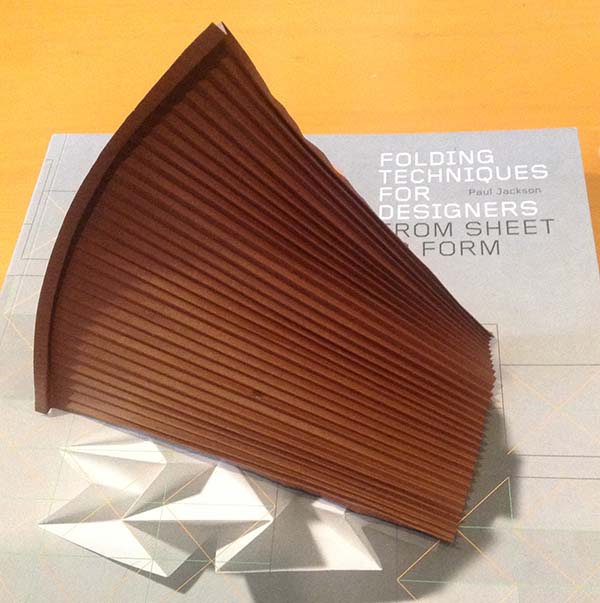
Pizza wedge model sitting on top of a copy of "Folding Techniques for Designers: From Sheet to Form" by Paul Jackson

Pizza Wedge, a design/experiment by me

I acquired a copy of Folding Techniques for Designers: From Sheet to Form, by Paul Jackson.  It has a rather unusual, but refreshing perspective.  Basically, it tries to avoid the origami tradition entirely, and instead focuses on folding as an element of design.  Several chapters are occupied by simple ideas about pleating paper.  The reader is encouraged to experiment, and this is just one basic experiment.

The Pizza Wedge is not technically challenging to create, but its simple and abstract nature leads one to contemplate the little details.  One emergent property of the paper is the negative curvature (i.e. the saddle shape).  When you crease a paper back and forth, on the macro scale the paper compresses in one direction.  When I added the “crust” of the pizza, that suppressed the creases, which has the effect of stretching the paper on one side.  The stretching and compressing leads to negative curvature.

I include a second experiment below the fold.

[Read more…]

Tessellation symmetry

This is (the last) part of my series about symmetry in origami.

A tessellation is a set of tiles that fill up a 2D plane. And I do mean the entire 2D plane, infinite in extent. When we talk about origami tessellations, these are models that could hypothetically fill a 2D plane, if we had an infinite amount of paper. In practice, an origami tessellation is finite, but for the purposes of discussing symmetry, we will imagine them to be infinite.

example origami tessellation

An example of an origami tessellation, the Rectangular Woven Design by David Huffman

Previously, I only discussed two kinds of symmetry transformations: rotation, and reflection. However, many tessellations have repeating patterns, and this in itself is another form of symmetry. Are there other kinds of symmetries that we forgot? Let’s take an inventory of all the possible kinds of symmetry transformations.

[Read more…]

The construction of emotions

I recently read How Emotions are Made, by Lisa Feldman Barrett. It explains the theory of constructed emotion and its implications. This is the best book of nonfiction I have ever read. Repeatedly throughout the book, I had to put it down because I was so blown away that I needed a moment to think through the implications. And since I’m a blogger, my thoughts would often drift towards how I might write about these ideas and share them. This post will be a bit of an introduction explaining the basic concepts as I understand them, and I hope to write more in the future.

Regular readers know that I believe in nominalism–I think there is a meaningful sense in which everything is socially constructed. I understand that a lot of readers disagree with this, and we may never persuade one another. But fortunately this is irrelevant. When we speak of the theory of constructed emotions, it isn’t a broad philosophical claim, it’s an empirical claim that is specific to human emotions.

When psychologists study emotions, they can record a number of objective measurements, such as facial configurations, positive/negative valence, high/low arousal, and activity in different parts of the brain. However, these objective measurements do not match up to emotional categories. A single emotional category could correspond to many different facial configurations, while a single facial configuration could correspond to any number of different emotions. Yes, there are many qualitatively distinct feelings we can feel. However, when we give a name to those feelings, and place those feelings in an emotional category, this categorization process is not purely based on the feelings themselves. It’s based on the emotional concepts that are available to us, it’s based on the context in which we have those feelings, and it’s based on what we think the purpose of those feelings are.

[Read more…]

What is an apology?

This is a repost of an article I wrote in 2014.

There are countless cases in the news where a public figure does something wrong, and we all collectively ask, “Why don’t they just apologize?” or “Why don’t they apologize the right way?”  In the mean time I’ve often thought, “Why does anyone apologize ever?  What is an apology aside from a collection of emotions with no rational analogue?”

An apology is a sort of script.  Alice wrongs Bob.  Bob demands an apology from Alice.  Alice apologizes.  Bob forgives Alice.

OR

Alice refuses to apologize.  Bob is angered and seeks other means to punish Alice.  He could deny her trust, deny her social status, or even punish through legal means.

But what’s in it for Alice?  What’s in it for Bob?  As far as Alice is concerned, the outcome of apologizing is clearly better than that of refusing to apologize.  As far as Bob is concerned, punishment may provide either a psychological or game-theoretic value–why should any of that change just because Alice arranges some words in a particular way?

[Read more…]

The Second Law and its misuses

An OrbitCon session brought to my attention to the fact that Steven Pinker spouts a lot of bullshit about the Second Law of Thermodynamics. (The Second Law is, “entropy cannot decrease over time in a closed system.”) In Pinker’s book, Enlightenment Now, he begins by refuting the creationist argument that the Second Law contradicts the theory of evolution. This is easy to do, you just say that the earth isn’t a closed system, and dramatically point at the sun. But Pinker then proceeds to forget about the sun, and argues that the Second Law of Thermodynamics explains poverty. I don’t have the book available, but Pinker has written an essay along similar lines:

Poverty, too, needs no explanation. In a world governed by entropy and evolution, it is the default state of humankind. Matter does not just arrange itself into shelter or clothing, and living things do everything they can not to become our food. What needs to be explained is wealth.

Here’s the thing: creationists are really really wrong about the Second Law. There’s plenty of room to be less wrong than creationists, but still really really wrong. For those of us who have taken an interest in fighting creationism, we know we can just point at the sun and be done with it. But just because you’re familiar with this argument, please don’t mistake that for an understanding of the Second Law. Don’t be like Steven Pinker.

Here I will state and explain a few basic principles about entropy, with the goal of going beyond a mere refutation of creationist arguments.

[Read more…]