
Niall Ferguson, queer theory, etc.

Niall Ferguson, a conservative historian, was recently in the news because schadenfreude. This started a train of thought to far away places, and I’d like to take you on the journey.

In The Stanford Daily‘s coverage of said schadenfreude, they mention another time that Ferguson put his foot in mouth, back in 2013. Ferguson had claimed that the famous (liberal) economist John Maynard Keynes didn’t care enough about the future because he was gay and childless.

Point in fact, Keynes was bisexual, married a woman, and tried to have children, although they had a miscarriage. Also, it’s not clear that Keynes didn’t care about the future.

Niall’s remark was clearly in response to Keynes’ famous quote, “In the long run we are all dead.” I immediately saw the connection, as this is a household quote and in-joke between me and my fiance. We say stuff like, “That may help in the long run, but you know what they say about the long run.” But it’s not really an expression of disregard for the future. It would help to see the quote in its original context: [Read more…]

Origami: Lilia

The Sparaxis, a spiky ball that fits in my hand

Lilia, by Ekaterina Lukasheva. I’m not sure I got the name right, but I’m absolutely sure about the author.

In the past year I’ve been dabbling a lot into other kinds of origami, such as traditional origami, tessellations, and minimalist designs.  But still, it’s good to make some modular origami models.  This is a kusudama model of very standard design.  30 units, 5 colors arranged symmetrically.  Although, I actually made 2 of the 5 colors identical, which is a cheeky way of making it slightly asymmetrical.  This was made as a gift for a relative.

Attraction and emotional granularity

This article was written for the Carnival of Aces themed on “Nuance & Complexity“. It is being cross-posted to my other blog, The Asexual Agenda.

Asexuality is chiefly about noticing a distinction between the emotions you perceive in other people, and the emotions you perceive in yourself. We give a name to this distinction, for example by saying some people experience sexual attraction and some people do not. And we discuss appropriate responses to our emotions, for example by saying that some emotions mean we want to have sex, and other emotions do not.

Within ace communities, we often discuss further distinctions in emotions. Again, we give names to these distinctions, for example by talking about romantic attraction, platonic attraction, aesthetic attraction, sensual attraction, and so forth. And we discuss appropriate responses to these emotions, for example by describing what kinds of relationships might satisfy our emotions, or if a particular emotion only makes us want to look at a person.

The ability to distinguish different emotions is a nascent research topic in psychology. And while you shouldn’t let psychology research dictate how you live, looking into the research may give us insight into a common topic.

[Read more…]

FTA part 2: Prediction distributions and inflation

This is the second part of a series discussing the Fine Tuning argument (FTA). The outline is here.

Comparing Hypotheses

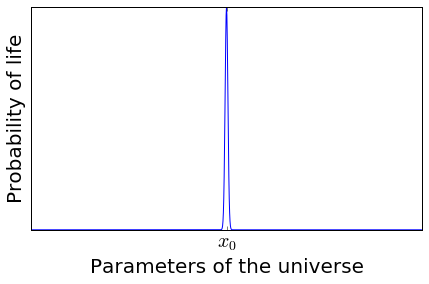
Previously, I explained how the Fine-Tuning argument assumes this kind of picture:

A graph showing the probability of life vs the parameters of the universe. The probability is sharply peaked at x_0.

The probability of life is sharply peaked. x0 marks the parameters of the universe that we have in the real world.

Does this graph mean that life is unlikely? No, not necessarily. It depends on the probability distribution of the parameters of the universe. For example, here are three possible probability distributions A, B, and C. Under probability distribution A, or C, life is very unlikely. Under probability distribution B, life is much more likely.

[Read more…]

Authorial intent is magic!

This is a repost of an article I wrote in 2015, although I changed the title.

The author is magic

Death of the Author” is a famous 1967 essay by Roland Barthes regarding the interpretation of literature.  He argues that the intentions and context of the author are irrelevant when interpreting the author’s work.  At most, the author provides a single interpretation, which must compete with all other interpretations.

Intent! It’s fucking magic!” is an influential 2010 essay by Kinsey Hope regarding the moral judgment actions.  There’s a common circumstance wherein a person tries to justify their mistakes by emphasizing their good intentions.  The essay snarkily observes that good intentions have the strange and magical power to erase all harms.  “Intention isn’t magic” has become a common saying among activists.

Though the two essays live in completely different contexts (literary criticism vs moral discourse), I would argue that the sentiments behind each are substantially similar.  Indeed, in the modern age, when we increasingly look at popular works of fiction through moral lenses, and when “actions” often consist of tweets or other comments, it is questionable whether they even live in different contexts.

[Read more…]

The Fine-Tuning Argument: A walkthrough

The Fine-Tuning Argument (FTA) is one of those standard arguments for the existence of God. The argument goes that humans can only arise when the parameters of the universe are tuned exactly right. And while it’s possible that we just got lucky, the argument goes that it’s far more likely that God did the tuning.

The standard way to talk about the FTA is delve into a bunch of math equations.  Not that there’s anything wrong with math, but here I wanted to write an in-depth overview that doesn’t talk about the math.  There will, however, be a lot of physics.  The goal here is not to refute the FTA (although refutations will occur incidentally), but to explore it, and to understand how we test hypotheses about the universe.

Outline

(Links to be added later)

1. The Fine-Tuning Argument: A walkthrough
2. Prediction distributions and inflation
3. Ignorant hypotheses
4. Anthropic reasoning

Perma-link to entire series

The parameters of the universe

The core premise of the FTA is that the universe is fine-tuned. Which is to say, the probability of life looks like this:

[Read more…]

Public ignorance/awareness of science

Have you ever read one of those news stories reporting that Americans are shockingly ignorant of science? For example, here’s an article saying that a quarter of Americans think the Sun orbits the Earth.

And if you found that shocking, brace yourself for the next one. According to this article, a quarter of Americans think the Sun orbits the Earth!

Okay, so both of the news articles are saying the same thing. But one of the articles is from 2014, and the other is from 1988. They’re both reporting on an NSF study, which has been repeated every couple years for three decades. They always ask whether the Sun orbits the Earth or the Earth orbits the Sun, and they consistently find that about a quarter of USians don’t know or get it wrong. They also ask if electrons are smaller than atoms, if lasers focus sound waves, and if antibiotics kill viruses.* News sources like to put the Sun/Earth statistic in their headlines, because it sounds the most shocking to readers.

You might guess from my tone that I’m a bit more apathetic about the whole thing. Yeah, it’s bad that USians are ignorant of elementary astronomy. But science is not a collection of factoids, and factoids are not the most important component of scientific literacy. As far as facts go, there are way too many for anyone to know all of them, and it’s difficult to judge which facts are more or less important for people to know.  If a fact is “basic” and “obvious”, that might make it socially unacceptable to be ignorant of it, but it also might make it less important to know, given how easy it is to look up the answer.  In my opinion, it’s far more important for people to understand scientific reasoning, like how experiments are designed, and how to read graphs.

[Read more…]