Unpopular tastes

I’ve said before that I tend not to like things that are popular (e.g. movies, music, TV shows, topics of interest, etc.). I reflect a lot on the minor disadvantages associated with such unpopular tastes.

To give an example, the popularly preferred social network is Facebook. What if you happen to hate Facebook, and instead prefer Google+? Either you join a network that’s missing most of your friends, or you just put up with a network you dislike. Many people think this problem could be solved if either Facebook changes or people leave. While this might help, the problem could never be eliminated, since there will always be someone dissatisfied with the most popular social network.

When it comes to social networks, many people want one that has their friends on it. But what about books? Do you particularly care whether you can find friends who like the same books? If you really like Ulysses, does it matter to you that few other people understand?
[Read more…]

The Physics Nobel this year

A few days ago, the Nobel Prize in Physics was awarded to Haldane, Kosterlitz, and Thouless, ”for theoretical discoveries of topological phase transitions and topological phases of matter”Hey, I recognize two of those names!  In my field of research, superconductivity, there’s something known as the Berezinskiĭ-Kosterlitz-Thouless transition.  (Berezinskiĭ didn’t win the Nobel because he died in 1980.)

As always, the Nobel provides an article explaining the background for popular audiences.  I’m just going to talk about it briefly to give you the gist.

Berezinskiĭ, Kosterlitz, and Thouless (BKT) explained the superconducting transition in flat, 2-dimensional materials.  Below a certain temperature, the material becomes a superconductor, conducting electricity with precisely zero resistance.  Above that temperature, it behaves as a normal material.  What changes?

Superconductors have topological defects called vortices (singular form is “vortex”), which I depict below:

On the left, a grid of atoms where all arrows point outwards from a topological defect. On the right, the arrows point horizontally outwards and vertically inwards.

Here, each blue circle is an atomic site, and the arrow represents the “phase” of the superconductor.  The two squares above show the two kinds of vortices, the “+” vortex and “-” vortex.  These vortices behave as electrical charges, with like repelling like, and opposite charges attracting. [Read more…]

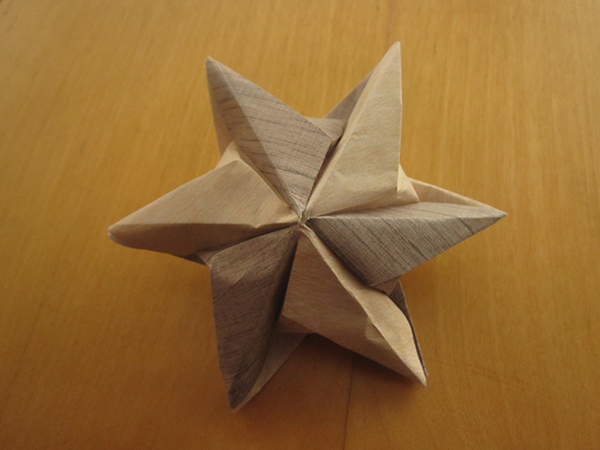
Origami: WXYZ Impostor

WXYZ IMpostor
WXYZ Impostor. The design is mine, but I include WXYZ units, designed by Tung Ken Lam.

Once a year, I run a little class to teach origami to kids. This year, one of the projects was to create the famous WXYZ model, which consists of four intersecting triangles (labeled W, X, Y, and Z). So I had been thinking about this model, and thought, I could design a variation on the theme. The result is shown above.

Once I had completed it, I realized I could not show this to the kids! It would just confuse them! The WXYZ Impostor looks like the model they were trying to create, but is slightly different in a way that is difficult to place. Check out the comparison below.
[Read more…]

Paper: The Sokal Hoax

In 1996, physicist Alan Sokal was unhappy with the tendency in academic postmodernism to dismiss scientific work. So he submitted a bogus paper called “Transgressing the Boundaries: Towards a Transformative Hermeneutics of Quantum Gravity” to Social Text, a journal in cultural studies. After it was published, he revealed it as a hoax. And now, it is one of the best known shots fired at academic anti-science.

While the hoax is a good conversation-starter, I would caution against thinking it’s a total slam-dunk. Journals are there to filter out shoddy work, rather than bad faith actors. Secondly, AFAICT Social Text is a journal of mediocre impact. Finally, Sokal himself said that academic postmodernism has now backed off from many of its previous excesses. (Sokal credits the Bush administration, which was more effective at satirizing academic postmodernism than he ever was.)

In any case, this is a paper report. To humorous ends, I will review Sokal’s paper as if it were a serious work.
[Read more…]

30 atheist discussion topics

I’ve long been involved in the local atheist student group. I really mean “long”–through both undergrad and grad school. I perpetually complain about the group, but never leave, and never lift a finger to help. This is probably important to understanding Who I Am As A Person.

Well, the leadership said they were looking for more discussion topics. I can help with that. I e-mailed them thirty topics that I came up with off the top of my head. If you run an atheist group anywhere, you are free to borrow any of these.

[Read more…]

What is a safe space?

Last month, a lot of discussion was prompted by a statement by the dean of University of Chicago opposing censorship, trigger warnings, and safe spaces. I’ve already briefly argued that the inclusion of trigger warnings is completely off-base. The inclusion of safe spaces is harder to judge. “Safe space” means a lot of things to different people, and I just have no idea what the dean thought he was criticizing.

Safe spaces under different names

In my personal experience, “safe space” is most frequently used as a description of queer student group meetings or conferences. Basically, we intentionally build an environment where people feel more comfortable sharing their experiences. This means starting meetings with an explicit agreement of confidentiality, as well as other agreements designed to head off conflict. Often these agreements have cutesy names, like “Step up, step back”, “One mic, one diva”, “Use ‘I’ statements”, “Don’t yuck my yum”, and “Ouch, oops, educate”, although I think the names might be regional.

I have mixed feelings about the explicit agreements, because they take up time and seem unnecessary. In my experience, atheist student groups also set up safe spaces, but they never call it by that name, nor are there any explicit agreements. Atheist groups also intentionally build an environment where people feel more comfortable being openly critical of religion. Many atheist students act very confident, as if they don’t need a safe space to speak their minds, but when you get to know them better you realize that some of the same students keep it very quiet around their families.
[Read more…]

Some PTSD statistics

This is a repost of an article I wrote in 2015.

I occasionally read social science papers, and I think it’s worth sharing what I find, even though in principle you could read about it yourself. This time I read about statistics on Post-traumatic stress disorder (PTSD) in the US, and my particular interest is in PTSD from sexual assault and rape.

A good basic overview of PTSD can be found from the US Department of Veteran’s Affairs:

Diagnostic criteria for PTSD include a history of exposure to a traumatic event that meets specific stipulations and symptoms from each of four symptom clusters: intrusion, avoidance, negative alterations in cognitions and mood, and alterations in arousal and reactivity.[1]

According to the National Comorbidity Survey (NCS), about 7.8% of people in the US have experienced PTSD in their lifetime. This is reinforced by the NCS-R (a replication of the original study) which found 6.8% prevalence. However, just because someone has suffered from PTSD doesn’t necessarily mean they’re still suffering; Only 3.5% have had PTSD in the past year.[2] Here’s a timeline of PTSD recovery:

A graph showing how long it takes for people to recover from PTSD. There are separate curves for people who get treatment and people who don't get treatment. The study extends for 10 years, with about a third never recovering.
[Read more…]