About interest rate hikes

Recently, the US Federal Reserve increased interest rates by 0.25% (CNBC). It may not seem like much, but it heralds further increases in interest rates, and it basically represents the failure of Trump policy. Let’s talk about it.

What are interest rates?

FYI, this is all stuff that you can learn about from more politically impartial sources, such as Wikipedia, or websites promoting financial literacy. I’m not saying anything new.

“Interest rates” is a generic term that describes how expensive it is to maintain debt, e.g. if you have a mortgage or credit card debt, you have to pay interest on that debt. But in this context, I’m referring to the Effective Federal Funds Rate (EFFR), which is a matter of US economic policy. The EFFR represents the interest rates that US banks pay on their debts to the US Federal Reserve. The EFFR is not identical to the interest rates that you pay on your own debts, but they’re strongly connected via market mechanisms.

Okay, but why are banks borrowing money?

When you deposit money in a bank, they don’t hold all that money in a vault, they turn around and invest the money. But you still need to be able to withdraw money when you need it, so banks maintain a certain amount of money on hand (aka liquidity). In fact, banks are strictly required to maintain a minimum amount of liquidity. If banks ever have too little liquidity, they borrow money from other banks that have too much. Or, they borrow money from the US Federal Reserve Bank.

So by setting the EFFR, the US Federal Reserve is basically setting the price of liquidity. And that affects the entire financial system.

If interest rates are low, then liquidity is cheap. You can borrow money to buy a house at relatively low interest rates. You can borrow money to start a new business. You can even invest in businesses that produce relatively little value to society, such as cryptocurrency or Twitter.

If interest rates are high, then liquidity is expensive. Starting a business is harder. Investors demand companies produce immediate profit, even if that means enshittifying their product. Even the US national debt becomes more of a concern, because the government, too, pays a higher interest rate.

Depending on your financial position, you may stand to personally gain or lose from higher interest rates. For example, if you have a fixed interest mortgage, lucky you, you’re protected. But the purpose of adjusting interest rates is obviously not to benefit some individuals and punish others, it’s for the health of the entire economy.  In case of a recession or financial panic (e.g. the 2008 financial crisis), the Feds will lower interest rates to inject more money into the system. In case of supply shocks or inflationary spiral (e.g. recent years), the Feds will raise interest rates, basically discouraging spending and tamping down inflation.

The current hikes

So, here’s the EFFR over the last 10 years.
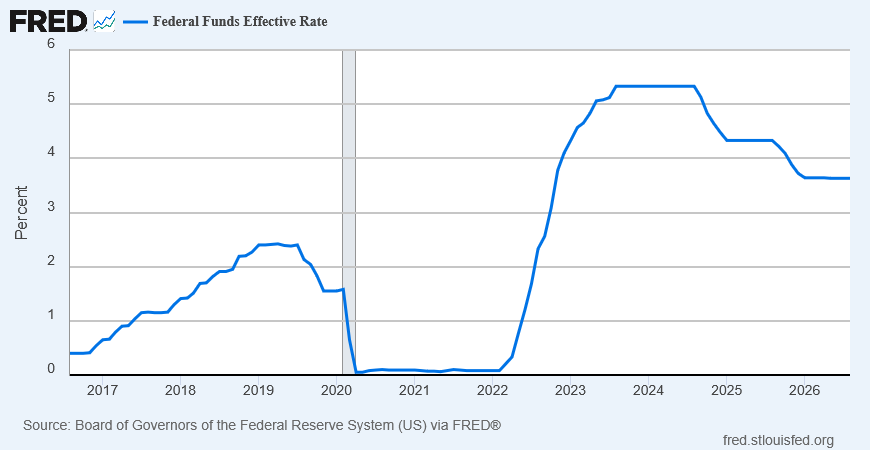
EFFR over the past 10 years

Source: FRED. The graph doesn’t reflect the latest increase in EFFR this month.

In 2020, the Feds suddenly cut rates in response to the pandemic, basically financial relief in the face of hard times. But it couldn’t last. In 2022, inflation started going up, attributed to pandemic stimulus checks, supply chain disruptions, and the Russian invasion of Ukraine. So the Feds responded by increasing interest rates. Under Biden, the economy was recovering and interest rates were slowly turning around. But Biden also took the blame, and this is probably the biggest reason why Democrats lost the election in 2024.

Trump put the brakes on economic recovery, as I’ve already discussed. He promised tariffs and immigration enforcement. So the Feds, conservative though they are, were concerned he’d make good on those promises, and slowed down interest rate cuts over the next few years.

The latest interest rate hike is pretty strongly related to another Trump policy: war with Iran. It turns out that if you take 20% of the world’s oil supply, and lock it behind the Strait of Hormuz, things get more expensive. Inflation goes up, and the Feds increase interest rates to tamp it down.

Trump, for his part, has been demanding that the Feds cut interest rates. He demanded it in 2025, and is demanding it today. He even installed Kevin Warsh as chair of the Federal Open Markets Committee (which decides interest rates), in an effort to pressure interest rate cuts.  But the latest vote was unanimous, with even Warsh voting to raise interest rates.

Why has Trump been demanding interest rate cuts? It’s nonsensical. The interest rate hikes are easily attributable to his own damn policies.  He’s openly advocating a policy of runaway inflation.

I’ve wondered if maybe Trump stands to personally benefit from lower interest rates. For instance, if he personally holds variable-rate loans. I found a source saying that he did, as of 2019. So basically, he’s advocating a nonsensical policy because of personal corruption. Unforgivable.

But another source argues that he’s demanding interest rate cuts in order to deflect blame onto the Feds. Hard to tell who exactly this would fool, as it requires you to simultaneously understand federal interest rates, and not understand federal interest rates. In any case, also unforgivable.

This has been your periodic reminder that the Nazis do not make the trains run on time. They just blame immigrants when they themselves screw up the trains.

The aspiration of homeownership

In my last post, I was talking about our search for a new apartment. For the record, my motivation was that I hadn’t written much lately, so why not write about what I’ve been doing? I was not specifically trying to comment on the politics of housing.

But the politics of housing are surely relevant, and worth talking about–at the risk of repeating myself.

As I’ve said many times by now, my household is relatively wealthy. Plainly stated, we are millionaires. That’s not a brag, I simply think you deserve my honesty. Since around 2020, my husband and I have become tech workers without any dependents, debt, or expensive tastes–it’s a recipe for wealth. In our position, some people expect that we would buy a house. But we don’t want to become homeowners, and we are ideologically opposed to the expectation that we should.

[Read more…]

2025 California Special Election position

California has a special election this year, and I’m following my routine of discussing my choices, with the intent of normalizing the voting process.  It won’t be too long this time, because there’s just one proposition.  Well, there’s also a local measure, but I tend not to discuss those.

Proposition 50: Yes

This is pro-gerrymandering legislation, and counterintuitively, I’m in favor of it!

[Read more…]

No Kings, October 2025

I just came back from the No Kings protest.  Last time, we went to the San Francisco protest, which was the largest crowd I’ve ever seen.  This time, we went to a more local protest.  Every one of the suburbs seems to have its own separate one.  Our resistance is fractal.

Where the San Francisco protest blocked off a whole street for a mile and a half, the Fremont protest occupied the sidewalks for about 5 blocks.  I’d estimate there were several hundred people.  You could stand at a corner and basically stay stationary the whole time, but we walked back and forth several times.  Because we weren’t blocking the road, cars were driving past us, and constantly honking in support.

Like before, we brought our big US flag.  My husband wore a shirt with a rainbow US flag, and I borrowed one of his shirts that said “Make Treason Wrong Again”.  We met up with another friend and took the opportunity to socialize–not just talking about politics, but also the usual.

All sorts of signs, ranging from the simple “NO 👑”, down to more specific fuck-yous to ICE or RFK Jr.  There was not one but two bands–one small brass band, and one saxaphone quartet.

If you google “how to prepare for a protest”, I think the advice is overly cautious, preparing for the worst.  But the median protest is entirely safe.  I recommend bringing a bottle of water, sun tan lotion, and a friend.  These protests are an environment of joyful resistance.  People are angry, but there’s an inherent optimism in the activity, seeing all the popular opposition.  I fully recommend participating.

Hell is Us: War and emotional distance

Hell is Us is a recent action adventure video game, with an emphasis on puzzles and exploration. I really like the game, but this is not a review.  See other sites for reviews. I am here to discuss story and themes.

Hell is Us is about war. But it’s not some high fantasy war, disconnected from reality. It’s a flat out genocide.

It takes place in the fictional country of Hadea, geographically isolated from the rest of the world. There are two religious groups, the Paloms and Sabinians. After years of forced resettlement, racist propaganda, a vote for Sabinian indendence, and so much more, the country has erupted into violence. The Sabinian army now is attempting to eradicate the Paloms. Even otherwise sympathetic characters, even young children, often express hatred for the other side, viewing them as less than human.

Paloms and Sabinians have a history that deliberately evokes Catholics and Protestants. But whether intentional or not, there is ~another~ genocide that very strongly comes to mind.

The player character is Rémi, who was born in Hadea but escaped as a small child. He never fights any humans, instead only fighting the demonic invasion that the war seems to have provoked. He is a heroic character, often helping civilians, and even saving lives. But as for the war itself, he mostly gives it the silent protagonist treatment, giving space to the player to have their own emotional reaction.

[Read more…]

No Kings San Francisco

I just came back from the San Francisco No Kings protest.

I went with my husband, who is very much more of a protestor than I am.  He’s been attending protests on a regular basis for months.  He has a bunch of protest shirts, and a big US flag.  Normally he flips the flag upside-down, symbolizing distress.  Today, he flipped the flag right-side up, saying he wanted to dial up the visible patriotism. At the protest, there were of course lots of people with US flags, and other flags as well.

In contrast, I’m the type of person that goes outside once a week.  I freely admit that I do not like being at protests.  But I showed up in my everyday clothes and a backpack.  I enjoyed seeing the immense popular support for democracy, and opposition to everything Trump stands for.

[Read more…]

Why loans cost money

Boots theory

Boots theory is the idea that being poor is expensive. It comes from a Discworld novel, where a character observes that being poor, he can’t afford a good pair of boots. Instead he buys cheap boots that don’t last nearly as long. The cheap boots cost less money upfront, but are ultimately more expensive since they frequently need replacement.

Taken literally, I’m not sure how accurate the story is. Is it really true that cheap boots are less efficient in durability than expensive boots? It could be, but the cost of boots might also be driven by characteristics besides durability, such as comfort or appearance. Hard to say, since I don’t wear boots.

But if we forget about the boots, then boots theory is obviously true. The boots represent capital. Capital is anything that costs resources now, and provides value later. Capital costs money. If you can’t afford to buy capital, then you ultimately lose out on the value of capital. Being unable to afford capital is therefore expensive.

[Read more…]