A woman has to be brave to work at a remote research station

I wonder if NSF regrets making their logo so prominent in these photos of the McMurdo research station in Antarctica. I can see where there is some pride.

Antarctica’s ancient ice sheet and remoteness make it ideal for scientists studying everything from the earliest moments of the universe to changes in the planet’s climate.

The population at McMurdo, the hub of US operations, usually swells from 200-300 in the southern winter to over 1,000 in the summer. Typically, around 70 per cent are men.

Funded and overseen by the NSF, the US Antarctic Programme is run by a tangle of contractors and subcontractors, with billions of dollars at stake. Since 2017, Leidos has held the main contract, now worth over $200 million per year. Subcontractor PAE, which employs many of the base’s workers, was bought last year by the government services giant Amentum.

Money, isolation, lots of men, it does look like an opportunity for research, but you’d think someone would recognize that it’s also an opportunity for men to behave badly, and that precautions would be taken to protect all the workers there. They weren’t.

The National Science Foundation, the federal agency that oversees the US Antarctic Programme, published a report in 2022 in which 59 per cent of women said they’d experienced harassment or assault while on the ice, and 72 per cent of women said such behaviour was a problem in Antarctica.

But the problem goes beyond the harassment, the Associated Press found. In reviewing court records and internal communications, and in interviews with more than a dozen current and former employees, the AP uncovered a pattern of women who said their claims of harassment or assault were minimised by their employers, often leading to them or others being put in further danger.

In one case, a woman who reported a colleague had groped her was made to work alongside him again. In another, a woman who told her employer she was sexually assaulted was later fired. Another woman said that bosses at the base downgraded her allegations from rape to harassment. The AP generally does not identify those who say they have been sexually assaulted unless they publicly identify themselves.

72%! That’s a rather significant number. You’d think that would be enough to prompt major changes in policy and enforcement. Nope. Instead, it encouraged denial.

Buckingham was hired by PAE. Amentum didn’t respond to questions from the AP. Leidos senior vice-president Melissa Lee Dueñas said it conducts background checks on all its employees.

“Our stance on sexual harassment or assault couldn’t be more clear: we have zero tolerance for such behavior,” Dueñas said in an email. “Each case is thoroughly investigated.”

Those are words that put me on edge: you’re saying “zero tolerance,” but when you’ve got a strong majority of women reporting harassment, that says you’re pretty tolerant. “Thoroughly investigated” sounds more like “thoroughly covered-up.”

I’ll spare you the many personal accounts of sexual abuse documented in the article. I’m most appalled by how the contractors who profit from McMurdo respond to the reports. Here’s how a woman, Liz Monahan, who was assaulted, was dealt with.

With her employers doing nothing to address her concerns, Monahon’s immediate boss and co-workers came up with their own plan, according to two employees familiar with the situation.

Monahon was told to pack her bags, and the next morning joined a group trying to navigate a safe route across the sea ice over eight days to resupply a tiny US outpost. The crossing is risky because the ice can crumble in the spring.

“To protect her, they put her in a dangerous situation,” said Wes Thurmann, a fire department supervisor who had worked in Antarctica every year since 2012.

But they all felt it was safer than her remaining at McMurdo.

It’s a pattern of neglect, denial, and protection of the abusers.

The woman told her bosses she’d been sexually assaulted by a coworker. Her performance was subsequently criticised by a supervisor, who was also the girlfriend of the accused man. Two months later, she was fired.

Many of the woman’s colleagues were outraged. Julie Grundberg, then the McMurdo area manager for Leidos, repeatedly emailed her concerns to her superiors in Denver.

“The fact that we haven’t come out with some sort of public statement is making the community trust our organisation even less,” Grundberg wrote.

Supervisor Ethan Norris replied: “We need your help to keep this calm and be a neutral party, as you have only one side of the story at this point.”

Wow. Leidos has been contracted by the NSF to manage the station since at least 2017; their contract expires in 2025. It’s part of the problem that their incompetence didn’t get them immediately terminated.

The deeper pattern here is that our scientific organizations are setting up remote research stations in places like Antarctica or the tropics while neglecting basic social obligations. They’re building cozy little cabins free of accountability that draw in rapists and abusers.

I don’t think Facebook understands the word ‘privacy’

They’d probably fail the vocabulary section of the SAT.

Many students have no choice about working with the College Board, the company that administers the SAT test and Advanced Placement exams. Part of that relationship involves a long history of privacy issues. Tests by Gizmodo found if you use some of the handy tools promoted by College Board’s website, the organization sends details about your SAT scores, GPA, and other data to Facebook, TikTok, and a variety of companies.

Gizmodo observed the College Board’s website sharing data with Facebook and TikTok when a user fills in information about their GPA and SAT scores. When this reporter used the College Board’s search filtering tools to find colleges that might accept a student with a C+ grade-point average and a SAT score of 420 out of 1600, the site let the social media companies know. Whether a student is acing their tests or struggling, Facebook and TikTok get the details.

No one should be surprised that Facebook and TikTok are stealing their users information. No one should be surprised that the College Board is pulling this crap, too. It’s cute that they were flat out caught lying.

“We do not share SAT scores or GPAs with Facebook or TikTok, and any other third parties using pixel or cookies,” said a College Board spokesperson. “In fact, we do not send any personally identifiable information (PII) through our pixels on the site. In addition, we do not use SAT scores or GPAs for any targeting.”

After receiving this comment, Gizmodo shared a screenshot of the College Board sending GPAs and SAT scores to TikTok using a pixel. The spokesperson then acknowledged that the College Board’s website actually does share this data.

Yeah, that’s the College Board all over the place. They’re a for-profit company(it claims to be a non-profit, but keep in mind the CEO makes over a million dollars a year) founded during the era of eugenics on the lie that a standardized test can be used to quantify the intelligence and ability of young people.

Shoes allow me to better serve my ravenous masters

I am pleased to report that for the first time in almost a month I am wearing shoes and socks, and have stuffed the ugly ol’ immobilizing boot in a closet. It feels like real progress at last. Next, I’m going to gingerly walk over to the lab and set up some class stuff and tend to my little beasties.

I know that this is the least exciting news you’ve ever heard — some guy is wearing shoes and socks! NY Times, get a reporter on that! — so here’s something that’s almost as newsworthy: false widow spiders kill and eat mammals larger than themselves.

The video shows a noble false widow’s web, located outside a bedroom window of the house in Chichester, with a small mammal ensnared in the silk. Later analysis of the mammal’s remains helped researchers identify it as a pygmy shrew.

The shrew was still alive in the web, the researchers report, although it was only seen making a few slight movements near the beginning of its ordeal. That’s probably due to the spider’s powerful neurotoxic venom, which is known to cause rapid neuromuscular paralysis.

The spider was seen moving back and forth between the shrew and the rafters above the window, using silk to hoist the shrew upward about 25 centimeters, the researchers report.

After 20 minutes, the spider had lifted its prey into the rafters, partially out of view. It wrapped the shrew in silk, fed on it for three days, and then dropped what was left out of its web.

According to the researchers, “the remains of the shrew were nothing but fur, bones, and skin”.

Now you know why, despite my recent travails, I still made the effort to guarantee the few hundred false widows in my lab a twice-weekly feeding. I don’t feed them rodents, but they do love big juicy mealworms that are at least fifty times their mass. They got fed yesterday, and today Igor…I mean, me…must extract the drained corpses. Next feeding on Tuesday.

Revenge is a dish best served flaming hot with lots of collateral damage

It was a strange detour in the war in Ukraine — the Wagner group, led by Yevgeny Prigozhin, abruptly left the field and started marching towards Moscow. Then Prigozhin equally abruptly gave up and retired to Belarus. I certainly had no idea what was going on, or what politicking was behind the maneuvers. It was clear that Prigozhin had made Putin sweat, briefly, and given Putin’s reputation for dealing brutally with betrayal, it was surprising that his opponent was walking away without a dose of poison or falling out a window.

Well, the price of crossing Putin has been paid. Prigozhin apparently has died, along with the crew and other passengers, in a catastrophic airplane crash.

In one video geolocated by NBC News near the village of Kuzhenkino in Tver Oblast, Russia, what looks like a plane can be seen spiraling down through clouds, trailing smoke behind it. The video, filmed from the ground and posted on social media, shows the apparent jet hurtling toward the ground before crashing and erupting into flames, sending a dark plume of smoke spiraling into the sky.

Another video filmed from a car near the same area shows an eyewitness driving beside a field in which the fiery wreckage of a plane can be seen. Another, graphic and close-up, shows someone inspecting the flaming wreckage in a field and swearing as they come across what appears to be two bodies.

You are clearly paranoid if you think Putin could have anything to do with such a ruthless, violent ‘accident.’

The state of AI

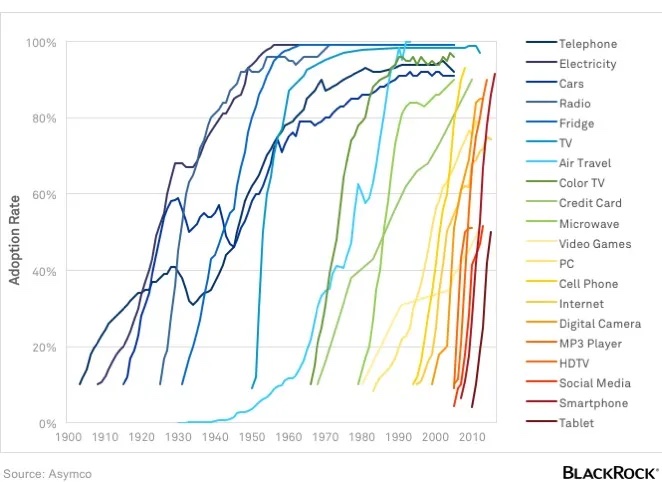
This is a fascinating chart of how quickly new technology can be adopted.

It’s all just wham, zoom, smack into the ceiling. Refrigerators get invented and within a few years everyone had to have one. Cell phones come along, and they quickly become indispensable. I felt that one, I remember telling my kids that no one needed a cell phone back in 2000, and here I am now, with a cell phone I’m required to have to access utilities at work…as well as enjoying them.

The point of this article, though, is that AI isn’t following that trajectory. AI is failing fast, instead.

The AI hype is collapsing faster than the bouncy house after a kid’s birthday. Nothing has turned out the way it was supposed to.

For a start, take a look at Microsoft—which made the biggest bet on AI. They were convinced that AI would enable the company’s Bing search engine to surpass Google.

They spent $10 billion dollars to make this happen.

And now we have numbers to measure the results. Guess what? Bing’s market share hasn’t grown at all. Bing’s share of search It’s still stuck at a lousy 3%.

In fact, it has dropped slightly since the beginning of the year.

What’s wrong? Everybody was supposed to prefer AI over conventional search. And it turns out that nobody cares.

OK, Bing. No one uses Bing, and showing that even fewer people use it now isn’t as impressive a demonstration of the failure of AI as you might think. I do agree, though, that I don’t care about plugging AI into a search engine; if you advertise that I ought to abandon duckduckgo because your search engine has an AI front end, you’re not going to persuade me. Of course, I’m the guy who was unswayed by the cell phone in 2000.

I do know, though, that most search engines are a mess right now, and AI isn’t going to fix their problems.

What makes this especially revealing is that Google search results are abysmal nowadays. They have filled them to the brim with garbage. If Google was ever vulnerable, it’s right now.

But AI hasn’t made a dent.

Of course, Google has tried to implement AI too. But the company’s Bard AI bot made embarrassing errors at its very first demo, and continues to do bizarre things—such as touting the benefits of genocide and slavery, or putting Hitler and Stalin on its list of greatest leaders.

Yeah. And where’s the wham, zoom, to the moon?

The same decline is happening at ChatGPT’s website. Site traffic is now declining. This is always a bad sign—but especially if your technology is touted as the biggest breakthrough of the century.

If AI really delivered the goods, visitors to ChatGPT should be doubling every few weeks.

In summary:

Here’s what we now know about AI:

  • Consumer demand is low, and already appears to be shrinking.
  • Skepticism and suspicion are pervasive among the public.
  • Even the companies using AI typically try to hide that fact—because they’re aware of the backlash.
  • The areas where AI has been implemented make clear how poorly it performs.
  • AI potentially creates a situation where millions of people can be fired and replaced with bots—so a few people at the top continue to promote it despite all these warning signs.
  • But even these true believers now face huge legal, regulatory, and attitudinal obstacles
  • In the meantime, cheaters and criminals are taking full advantage of AI as a tool of deception.

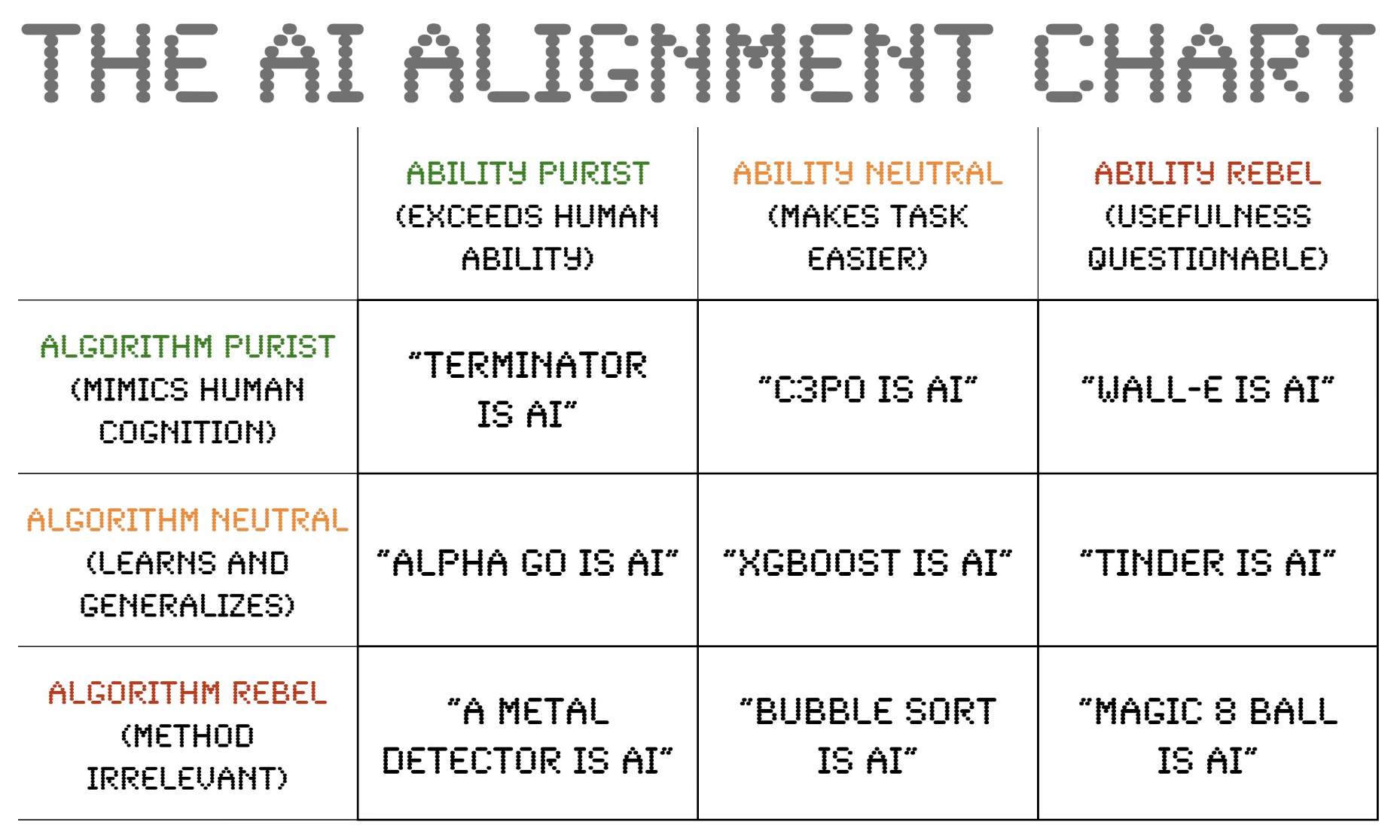
I found this chart interesting and relevant.

What I find amusing is that the first row, “mimics human cognition,” is what I’ve visualized as AI, and it consists entirely of fictional characters. They don’t exist. Everything that remains is trivial and uninteresting — “Tinder is AI”? OK, you can have it.

The children were bickering at the kiddie table last night

There was a Republican debate last night. Who cares?

To my surprise, I do. The Republicans are reduced to a cadre of climate change deniers, anti-vaxxers, anti-science loons, opportunistic parasites, and Trumpkins. They are irrelevant. Their only strategy for electoral victory is to be as outrageously flamboyant as possible and get votes by fueling the worst elements of society. It’s fine if the loons want to flush themselves down the toilet — it could be a way to concentrate the bad guys before purging the political process.

Sounds great…except what’s happening on the other side. The Democratic choice is now and forever going to be an apparatchik anointed by the party and advances to confront the shambling horde. This is not a way to run a democracy. It’s how you run a bureaucracy. We need change, deep structural change, but you know the Democrats aren’t going to bring it, while the Republicans are going to bring looney autocracy and theocracy.

Kooks hate being called on their kookery

Quack.

The College of Psychologists in Ontario has threatened to yank Jordan Peterson’s license if he wouldn’t take a course on professionalism in social media (it’s obvious that he needs it). Peterson challenged the decision in court.

The courts have spoken. He better take that course.

Last November, Peterson, a professor emeritus with the University of Toronto psychology’s department who is also an author and media commentator, was ordered by the College of Psychologists of Ontario to undergo a coaching program on professionalism in public statements.

That followed numerous complaints to the governing body of Ontario psychologists, of which Peterson is a member, regarding his online commentary directed at politicians, a plus-sized model, and transgender actor Elliot Page, among other issues. You can read more about those social media posts here.

The college’s complaints committee concluded his controversial public statements could amount to professional misconduct and ordered Peterson to pay for a media coaching program — noting failure to comply could mean the loss of his licence to practice psychology in the province.

Peterson filed for a judicial review, arguing his political commentary is not under the college’s purview.

The Ontario Divisional Court has dismissed Peterson’s application, ruling that the college’s decision falls within its mandate to regulate the profession in the public interest and does not affect his freedom of expression.

I’m trying to imagine myself in his position — it’s not that hard, although I don’t think I’ve been quite as maladroit and hateful on social media as Peterson. If I was threatened with loss of my position — I don’t have the external resources he does — and told I need to take a course in social media professionalism, I’d shrug and do it. Maybe I’d learn something. Peterson just hates to be told that he’s wrong about anything.

Peterson says he hasn’t undermined his profession at all.

He denies that he has brought disrepute to the profession, arguing the opposite is true.

I think I’ve done demonstrably more than any psychologist has ever produced to increase the prestige and trust of the practice of psychology around the world, Peterson said.

I can think of no one who has done more harm to the reputation of psychology than Jordan Peterson. He’s a narcissistic blabbermouth who invents, and teaches, garbage ideas.

Perfect sheet webs

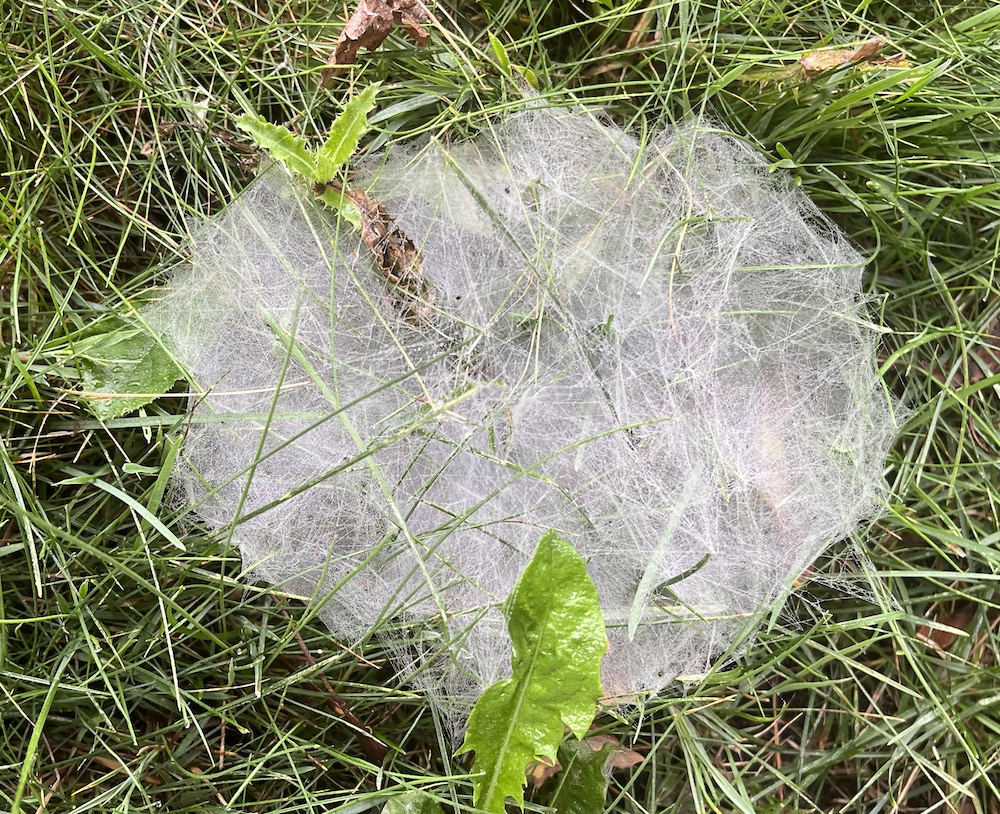
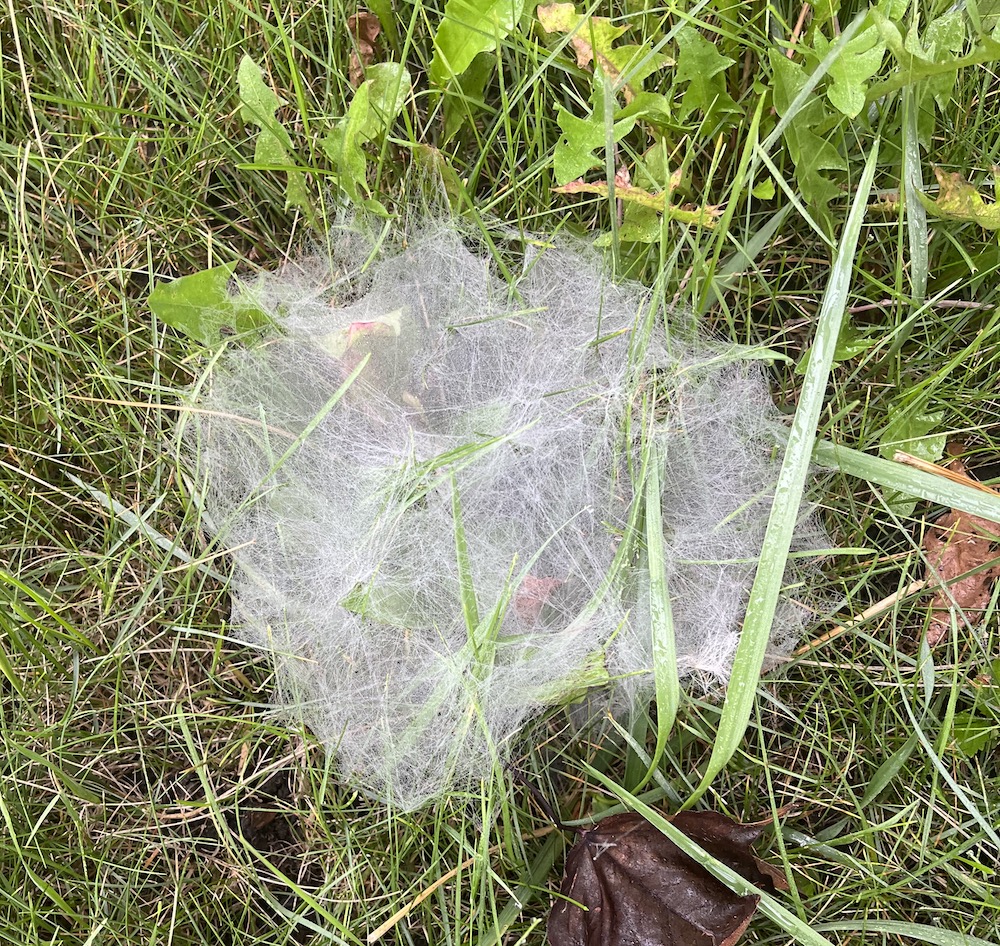
We’re having a little unpleasant weather — high temperatures and sky-high humidity, to the point where this morning we were socked in with a gray mist. The good thing about that, though, is that it highlights all the grass spider webs in our lawn. These are perfect and beautiful.

Yes, we have a few weeds in our lawn. It’s a yard for diverse invertebrates, so that’s OK.

Leaves? The leaves have started to fall? It’s that time, I guess.