The problem with Zoom…confirmed!

I was complaining about the effect of Zoom on students — it doesn’t encourage engagement and leads to apathy — and oh, look, someone did a study on “zoom fatigue”.

The study, published in the journal Scientific Reports, looked for physiological signs of fatigue in 35 students attending lectures on engineering at an Austrian university. Half of the class attended the 50-minute lecture via videoconference in a nearby lab and a face-to-face lecture the following week, while the other half attended first in person, then online.

Participants were monitored with electroencephalogram (EEG) and electrocardiogram (ECG) instruments that recorded electrical activity in the brain and their heart rhythms. They also participated in surveys about their mood and fatigue levels.

The researchers searched for physical changes correlated with mental fatigue, including distinctive brain waves, reduced heart rate and hints the nervous system might be trying to compensate for growing exhaustion during the lecture.

There were “notable” differences between the in-person and online groups, the researchers write. Video participants’ fatigue mounted over the course of the session, and their brain states showed they were struggling to pay attention. The groups’ moods varied, too, with in-person participants reporting they felt livelier, happier and more active, and online participants saying they felt tired, drowsy and “fed up.”

Overall, the researchers write, the study offers evidence of the physical toll of videoconferencing and suggests that it “should be considered as a complement to face-to-face interaction, but not as a substitute.”

I know, that’s a tiny n, tested on a yet another WEIRD group. I also think that for Zoom to work, you have to completely revamp how you teach, and this is obviously just presenting the same content in two different media. Given those problems with the study though, it aligns with my personal experience, and I’ll use it to further justify my decision to cut Zoom out of my life next semester.

Lectures are boring unless you can get some questions and other interactions during it, and I’ve noticed that, when I make my in-person lectures simultaneously available over Zoom, I get zero responsiveness from the online part of the class. I suspect I’ve put them all to sleep.


Toughness

Big Bluestem roots

Good deep roots make a difference. The photo to the right is from the University of Wisconsin Arboretum, and it shows how deep and strong and tangled the roots of the prairie bluestem are. It’s impressive how robust prairie ecosystems are, and we rip them up and replace them with Kentucky Bluegrass, which has the most pathetic shallow mat of a root system. See?

My mother is in the hospital right now — she’s been declining for years, but she keeps bouncing back because she has deep strong roots. I’ve taken her for granted for my entire life, because she always perseveres. I’m hoping she pulls through this time, too.

Well, now I know how spiders celebrate Thanksgiving

I was in the lab this morning, and found the Steatoda borealis in an odd position: face-to-face, chelicerae almost touching, and they were pulsing. I put this pair under the microscope, and actually saw that the male had one massive palp extended all the way to the female’s epigyne, and he was literally throbbing as he pumped her full of his semen.

Jeezus, this sounds like a porn novel.

I tried to get a photo of them in the act, but wasn’t quick enough. This [sorry, no spider photo here. You can see it on my patreon or instagram] is the moment after; the male had pulled back slightly, and was busy licking his palps clean. First he puts it in the female, and then he pulls out and puts it in his own mouth — at least you won’t find that in most porn stories, I don’t think.

I’m expecting eggs in a few days now.

Not in my home!

No barbarous carnivores here! Well, except for the spiders.

Our plans have changed. The original idea was that we were going to stay at home, and I’d grade lab reports and make a vegetarian shepherd’s pie. My son called, though, and now we’re driving to St Cloud (about 2 hours away) to join him for a mid-afternoon meal, probably at an Indian restaurant. I’ll make the pie and grade the lab reports tomorrow.

We won’t have Michael Voris to kick around anymore

I’ve featured Michael Voris several times here — he was the front man for an organization called the Church Militant, a small mob of disgruntled TradCaths, and Voris does a YouTube show called The Vortex which is usually him complaining about the gays, the liberals, the Pope, that sort of thing.

Michael Voris has resigned. Can you guess why?

I still don’t know. He rambles on about “demons” and “moral failings” and “horrible stuff” without dishing out any details.

Here’s another Church Militant weirdo who makes an empty statement on his resignation. Near as I can tell from this evasive complaint, Voris stopped praying with the staff a few years ago. Prayer is so important! No wonder he lapsed in some mysterious way.

We do know that he was “asked to resign for breaching the Church Militant morality clause,” so there was probably something sordid going on, like that he kissed a boy or donated to a social justice organization or, you know, didn’t pray enough. As much as I would be entertained by a tale of decadence and degeneracy, I suspect that his downfall was brought about by some simple thing that the rest of the world would find quaint, but that his insane community would have been horrified by.

What is going on with OpenAI?

It’s mystifying. I’m not a fan of the company, OpenAI — they’re the ones hyping up ChatGPT, they’re 49% owned by Microsoft that, as usual, wants to take over everything, and their once and future CEO Sam Altman seems like a sleazy piece of work. But he has his fans. He was abruptly fired this past week (and what’s up with that?) and there was some kind of internal revolt and now he’s being rehired? Appointed to a new position?. Confusion and chaos! It’s a hell of a way to run a company.

Here, though, is a hint of illumination.

Sam Altman, the CEO of OpenAI, was unexpectedly fired by the board on Friday afternoon. CTO Mira Murati is filling in as interim CEO.

OpenAI is a nonprofit with a commercial arm. (This is a common arrangement when a nonprofit finds it’s making too much money. Mozilla is set up similarly.) The nonprofit controls the commercial company — and they just exercised that control.

Microsoft invested $13 billion to take ownership of 49% of the OpenAI for-profit — but not of the OpenAI nonprofit. Microsoft found out Altman was being fired one minute before the board put out its press release, half an hour before the stock market closed on Friday. MSFT stock dropped 2% immediately.

Oh. So this is a schism between the controlling non-profit side of the company, and the money-making for-profit side. It’s an ideological split! But what are their differences?

The world is presuming that there’s something absolutely awful about Altman just waiting to come out. But we suspect the reason for the firing is much simpler: the AI doom cultists kicked Altman out for not being enough of a cultist.

There were prior hints that the split was coming, from back in March.

In the last few years, Silicon Valley’s obsession with the astronomical stakes of future AI has curdled into a bitter feud. And right now, that schism is playing out online between two people: AI theorist Eliezer Yudkowsky and OpenAI Chief Executive Officer Sam Altman. Since the early 2000s, Yudkowsky has been sounding the alarm that artificial general intelligence is likely to be “unaligned” with human values and could decide to wipe us out. He worked aggressively to get others to adopt the prevention of AI apocalypse as a priority — enough that he helped convince Musk to take the risk seriously. Musk co-founded OpenAI as a nonprofit with Altman in 2015, with the goal of creating safer AI.

In the last few years, OpenAI has adopted a for-profit model and churned out bigger, faster, and more advanced AI technology. The company has raised billions in investment, and Altman has cheered on the progress toward artificial general intelligence, or AGI. “There will be scary moments as we move towards AGI-level systems, and significant disruptions, but the upsides can be so amazing that it’s well worth overcoming the great challenges to get there,” he tweeted in December.

Yudkowsky, meanwhile, has lost nearly all hope that humanity will handle AI responsibly, he said on a podcast last month. After the creation of OpenAI, with its commitment to advancing AI development, he said he cried by himself late at night and thought, “Oh, so this is what humanity will elect to do. We will not rise above. We will not have more grace, not even here at the very end.”

Given that background, it certainly seemed like rubbing salt in a wound when Altman tweeted recently that Yudkowsky had “done more to accelerate AGI than anyone else” and might someday “deserve the Nobel Peace Prize” for his work. Read a certain way, he was trolling Yudkowsky, saying the AI theorist had, in trying to prevent his most catastrophic fear, significantly hastened its arrival. (Yudkowsky said he could not know if Altman was trolling him; Altman declined to comment.)

Yudkowsky is a kook. What is he doing having any say at all in the operation of any company? Why would anyone sane let the LessWrong cultists anywhere near their business? It does explain what’s going on with all this chaos — it’s a squabble within a cult. You can’t expect it to make sense.

This assessment, though, helps me understand a little bit about what’s going on.

Sam Altman was an AI doomer — just not as much as the others. The real problem was that he was making promises that OpenAI could not deliver on. The GPT series was running out of steam. Altman was out and about in the quest for yet more funding for the OpenAI company in ways that upset the true believers.

A boardroom coup by the rationalist cultists is quite plausible, as well as being very funny. Rationalists’ chronic inability to talk like regular humans may even explain the statement calling Altman a liar. It’s standard for rationalists to call people who don’t buy their pitch liars.

So what from normal people would be an accusation of corporate war crimes is, from rationalists, just how they talk about the outgroup of non-rationalists. They assume non-believers are evil.

It is important to remember that Yudkowsky’s ideas are dumb and wrong, he has zero technological experience, and he has never built a single thing, ever. He’s an ideas guy, and his ideas are bad. OpenAI’s future is absolutely going to be wild.

There are many things to loathe Sam Altman for — but not being enough of a cultist probably isn’t one of them.

We think more comedy gold will be falling out over the next week.

Should I look forward to that? Or dread it?


It’s already getting worse. Altman is back at the helm, there’s been an almost complete turnover of the board, and they’ve brought in…Larry Summers? Why? It’s a regular auto-da-fé, with the small grace that we don’t literally torture and burn people at the stake when the heretics are dethroned.

I want to see the mighty sex battles

Lately, I’ve been curious about this one species of spiders I’ve been breeding, Steatoda borealis. What makes them stand out compared to the other two species in the lab is the size of their palps — they’re significantly larger in S. borealis. It’s got me wondering why they have these massive spiky hooked medieval maces on their faces, where other species have prominent, distinctive bulbs but nothing of the magnitude of this one set of males.

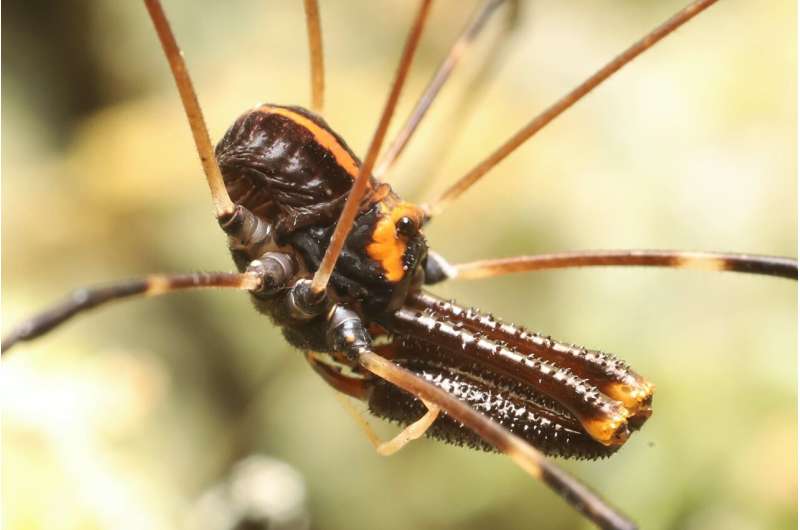
Then I see this species of harvestmen that put my spiders to shame. Look at this gigantic apparatus on the animal’s head! It can be up to 50% of their body weight!

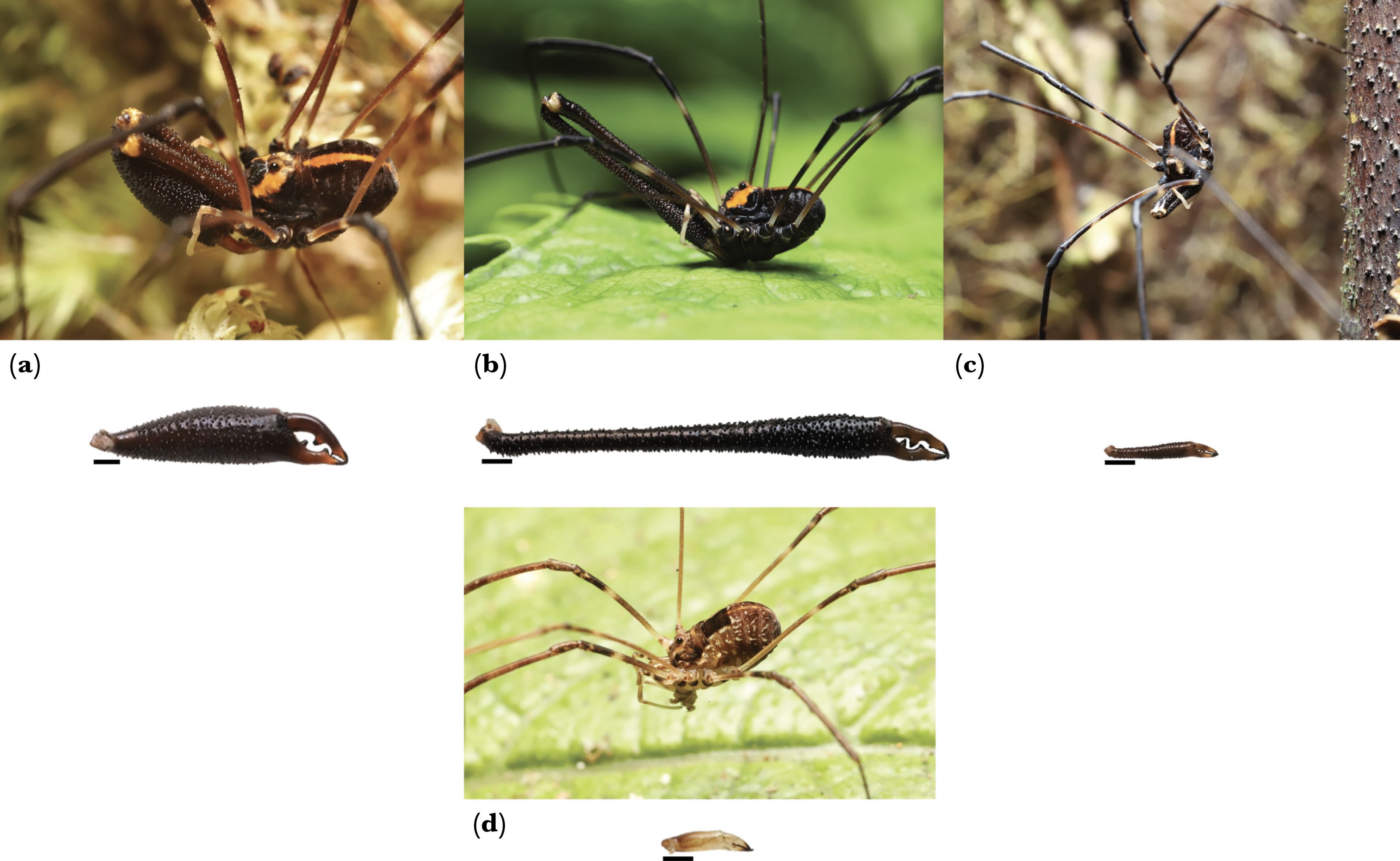
The surprised don’t end there. These harvestmen have three distinct kinds of males, alpha, beta, and gamma, all distinguishable by the morphology of their genitals, and then there are females, of course (only one flavor, though). So four sexes?

Intraspecific variation in the New Zealand harvestman Forsteropsalis pureora: (a) alpha male (major), (b) beta male (major) (c) gamma male (minor), and (d) female. The second cheliceral segment representative of alphas, betas, gammas, and females is shown underneath the corresponding in situ photograph. Scale bars indicate 1 mm.

So how did this state of affairs come about? Fighting. The males engage in combat to gain access to females. This is a familiar strategy — you’ve got the big bruisers who go straight into battle with their rivals, and while they’re thus engaged, you’ve got the gracile sneaker males who dart in and have sex. Those big genitals are costly and tactics that don’t require that kind of investment are advantageous. We’ve seen similar phenomena in beetles and squid.

Alpha and beta males can have a body mass up to seven times higher than that of gamma males, demonstrating the drastic intraspecific variation found in this species. Gamma males adopt a scrambling strategy, searching through their environment to find mates and avoiding contests with other males, while alpha and beta males use their exaggerated chelicerae as weapons in contests to access females.

Awesome. Now I’m thinking that maybe S. borealis exhibits a pattern of combat that has driven the evolution of more exaggerated genitals. It’s not the only possibility, though — the females of this species are also fairly large and powerfully built. So who’s fighting whom?

I may have an excuse to set up some cage matches in the lab.

Crypto is disintegrating before our eyes

Just a bit crooked

Good news! Changpeng Zhao, Sam Bankman-Fried’s brother-by-another-mother, just got slapped with a $50 million fine and was forced to resign, while his company, Binance, was fined $4.3 BILLION.

Court papers filed by the government say that Binance chose not to implement anti-money laundering measures, essentially allowing the firm to become a clearinghouse for all manner of illicit financial transactions. Between 2018 and 2022, that led to nearly $900 million in financial transactions that violated sanctions against Iran, the court papers charge.

In June, the Securities and Exchange Commission came after Binance and Coinbase, another crypto exchange, asking Binance to freeze all assets on its U.S. platform and accusing Coinbase of acting as a securities exchange, broker and clearing agency.

The plea deal is the latest victory in the Securities and Exchange Commissions’s effort to rid bad crypto actors from the United States, said Carl Tobias, a law professor at the University of Richmond.

Wait, how do you tell a bad crypto actor from a good one? Is it because the latter doesn’t exist?

The end of Zoom…for me

I adopted Zoom in all of my classes when the pandemic hit — I liked the flexibility it provided for the students. I would offer the full combo: I’d have class in person, and simultaneously broadcast it over Zoom, and also record video that I’d put online. All exams were online, which opened up opportunities, because I wouldn’t have to waste a class hour watching students scribbling on paper. I’m done, though. It just doesn’t work, and this week has highlighted the problem.

It’s a short week because of Thanksgiving break, and instead of losing one lecture hour to proctoring an exam, I’ve lost a whole lot of student hours. Attendance is way, way down. I think some students have decided to start their break on Monday instead of Thursday, because I’ve fostered a classroom culture where everyone thinks they can make up absences on the fly. I’m a bit concerned that I’m going to go to class today in a nearly empty room.

So, next semester…no more Zoom. I’m going to block off days for exams and quizzes. If students don’t attend classes, they will just miss out. I’m going to be so traditional and old-fashioned, and I hope that turns things around.