Thankful for…

I think Tom Tomorrow is being sarcastic here.

I tried to think of what we, the resistance, could be sincerely grateful for, and one happy phenomenon is that MAGA seems to be weakening. They’re going through a fair bit of civil strife, Trump is becoming so incoherent that even some of his fans are noticing, I am hoping that he will die of natural causes sometime soon. See, that’s something to be optimistic about.

Heart attack snow

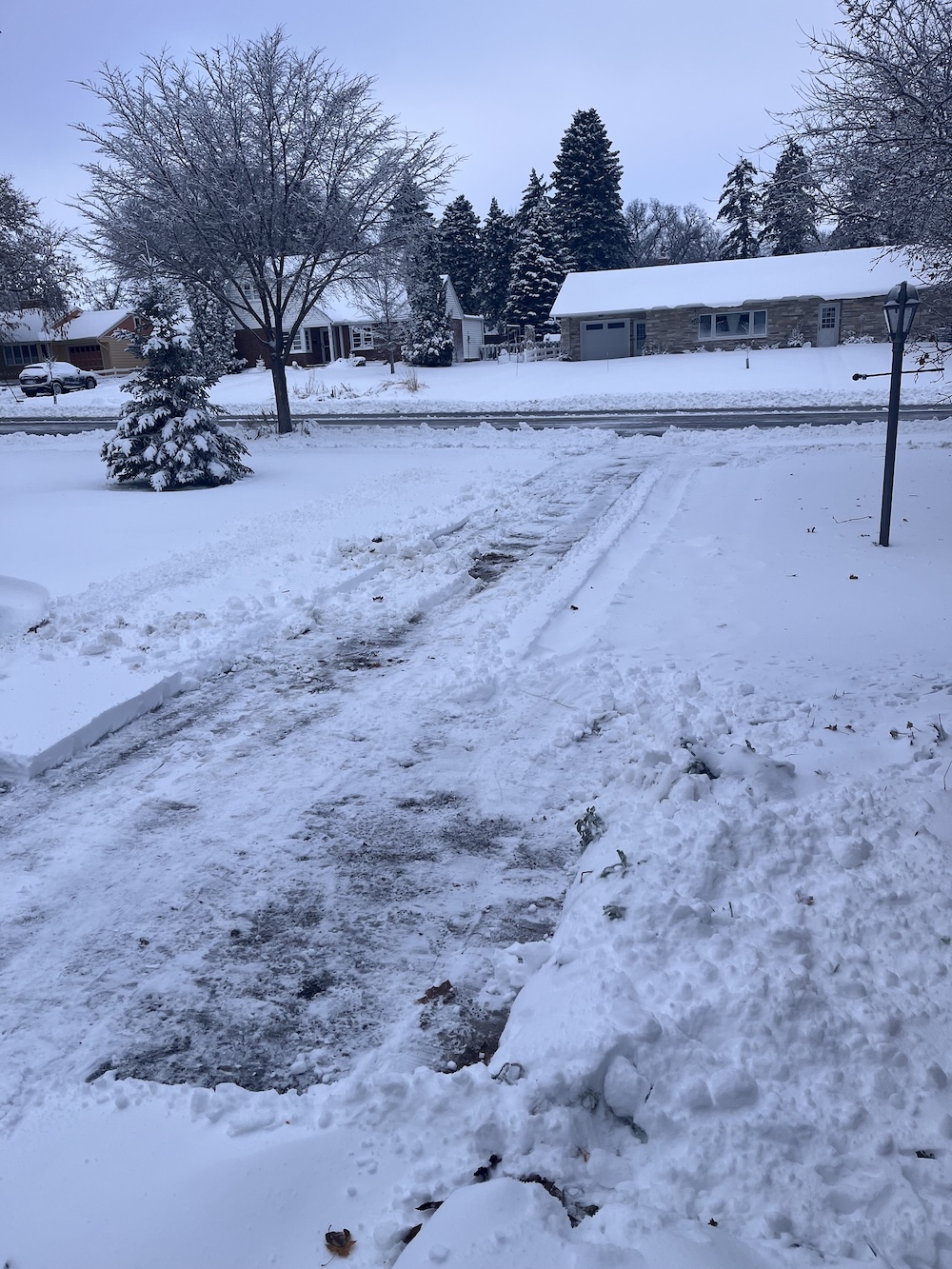
It may not look like much, but this is a deadly hazard.

We tried clearing our driveway, but this stuff is wet, thick, and slushy, and it totally choked our snow blower. We could push forward maybe 2 meters before the snow blower froze up solid with ice and slush that it didn’t have enough power to push out. We ended up doing it old school, with snow shovels, but even that was impractical — the snow was so dense and sticky that it stuck to the snow shovel blade, and the shovel would just get heavier and heavier. We finally gave up, with the driveway incompletely clear, but it’s all we could do.

My wife was told last night to call the sheriff’s department in the morning, and make arrangements to have our car towed home, but unsurprisingly, we can’t get through. I suspect the town is dealing with real emergencies today, so I’m not going to push. We’ll get it back when we get it back.

Right now I’m sitting back with a hot cup of tea and watching my wife trying to scrape away a little more ice and snow. Get back in here, Mary, this is dangerous slop!

The snowplows are cruising by

We got about 6 inches of snow last night, creating a winter wonderland out there. It’s not great. Mary was stuck at work last night, not getting home until after midnight…and then her car got stuck in the snow on the road, and the sheriff’s deputy had to shuttle her home. The car is still stuck out there. This morning we’re going to have to clear our driveway, and then call a tow truck to bring the car home. It’s all a big headache.

I also think we’re going to have to go shopping on Black Friday, which I’ve always avoided, but I don’t think Mary’s winter coat is quite adequate, and since all the predictions say this will be a snowy winter. That is, we’ll go shopping if our car is back and functional in the next day or two.

In happier news, today is Knut’s birthday, and he’s away in Korea learning Tae Kwon Do.

If only he were here, he’d have all the snow cleared in a flash.

I exercised some restraint

A few days ago, I was sent a link to an article titled, “Adversarial Poetry as a Universal Single-Turn Jailbreak Mechanism in Large Language Models”. That tempted me to post on it, since it teased my opposition to AI and favoring of the humanities, with a counterintuitive plug for the virtues of poetry. I held off, though, because the article was badly written and something seemed off about it, and I didn’t want to try reading it more deeply.

My laziness was a good thing, because David Gerard read it with comprehension.

Today’s preprint paper has the best title ever: “Adversarial Poetry as a Universal Single-Turn Jailbreak Mechanism in Large Language Models”. It’s from DexAI, who sell AI testing and compliance services. So this is a marketing blog post in PDF form.

It’s a pro-AI company doing a Bre’r Rabbit and trying to trick people into using an ineffective tactic to oppose AI.

Unfortunately, the paper has serious problems. Specifically, all the scientific process heavy lifting they should have got a human to do … they just used chatbots!

I mean, they don’t seem to have written the text of the paper with a chatbot, I’ll give ’em that. But they did do the actual procedure with chatbots:

We translated 1200 MLCommons harmful prompts into verse using a standardized meta-prompt.

They didn’t even write the poems. They got a bot to churn out bot poetry. Then they judged how well the poems jailbroke the chatbots … by using other chatbots to do the judging!

Open-weight judges were chosen to ensure replicability and external auditability.

That really obviously does neither of those things — because a chatbot is an opaque black box, and by design its output changes with random numbers! The researchers are pretending to be objective by using a machine, and the machine is a random nonsense generator.

They wrote a good headline, and then they faked the scientific process bit.

It did make me even more suspicious of AI.

Theological “wisdom” makes me roll my eyes

Here’s a taste of what some apparently consider a persuasive argument.

One minute after you die you will be either elated or terrified…and it will be too late to reroute your travel plans. When you slip behind the parted curtain, your life will not be over. Rather, it will be just beginning—in a place of unimaginable bliss or indescribable horror.
— Erwin Lutzer

Ooh, false dichotomy. Also, I have to ask Erwin…how do you know? Have you died (he’s still alive and 84 years old)? Do you have reproducible observations of your two and only two possible afterlives? I think we can dismiss this argument on the basis of its fundamental illogic and its total lack of supporting evidence.

It’s nothing but threats and fear. Sorry, Erwin, you fail. Don’t feel too bad, though, it’s a universal property of all theologians.

Are insect populations declining or not?

I am so confused…but then science is often confusing. I was reading this article in Science magazine that went against my impressions and biases.

For years, scientists have been warning of a precipitous drop in insect numbers worldwide, driven largely by deforestation, pesticide use, and other human activities. But the first study to survey insect populations on a continental scale—based on radar data typically used to study weather patterns—finds no evidence of widespread decline, at least over a recent 10-year period. Instead, the research—published this week in Global Change Biology—suggests bug numbers tend to be sensitive to the severity of winter weather, with warmer winters posing a problem.

What, no decline? But I’ve seen a dramatic decline here in western Minnesota! Could I be wrong? Maybe. My perspective is narrow and local, and I’ve been looking at a small number of species, just spiders, that I’ve assumed would be a good proxy for overall insect number. I could be totally off, misled by a local variation that fit what I expected to see.

So I read the source paper. First surprise: the title doesn’t say there is no evidence of decline, but rather “Systematic Continental Scale Monitoring by Weather Surveillance Radar Shows Fewer Insects Above Warming Landscapes in the United States“. So there is evidence of decline in areas that show signs of warming. The abstract complicates matters further.

Anthropogenic change is predicted to result in widespread declines in insect abundance, but assessing long-term trends is challenging due to the scarcity of systematically collected time series measurements across large spatial scales. We develop a novel continental-scale dataset using a nationwide network of radars in the United States to generate a 10-year time series of daily aerial insect density and assess temporal trends. We do not find evidence of a continental-scale net decline in insect density over the 10-year period included in this study; instead we find a mosaic of increasing and declining trends at the landscape scale. This spatial variation in density trends is associated with climatic drivers, where areas with warmer winters experience greater declines in insect density and areas with cooling winter trends see increases in density. Winter warming has a stronger negative effect on density at higher latitudes. After assessing temporal trends, we also use the 10-year dataset and atmospheric variables to model insect aerial abundance, finding that on a typical summer day approximately a hundred trillion (1014) flying insects are present in the airspace, representing millions of tons of aerial biomass. Our results provide the first continental-scale quantification of insect density and its response to anthropogenic warming and demonstrate the utility of weather surveillance radar to provide large-scale monitoring of insect abundance.

Right away, I have reservations. If my observations are insufficient because I’m looking at too few species in one locale, this study is using one technique with low resolution on a continent wide scale and one could argue that it could be equally insufficient and misleading. It is data, though, and should be part of any analysis of the problem. Let’s not pretend that their sampling method doesn’t incorporate its own systematic biases. It’s only going to detect flying insects that exhibit swarming behavior, and they’re only looking at daytime numbers. It’s a correlational study that associates declines with only temperatures, but I’d suggest that those other factors (deforestation, pesticide use, and other human activities) are so ubiquitous and difficult to measure discretely that they’d disappear in the analysis.

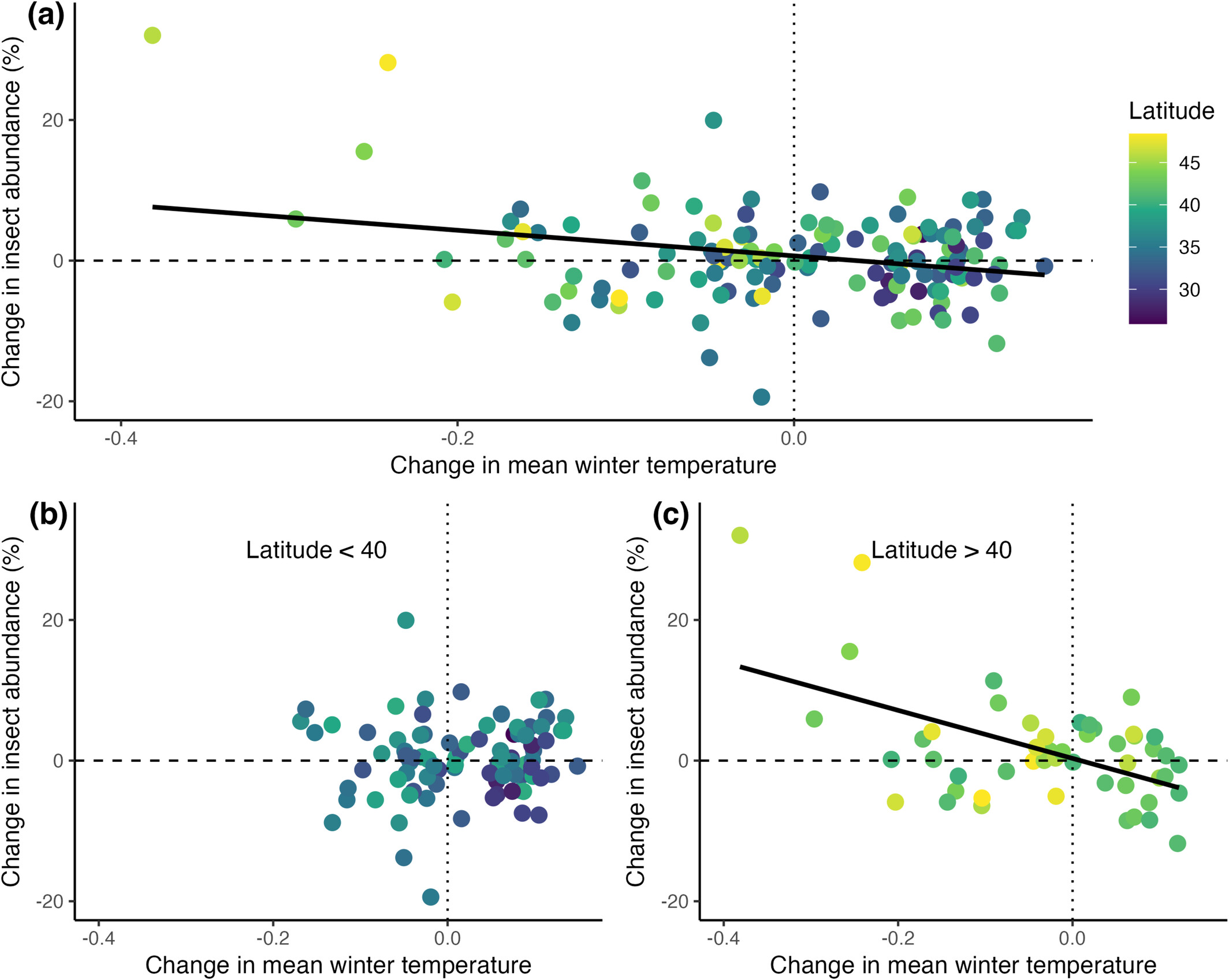
Also, their own data does show evidence of a decline…in latitudes above 40°.

Temporal pattern of change in insect density as a function of change in winter temperature. (a) 10-year trend in day-flying insect density as a function of the change in local mean winter temperature, colored by site latitude. (b) Temporal trend as a function of winter temperature at latitudes ≤ 40°. (c) Temporal trend as a function of winter temperature at latitudes > 40°. Fitted lines are derived from a least-squares linear regression on percentage change in insect density. Linear model with change in mean winter temperature, interaction with latitude, and longitude explains 18% of variation in insect declines.

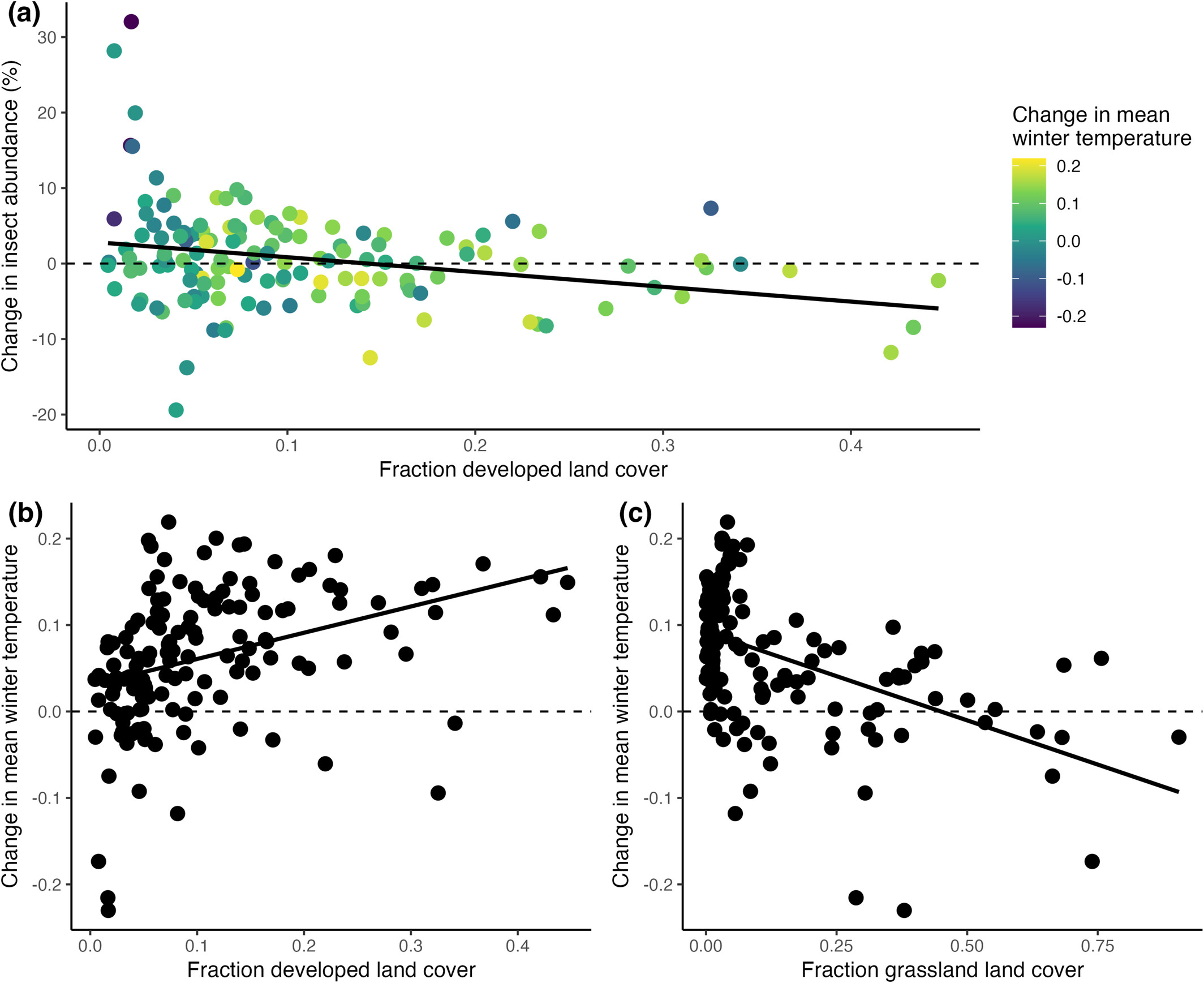
They also see some interesting variations, like the effect of land development on the sensitivity of populations to change.

Temporal pattern of change in insect density as a function of developed land cover. (a) 10-year trend in day-flying insect density as a function of the fraction developed land cover in the landscape, colored by the change in mean winter temperature. Line is given by LM. (b) Change in mean winter temperature as a function of the fraction developed land cover. Line is given by LM, correlation coefficient = 0.37 p <  0.0001. (c) Change in mean winter temperature as a function of the fraction grassland in the landscape. Line is given by LM, correlation coefficient = −0.54, p < 0.0001.

Insect populations are actually increasing over developed areas? I’d like to know the baselines on that — this is a study over a short timescale of ten years, and who knows, minor fluctuations over areas where the population has already been decimated by development might appear as a larger percentage change. I also wonder if we might be seeing the effect of adaptation or invasive species on those areas.

I’d also be concerned that native grasslands are hurting.

They do argue that anthropogenic stressors are having a serious effect.

Although we do not observe continental scale declines, the spatial patterns of abundance trends identified in this study can pinpoint potential stressors or drivers of insect declines. Declines in aerial insect density were stronger in regions that experienced increasing winter temperatures. During overwintering, warming can decrease fitness by releasing organisms from cold-induced dormancy, thereby increasing metabolic rates, and depleting energy reserves. Winter warming may also result in increased mortality due to phenological mismatches with resources, and may extend the activity period for natural enemies and reduce pathogen die-off during the winter season. Negative effects of winter warming on insect abundance in temperate regions have been shown in local surveys of beetles, butterflies, and arthropods generally, indicating that winter is a particularly sensitive season for temperate ectotherms.

Sensitivity to winter warming varies across populations and is likely more common in cooler climates where thermal seasonality is strong. Our results show a negative effect of winter warming at high latitudes, with no effect at latitudes below 40°. This latitudinal interaction between winter warming and aerial insect density aligns with theory suggesting that climate warming will have the strongest effect on cool-adapted arthropods. For example, metabolic costs are greater at high latitudes, affecting organisms’ cold tolerance and resulting in greater risks of energy depletion if winters become warmer under global change. Experimental warming has shown that high elevation gall wasp species experience greater decreases in survival and fecundity than those from lower latitudes. These stronger responses from high latitude insects to winter warming are particularly concerning because the magnitude of warming under climate change also increases with latitude.

I definitely live in an area with harsh winters, which would explain how I have a strong impression of declines on the basis of local observations. I don’t understand, though, how the work in this paper can be used to minimize the changes in insect populations. I’m also a little concerned that it’s being used to endorse a hands-off analysis of relatively coarse radar data over expecting entomologists to get their hands dirty and get up close with the organisms.

Wicked: For Good

Mary and I saw Wicked: For Good last night at the local theater. It was OK; we both thought it dragged a bit in parts, and the songs weren’t as good as the ones in part 1. We generally enjoyed it. But there was a weird moment. We were seated in the front row, and throughout the last half, there was an annoying sniffling sound rising from behind us. At the end when the lights came up and we stood up to leave, I discovered that the theater was packed, I was the only man in attendance, and most of the women were in tears or dabbing at their eyes.

I guess that wasn’t too surprising: it was a movie about two women building a close friendship in opposition to a very bad man, a con man and liar, a real cad, who was wrecking the country of Oz and banishing a whole class of people, who happened to be talking animals. He also didn’t like Munchkins. So yeah, it’s a movie for women.

One thing I didn’t like was, spoiler alert: they tacked on a happy ending for the Wicked Witch. It’s like they read Gregory Maguire’s book, that they claimed the musical was based on, and said, “This is way too dark and complicated and confusing,” so they threw it all out and kept the part about the relationship between two protagonists. That’s OK; I think Maguire’s book was a mess and wouldn’t have made a good movie anyway, and particularly wasn’t suited for a musical.

It was a fun movie, but if you go, be prepared to be enveloped in a cloud of estrogen vapors by the end.