Link Roundup: August 2023

Last month, I published an article in The Asexual Agenda about initiation in mixed relationships.

Workplaces Without Borders And Sexual Harassment | Thing of Things – Ozy writes about how sexual harassment laws work best in a stable workplace environment.  In an “borderless” workplace, such as actors who work gig to gig, there’s a lot less protection, and little to prevent quid pro quo.  I think this is a consequence of the weird way that sexual harassment is constructed in US law.  If someone catcalls you in the street, we would colloquially think of that as sexual harassment, but in the eyes of the law it isn’t.  Sexual harassment laws are built upon employment discrimination.  So if it doesn’t affect your job, or if it’s targeted equally at men and women, then it’s legally defensible.

It’s okay to be bad at games | Clayton Purdom – An interview with Bennett Foddy about difficult games.  He talks about the game as a dialogue between the player and designer, rather than the designer just giving players everything they want.  He also says he wants players to admit they like the friction, that failure is a big part of the attraction.  I think that’s true of a lot of games and gamers, although personally I’ve found it useful to recognize that I actually don’t like much friction in games.  That’s why I like walking sims, which have so little friction that they’re often accused of not being games at all (though they totally are).

[Read more…]

Firewatch was too hard

cn: moderate spoilers for Firewatch.

Firewatch is a 2016 walking simulator about a man named Henry, whose wife is suffering from early onset dementia. He joins the firewatch as a way of running away from his problems. Gameplay consists of hiking through a naturalistic forest, while Henry chats frequently with his boss, Delilah, over the radio. At some point they learn that someone has been listening in on their conversations, which ignites in both of them a paranoid fantasy.

Firewatch has a linear narrative, with no major branching points and no fail states. Nonetheless, I found it too difficult. I had already been spoiled as to its general plot and themes before I even started. And yet, I still felt like I didn’t “get it” in my own playthrough. I felt like I had watched a walkthrough but was still unable to perform the actions that I had seen others do.

[Read more…]

Origami: Lucky Star

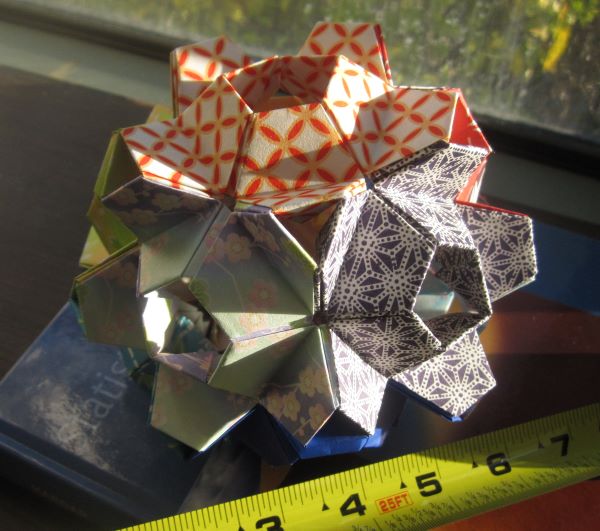
Lucky star origami

Lucky Star, designed by Ekaterina Lukasheva

This origami model was part of a pair that I folded at the same time.  I posted a photo of the other one in 2018.  Like the other model, this one also has four distinct colors.  Three of the colors have 5 units each, and the fourth has 10 units.

Empathy games and critiques

Empathy games are a genre of game that enables players to understand and appreciate other people’s feelings or experiences. Supposedly, games are uniquely positioned to cultivate empathy because of the embodied experience of playing. In a game, you can almost literally walk a mile in another person’s shoes. Empathy games also offer a counterpoint to the mainstream viewpoint that video games are all about “fun” or plain bloodlust.

Among my readers, I suspect that many have never heard of the concept of empathy games. And when you first hear about empathy games, you might feel that it’s a great idea. However, in games critic circles, especially among queer critics, it’s often considered passé, or even a discredited trope. Marginalized creators have spoken out about the limitations of empathy, and its commodification. Exploring their perspectives may help us understand pitfalls in media representation of marginalized groups.

[Read more…]

Response to Dr. Collier on AI

I obviously watch a lot of youtube video essays, so I frequently get recommended thinkpieces about the problems with AI. And I don’t watch them because I am literally a professional in the field and I don’t need some vlogger to ramble at me about something I generally understand better than they do. But I watched one of these videos, and I disagree on some points, and now you’re going to hear about it.

The video is “AI does not exist but it will ruin everything anyway” by Dr. Angela Collier. It is not necessarily the best example to highlight (it’s an hour of rambling, I respect that most readers will not want to watch that), but it’s the one I watched, okay? I’m going to structure this as a list of items, starting with the most fact-based items, moving towards my more contentious opinions.

[Read more…]

Theories of “mind” for corporations

Jack Saint recently made a video remarking on Netflix, and how Netflix appeared to be criticizing itself. He was talking about the show Dahmer, which Jack Saint felt was exploitative. And then an episode of Black Mirror appeared to make the same point by portraying an exploitative documentary that was obviously in reference to Dahmer. I will not comment on either show because I don’t like TV enough to watch the stuff, and I only really enjoy watching youtubers talk about TV I don’t watch.

However, I do have an opinion on the supposed hypocrisy of Netflix, for putting out two television shows that thematically contradict each other. When a corporation like Netflix is hypocritical, that’s obviously quite unlike individual hypocrisy. It’s not a single individual saying something and then doing a different thing. It’s two groups of individuals who disagree with each other despite their common affiliation. The Dahmer creators don’t think it’s exploitative (or don’t care), and the Black Mirror creators do. The executives above them don’t care enough to intervene either way. There’s no real hypocrisy on an individual level.

[Read more…]

Semi-cooperative board games and the win/loss binary

In Twilight Struggle, if you cause nuclear war, your opponent wins and you lose. Twilight Struggle is a two-player strategy game that simulates The Cold War. As you know, in the real world, if there is a nuclear war then everyone loses. But in Twilight Struggle, nuclear war leads to one winner and one loser. This speaks to limitations in what a strategy board game can effectively simulate.

Twilight Struggle is simulating a semi-cooperative situation, which means it combines cooperative and competitive elements. A semi-cooperative game is one that allows one player to get ahead of the other, but also allows outcomes which are good for both players or bad for both players.  Note that ties don’t count, because they aren’t good or bad for both players!  A semi-cooperative game requires at least three distinct outcomes, outside of ties. In Twilight Struggle, the three outcomes are USA wins, the Soviet Union wins, or there is nuclear war. This is challenging to adapt to a board game format, because players are accustomed to only two non-tie outcomes: winning or losing.

[Read more…]