I grew up in Washington state, and many of my relatives worked the apple orchards in season — they were good, hardworking fruit pickers. But I hadn’t even thought about where apples came from. I was pretty sure it wouldn’t have been the Yakima valley, and of course I knew of the legend of Johnny Appleseed, but wouldn’t have been able to even guess what their origin was.
It turns out they’re from Kazakhstan.
What I thought was most interesting in the video is that it mentions Nikolai Vavilov, and his famous hypothesis — so famous that we take it for granted in any discussion of human origins.
The origin of any cultivated plant can be found where its wild relatives grow with the greatest diversity.
Awesome! I’m going to have expand my discussion of extreme heterozygosity and centers of origin in my Spring semester genetics class (but not now, I have to focus on cell bio for next week). I read this most excellent review, Human-driven evolution of cultivated plants and the origin of early civilizations: The concept of Neolithic revolution in the works of Nikolai Vavilov and found it enlightening.
The concept of centers of origin of cultivated plants (crop biodiversity hotspots) developed by Nikolai Vavilov (1887–1943) is essential for understanding the origin and evolution of human civilization. Vavilov formulated the principles of the Neolithic agricultural revolution and substantiated the basic patterns for the emergence of agricultural civilizations. He established that the center of speciation of the plants that have a potential for cultivation determines the origin of primary civilization. Humans actively performed the selection of plants with valuable properties, which led to the formation of new cultivated species and varieties, while the starting point for such unconsciously human-directed evolution was the presence of potentially useful traits due to the increased genetic diversity in the center of origin. The spreading of agriculturally important cultivars from the center of their origin led to the propagation of beneficial farming technologies over large areas. The establishment of human civilization resulted from the dynamic quasi-symbiotic relationship between humans and domesticated plants and animals, which human-driven evolution became an essential factor for the transformation and dynamics of human societies.
Here’s all the human history you need. (I exaggerate slightly.)
Fig. 5 summarizes the proposed views on the development of agricultural civilizations and phytospreading during the Holocene. The phytospreading process became to a major extent human-driven in the Holocene, which resulted in intensive biomass formation related to the production of crops. Centers of origin of cultivated plants determined the rise of early civilizations, which in turn facilitated the spreading of wild, cultivated, and weed species to higher latitudes. The process of phytospreading in the Holocene was described by Vavilov for the origin and distribution of cultivated plants. He identified the centers of origin of cultivated plants as the hotspots of genetic diversity for the plants potentially having agricultural importance. In these spots, the series of parallel variability (described as Vavilov’s law of homologous series) were very intense.
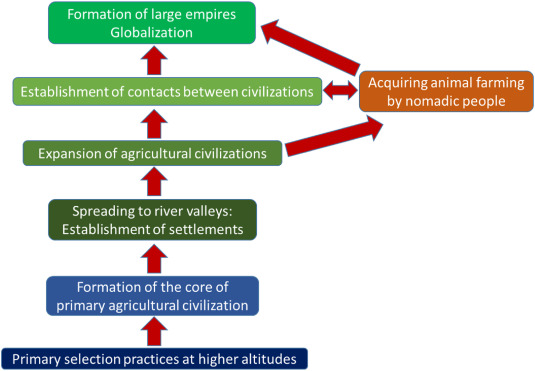
Fig. 5. Schematic illustration of the development of agricultural practices, spreading of cultivated plants, and social evolution of human civilization.
The law of homologous series is a very evo-devo concept. It’s the idea that similar variations can be found in members of the same genus, the same family, that is, that there seems to be something in the ancestral form that recurs spontaneously in later descendant forms, that the feature is an intrinsic property that can pop up in multiple branches of a lineage. These are brilliant observations rooted in Vavilov’s extensive study of native populations. Yes, he visited Kazakhstan and studied the apples there.
It’s especially impressive that he was doing this work that merged the disciplines of evolutionary biology and genetics in the 1920s.
You may have heard Vavilov’s name in another context: he was hated by the anti-science ideologue Trofim Lysenko, who eventually had him arrested and condemned to death in 1940. Vavilov died in prison in 1943, all because he recognized the scientific validity of Mendelian genetics, and opposed the nonsensical delusions and wishful thinking of Lysenko (delusions that led to the death of millions by famine). I can’t help but notice the similarities in the conflict between American science and the lies of MAHA and our modern Lysenko, RFK jr.
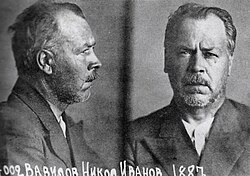
Vavilov’s mugshot
Thank goodness no scientists are being harassed in show trials and threatened with prison here! How many great scientists are going to wither on the vine thanks to the current radical politicization of science in this country?