
Barna has put out the results from a survey of American beliefs, and it bewilders me.
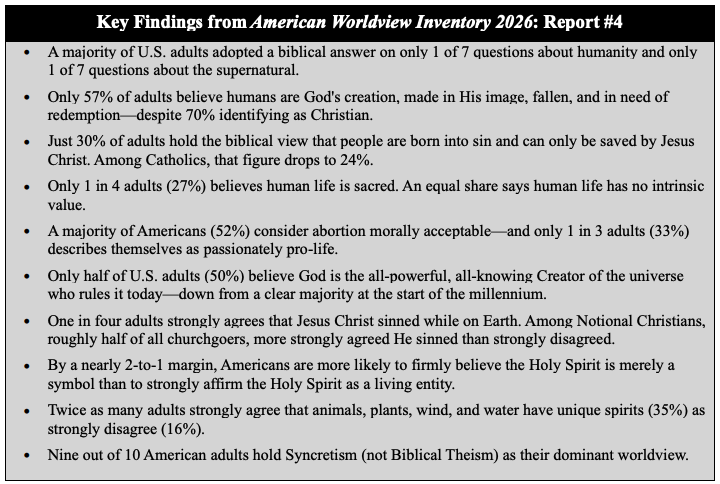
• A majority of U.S. adults adopted a biblical answer on only 1 of 7 questions about humanity and only
1 of 7 questions about the supernatural.
• Only 57% of adults believe humans are God’s creation, made in His image, fallen, and in need of
redemption—despite 70% identifying as Christian.
• Just 30% of adults hold the biblical view that people are born into sin and can only be saved by Jesus
Christ. Among Catholics, that figure drops to 24%.
• Only 1 in 4 adults (27%) believes human life is sacred. An equal share says human life has no intrinsic
value.
• A majority of Americans (52%) consider abortion morally acceptable—and only 1 in 3 adults (33%)
describes themselves as passionately pro-life.
• Only half of U.S. adults (50%) believe God is the all-powerful, all-knowing Creator of the universe
who rules it today—down from a clear majority at the start of the millennium.
• One in four adults strongly agrees that Jesus Christ sinned while on Earth. Among Notional Christians,
roughly half of all churchgoers, more strongly agreed He sinned than strongly disagreed.
• By a nearly 2-to-1 margin, Americans are more likely to firmly believe the Holy Spirit is merely a
symbol than to strongly affirm the Holy Spirit as a living entity.
• Twice as many adults strongly agree that animals, plants, wind, and water have unique spirits (35%) as
strongly disagree (16%).
• Nine out of 10 American adults hold Syncretism (not Biblical Theism) as their dominant worldview
• A majority of U.S. adults adopted a biblical answer on only 1 of 7 questions about humanity and only
1 of 7 questions about the supernatural.
What is a “biblical answer”? I don’t think there is such a thing — the Bible is a tremendous hodge-podge of archaic, conflicting, and fuzzy ideas. This is an assumption that there is a clear “biblical” position on everything, so I’m unsurprised that there is an absence of a coherent response. The survey returned results that don’t match Barna’s presupposition of what Americans should believe.
• Only 57% of adults believe humans are God’s creation, made in His image, fallen, and in need of
redemption—despite 70% identifying as Christian.
57% is still too damn high. I’m curious as to what the 43% believe.
• Just 30% of adults hold the biblical view that people are born into sin and can only be saved by Jesus
Christ. Among Catholics, that figure drops to 24%.
That’s just a fundamentally horrible belief. What is sin? What is it that a newborn is a sinner? I’m happy to see that belief is in decline.
• Only 1 in 4 adults (27%) believes human life is sacred. An equal share says human life has no intrinsic
value.
I believe that human life is valuable and should be protected, but I don’t believe in the “sacred,” so I guess I’m in the majority. A lot of people are becoming cynical if they think life has no intrinsic value.
• A majority of Americans (52%) consider abortion morally acceptable—and only 1 in 3 adults (33%)
describes themselves as passionately pro-life.
The pro-life movement has always been nothing but an ideological game that was ginned up in the 1970s. The Bible doesn’t say much of anything about abortion, and basically takes it for granted that it happens. Is this one of the things they score as a “non-biblical answer”?
• Only half of U.S. adults (50%) believe God is the all-powerful, all-knowing Creator of the universe
who rules it today—down from a clear majority at the start of the millennium.
Good. Let’s see that number continue it’s decline. The concept of an ominipotent supernatural agent is nonsensical.
• One in four adults strongly agrees that Jesus Christ sinned while on Earth. Among Notional Christians,
roughly half of all churchgoers, more strongly agreed He sinned than strongly disagreed.
I’ve never even thought about this idea! Why would anyone care about the sin-status of a rabble-rousing Jewish preacher who lived 2000 years ago? Apparently it’s a serious theological question, which is an indictment of theology.
• By a nearly 2-to-1 margin, Americans are more likely to firmly believe the Holy Spirit is merely a
symbol than to strongly affirm the Holy Spirit as a living entity.
Don’t you suspect that most people are confused about this whole business of a “holy ghost”? I know I was only exposed to the concept of the trinity as a grade school child, and found it absurd, so I’m sure theology has a more “sophisticated” muddle of excuses, but I suspect most Americans have the equivalent of my childish explanation.
To be a good Christian, must one believe in a nebulous space ghost?
• Twice as many adults strongly agree that animals, plants, wind, and water have unique spirits (35%) as
strongly disagree (16%).
“Spirits.” Stop there. When your survey is treating spirits as discrete entities that need to be evaluated, you’re lost.
• Nine out of 10 American adults hold Syncretism (not Biblical Theism) as their dominant worldview
OK, good. Ken Ham is thus rebuked.
I read the whole paper, and I’m mainly confused about why we should consider it significant that American religious belief is complicated and messy and does not conform to one particular view. There are tens of thousands of protestant denominations! I guess it’s nice that Barna is highlighting how incoherent religious belief is.

I got a little turned around on the juxtaposition of “sacred” and “intrinsic value”. I for one don’t think very much in terms of sacred versus profane. But there is something to that aspect of Kant’s categorical imperative, where people are treated more as ends in themselves over being means to an end. That may have been an early point of contention of Critical Theory as it addressed instrumentality. Capitalism commodifies everything and reduces people to mere means, cogs, or tools.
I’m not much into “spirits” or spirituality, but from a cognitive standpoint find “daemons” an interesting metaphor. Blame BSD Unix and an episode of Mr. Robot for that quirk. Or Pantera who famously screamed “By demons be driven!”.
And yet people still use Christian as a synonym for virtuous.
The bible was written over many centuries by multiple authors. The current version probably was written over 1,500 years.
Everything in it changes and evolves over time.
God starts out as barely above a human in powers and just one god among many. A tribal Hebrew god. He evolves into a powerful abstract spirit and then becomes the Trinity as other gods are added to the Hebrew pantheon.
The same thing happens with satan.
He starts out as one of god’s friends and angels and morphs when Zoroastrian ideas are adopted by xianity.
Same with the universe, which starts out small and flat and eventually gets larger.
Xianity itself is a syncretic religion.
It is based on Judaism with a lot of Roman Pagan, Zoroastrian, Greek, European Pagan, and Egyptian influences mixed in.
I’ll add here that a huge amount of what American xians believe isn’t even in the bible.
To take just one central idea, just about everything about satan is a modern invention.
Satan doesn’t rule in hell.
He isn’t even in hell. He was last seen living in Los Angeles.
There was no War in Heaven. Satan was never cast out of heaven either.
That came from Milton.
His name isn’t Lucifer.
Satan also never rode a tank, have a General’s rank, nor did he kill the Tsar.
George Barna is a fundamentalist evangelical. He defines his terms on that basis. Yes it is cherry picking.
Christians are all over the map. You’ve got those for whom “Christian” is merely a label with no content — they’re Christian because so are their family and most of the neighbours, so that’s what’s comfortable, may or may not attend church much, and their actual beliefs probably qualify them for Barna’s “Syncretist” category. Even among self-identified evangelicals, there are probably a lot who are in it for social-emotional motivations, and have only the vaguest ideas about doctrine. (Except that abortion is bad, so is trans, and Trump is the greatest president ever. Note that none of those are in the Bible, at least not in any clear way).
“• Nine out of 10 American adults hold Syncretism (not Biblical Theism) as their dominant worldview.”
I didn’t know those were the only two choices. Never heard of Syncretism before, had to look it up. I guess I don’t have a worldview.
Reminds me of this poll and segment on PBS Newshour fairly recently :
Source : https://www.pbs.org/newshour/politics/mean-american-answer-depends-politics-study-says
Except Ireckon this PBS one is much better &more intresting.
@ 8. larpar : From this wikipage :
https://en.wikipedia.org/wiki/Syncretism
It seems there’s a general term and also specific liguistic, political and religious ones.
So given its politics, religion and talking; syncretism is metaphorically not a good topic for polite conversation .. or something like that!
I wonder if a cartoon one (55 secs) would suffice?
AIUI, the doctrine held by most Christians is that newborns are guilty of original sin (i.e., the sin of disobedience in breaking the prohibition on eating the fruit of the Tree of Knowledge of Good and Evil) inherited from Adam, “in whom all have sinned”, according to a line in one of St. Paul’s letters (the exception being, according to Catholics anyway, Mary, who was conceived immaculately as a fitting vessel for the incarnation of God).
Also, it gets worse: according to Christian orthodoxy, not only are humans all born fucked, we are incapable of unfucking ourselves unless God condescends to extend His grace to us. A fifth century Christian writer, Pelagius argued that this was dumb and undermined any notion of human free will, but he was shouted down by guys like Augustine and was eventually excommunicated for his pains; for centuries afterwards, anyone trying to argue that humans might be able to become good by their own efforts were denounced as crypto-Pelagians. The official stance of most Christian denominations boils down to: humans are born fallen and stay fallen for as long as God decides, which leads to extreme positions such as Calvin’s where everyone’s fate is predestined, reducing everyone to NPCs in some kind of game run by God.
This is a very strange belief. In the endless arguments in the early days of Christianity about God and Jesus and their exact relationship to one another, it was pretty much agreed (even if nothing else was) that Jesus led a sinless life. The Athanasian Creed says so explicitly:
(I apologise for quoting so much, but the AC is hilarious to me in its over-the-top End User License Agreement-ass phrasing. You can’t read it without hearing the centuries of hair-splitting and axe-grinding over divine nature in the background as you do)
Ultimately, it matters very little exactly what people believe– or claim to– but it’s disappointing how little people who say they are Christian know about the history of their religion.
cheerfulcharlie@6:
His name is funny to me as an Irish speaker because “bearna” is the Irish word for “gap”; so anything he says is arguing for the “God of the gaps” 🤣
Any aspects or behaviors the group incites shame for (of yourself, ancestors, sovereigns), with an added threat of near-or-distant future unpleasant experiences not inflicted by the group. The shame seeds causal attribution of spontaneous events, either from guilty preoccupation or working backward from an event lazily invoking just world fallacy on an unknown personal fault. Usually combined with the offer of an exclusive proprietary means to ward off such unpleasant events, which depends on the degree of your fealty to the group: psychologically, socially, or financially.
Which things are shamed is the product of ignorant entitled bullshitting, iterated over generations, but presented as if it were long-held authoritative wisdom. Fads of a loosely-directed peer pressure group, unconstrained by facts, ethics, or consistency.
In fact, the bible does appear to contain quite a bit of atheist content. The infamously good-humoured Johannes Brahms took a few of those passages and set them to music:
“Who knows then if the spirit of man rises upward, or rather downward like that of the animal?”
@#3 raven
I agree. Not only many authors over many centuries, but many languages, translations, editors, editions, mis-translations, and printings.
Can anyone say for sure what “the” current Bible is?
flange @16:
Wouldn’t matter if they did. Were it possible, that’d just be another inconvenient fact to ignore. The book is a prop. Jehovah’s Witnesses insist Jesus died on a stake, not a cross. It’s part of their distinguishing aesthetic.
Wikipedia – Joseph Rutherford
Wikipedia – Jehovah’s Witnesses beliefs
raven @ #3 — Not only was it written over many centuries by many different writers from different perspectives and for many different purposes, but the writings were also…importantly…compiled, scribbly copied, and translated over the centuries by people who had different perspectives and agendas which may have permitted them to alter the text as they saw fit.
flange @ #16 — “Can anyone say for sure what “the” current Bible is?”
If you mean the “canonical Bible” then I think the answer is no. There are many versions of the canonical Bible tho three dominate: Catholic Latin Vulgate, Protestant, and Hebrew. Protestants have several slightly different canons with the so-called “King James Version” being the foundation for American evangelicals.
“Let he who is without sin cast the first stone.”
So, Jesus was a sinner? I guess that explains why he didn’t then pick up a rock and go, “BLAMMO!”
feralboy12 @19: Speaking of scribes altering the text…
Dan McClellan – One of the most quoted Bible verses is a forgery (1:46)
feralboy12 @ # 19: “Let he who is without sin cast the first stone.”
So, Jesus was a sinner? I guess that explains why he didn’t then pick up a rock and go, “BLAMMO!”
My favorite version of that story has Jesus delivering his zinger – and then a rock flies past him and knocks the alleged adultress on her ass.
Then Jesus says: “Mom, sometimes you really piss me off!”
Your favourite version is of a woman being judged for sexual choices and then being punished?
OK. Informative about you.
I stumbled on Dan McClellan addressing Eden and sin.
Data Over Dogma podcast – Not Original, Not Sin (1:05:25)
CA7746, dude is a Mormon. Not an actual Christian.
John Morales @24: I’m aware. The footnote is not wholly irrelevant as the LDS Articles of Faith say, “We believe that men will be punished for their own sins, and not for Adam’s transgression.” The ex-mormon atheist co-host mentions it in the episode at 37:38.
Well, yes.
But it’s Christians who bemuse PZ. Not Mormons with their Mormonic beliefs.
Sin is everywhere, of course. Not a peculiarly Christian conceit.
Basically, it’s transgression against some set of rules.
Even a self-chosen self-adopted set of rules.
(Also, who is doing the punishing? Not an impersonal force, like Karma, is it? ;)
I find that… implausible. I’d want to see the actual wording of the question(s) they used to generate that result.
Nemo, seek and you shall find: https://web.arizonachristian.edu/CRC/2024/CRC-Release-AWVI-4-Aug-6-2024-Fourth-Draft.pdf
Not only many authors over many centuries, but many languages, translations, editors, editions, mis-translations, and printings. Can anyone say for sure what “the” current Bible is?
According to one bumper-sticker I saw, “The King James Bible is the Inerrant Word of God.” So I guess that means the original Greek NT and Hebrew OT were error-ridden heresies and God had to nudge King James to get his people on it to make it Inerrant. Hopefully God has a special place in his heart for England for helping with that…?
Nemo @27: I’d want to see the actual wording of the question(s) they used to generate that result.
Not to mention sampling and selection methods, as well as other questions of methodology…
FWIW:
@28: Ah, King James Onlyism — the KJV is the One True Translation from the One True Received Text (check WP for the details, if you care). So the Greek and Hebrew originals are OK, so long as you pick the correct variants of the text. Back in my fundy days, I and pretty much everyone I hung with thought the idea was silly, and generally preferred more modern translations. Of course, the KJV itself has gone through a few revisions (again, see WP for the details).
I recently learned that there’s a Catholic version of this: Douay-Rheims Onlyism, translated from the Latin Vulgate (i.e. already one step removed from the original languages).
Y’all upthread talking about different “canons” — where are you getting this from? A different translation is not a different canon, at least I’ve never heard the word used that way. “Canon”, refers to which writings are included in the authoritative text, and so far as I know the only major variant to day is that Catholics like the Apocrypha (but WP has a couple of very informative tables about exactly who accepts exactly what: https://en.wikipedia.org/wiki/Biblical_canon#Canons_of_various_Jewish_and_Christian_traditions. I’ve never even heard of half those sects. But I note that all Christian groups seems to agree on the NT canon).
Here it is in excruciating (heh) detail: https://www.youtube.com/playlist?list=PL5Ag9n-o0IZBx9z9p6C4hk673VISwRMRv