Let’s just give up on patriotism

Patriotism is a concept that many people think is a good thing but it just doesn’t stand up under close scrutiny, usually ending up in ‘my country, right or wrong’ and defending the actions of a government even when it commits the most outrageous crimes against its own people or those of other countries. Most frequently it is used as a cudgel against those who point out a nation’s flaws, in order to shut them up and as a means of diverting their attention away from global isues of justice.. I agree with Leo Tolstoy who wrote:
[Read more…]

Once the well is poisoned, does adding more poison matter?

One of the more bizarre developments on the right wing of US politics (and this saying a lot given how off-the-charts nutty the right wing has become) is the emergence of a group known as ‘groypers’. They have taken as their symbol an obese version of the cartoon character Pepe the Frog, which is appropriate in a way because the right-wing neo-Nazis and white supremacists had already adopted Pepe as their symbol over the objections of its creator. Groypers are, if you can believe it, even more racist and have ramped up their racism and anti-Semitism to 11.

Illustration by Elizabeth Brockway/The Daily Beast

[Read more…]

Rules are made for people, not people for rules

Yesterday I wrote about Merriam-Webster announcing that it had chosen to make the non-binary singular personal pronoun ‘they’ its word of the year. I have been using it that way for some time now and it comes naturally for me. But it was not so at first. When I first started using it, it was reluctantly and with a sense of unease every time even though I was fully aware of the positive reasons for adopting the practice.

I initially thought that my unease was because it seemed to violate a basic rule of grammar that I had learned and that had become instinctive to me. But I began to realize that there was a deeper reason and that it was because I thought that people who heard or read me using it might look down on my lack of knowledge of proper English and thus think less of me. Since I take some pride in my writing and speaking skills, this bothered me.

Following that self-realization, I made the conscious decision that if something is the right thing to do (which this clearly was) then I should go ahead and do it because why the hell should I care what other people think? In my pre-occupation with my self-image, I had forgotten the basic fact that rules are made for people, not people for rules.

Keeping that front and center turns out to be quite a significant and simplifying factor in decision-making. It should have been obvious to me from the beginning, of course, but sometimes we are not aware of how much our behavior is based on seeking or keeping the approval of others, even those whom we do not know or perhaps even like.

Vote for Labour tomorrow!

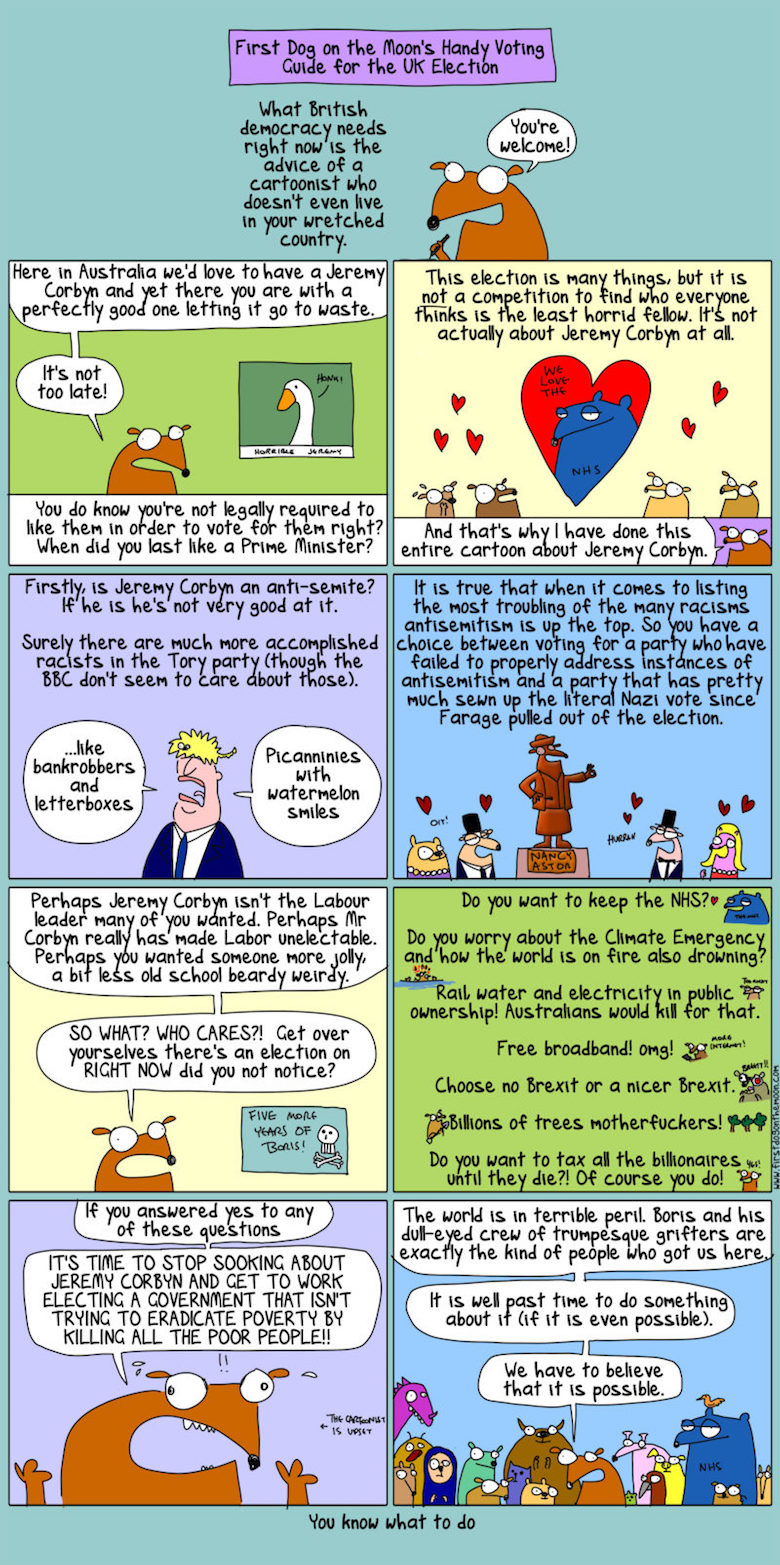
Tomorrow is the general election in the UK where the Labour party and its leader Jeremy Corbyn have been subject to a massive smear campaign. Not being British, my views count for little but here is a cartoon by another non-Britisher, an Australian cartoonist who goes under the pen-name ‘first dog on the moon’, that quite nicely sums up my feelings.

As the cartoonist rightly points out, “You know you’re not legally required to like Jeremy Corbyn in order to vote for him right?”

The financial finagling of the British Royal family

The scandal surrounding Prince Andrew and his involvement with Jeffrey Epstein and the allegation made by Virginia Giuffre that when she was just 17 she was forced by Epstein and his cronies to have sex with Andrew has put the spotlight on the British Royal family in ways that they would rather have avoided.

In particular, this article by Clive Irving, based on a book What the Royal Family Don’t Want You to Know…And What Do You Do? by Norman Baker, a former government minister and long-time Member of Parliament, looks at the lavish lifestyle of ‘The Firm” as they are called and how they hide it, finance it, and avoid taxes, headed by Prince Charles and his own fortune building empire. This may explain why Charles was so quick to put wraps around Andrew and whisk him away from the public eye for fear that the other shenanigans might also come out. What the article reveals is secret indulgence on a massive scale.
[Read more…]

Non-binary singular personal pronoun ‘they’ is word of the year

This was announced by Miriam-Webster today.

Merriam-Webster has named “they” its word of the year.

The US dictionary also recently added a new definition of “they”, reflecting its use as a singular personal pronoun for non-binary people.

Searches for “they” on Merriam-Webster’s website were 313% higher this year than they were in 2018.

Peter Sokolowski, Merriam-Webster’s editor-at-large, told the Associated Press news agency that searches shot up when Oslo Grace was rising to prominence, when Sam Smith came out, and when US congresswoman Pramila Jayapal spoke about her gender-nonconforming child while arguing for LGBTQ rights legislation in April.

“It reflects a surprising fact: even a basic term – a personal pronoun – can rise to the top of our data,” the dictionary said in a statement.

“Although our look-ups are often driven by events in the news, the dictionary is also a primary resource for information about language itself, and the shifting use of ‘they’ has been the subject of increasing study and commentary in recent years.

“English famously lacks a gender-neutral singular pronoun to correspond neatly with singular pronouns like ‘everyone’ or ‘someone’, and as a consequence ‘they’ has been used for this purpose for over 600 years.”

In addition to being respectful towards the gender non-binary community, it also immensely simplifies things when trying to write in the third person.

The future Johnson-Trump deal following Brexit

Lee Fang of The Intercept writes that US health industry lobbyists are just waiting for a Conservative victory on Thursday to shred British consumer safeguards and raise drug prices as part of their demands in the trade deal that the US will agree upon with a Conservative government following Brexit.

Departing the EU could mean that British consumers would no longer be protected by broad EU-wide regulations on chemicals, food, and cosmetics, among other products. Several international corporate groups have pushed to ensure that in the event of Brexit, such safeguards are abandoned in exchange for a regulatory standard that conforms to the norms of the U.S.

Consultants working directly on the Brexit deal in London and in Washington, D.C., have asked to limit the ability of British regulators to set the price for pharmaceutical drugs, lift safety restrictions on pesticides and agricultural products, and constrain the ability for the U.K. to enact its own data privacy laws.

Dean Baker, a senior economist with the Center for Economic and Policy Research, noted in an email to The Intercept that such regulatory demands by industry are “always part of trade deals.” Baker said that U.S. trade to the U.K. is relatively trivial, at around 2.5 percent of GDP, making incentives for rushing a trade agreement relatively small.

“On the other hand,” Baker wrote, “paying higher prices for drugs and being unable to regulate the Internet is likely to impose very substantial costs.”

“A government weighing these factors carefully would almost certainly refuse a deal, but a Johnson government that made Brexit front and center is likely to feel strong political pressure to have a deal with the hope few people will pay much attention to the content,” Baker noted. “Johnson could tout the deal as a big success. People would only see the negative effects years down the road.”

[Read more…]

The lies about the Afghanistan war, just like the lies about previous wars

The Washington Post has obtained, under a Freedom of Information Act lawsuit, an internal report produced by an obscure government agency known as the Special Inspector General for Afghanistan Reconstruction that consists of interviews with people intimately involved with the US war in that country. It shows that the American public has been lied to constantly about the progress of the war, given a rosy picture when those on the inside knew that the war was lost almost from the very start.
[Read more…]