I am not sure what caused the entire FtB site to go down for five days but will update when I know more.
UPDATE: PZ has an explanation.

I am not sure what caused the entire FtB site to go down for five days but will update when I know more.
UPDATE: PZ has an explanation.
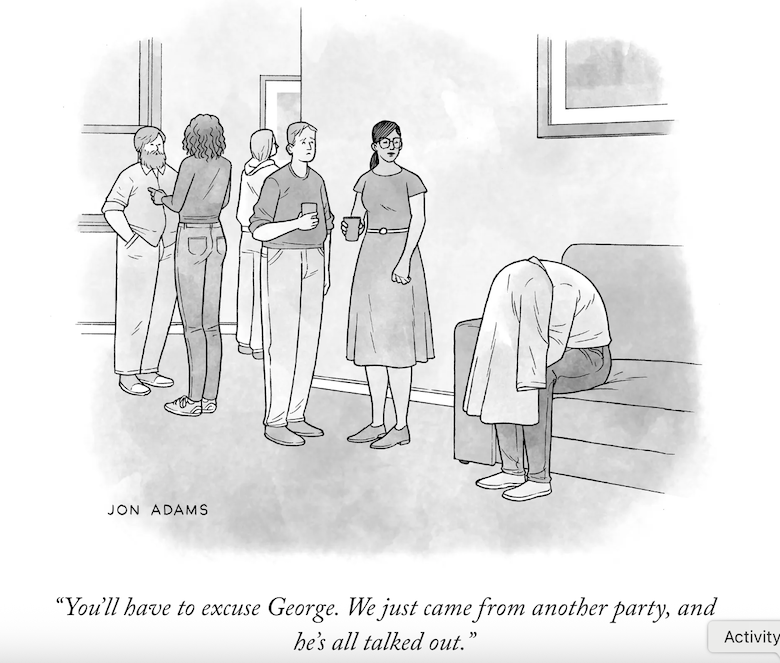
There is just so much interaction with people that I can take before I need to escape into solitude.
There seem to be two iron rules of American consumerism.
The first one is that people love to buy stuff even if the don’t really need the items. This habit has become hugely magnified by companies making it extremely easy to buy stuff on impulse. You see something online that interests you? Just one click and it appears at your door the next day. The second one is that people hate to get rid of stuff that they do not use and perhaps should never have bought in the first place.
I know people who have ever increasing amounts of stuff even as their need for it decreases. They buy things because they met a specialized need, like some tool or a kitchen gadget that is designed for a specific task, and now lies unused They hang on to them for sentimental reasons or with the idea that at at some point they may need it again, however unlikely that is.
I tend to be of the opposite frame of mind. I am an anti-consumer and try not to buy anything, however small and cheap, unless I absolutely need it and nothing else can substitute for it or it serves multiple useful purposes.Recently I was in the supermarket in the kitchen items aisle that has lots of gadgets. I make omelets and recipes for that and other things often call for the use of a whisk. I picked one up to buy but after a few moments decided that a fork would be an adequate substitute and put it back. Then the other day, I saw a video of a neat little gadget. You put a raw egg in it, close it, and then open it and the two halves of the egg separate cleanly, with no bits of shell or a broken yolk. But did I really need it? I usually crack an egg on a sharp edge of a skillet or a bowl and most of the time it separates just fine but occasionally there will be bits of shell or the yolk breaks. But I figured that the occasional mishap did not warrant getting such a specialized gadget. But clearly there is a market for such items. Because of my attitude, although my apartment complex provides additional storage space, I have not used it at all.
[Read more…]
Some time ago I was in the kitchen chopping onions and started singing “Onions, onions, ha, ha, ha”. My daughter who happened to be there asked what on earth I was singing. She refused to believe that there could have been a song that was that silly and implied that her wacky old dad must have just made it up.
Thanks to the internet I was able to quickly pull up this song to prove that it did indeed exist in the days of my youth and that there was a time when silly songs like this got play time on the radio.
Readers may recall that at one time I was becoming frustrated with the tone of the comments in this blog, with few people endlessly and acrimoniously sniping at each other over trivial things, treating them with disdain, being needlessly sarcastic, acting superior, and generally creating an unpleasant atmosphere for everyone.
So I introduced some harsh measures such as a limit on the number of comments that could be made to a single post and what I would not tolerate. You can see that policy here. As a consequence, a very few people were either banned or received private messages from me that they were skirting the line.
I must say that the blog comments have become so much better. People are actually talking to one another, responding positively and collegially to others even they disagree, and contributing very useful information that I find enlightening. Sometimes people ask questions and others respond thoughtfully with answers instead of being dismissive. The comments on this post are a good example of what I am talking about because in them I learned a lot about naval logistics.
It is just what I hoped the comments section should be like and a rarity in the world of the internet. I find the comments section to be very pleasurable to read now and hope others do to.
So thanks everyone!
My family is visiting over the next few days so there will be little or no blogging until around Wednesday.
In any sports, one can always engage in endless debates as to who was the greatest ever player in some capacity. But in cricket it is universally acknowledge that Garfield Sobers was the greatest all-rounder the game has even known, and it was announced today that he had died.
Sir Garry Sobers, an undisputed cricketing great and widely regarded as the sport’s greatest all-rounder, has died aged 89.
…The late Richie Benaud, a revered broadcaster and former Australia captain, described Sobers as “the greatest all-round cricketer the world has seen”. He wrote: “Sobers was a brilliant batsman, splendid fielder, particularly close to the wicket, and a bowler of extraordinary skill, whether bowling with the new ball, providing orthodox left-arm spin or over-the-wrist spin.”
Cricket, as in many sports, has players who excel in one particular facet of the game. In cricket, the three areas are batting, fast bowling (where the bowler uses sheer speed to get the batter out), and slow bowling, where the bowler spins the ball using fingers or the wrist in order to get the ball to change directions after bouncing, and thus fool the batter. An all-rounder is someone who can both bat and bowl well. Most all-rounders are those who are primarily batting specialists who can bowl reasonably well, or primarily bowlers who can bat reasonably well. But Sobers was someone who could bat, bowl fast, and bowl slow at the highest levels. He could also field very well.
[Read more…]
I scan a lot of news sites and in the process come across items that are not newsworthy in the sense of being important but are amusing and quirky. But there are some items that keep appearing in the headlines so frequently and so prominently that they signify something important but that I never click on.
One of these is the dispute involving Harry and Megan Windsor and his family. Such intrafamily conflicts can be very unpleasant and I do not wish them on anyone but I do not really need breathless commentary on that particular soap opera. The other is the impending wedding of Taylor Swift and Travis Kelce. While I am pleased for any happy couple taking such a decisive step, the details of this event have zero interest for me.
But given how these things constantly appear on the newsfeeds, clearly a lot of people must be interested in them. And it testifies to the skill of news headline writers that even though I don’t follow up on the links, I still know something about these two things just from the headlines.
Two wonderful singers, one wonderful song. What’s not to like?
Most of us take some steps to look our best selves, especially if we are going out in public. Usually those are limited to how we dress and some minimal efforts at grooming. But as with so many things, there are those who take this to an extreme, leading to a phenomenon known as ‘looksmaxxing’, one of the recent trends that have had the suffix ‘maxxing’ added to it to give the cachet of sounding cool and hip.
Perhaps the most viral example of maxxing is looksmaxxing, a cultural phenomenon that originated in the incel (a.k.a. involuntary celibate) community, encouraging boys and young men to take intense, often dangerous, measures to enhance their physical appearance. That includes undergoing intrusive surgeries, using steroids to bulk up, or using a hammer to smash your facial bones in hopes of accentuating one’s jawline. Looksmaxxing promises one sole goal: that by being exceedingly and unattainably hot, men can achieve the utmost confidence, social clout and sexual success.
The article goes on to describe other forms of maxxing, all involving taking some ordinary activity to the extreme, including food, with things like protein and fiber being targeted for maxxing.
On TikTok and Instagram, the protein hysteria reached a fever pitch. Influencers showed off their high-protein diets filled with protein powders, eggs, egg whites, cottage cheese, poultry and red meat. Some also pushed for eating more high-protein snacks, ranging from meat sticks and cold cuts to homemade chicken chips made from seasoned, ground meat. Everyone was hellbent on maxing out on the macro.
…That’s all to say that our food was never intended to be maxxed. Certain nutrients and so-called superfoods were never meant to be heavily prioritized at the expense of other beneficial ingredients. Regardless of how severe the spectrum is, maxxing implies that more is always better. It’s in the name. But that’s not what healthy eating is all about. Per the World Health Organization, a healthy diet is made up of four basic principles: adequacy, balance, moderation and diversity. Maxxing, for the most part, fails to satisfy three of those principles — adequacy, balance and diversity.
It also raises the question of how much food maxxing is necessary in the future to undo the damage of previous maxxing trends. First, it’s protein. Then, fiber, which many U.S. adults aren’t eating enough of already. What’s next? Carb-maxxing to compensate for the lack of carbohydrates in our diets? Or perhaps, raw greens-maxxing?
As the age-old adage goes, “too much of a good thing is a bad thing.” It feels especially pertinent in a new era of maxx eating.
It seems to me that people are disregarding the health of their future selves by emphasizing short-term gains and ignoring the possibility of serious long-term damage to their bodies. We will not know the real consequences of such actions until these people age and by then it may be too late to repair any damage. We can place some of the blame on so-called influencers who boast that they have become successful by doing all these things and selling products that they claim they used to achieve that look, whether that is true or not.