Just so you know.
Pharyngula
Evolution, development, and random biological ejaculations from a godless liberal

Just so you know.

I just got out of class, which was part explaining science, and part negotiating how we’re going to continue from here to the end of the semester. The students had questions, I have questions, and we have relatively few answers.
Next up, I’m coordinating a biology faculty meeting which may get eaten up with addressing the multiple questions we’re going to have about how to suddenly switch to teaching online. We’ll have questions, I hope we have some answers.
Then I’m teaching a lab, which will be very short, because I’m just going to abort the experiment we were about to start and tell them we’re going to switch to me doing online demos and getting results, which they’ll have to analyze and interpret.
Finally, I’m just going to lie down. I didn’t get much sleep last night, trying to figure out how I’m going to have to revamp everything in both my classes. I expect I’ll be spending spring break trying to cope with this headache.

I did it. I watched Trump’s address last night. It was painful. Somebody told him he couldn’t mug for the camera and that he had to hold still and not rant, but only read from the teleprompter, a completely unnatural behavior for him, and it showed. What’s with all the loud sniffing? All the speech did was highlight the unsuitability of this man for a crisis. He doesn’t know what he’s doing. Nothing he’s saying makes sense, except as an incoherent reaction to a problem that motivates him to reach out and help…his fellow rich people. We keep getting whipsawed by inconsistent policy decisions.
Makes sense:
Doesn’t make sense:
Makes sense:
Makes sense:
Doesn’t make sense:
Makes sense:
Doesn’t make sense:
Makes sense:
Doesn’t make sense:
Makes sense:
Doesn’t make sense:
The president’s address was preceded by this phenomenon, which was perfectly representative of how America works.
when historians write about the last hour they will begin by noting the 2008 republican vp nominee was rapping on tv dressed as a bear, then the network cut to trump announcing coronavirus flight suspensions, then tom hanks got it & the nba suspended pic.twitter.com/QlJDDHMWtS
— David Mack (@davidmackau) March 12, 2020
And on that note, I have to go work with students who I may be seeing personally for the last time to figure out how we’re going to finish up this semester.

And here we go…
We are suspending in-person instruction, including field experiences and clinicals, across our five campuses and are moving to online, or alternative, instruction. Students on the Morris and Crookston campuses will have in-person classes through this Friday, March 13.
I guess my spring break will be spent trying to figure all this out.

They started testing for SARS-CoV-2 in Seattle, with one researcher, Helen Chu, leading the way. They started getting positive hits, and then the federal government stepped in, but not to anyone’s benefit.
The state laboratory, finally able to begin testing, confirmed the result the next morning. The teenager, who had recovered from his illness, was located and informed just after he entered his school building. He was sent home and the school was later closed as a precaution.
Later that day, the investigators and Seattle health officials gathered with representatives of the C.D.C. and the F.D.A. to discuss what happened. The message from the federal government was blunt. “What they said on that phone call very clearly was cease and desist to Helen Chu,” Dr. Lindquist remembered. “Stop testing.”
I found that shocking. Stop collecting information, stop responding to patient concerns, minimize the threat. This is not what I want the government to do.
On a phone call the day after the C.D.C. and F.D.A. had told Dr. Chu to stop, officials relented, but only partially, the researchers recalled. They would allow the study’s laboratories to test cases and report the results only in future samples. They would need to use a new consent form that explicitly mentioned that results of the coronavirus tests might be shared with the local health department.
They were not to test the thousands of samples that had already been collected.
While I sympathize with privacy concerns, this is a situation where public health ought to have priority. Being diagnosed with COVID-19 does not create a permanent stigma. It guides the appropriate response to the affected individual.
Especially since this is what’s happening:
In the days since the teenager’s test, the Seattle region has spun into crisis, with dozens of people testing positive and at least 22 dying — many of them infected in a nursing home that had unknowingly been suffering casualties since Feb. 19.
My mother lives in that area, she’s a few years older than I am (just a few), and she’s already had a few respiratory episodes that required temporary hospitalization. When I talked to her the other day, she’s self-quarantining and avoiding going out in public at all…but I feel like if there were a problem, she wouldn’t get the help she would need, but instead is going to be told to shut up.

Uh-oh. Given that move, I’m expecting dictates from on high at my university any day now.
Also Ohio.
Oh. And Minnesota.
“While the Duluth, Rochester and Twin Cities campuses are on Spring Break this week, and in anticipation of the Crookston and Morris campus breaks next week, we encourage our faculty to begin preparing to move classroom instruction online, especially for courses where this can be implemented immediately,” University of Minnesota-Twin Cities President Joan Gabel wrote in a letter to students, faculty, and staff Tuesday.
“Encourage” is different from “ordering”. I’m going to talk to my students in class about this today.
Add my alma mater, the University of Washington, to the list. Although I see that the Seattle Mariners are still dithering about their sporting events. Will it wipe out all the sportsball fans who go into crowded stadiums next?

Yikes. I just read this comment about the coronavirus shut down in Poland — 22 cases in the whole country, so all university classes are suspended for the next month. That’s taking the issue seriously and taking major steps to slow the spread of the disease.
At my university, it’s only provosts and deans and chancellors and department heads talking about contingency plans, with no imminent threat of a shut down. But it could happen! With the number of cases doubling every week, I might come back from Spring Break to find my students have been ordered to stay away. I’ve scribbled up a quick contingency plan for my genetics course, just in case.
Contingency plan for Genetics (Biol 4312)
Genetics is an unusual lab course in that it already doesn’t fit the mold of the weekly intensive lab session. We’re working with Drosophila, and are at the mercy of their 9 day reproductive cycle, so we have to be more flexible. Typically, we meet for a half hour to an hour at the scheduled lab time, during which I explain the steps that the students need to take that week. The students need to come in frequently during the course of that week to maintain their flies, set up crosses when they’re ready, and count phenotypes. Some weeks this is a light load, coming once or twice on their own time to check on flies; other weeks they may have to come in 3 or 4 times a day to collect flies for a cross; and on several occasions they have to come in for long sessions of fly screening. The variability and flexibility suggest one fairly non-disruptive way to protect students.
Staggered, scheduled lab times. To minimize exposure, I could set up specific, individual lab times for each student. Right now, it’s a free-for-all with students doing their work whenever they can, but we could switch to exclusive lab sessions for each. So far this semester we have completed one whole experiment involving 3 different crosses, so students are familiar with the details of the methods, and they are experienced enough to not need direct instruction from me; I could manage with an explicit set of detailed instructions on Canvas for the steps in the next experiment.
They would still be using a shared lab facility, so we’d couple this scheduling with instructions on using sanitizers and sterilizing lab benches with alcohol between students.
In a worst case scenario, in which the university is shut down, another alternative is:
Drosophila genetics kits. I could assemble a kit with two fly stocks, a half dozen fly bottles, a small supply of medium, some anesthetic, and a hand lens for each student or pair of students. They could then carry out the whole experiment at home, again with detailed week-by-week instructions on Canvas. Data would be shared between students online.
Potential problems: Lack of an incubator would mean developmental rates might vary significantly. A hand lens is going to make it harder for students to score phenotypes. Currently, if one student’s cross fails, they can share specimens with other students and complete the experiment; in isolation, if one cross fails, they’ll be unable to finish. The final assays are somewhat labor intensive, alleviated by the fact that a group can share the load of counting thousands of flies.
Please note that these alternatives are only feasible because the students have completed an experiment with multiple crosses in the first half of the semester, with direct instruction and demonstration from me on how to set up a cross, how to maintain flies, and how to analyze phenotypes. The second half of the semester is repeating these same methods with a very different kind of cross and different mutant phenotypes. These stop-gap procedures would not be applicable to teaching a full semester lab course in fly genetics.
Setting up staggered lab times looks like wishful thinking now, if entire countries are locking out universities in the face of the threat. I might have to spend my spring break boxing up flies and media for distribution.

I’m sorry, but the spiders have put up big “Do Not Disturb” signs all over the place, so I have to leave them alone…until they’re hungry again.

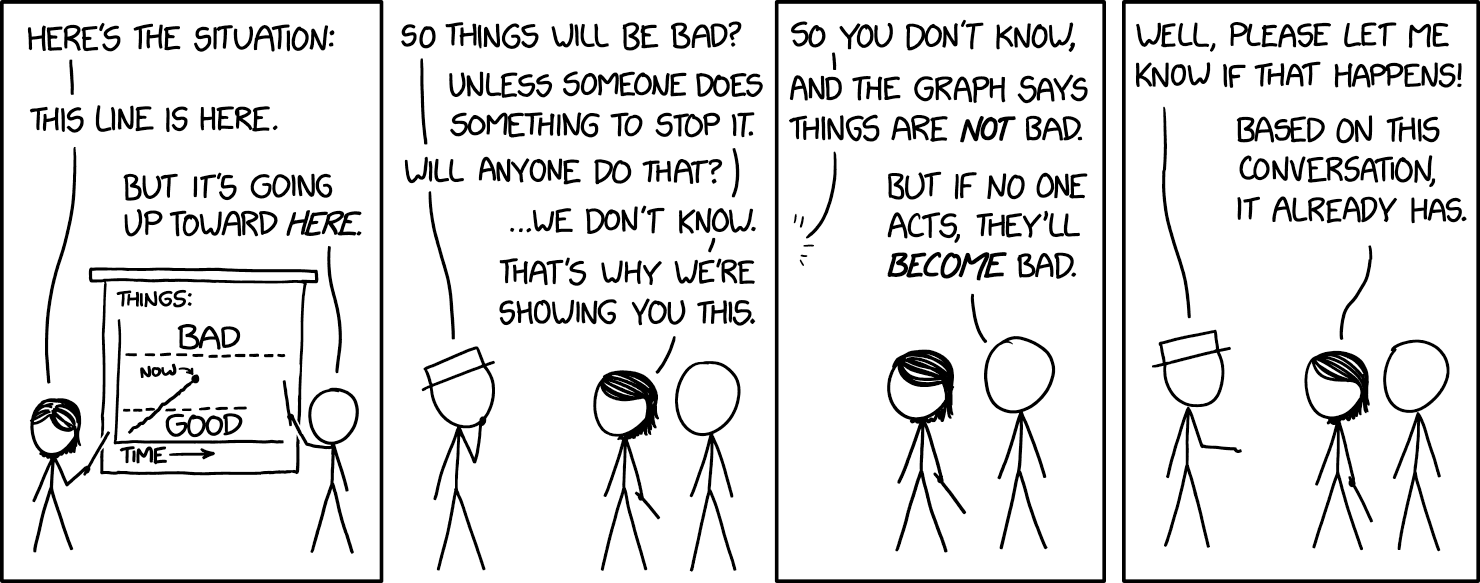
It’s amazing. This is the universal comic, it applies to everything right now.
Except spiders and cephalopods, that is. They’re looking better and better.

It’s cutting close to home now. South Dakota has reported FIVE putative cases of COVID-19 with one death scattered across the state, among people who had no contact with each other.
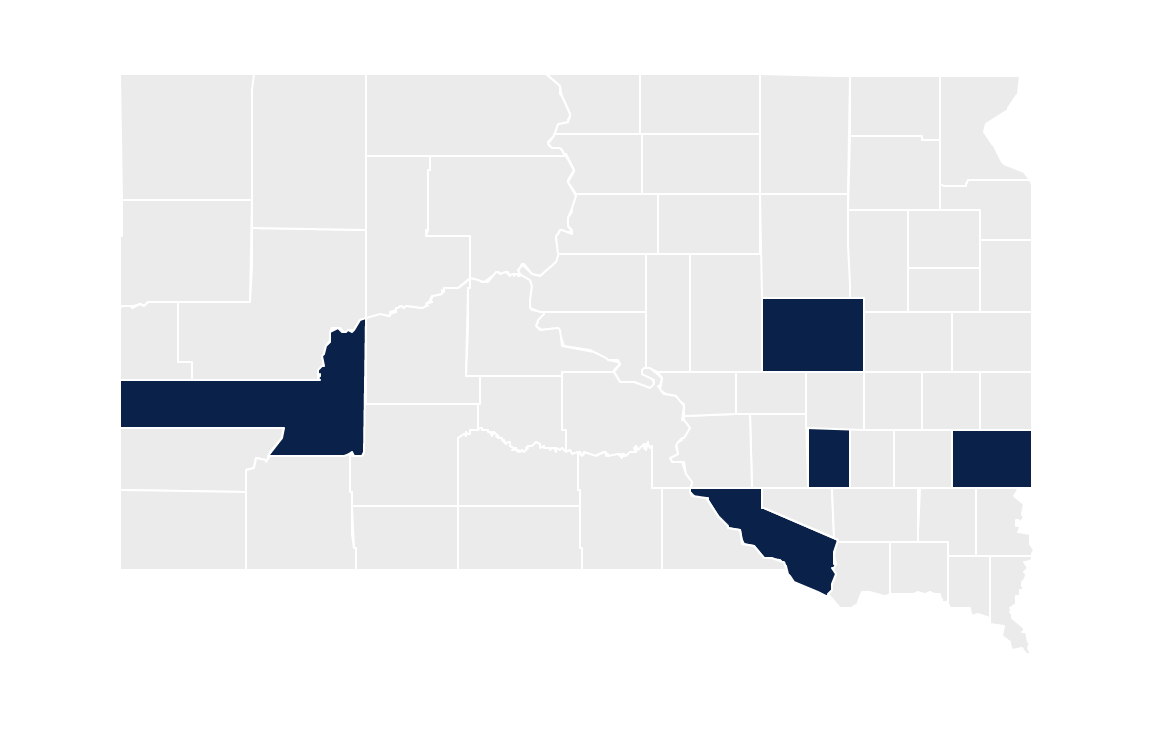
It’s entirely possible that this is a case of paranoia and misdiagnosis, since adequate testing kits have not been available, despite the fact that Trump officials keep saying it is contained. We can’t know. That’s a big part of the problem, that when science denialists are running the government they interfere with getting good information and allowing us to manage a disease effectively.
Here’s Richard Lenski’s take on the situation.
The news just came out that South Dakota — South Dakota! — has 5 presumptive cases of SARS-CoV-2 infections, including 1 death. South Dakota has lovely people and places, but it’s not exactly the center of the universe, or even of the midwest. It has ~885,000 people in total … roughly 0.3% of the US population. So a simple extrapolation to ~330 million people would imply something like 1,800 infections over the entire USA.
There’s good news and bad news. Good news: there weren’t 5 cases reported in North Dakota, which has an even lower proportion of the US population.
All the rest is bad news. We’re assuming all potential infections have been tested and discovered. We’re also looking in the rear-view mirror, time-wise. In most cases, it takes a few weeks for an infection to lead to death (when it does, which fortunately is not usually the case). Maybe a week or so to develop symptoms that would lead to someone being tested. So let’s call it a week. Well, this virus typically doubles in a week or so. So 1,800 infections a week ago (ones that have become symptomatic today) implies ~3,600 infections at present in the USA as a whole.
It’s personally worrisome, because Morris, where I live, is way out on the western edge of Minnesota, physically closer to South Dakota than we are to Minneapolis. Isolated rural communities aren’t supposed to be hotspots for pandemics, don’t you know — we leave that to the big city folks. Yet here we are, where we might have to deal with this at home.
We’ve received some concerned messages from the university administration, too. We’re supposed to develop a plan for how we’d complete lab courses if we go on lockdown, which isn’t exactly reassuring. I’ve been thinking about it, and have some less-than-satisfactory ideas about how I could wrap up the genetics course, and we’re supposed to have a meeting to discuss biology’s response tomorrow.
Our goal has to be to slow the spread of the disease to prevent medical services from being overwhelmed. Nobody is panicking — I’m already seeing conservatives mocking any response as panic — but taking necessary steps so that we don’t reach a situation that is unmanageable.
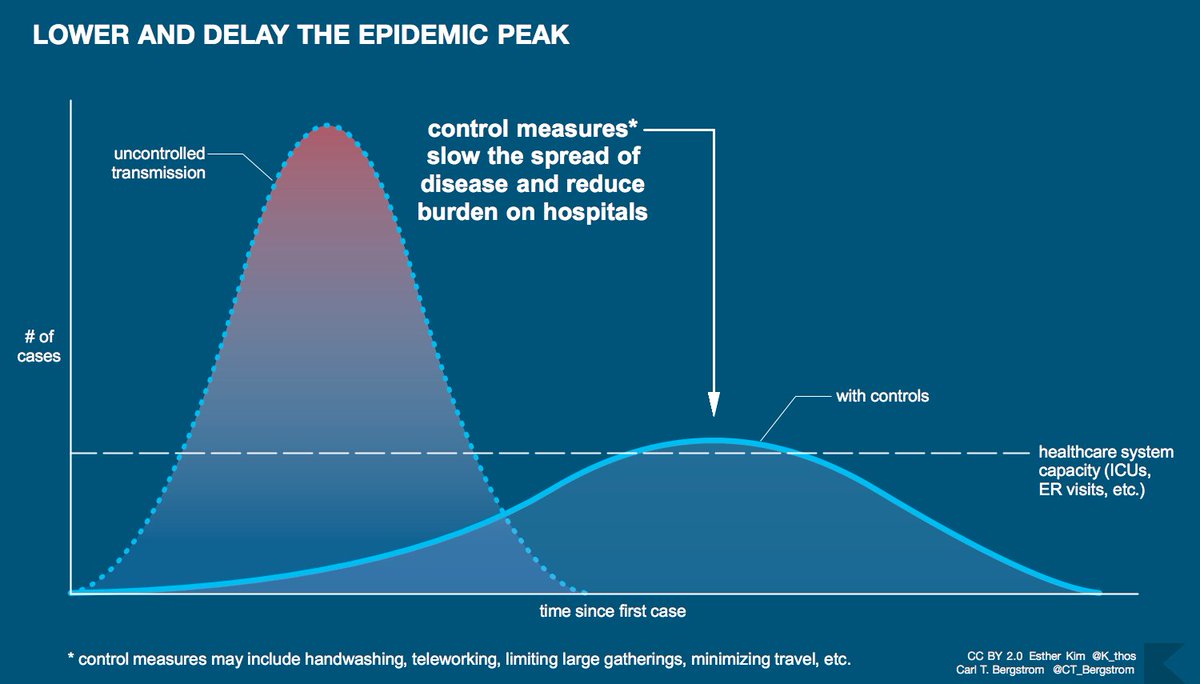
We already have examples we should be learning from, in China, in South Korea, in Italy. This rather cluttered infographic summarizes the lessons from Italy. It’s like a tsunami.

There’s a lot of medical jargon in that — I hope my local clinic is paying attention.