
Found on Bluesky:
@angus.bsky.social
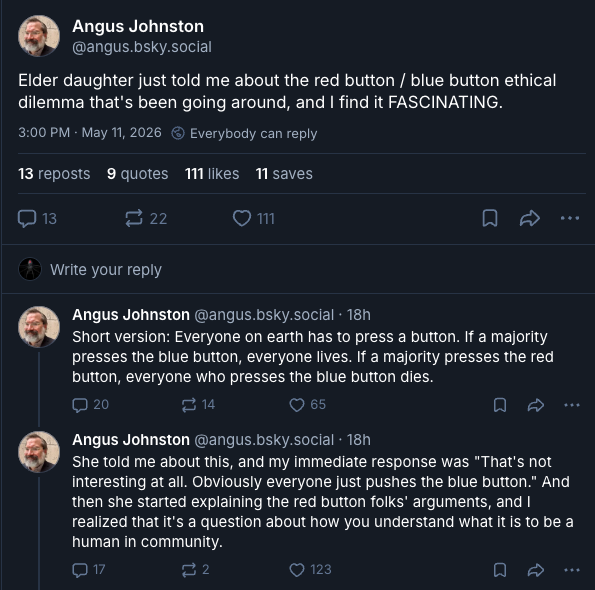
Elder daughter just told me about the red button / blue button ethical dilemma that’s been going around, and | find it FASCINATING.
Short version: Everyone on earth has to press a button. If a majority presses the blue button, everyone lives. If a majority presses the red button, everyone who presses the biue button dies.
She told me about this, and my immediate response was “That’s not interesting at all. Obviously everyone just pushes the biue button.” And then she started explaining the red button folks’ arguments, and |realized that it’s a question about how you understand what it is to be a human in community.
Likewise, my first thought was to press the blue button. But then I thought that that would just give all the red button people what they wanted, and I’d end up dead while they could take all my stuff. But then I thought again, would I want to live in a world full of murderous bastards? And I was back to pushing the blue button.
You could cycle around and around this dilemma all day long. Entertaining, but I have better things to do.
This does have evolutionary implications. We don’t have buttons with global effects, but throughout our history we’ve had people meeting and having to choose between cooperating and expediently executing those who oppose us. I think in the long run, cooperation wins, but the problem with this thought experiment is that it compresses a billion incremental decisions into one final, immediate commitment, and that isn’t at all realistic.

Another take on the red pill versus blue pill metaphor. I guess the Matrix continues to influence culture. Another aspect of the unrealistic nature of the problem is the sharp dichotomy. Reality is seldom so extreme and sharply defined. Welcome to the land of gray.
It’s a terrible truth that reason alone drives a person to push the red button.
There is a zero cost and a non-zero potential benefit to pushing the red button, and there is a huge potential cost and zero potential benefit to pressing the blue one. Competing with that decision is that pressing red would make me feel like a shit human, while pressing blue would make me feel good about myself until my inevitable incineration.
We have evolved to cooperate. The problem is when we encounter outgroups.
But there IS a potentially huge cost to pushing the red button. You could be executing people you love, need, or otherwise care about.
In what possible sense is directly and purposefully contributing to the deaths of an untold but undoubtedly very large number of people “zero cost and a non-zero potential benefit”? Other people have no value? What the hell is wrong with you?
It would not make you feel like a shit human, it would make you be a shit human.
We should find a way to implement this – except that what actually happens is that it kills everybody who votes for other people to die.
It’s trivial.
Everyone presses the red button, and everyone lives.
The outcome of the game is the same, i.e. everyone lives, for p(defection) = [0, 0.5) and [1]. This doesn’t suggest any plausible biological scenarios to me. Can anyone think of an analogue? Having said that, I think it’s interesting as an exercise in examining people’s moral reasoning.
I had to think about this. It is about how the question is phrased. The same game could be stated “Push the red button to live and press the blue button to die. If more than 50% of people push blue button, everyone lives instead.” It is logically the same game.
I would push the button that activates the Eschaton. As it is basically an electric Time Lord I would thus delegate ethical issues to an entity better suited to deal with them.
Red is not “If more people press red, everyone who pushes blue dies”. That’s framing. The question isn’t even interesting, it’s meant to generate divisive conversation.
We finally have a moral quandary where the right choice is for everyone on earth to be selfish. It would finally be the best strategy. It’s objectivist bullshit. Fine. Red. I guess I’m finally not a second-hander.
Interesting choice of colors:
Red states, red hats, red button.
Blue states, ? hats, blue button.
Dunc@4–
trevorn was talking about the scenario within Game Theory, where costs and benefits are defined and the players are rational, self-interested, and fully aware of the rules of the game. Moral implications may follow, but they are not part of the game itself (which is one of several reasons Game Theory doesn’t always work in real-world situations, especially in economics).
chrislawson: @ #11: The fact that John Nash formalised his mental illness into a mathematically computable system does not change the fact that it’s insane. As soon as you start using game theoretic concepts to talk about human lives, you have committed what Granny Weatherwax defined as sin: treating people as things.
Basically: Blue button = followers of Jim Jones. Red button = everyone else.
I’d try to convince people not to follow the insane suicide pact.
I think you might frame this as an analogy of people’s reaction to the climate crisis. They can approach it purely from their personal benefit (press the red button, you know you’ll live, even if a lot of other people may die. This is like ignoring the crisis, because you want the best outcome for you, right now), or from the collective point of view (press the blue button, and everyone lives if enough of you are thinking the same way; do things to stop global warming, and it’s best for the world).
OK, on further thought, numerobis may have the better take. The problem would be that almost any decision can be got wrong by a small minority, even when people are given time to think about it, So no matter how well you argue that the entire world should press their red button, and then everyone would know both that they’re safe and so is everyone else, someone wouldn’t see it that way. And you might say “easier to persuade a bit over half the world to save everyone, than persuade every last person that they can act in their own interest, and so can everyone else”. But if you’re only somewhat successful in that argument, a lot of people could die.
I think there is interest in it.
I’m sorry Dunc @ #11, within the parameters of the GAME as presented doing anything other than pressing the red button would be insane.
It’s not a prisoners dilemma where the payoff if everyone cooperates is different to that if everyone betrays. In this game the optimal outcome is for everybody to press the same button, either red or blue. But if a mix of people choose red and blue buttons then the blue button has the potential to be suicide while the red button does not. So any logical person would dispassionately press red and a logical person who also had a strong moral conscience would hope that everyone else did the same.
I’m sorry, this is semi-off-topic, but all I can think about is the end of the Ren & Stimpy Space Madness episode with the “beautiful, SHINY button… the jolly, CANDY-LIKE button!”
Pretty much how I approached it. Though my tendency was to think of it in the added context of an imposed decision from powerful people who have to frame it as a false democratic choice, which made it become a question of solidarity with humanity against this vague oppressive force. I push blue because I’m not willing to throw blue under the bus to guarantee my own safety. After all, what’s stopping them from issuing another false problem like this where I’ll suffer later? First they came for the blues…
@5 Roy: If a majority presses the blue button, everyone lives as well. In addition you didn’t put anyone in danger of dying for not following your faulty logic.
So yeah, the choice is easy, press blue. If i die it’s a win, because I don’t have to share a planet with a majority of stupid psychos.
Exactly. The question is whether you want to live in the current world (blue) or a world where
1. Everyone is willing to destroy other people for their own benefit.
2. Everyone knows that every other person they meet is willing to destroy other people for their own benefit.
It effectively eliminates the ability to trust anyone. If life is a game of iterated prisoner’s dilemma (as game theorists like to portray) where the tit-for-tat strategy is optimal then everyone is a known defector, so defection becomes the optimal strategy and cooperation is dead.
Pressing red is effectively a vote to end civilization.
No matter what, the red leader will say the vote was rigged and kill all the blue folks anyway.
Knowing we all know the rules, clearly blues have to preemptively kill everyone who might be reds before they can press the red button. And reds have to preemptively kill the blues becuase the red button won’t work if the blue button hasn’t been pressed yet. /s
I immediately thought of the red/blue-Republican/Democratic analogy, but I quickly realized that it doesn’t work for a couple of reasons:
1. “If everyone votes for Trump, we’ll all be better off” strikes me as absurd.
2. Most Republicans don’t want everyone to be better off because they see it as a zero-sum game.
larpar@21: Yeah, that too.
Let’s reframe this to flipping a switch to have the trolley drive over a blue button or…
If I push the red button, then I have contributed to the deaths of everyone who pushes the blue button. If I push the blue button, then my hands are clean, and if I’m on the losing side, I’ll be dead, so I won’t care. Blue button it is. Unlike Newcomb’s Paradox, this is not an interesting philosophical problem.
What I lack is a reason for playing the game in the first place. What happens if I don’t push any button?
This is unlike climate change entirely: if we individually burn fossil fuels, we collectively choke today and starve to death tomorrow. If we individually don’t burn fossil fuels, we still choke today and starve to death tomorrow, but worse, we individually live longer because we’re in better health compared to those who drive everywhere. If we collectively stop burning fossil fuels, then we can start breathing better and … well, we are still in a tough spot tomorrow but maybe we can work things out.
I’d not push either willingly. I’m not much for being told what to do.
And if I had to do it via coercion, I’d push both if I could. Because fuck that shit.
Sometimes all you can do is walk away.
Given that logic isn’t many people’s strong point and that most people would choose which button to press more for emotive reasons than carefully-deduced rational ones, would it be fair to assume that the people who are more compassionate and more community-minded would be more likely to press the blue button than the red? If those thinking of pressing the red button were told that they risked wiping out a significant majority of those skilled in medicine and healthcare, thus putting their own health at greater risk in the years after the Big Press, what proportion would change their minds?
I think all of this hinges upon the opportunity for communication and discussion. If everyone on the planet had a box with the two buttons appear magically in their hands and were given just sixty seconds to make their choice or have it made randomly for them, the outcome would be very different than if the entire population was given a year to freely and globally discuss all the issues before the boxes manifested on BP Day.
Then again, a year is plenty of time for a heated discussion to get out of control and trigger a thermonuclear world war. Maybe that would be the real test and the boxes were never going to appear.
Yeah, well. Brexit is a perfect example of that.
There is only one red button we have to worry about. That is the one in the White House that has a demented, corrupt, grasping sociopath in charge. If he pushes that a whole lot of other red ones will be pushed in reply.
Is it stipulated that people can’t communicate with each other before deciding? Because this seems like a problem where one should decide based on facts (i.e. what other people say they will do) rather than principles.
Why would I be a bad person if I refuse to join a suicide pact?
Everyone in the world gets a poison bottle placed before them. They may either drink it and die, or refuse to drink it and live. But if more than half chose to drink, then Santa Claus will revive everyone that died to the poison.
Exact same problem.
The choice is a simple one to make for me.
If I press the blue button I am likely to contribute to the survival of everyone.
If I press the red button I am possibly assisting in the death of a potentially large number (billions) of innocent people.
I therefore press blue.
My dilemma is that if you press the red button and I and enough of my fellow decent human beings to make the majority also press blue, I get to share a reality that includes you but since this is reality right now anyway nothing changes.
But if I imagine this to be a real scenario with anything more than a few days to consider the options I inevitably conjure images of third-party spoilers – propagandists creating a “Press Yellow” party whose manifesto is to poison the discourse and convince some blue pressers that the blues are corrupt and don’t actually care about any of the red pressers so don’t press blue because, you know, those nasty liberal-minded blue-gooders want genderless bathrooms so are therefore all sick demons the world is best rid of – again because this it the reality of the world such as we have made it. Then all those yellow pressers get to live happily ever after with those red-pressing dickwads without any blue-pressers to damp down the base brutality of a society made up largely by those who preferred the death of billions with the rest not caring either way. But at least they got rid of the genderless bathrooms!
This is just another stupid game fucking with peoples lives. We should grow the fuck up.
[nice allegorical parable, Nick. Not subtle, but very nicely multiplexed.]
You’ve got Ukraine staring you in the face. It’s a legitimate war. You might not like how they’re fighting it, but they are. Choose a side.
I’m pushing the red button.
I can’t fight if I’m dead.
Dunc@12–
You’ve stigmatised game theory, John Nash, and mental illness just so you don’t have to retract one poorly-considered comment. Please reconsider.
@fishy: “I can’t fight if I’m dead.”
If I’m parsing that right, you decided the buttons would kill the wrong cohort and—accepting that as the likely outcome—you’d tilt the scale in that direction to join the bloodthirsty reds, so you can personally kill survivors in the post-rapture hellscape to continue a legitimate war?
@CompulsoryAccount7746, Sky Captain
(shrugs)
So, who’s with me?
It’s all fun and games until the suicidal guy presses both.
Re: “reason alone makes people push red” or “per Game parameters only”.
The death of people choosing blue (if ends up as minority) is persistent and not reverted after the game result is carried out. Therefore, the game DOES NOT RESOLVE UNTIL EVERYONE DIES (from this choice or not). This explains all the “I don’t want to live in a world with selfish murderous a–holes” because those are reasonable.
IMO artificially draw the boundary of the game immediately after the result is revealed is wishful thinking at best.
Prison’s dilemma does have long-term effects but the analysis still stands if you draw the boundary at the 5-year point.
Well, not me.
Also, if your survival strategy depends on other people not using the same strategy, I don’t like your chances. I get it; it’s a sort of personal ‘survival first, then resistance’ strategy, but of course, Brexit.
Basically, I reckon this is a crowd‑dynamics problem, not an individual moral‑reasoning one, so it requires a different level of analysis.
Meh. Blue. I wouldn’t want to live in a world populated only by red buttoners.
There’s a movie version of this: https://www.youtube.com/watch?v=K4GAQtGtd_0&t=49s
@ ^ John Morales : Ah yes. Thought that would be the ”Batman – Dark Knight’ one before I saw it!
Fiction of course but a great example.
Contrived as fuck but then this whole thing is.
@26
thank you!
it is stupid
I don’t see it as particularly interesting. If you have to choose, pushing the blue button is the only remotely moral choice.
Most people, in my experience, need to think of themselves as good people. Some are, some aren’t, but most of them seem to think they are. You can’t be a good person if you push the red button. Therefore, I don’t realistically see any scenario in which more than half of humanity chooses red.
I am a bad person, but I’m not so bad that I want to murder almost half of humanity. Mind you, I’m a particularly bad person, so I wouldn’t be averse to, say, rigging all the nuclear weapons in the world to launch if the majority presses red.
I just hope I’d have time to scream “ALL! SHALL! BURN!!!” loud enough that the whole world hears me, all-caps and multiple exclamations included, before the red button takes me, ‘cause if you gotta go you might as well go out doing what you love. Me? I’m a great big spiteful ham to my rotten little core.
Is that silly? Yes. It’s also exactly as serious as both this “thought” experiment (and the arguments for pushing the red button) deserve.
Basically, you press one button and help everyone live or press the other and know that you are potentially murdering people. A whole lot of people. yeah, I know what button I can live with myself after pressing there.
Tangent but why those particular red and blue colours I wonder not say yellow and green or black or white?
The blue button. No question. I’d rather be dead than haunted by the ghosts of everyone who pressed blue.
The probability of everyone choosing red seems very low, so choosing that with the idea that no-one will die if everyone does that does not seem rational or justified to me.
There are far better chances to save everyone by at least 50.0001% of people choosing blue.
Interesting how many people jump to red, more than I expected, wonder if it indicates they are willing to kill\do nothing to stop other people dying, or something else going on.
This goes through logic if interested
https://youtu.be/bY7OeqrGfGY?si=FFbw4N-X1EwfNsTk
chrislawson, @ #39: No. As far as I can see, game theory teaches us basically 2 things:
If you stack your conditions, pre-suppositions, and definitions of things like “rational self-interest” carefully enough, and then declare all of those choices out-of-bounds for discussion, you can make any outcome you like seem “rational”, no matter how cartoonishly evil or immoral it may be.
A disturbingly large number of people will fall for this bullshit.
Really, these sorts of “thought experiments” are absolutely no different to Sam Harris’s “ticking time-bomb” justifications of torture. Oh, look, if you completely rig the rules of the game, you can force people to accept the outcome you wanted anyway. How informative!
The real question is: why is it that all of these carefully-contrived and utterly unrealistic scenarios always seem to point to the conclusion that it’s “rational” to be a selfish arsehole?
@kurt1: claiming some-one’s logic is faulty but not identifying the flaw is unconvincing. When you don’t know what the logic was, it’s even more unconvincing. When you then use an emotional argument you have relegated yourself to the point-and-laugh category.
Why would anyone say that people pushing red buttons might be responsible for others’ deaths?
They aren’t. That responsibility lies with whoever set the scenario.
Nor does pushing blue buttons save any lives. Not just because there shouldn’t be any lives to save, but also because you’d only give other blue-button-pushers a temporary respite before they are strapped to a tramline, stranded at sea or surgically connected to a violinist.
@John Morales #32:
Brexit is a terrible comparison. We had had 25 years of anti-EU propaganda (including flat-out lies by a future prime minister) slowly poisoning the issue. In 2013, polling showed that EU membership still came in only 7th on the list of the electorate’s concerns. A complex situation with many, many ramifications was reduced to simplistic (and inaccurate) phrases like “they need us more than we need them” and “a great deal on Day One” backed by self-serving millionaires who didn’t want to pay taxes like the rest of us have to. It was so polarising that some morons still deny verifiable reality and say that the country is better off now than it would have been if we had stayed in; it directly led to the promotion of three ministers to Prime Minister who were successively inept, mendacious and incompetent.
Choosing which button to press may have some potential complications, but nothing as tangled or as open to abuse was was Brexit.
I like to modify these things a bit to tease out where boundaries might be. So: What if supposing the majority press red, then only 1 blue dies? Or 10, or 100, or 1000? Would that change the answer for you either way?
Me. I dunno, I am trying to come up with a real world analogue where the reasoning applies one way or another.
Rich, re “Brexit is a terrible comparison. We had had 25 years of anti-EU propaganda (including flat-out lies by a future prime minister) slowly poisoning the issue.”
Sure. You did. But that was not my point.
Again:
25 years is a lot more than one year, sure, but it’s what you were talking about, no?
Not an instachoice, that is. A considered choice.
(I quite well remember that actual event, BTW; I noted at the time how stupid a choice it would be, then how it was razor-thin result and how it was originally proposed as non-binding. A decade ago)
@roy 54: The fault is the assumption that it’s a trivial and obvious choice. Since PZ in his initial post as well as a lot of people commenting here would press the blue button you might have killed them. If your goal is for everyone to live, there is absolutely no point in pressing the red button.
Label the buttons “i don’t mind dying” and “i want to live”. Problem solved.
@60 erik333
You could also label them “I want everyone to live” and “I don’t mind other people dying”.
erik333.
Let me correct you there…
“I don’t mind you dying” and “I want us to live”.
Gives the options different ‘colours’, no?
@kurt1: I wouldn’t have killed anyone. Whatever entity produced this scenario killed them.
Try “I want everyone to live, and am willing to die if we don’t achieve that” vs “I want everyone to live, but am not willing to die if we don’t achieve that”.
All you need to do is a massive publicity campaign. “Have you met people? Do you honestly want to pin your hopes on most of them wanting to be morally superior enough to risk death? If you understand game theory or human nature, press red, or you can be sure as shit that you’re going to die.”
Not very interesting because pressing the red button comes with no inherent risk to oneself so people would press it just to ensure they don’t die themselves. How about if the majority presses the blue button, everyone who pressed the red button is highlighted and branded for life.
Now you have to actually make a good guess of how social you think people as a whole are.
@20 & #61.kurt1 : Any chance you’ll answer my questions for you here please?
0
https://freethoughtblogs.com/pharyngula/2026/04/17/humans-are-awful-creatures/#comment-2298887
Isn’t the “red button” just current MAGA logic – “Our enemies will all press the blue one, so we should all press the red one, then legislate the blue one out of existence after. Nothing can possibly go wrong with this! Oh, wait, why the F are everyone rejecting our policies, and hammering the blue button all of the sudden? I We need to press the red one faster to stop it!!!”
@StevoR: It seems you do not understand my replies under that blogpost, otherwise you would know why I am not answering any longer. If you had read the introduction I made on this site, which John Morales kindly linked for you, you could answer some of them yourself. It is also rude to ignore my explicit wishes to not constantly rehash the same debate about voting ethics in topics that have nothing to do with elections.
I would doubt whoever imposed this game on us was telling the truth. Perhaps the outcome would really be that only the red button pushers die. Or maybe the only people who win are those that refuse to play.
If we postulate a world, which as libertarians we must, where communication and cooperation are impossible before we make a decision , yes society will fall. The trick is to not presuppose libertarianism is a natural state.
If blue is in the majority, there’s no penalty for anyone. If red is in the majority, there’s a penalty either way: For blue-pushers, the penalty is dying, and for red-pushers, the penalty is having contributed to the deaths of blue-pushers.
But there’s no penalty in either situation for the not-pushers. A not-pusher won’t die if blue or red is in the majority, and won’t have contributed to deaths either.
So the best option is not to push either button. Fuck off, false dilemma!
I was curious about where this thing originated from, and ddg found this reason post:
https://reason.com/2026/04/30/you-should-press-the-red-button-never-the-blue-button/
Note that the author strongly advocates for being a red-pusher. Yay, libertarians.
The re-wording actually is a good point, but there’s still no penalty for being a not-pusher.
I note the following:
Reason sometimes has good points but this is very much not one of those times.
Anyway, Reason is not the source, but links to the sources on Xitter :
Tim Urban
https://xcancel.com/waitbutwhy/status/2047710215265730755
MrBeast (following up on Tim Urban)
https://xcancel.com/MrBeast/status/2049273335742435617
(Links changed to xcancel so as to avoid Musk’s xitty tracking and javascript bloat)
Both polls ended up with a blue majority.
The earliest version of the scenario seems to have been from 2023
https://trending.knowyourmeme.com/editorials/guides/what-is-the-red-button-or-blue-button-question-the-meaning-and-memes-behind-the-viral-moral-dilemma-explained
@ Roy, #55
It’s this kind of bullshit that explains so much of why the world is in such rotten shape. Yes, who or whatever sets up the blue v. red button scenario bears a huge share of the responsibility for whatever happens, but everyone who chooses to murder every blue button pusher is still responsible for that act of mass murder.
It’s like saying that a leader who chooses to wipe out another nation by ordering a nuclear first strike isn’t responsible for the deaths that causes, because the scientists who discovered and described the concept of nuclear fission/fusion are the ones who made it all possible.
Or, to put it another way: someone blindfolds you and puts a gun in your hand. They say to you “Don’t you like pew-pew noises?” You do! You do like pew-pew! But… aren’t there people around? “The odds of actually hitting another person this way are very small,” the person tells you, and this is true. It’s not zero, though. The choice of whether or not to pull the trigger is entirely yours.
If someone dies, the shooter is the murderer, not the person who armed them. Yes, it’s irresponsible to put a gun in a blindfolded person’s hand and suggest that they pull the trigger, but whatever happens from this point is on the person who pulls the trigger.
You would push the red button. If I’m right, then nothing happens because the majority chooses blue. If you’re right, you and every red button pusher have the blood of billions on your hands, because you pulled the trigger. You can tie yourself in knots and claim that you were forced, because what if blah-blah-blah, but the simple facts of the matter is that you pushed the button knowing that billions could die.
Pushing the red button is not a rational or reasonable choice unless your goal is mass murder. If your goal is to preserve life, the blue button is the only choice. If your thinking is driven by fear over what could happen, then red seems like a good choice, but it’s not. Remember: more than half of humanity has to push red for blue to die. It’s going to be a close vote, if the majority pushes red. You’re condemning ~4 billion people to death by pushing the red button.
Humans are wildly irrational creatures, but if humans were so broken that the vast majority would push red we’d never have gotten to the point where we could discuss asinine scenarios like these on the internet. We’d have beaten each other into extinction with rocks millennia ago if we were.
One last point to add to my #75-
If the RBP (Red Button Pushers) are right, we’re not looking at the deaths of almost half of humanity, we’re looking at the deaths of pretty much everyone. The first thing the survivors will do is turn on one another, blame each other for the great red button genocide. True, the logical, rational thing to do would be to look around and try to start rebuilding, but there’s zero chance of that happening. There are people who would argue for that, true, but oops, they all pushed the blue button. All that’s left of us is the worst, least-trusting and least-trustworthy of humanity, the irrational and the vicious. The killing won’t stop until there’s no one left to blame.
The scenario as presented in the OP says everyone HAS to press a button, so you can’t just opt out and wash your hands of it. The logical choice is for everyone to press the red button because that way no one will die or ever be in danger of dying. There’s no reason to press the blue button at all.
That’s why I think the scenario as originally presented is stupid unless baiting out people with their heads stuck up their self-righteouss asses who think they need to virtue signal for no reason is the whole point.
Why not? “Everyone on earth has to press a button.”
Has to, lots of things I have to do. Obey the speed limit, for example. Not jaywalk.
(Enforcing it is the key; legislation without enforcement is pointless)
cf. my #29.
Also, that literally applies to babies and to vegetative cases and to dementia patients, right?
Everyone on Earth. Psychopaths, depressed people, suicidal people included.
(Technically, it does not apply to people in airplanes or to astronauts or hot air balloons)
Anyway. Only way to ‘win’ is to not play, and buying into the premise is playing.
@ AugustusVerger, #77
If everyone is somehow compelled to make this binary choice between red or blue, but the choice of buttons itself is freely decided, then 100% of the people will not, under any circumstances, push red. A hell of a lot of people will simply misunderstand the question and, as John Morales points out #78, a lot of them won’t even be capable of grasping it. We’re talking hundreds of millions dead at the least, speaking extremely conservatively.
Even if we follow your line of thinking and most of the world presses red, every RBP will be deliberately condemning every one of those confused and/or uncomprehending souls to death. Refusing to do so is what you call being “self-righteouss asses who think they need to virtue signal for no reason.”
Unless mass murder is the goal, blue is the only logical choice.
I find the sheer artificiality of the scenario seems to be what fuels RBPs. The guarantee to live is too perfect and death too controlled.
It strikes me as a divide and conquer metaphor, so I tend to see it through that lens: Get people willing to trigger the death of their peers, and then the remaining ones will be even more likely to follow through with the oppressor’s wishes. If anything, RBPs signal me that they’re naive sheep who naturally treat every vote as a one-time event in isolation, not as part of a continuing cycle built on intentions.
As John Morales and vucodlak have already pointed out to AugustusVerger, the vote applies to EVERYONE on earth.
If protecting such people as infants, small children, people with intellectual impairments or neurological conditions – you know, all those people that cannot reason the implications of their button press, is virtue signalling, what the fuck do we call whatever the hell AugustusVerger and several others here are doing?
If just one person presses blue because they cannot understand the question, all those that press red (who seem to not understand the full implications of their own choice) condemn that one person to death.
it is a stupid game that brings out the stupid in people.
[musings]
Good point, Nick.
Makes me think of Omelas [Ursula K. Le Guin].
Only in the one case one benefits by not acting, unlike in the other.
Active vs passive.
(Walking towards, walking away)
@69 kurt1
Nope. Your intro here :
https://freethoughtblogs.com/pharyngula/2012/08/12/introductions/comment-page-1/#comment-429518
Sheds no light whatsoever on your refusal to answer my questions for you or where you stand on the issues raised in my questions to you here :
https://freethoughtblogs.com/pharyngula/2026/04/17/humans-are-awful-creatures/#comment-2298887
Those questions (comments #19 & #27) are about your political views and words and actions and whether you think there should be consequences for those who aided Trump in taking power whereas your intro was about your personal background and that you read this blog which is irrelevant and provides no explanation for your refusal to answer questions in that ’Humans are awful creatures’ thread.
It is rude of you to ignore my explicit wishes to hold Bothsiderists, Only-Unicornists and others who made our planet far worse by their words and actions here accountable and to warn people that a bad faith troll here is a bad faith troll.
You are saying here that your wishes should be respected and mine should not be? That sound fair?
You are saying that others here shouldn’t be warned that someone here who pretends to post in good faith is a disingenuous troll who has in reality campaigned for Trump when they pretend to be leftwing?
Pharyngula has famously been previously described as a rude blog although I do try to be polite to most people here.
But thinking rudeness, aside from one previous discussion that I’d totally forgotten where you apparently did a convincing impression of a Russian bot, your first comment to me that initiated all this was your personal attack on me here (@#15) :
https://freethoughtblogs.com/pharyngula/2026/04/17/humans-are-awful-creatures/#comment-2298587
Accusing me without reason or supporting argument or evidence of saying “bullshit” that should be ignored and stopped sounds pretty rude to me. As well as unfair and unsupported bullshit itself.
Claiming as you did that I must be an unpleasant person to be around that sounds pretty rude to me. As well as unfair and unsupported bullshit itself.
Attacking me personally for my mental health and saying that holding people accountable and reminding others NOT to repeat the mistakes that put Trump in power is just “impotent rage”; that sounds pretty rude to me. As well as unfair and unsupported bullshit itself.
If it so “impotent” why does it bother you? Rage, yes, but fucking well justified rage at people who haven’t even accepted what they did and apologised and are continuing to lie and repeat their mistakes here.
If you, kurt1, previously sounded like a Russian bot maybe you should reflect on that and what it says about how deeply you have swallowed Putin’s propaganda rather than attacking the messenger who tells you that’s what you sound like.
If you,kurt1, want to claim something is BS then you definitely – no ‘maybe’ about it – should explain why you think so and give reason to think so and, oh yeah, answer basic questions that show people where you are coming from so people know that and can evaluate your claim and credibility accordingly.
If you,kurt1, want your wishes respected by me then insulting me and calling what I say ‘BS’ and implying that my wishes shouldn’t be respected and I should stop doing what I think I should do because you don’t like it is not a massively persuasive technique.
You know what? If you answer my questions and make a convincing, evidence-based, reasonable case then I might do what you request. My mind is open to change based on the facts and logic – is yours?
Sorry, you can virtue signal as much as you like, the fact remains the only people who put anyone at risk are the people who press the blue button as that’s the only action that can potentially result in casualties. Thinking logically about the problem for just five seconds tells you there’s only one right choice and no reason whatsoever to press the blue button. So what this does is actually sort out anyone who makes rash and irrational decisions based on gut feelings and a hero complex. Kinda’ an apt metaphor for all the people who sat out the 2024 presidential elections because they supposedly cared about Palestine.
Infants and people who cannot make an informed decision are not part of the scenario, so I don’t give a shit thinking about them. That’s on the scenario maker not thinking things through. .
I do consider this scenario to be stupid because it doesn’t open nearly as deep a debate as they thought.
@ 84
Oooh, victim blaming. How nice!
And a smelly red herring about the 2024 US election to boot.
Let me get my bingo card started.
What I find interesting is that nobody is engaging with the threshold “half”. Almost all arguments in support of the “blue button” can be applied to the case when the threshold for the “blue button” to save everyone is raised to any arbitrary level, e.g., to requiring 99.9999% of the people to press the button for everyone to survive. This to me shows that the desire to announce that you press the blue button is basically just empty virtue signalling. It’s very emblematic of the north american culture, fueled by social media.
@86 I like that twist on the problem too.
“Sorry, you can virtue signal as much as you like, the fact remains the only people who put anyone at risk are the people who press the blue button as that’s the only action that can potentially result in casualties”
Did you read the problem correctly? If you press the red button, you put everyone who pressed blue button at risk (which empirically in this small subset of humans already seem to be some). Did you confuse the button colors?
I would like to say that I absolutely agree that in purely logical terms the correct response to the button-press scenario is to press red, but I have to qualify this by adding ‘if this was the planet Vulcan’.
It is not. It is earth and the button pressers are humans.
The majority of the humans that I know would not approach this scenario with logic in mind because they are not Spock. In fact most of the humans I know would reject all attempts to persuade them to press red because of their emotional response to the button-press scenario. Nobody deserves to be disparaged because of their emotional attachment to other humans.
Some humans will press blue no matter our attempts to convince them otherwise and for that reason blue is the logical choice. Some will press blue because they don’t understand the question and for that reason also blue is the logical choice.
If you want to continue to accuse me of virtue-signalling because of my chosen position, go for it. You have every right to do so.
So both this thread and “I say it again: I don’t like Sam Harris” are becoming about the Trump enablers? This thread too? JFC!
@89 nice summary.
The thing I found interesting is how, yeah, the blue button seems like the obvious answer. But, you can create functionally identical scenarios where the opposite answer is the obvious one, despite nothing changing in terms of the actual scenario.
Like, imagine that everyone on Earth wakes up in a room. There is a button on the wall. If you push the button, you will die unless at least half the people also choose to push the button. Or you are free to just open the door and go home without pushing the button. In this scenario, nothing really changes – the outcome of pushing the button is identical to that of pushing the blue button, while the outcome of just going home is identical to that of pushing the red button, but I think almost nobody would argue that you should push the button in that scenario.
@92: True, reframing the problem is interesting. Imagine you wake up and someone orders you to push a button that kills everyone who refused the order, unless a majority decides to do so.
Another change that immediately alters the answer in most people’s mind without changing the scenario functionally is to exclude the fact that the blue button will kill the person who pressed it, and instead simply say that it will kill “somebody” unless half of all people press it. Even though this still describes the scenario above (the button presser is “someone”) almost everybody would pick the red button if the fact that they were the person who would die was excluded.
And of course, conversely, we constantly make decisions in our real life that follow similar patterns, and people overwhelmingly choose their own convenience over the possibility of saving other people’s lives. Everyone who participates in this discussion is choosing to allocate not only time, but energy resources generated at a cost to our ecosystem, to doing so. All of that could have been used in a manner that at least potentially saved lives.
In the end, the entire scenario is maliciously designed and described in such a way as to trick people into making the wrong choice. Objectively, pressing the blue button only makes the world worse – the maximum number of people who can possibly die is the number of people who press the blue button, whereas the number of people who press the red button matters only insofar as those people do not press the blue button.
Everybody wakes up in a room clearly labled “Suicide Room – Push blue button to activate. If you are here accidentally, press the red button to open the chamber and leave safely. Warning! Suicide Room will fail to activate if too many people attempt to use it at one time.” Which button do you press? If you don’t press the suicide button, are you morally responsible for the deaths of those who do?
Almost any honest presentation of this situation makes the answer obvious.
OK, here’s another slight reframing. The situation is exactly as in the original, but you are told that 90% of people surveyed prior to the exercise had stated that they would absolutely be pressing the red button (and you know that everyone else also has that information). How can you justify pressing blue or trying to persuade anyone else to do so knowing that it’s basically suicide? How could you morally defend anything but convincing everyone you can to press red in that situation?
Another reframing:
Pressers of the blue button would rather die than commit mass murder, but won’t die if there are more of them than of red button pressers
Pressers of the red button would rather commit mass murder than die, but will only commit mass murder if there are more of them than blue button pressers.
===============================================
AugustusVerger:
It says nothing of the sort. You can read all sorts of implications into the wording, but non-button-pressers are not bound by your inferences, or your homicidal/suicidal ideation.
(Suddenly flashing on the Milgram experiments:
—
—
— )
Obviously false. You can’t just disclaim the mass-murder that occurs when mass-murderers outnumber those who would rather die than commit mass-murder.
Oh, so your inferences are the only possible ones, and no-one else’s inferences can possibly be correct? Especially around the word “everyone“?
Your apathetic thoughtlessness is noted.
It isn’t mass murder, though. It’s massive suicide that you can choose to partake in.
There are a bunch of helmets packed with explosives. You’re offered a helmet and can choose to either strap it on (which presses a button on the inside of the helmet) or throw it in a pit. After everyone has chosen, if more than half of the helmets have had their buttons depressed, all the bombs are disabled. Otherwise, they blow up, killing those wearing the helmets but harmlessly if they are in the pit.
How is it the fault of people opting to throw the helmets away that anyone is stupid enough to strap one on?
@61 kurt1
If you want more people to die, sure. My suggestion is better.
Well the fault is, that you know that a substantial part of the population are not rational actors. And if you consider that, the correct choice would be blue, since otherwise that part of the population will perish, as @89 Nick Wrathall described. The framing of the problem is key to the outcome and what the choice should be. If you would present the different framings to groups of people, you would likely get different distributions of actions.
How can you be sure that you can convince everyone to press red? You see, right there is the reason this little conundrum is not a matter for pure logic.
You cannot even convince all of us here. Imagine trying it amongst the emotional masses? Or are those the ones you are happy to see killed?
@ kurt1 : Your running away from rather answering my questions and comment for you #83 is duly noted, coward.
Coward without an arguable case so it seems @kurt1.
drmarcushill:
It isn’t massive suicide. It’s mass-murder that you can choose to partake in.
Reframe your helmet scenario: Everyone is offered a helmet. If most people refuse the helmet, nothing happens. If you choose to strap on a helmet, you’ve guaranteed your own personal safety — but if more people wear the helmet than not, everyone not wearing a helmet gets their head smashed in.
Here’s a thought experiment:
In thirty days 60% of the worlds population will be obliterated.
That’s it. That’s the experiment.
…..
I’m being facetious but that often seems the point of theses experiment to try to artificially put these unacceptable (and, yes, unacceptable situations are still unacceptable even if they happen are can not be averted) catastrophes as compliently acceptable.
Bottom line, I figure, 1) No-one dying is the most desirable (only acceptable) option. 2) Even with a massive “vote red campaign” at the very least 15% will vote blue (this assumes a massive “vote blue” campaign is impossible? All it would take for me to vote blue with be knowing my mother and sister are voting blue… I can’t vote to kill them! I just can’t! getting 51% to vote blue does not seem that impossible) 3) the only reason to vote red is self-preservation. You can not claim voting red is helping anyone one. And you can’t claim voting blue isn’t helping other blue voters (even if it is “harming” yourself).
Now maybe self-preservation voting red is the sane thing for the individual. It might even be the thing I’d do (god help me). But you can’t in any-sense claim it is a good thing to do and these convoluted arguments that the blue voters are the unfair one imposing pressure on the red voters, or that the blue voters are involved in voluntary suicide (it’s not suicide if their death is imposed on them) you have no reason to care about (what? If you found out 15% of the world was going to off itself, you’d sit back and say “ho-hum, oh well”? Maybe in the end you wouldn’t be able to do anything and even [if it were an entirely different situation then the democratic holocaust] accept it is their choice but you should at least be upset) is just plain bullshit assholery evil wanking.
There are some well conducted pre-polls about the percentages intending to press blue. At what level does it stop being evil to advocate for red? If it’s above or even slightly below 50%, you clearly want to push for blue. But if 99% of people are saying they will press red, are you really going to urge the people you know and care about to go for a nearly certain death? People do stupid and dangerous shit every day in the real world, all we can do is urge them not to put themselves in danger, and do everything we can to keep them safe. In this fictional scenario, pressing blue when the vast majority have said they will press red is stupid and almost certainly fatal. You’re too far from 50% to have any hope of saving the people pressing blue, so your sacrifice is just to allow you to feel morally superior.
Ideally, I would rather nobody dies. But if we are in the scenario where we have to choose, then a choice between 5% of humanity dying along with me and everyone I know who listened to me or the 5% but my friends survive, I will absolutely choose the latter.
The difficulty with the original scenario where we have no a priori knowledge of voting intentions is that we have to make that guess. If you think it’s likely that blue is at or close to a majority, there is an absolute moral imperative to try to push it over the line. If you think a significant majority of people are selfish enough to press red regardless of the choices of others, then the mass murder is not going to be stopped by your sacrifice and all you can morally do is minimise the slaughter to the extent that you can. Ten or fifteen years ago, I would have been firmly in the first camp, but now I am far more inclined to believe the latter.
You could push the red and work hard to convince all friends, familly and community to do likewise, removing the payoff for those who want to kill off those blue button folks. The buttons come across as teams and as value signals about who presses them. That is not the case.
I’ve watched enough “Twilight Zone” episodes to. know the answer to this one.
We’ve been told what the buttons do, but we don’t know if we’re being told the truth.
What if we’re being lied to, and everyone will survive no matter which button they press. But the people who press the red button will grow donkey’s ears so that everyone will know who they are?
As long as there’s a non-zero chance of that happening, I’m pushing the blue button. Afterwards, I tell everyone, “I pushed the blue button to try to save all the little children who couldn’t understand the question and pushed a button at random. No need to praise me, the knowledge that I did the right thing is all I need.”
I see the gist here.
A tiny bit of massaging:
“Everyone on earth has to press a button. If a majority presses the blue button, everyone lives. If a majority presses the red button, everyone who presses the biue button dies.”
↓
“Everyone on earth has to press a button, resulting in a permanent coloured tilak. If a majority presses the blue button, everyone lives. If a majority presses the red button, everyone who presses the biue button dies.”
I suspect that, though the mechanics of selection (the purported moral conundrum) is the same, the sociological aspect would affect the outcome.