A grading epiphany!

As has become increasingly typical, I was up late last night grading exams, rather than reading a good book or watching a movie or going for a walk, like normal people do, and I was getting a little bit frustrated. This was an exam for an introductory biology course, all first year students, and it was fairly straightforward: about 40% multiple choice questions, the rest being short “essay” style questions that had to be answered with a coherent paragraph. I had questions like, “explain the difference between methodological and philosophical materialism” (yeah, there was some baby philosophy in this course) and “summarize the work of Peter and Rosemary Grant”, all stuff that we’d discussed in class, and if they’d missed class, it was there in the lecture notes I’d posted online, and which they should have studied.

You will be shocked and surprised to learn that some of them had not studied.

What annoyed me, though, and ate up a lot of my time, was when desperate students who had not studied tried to bullshit their way through an answer, throwing out vaguely recalled terms, hoping that some of them stick. The Grants, for instance, who actually did work on finch beaks and adaptation, were assigned to have worked on Galapagos tortoises or iguanas, and seemed to have compiled a taxonomic catalog of random, memorable animals on the islands. You don’t even want to know what kind of inventions they created to explain away the philosophy or history of science, or how the Cambrian was after the Cretaceous. It was ludicrous errors of fact and random word association games, and worst of all, I had to carefully read it all to see if there was a glimmering of an echo of a shadow of comprehension in there, and give them points for it. Ick.

I think I was muttering to myself something like “why don’t you just admit you didn’t know the answer” when I had my idea. In the very first lecture in this course I had talked to them about the value of asking good questions, and how it’s acceptable for a scientist to say “I don’t know” when they don’t have a good answer, and I thought, I should encourage them to admit when they don’t know the answer, especially since I have a pretty good bullshit detector. So I’ve invented a new policy I’ll announce to them.

If you don’t know the answer to an exam question, just write “I don’t know” and I’ll give you 25% of the points. It’s that easy! It’ll save me the agony of trying to interpret word salad, which generally earns 0 points anyway, and you’ll get a few points for honesty. Everyone wins!

Of course, 25% is not adequate to pass the course — 50% earns a “D” grade — so you can’t expect to slide through by answering “I don’t know” to everything, but if you hit one or two questions you’re drawing a blank on, it’ll spare you some anxiety and suffering, and me some exasperation, if you can just dismiss the question and move on. It’s also fitting with a major theme of the course, which is about how scientists do science and how we came to understand principles of evolution, genetics, and development.

I’ve only been teaching for a few decades before I thought of this simple solution to a chronic problem.

Really, world, I can’t afford much of a drop in life expectancy

The COVID-19 pandemic — you know, the one right-wingers tried to claim didn’t exist, was nothing worse than the flu, and could be treated with horse paste — caused the largest drop in American life expectancy since WWII. Did anyone not take the casualties in WWII seriously?

Of the 29 countries studied by researchers from the University of Oxford, just Denmark and Norway did not see a drop in life expectancy in 2020, according to demographic data.

The U.S. recorded the biggest losses in both men and women—2.2 years and 1.65 years compared to 2019 levels, respectively—something Ridhi Kashyap, co-lead author of the study, said could be partly explained by the “notable increase in” deaths among working aged people due to Covid-19.

USA! USA! Number ONE! We got the biggest numbers. Oh, wait, is this like golf, where the lowest score wins? Whoops.

So what went wrong, America?

The countries that successfully avoided drops in life expectancy (which partly included Finland, which staved off a decline in women only) implemented “early non-pharmaceutical interventions” and had strong healthcare systems. The researchers said these factors likely contributed towards the countries’ successes. The U.S. suffering the biggest drop in life expectancy is unsurprising. It has suffered more Covid-19 deaths than any other country, a burden that has, as many health issues, disproportionately fallen on people of color. Earlier studies have shown the U.S. to have experienced a far worse drop in life expectancy than other high income nations like the U.K. and Sweden. Despite an abundant vaccine supply, every adult (and many children) having been eligible for months and having a head start over much of the world, many in the U.S. remain unvaccinated and the country is facing a huge surge of hospitalizations and deaths.

To make it short, we’re world leaders in capitalism, racism, and stupidity. Yay! Number one again! If only we were playing football rather than scoring deaths.

They used those teeth to crack coconuts, don’t you know

Wow. It’s been years since I heard a creationist bring up this argument. I thought it was as dead as the dinosaurs! But the crack team of Christian apologists actually said this (around the 11 or 12 minute mark):

Let’s do this thought experiment. You need to cut up a big head of lettuce. What do you reach for? Probably a sharp serrated knife.

If I were to show you the skull of a fruit bat, you’d probably think it was a meat-eater. But it uses those teeth to rip and shred the fruit of a mango.

What were they talking about? This.

A new study of the creature’s jawbone — published in Royal Society Open — found that the dinosaur often measured 26 feet long and weighed close to 2,200 pounds.
That means it was longer than an African elephant and heavier than a bison, according to Science Alert. So that’s pretty big.

No word on whether the scientists have discovered giant Mesozoic lettuces or mangoes. Yet.

Come see the violence inherent in the system!

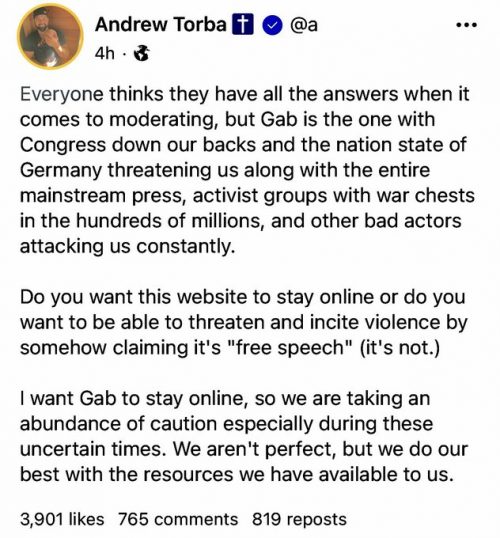
Gab, the social networking site, is having some troubles, again. They’re being attacked! By bad actors! Oh no!

This is my favorite ironic line from the complaint.

Do you want this website to stay online or do you want to be able to threaten and incite violence by somehow claiming it’s “free speech” (it’s not.)

Wholesome, pure, violence-free Gab…you know, the site that welcomed Nazis.

Since its inception, Gab has welcomed deplatformed social media users, generally attracting those on the far right. When Twitter suspended a number of alt-right accounts just after the 2016 election — including white nationalist Richard Spencer’s — Gab welcomed them with open arms.

And QAnon.

In early October, when Facebook purged a number of accounts connected to QAnon, Torba published a blog post welcoming them to the site. “Gab is happy to announce that we will be welcoming all QAnon accounts across our social network, news, and encrypted chat platforms,” Torba wrote. He added, “Members of the QAnon community have been active on Gab for several years. We have never seen any calls for violence, threats, or any other illegal activity from this group of people.”

Except for fomenting the Jan. 6 insurrection, of course.

The Capitol mob began organizing weeks ago for the violence that occurred on January 6, planning inside conspiracy theory and far-right online communities on platforms like Parler and Gab. Groups that typically live in the darker corners of the internet stepped into the spotlight when they took the Capitol and broadcast the breach around the web.

The groups that stormed Capitol Hill this week have long been active on platforms like Gab and 4chan, and more recently, they’ve adopted newer tools like the lightly moderated social media site Parler and the anonymous messaging service Telegram to organize.

And who could forget?

The platform made headlines in October 2018 after a gunman opened fire in Pittsburgh’s Tree of Life synagogue and killed 11 worshipers. Robert Bowers, who is accused of the crime, spent years posting anti-Semitic rhetoric on Gab. His final post before the shooting read, “I can’t sit by and watch my people get slaughtered. Screw your optics, I’m going in.”

No sir, no violence here. It’s all those people trying to shut down a hate and conspiracy theory site who are being violent.


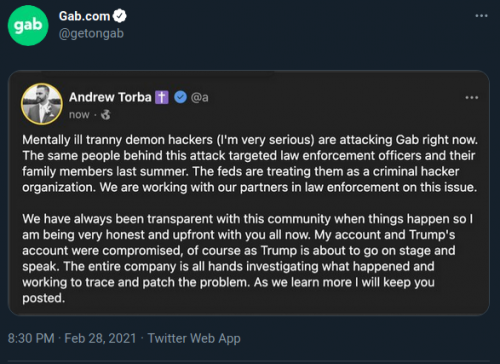
Here’s another blast from tolerant, lovely Andrew Torba from last year: the people going after Gab are Mentally ill tranny demon hackers (he’s very serious).

My cell biology students would have fun with this

Or maybe some would just be confused? After all, it comes from that reputable scientific authority, the Daily Mail.

To the red marks I’d also add that mitochondria is plural, mitochondrion is singular, and a mitochondrian is, I think, a Dutch abstract painter.

I don’t think I’ll expose my students to this because I’m concentrating on teaching them good science.

I guess cowboys just hate Indians

There is this law called the Indian Child Welfare Act which, along with providing necessary protections, also helped kill the practice of tearing apart Indian families and putting their kids in boarding schools. Sounds like an obvious idea, right? It’s somewhat surprising that it was only enacted in 1978. Would you also be surprised to learn that some people are trying to overthrow that law?

It’s being challenged in child custody cases, with people actually saying that no, it is wrong to try and keep children with their relatives or their tribe, and their reasoning is unbelievable.

So a U.S. federal district judge did exactly that. He … a radical conservative judge in Texas. And he took the Indian Child Welfare Act and he checked it out the window and said that it was racial discrimination.

That’s their argument: that a law to protect an oppressed minority is racist. That’s rich, coming from a radical conservative, the kind of person who wants to preserve the privilege that maintains a white majority rule. He doesn’t care about racism, except when brown people get uppity.

What’s worrisome is that the decision was appealed all the way to the 5th Circuit Court of Appeals, and they split.

They strike down a few narrow parts of the law, but that 16 judge panel was evenly split on whether basically the foundation of the legal status of tribes is constitutional. And so that’s how close we are to a scary result in this case. And I think that we’ll have to see what the Supreme Court will do. But it’s terrifying to think that the Supreme Court is going to take it up and all federal Indian law is on the table.

I wonder how many Trump appointees were involved. The Republicans have been doing their best to pack the courts. I wonder who could possibly want to strike down the ICWA, and it’s “private adoption attorneys, corporate lawyers and this universe of right-wing money and operatives”.

It always astonishes me, a professor at a college with a student body that is about 20% Indian, how much discrimination goes on in the communities around me — discrimination that is almost entirely invisible to me, and it’s disturbing when it rises up where an oblivious old white dude can see it.

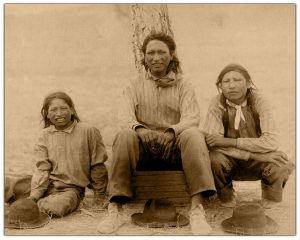
Here’s another story, from Nebraska, in which busybodies in a public school decided to cut Lakota kids’ hair in the name of searching for lice. What gets me is all these white ranchers defending the school secretary who took it upon herself to hack at the kids’ hair (they didn’t have lice, by the way). She’s a nice lady, they say, she didn’t mean any harm, “She did it to help the children and keep the school safe”, etc. I don’t believe it. My particular culture doesn’t attach the kind of importance to long hair that the Lakota do, and if some school official had taken scissors to my kids’ hair, I would have marched to the school district office in a rage and demanded that they be fired. You don’t get to make those kinds of decisions for my children, they have more autonomy than that.

It’s an act that doesn’t have the historical resonance it does for the Lakota, so I can only imagine a fraction the anger it would generate.

As the story circulated on social media, raw emotions surfaced. Grandparents shared stories of how their hair had been cut in boarding schools decades ago.

“Having the seventh, eighth, tenth generation having to go through it again … I mean, it’s just a big eye opener because it’s being re-lived,” LeRoy said.

On March 3, 1819, nearly 201 years to the day before the children’s hair was cut, the United States signed the Civilization Fund Act. That ushered in an era from 1860 to 1978 when boarding schools nationwide, including in Nebraska, separated Native children from their families, punished them for speaking their language, and often cut their long hair.

“… All the Indian there is in the race should be dead. Kill the Indian in him, and save the man,” Capt. Richard H. Pratt, who founded the Carlisle Indian Industrial School, famously said in 1892.

In 1884, Christian missionaries came to South Dakota’s Yankton Reservation and took eight-year-old Zitkála-Šá from her mother.

“I remember being dragged out, though I resisted by kicking and scratching wildly,” Zitkála-Šá wrote in 1900 of her hair cutting. “In spite of myself, I was carried downstairs and tied fast in a chair. I cried aloud, shaking my head all the while until I felt the cold blades of the scissors against my neck, and heard them gnaw off one of my thick braids. Then I lost my spirit…now I was only one of many little animals driven by a herder.”

Are we really going to be fooled by a bunch of racists who cry that it’s racist to interfere with their racism?