These are cute. “Loessbians” — clever.

We biologists have always been allies.

These are cute. “Loessbians” — clever.
We biologists have always been allies.

That is a hate symbol aimed directly at me.


I knew the Supreme Court was corrupt, but they aren’t even trying to hide it anymore. Their recent decision to allow businesses to discriminate against gay people was a total sham, in violation of basic principles even I, a legal ignoramus, recognize as baseless.
But what makes this clown show even worse is that the complaint at the heart of 303 Creative v. Elenis is completely made up. In Masterpiece, there really was a baker who really did discriminate against a gay couple, creating both standing and a fact pattern to discuss in court. With 303 Creative, however, the “facts” justifying the case are all make-believe. The plaintiff, Lorie Smith, sued on the grounds that she doesn’t want to make wedding websites for same-sex couples. But no one had actually requested that she do so, for one simple reason: She didn’t make wedding websites. Her lawsuit was purely hypothetical. Legally, she shouldn’t have had a right to sue at all.
To get around the fact that their client had no right to sue, ADF claimed she had received an inquiry from a man named “Stewart” who had some vague questions about maybe hiring 303 Creative in the future for a wedding to “Mike.” But it appears that the entire story may be fabricated. Melissa Gira Grant of the New Republic contacted Stewart, using the email and phone number included in the lawsuit. He denies having sent that request, pointing out that he is already married, to a woman.
Who needs facts anymore? Just make up any ol’ story you want, demand justice, and this Supreme Court will invent an excuse for you, as long as it aligns with their biases. I wasn’t surprised to learn that this particular decision was authored by Gorsuch, who is always happy to lie to promote his religious agenda.
This isn’t even the first opinion Gorsuch has written based on made-up “facts.” Last term, Gorsuch ruled in favor of a football coach who wanted to lead prayers at a public high school, in direct violation of the First Amendment. To get to the desired outcome, both Gorsuch flat-out lied about the situation. Gorsuch claims the coach merely “offered his prayers quietly while his students were otherwise occupied.” That, and this cannot be stated firmly enough, is a lie. As Sotomayor noted in her dissent, the coach actually held showy prayers at the 50-yard line during games. He made such a spectacle that “[m]embers of the public rushed the field to join Kennedy, jumping fences to access the field and knocking over student band members.” She even included helpful pictures, which is unusual in a dissent, to illustrate what a lying liar Gorsuch is.
The court is illegitimate and needs to be dissolved. Expect it to instead litter the law with phony precedents that will poison justice for years to come.


Good. Can they die a little faster, please?
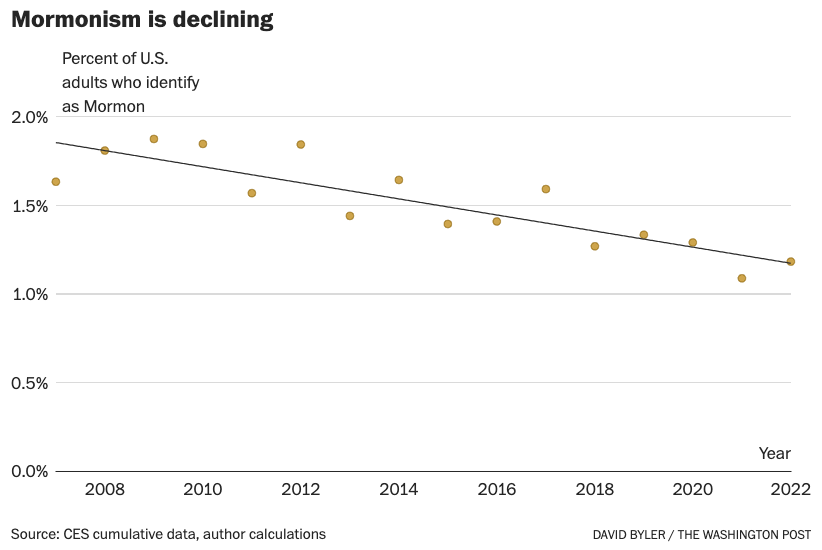
I always felt that living in Utah was like living in a nest of Scientologists — all this money-making scheming plastered over with a veneer of florid scripture written by a mountebank. I wouldn’t miss it if it disappeared altogether.
That’s nothing special about Mormonism, though. Look! All religions in the USA are dying slowly.
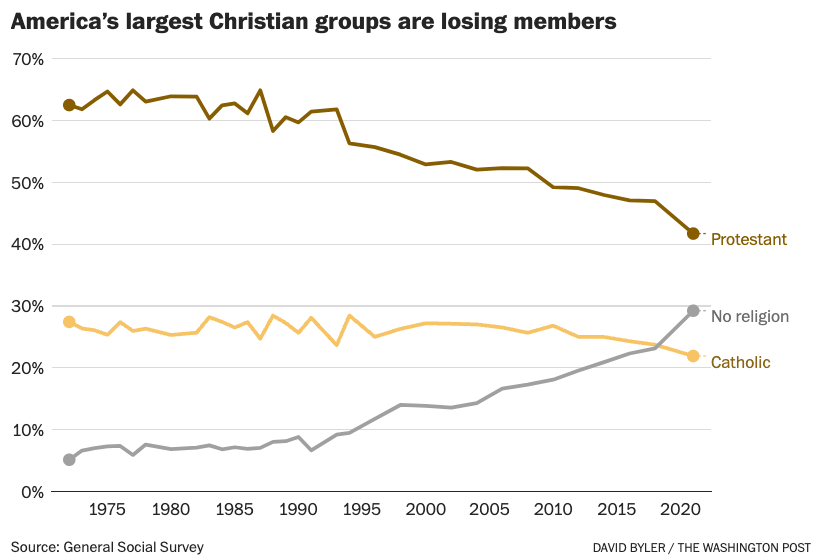
There are many factors behind this decline. Here’s one:
Meanwhile, the church’s close alliance with the GOP might be costing it members. As Notre Dame political science professor David Campbell, who was raised Mormon, told me, “There’s an allergic reaction among many Americans — particularly those who lean to the left politically — when religion and politics mix. We see it among Catholics. We see it among evangelicals. And we’re seeing it among Mormons.”
It gets messy when you include politics, though: the Republicans have become increasingly cult-like. That’s the next religion that needs to go!

As mentioned, my task for this morning was murdering spiders. Mission accomplished, and now I feel terrible.
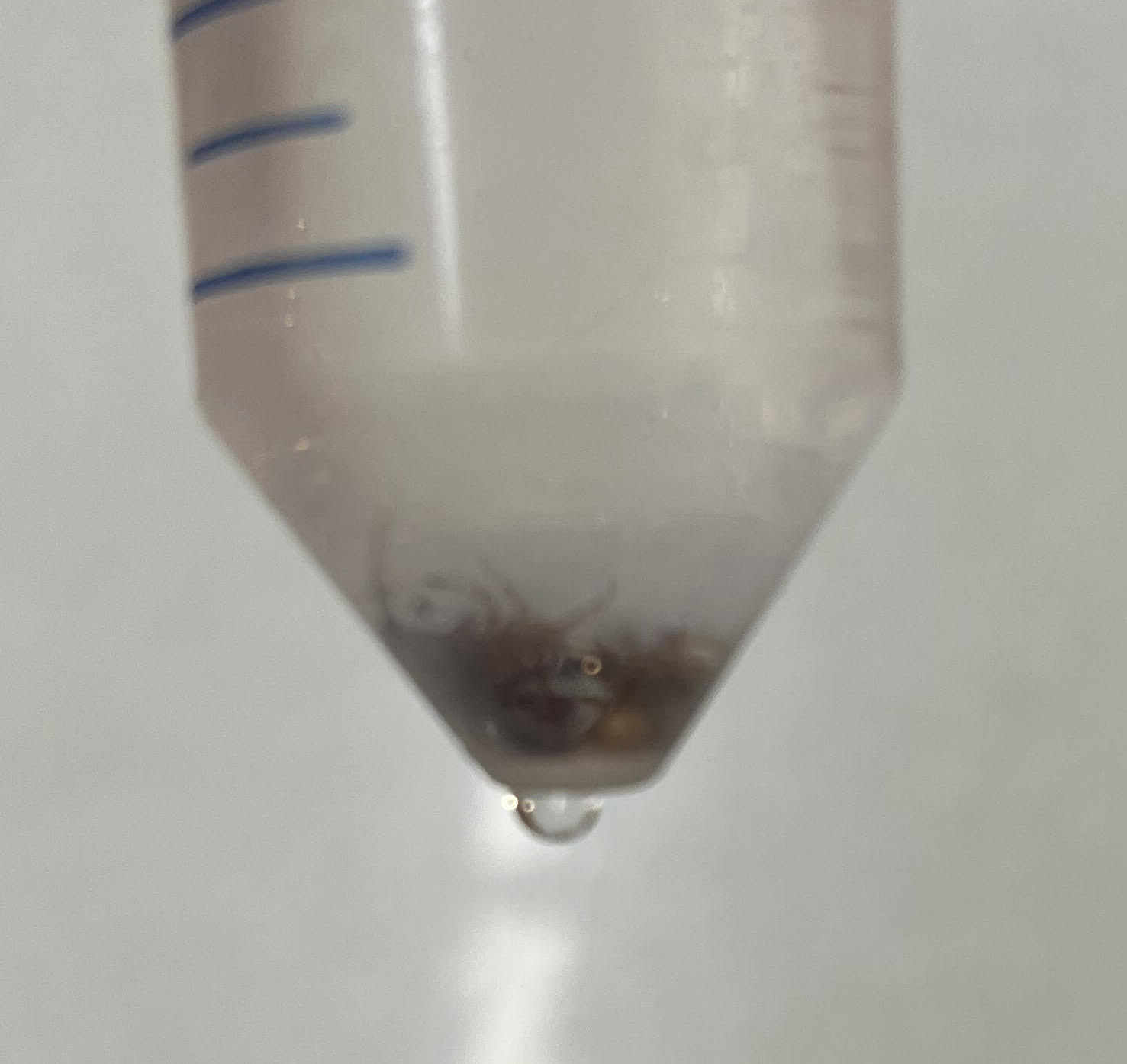
It was a simple procedure. I put the vials of happy gamboling spiders into the refrigerator to calm them down and numb them — I gave them about 15 minutes of chill. Then I went into each vial with a paintbrush and teased them out, and they descended into a tube of icy, pre-cooled alcohol, where they died within minutes. Now their bodies are packed into a freezer, awaiting delivery to the person who will chop them up.
The worst part was going through the assortment of spiders in the colony and having to choose which ones would die.
You have to understand that this was the very first time I’ve had to kill an adult spider. I’ve been wiping out embryos right and left, and I’ve had adults die of natural causes — but actually terminating their existence by my hand? Unpleasant. I like my spiders lively and interesting. I’m a biologist, not a necrologist.

That’s the topic of our next podish-sortacast:
I think the August topic might have to be “Spelling”.


It’s some kind of national holiday celebrating our independence, but I don’t feel like celebrating in a country where justice has been deposed and our supreme court is nothing but a corrupt arm of the far right Federalist Society. So instead I’m going to murder spiders.
I’ve got a set of wild-caught Steatoda triangulosa, and another set of wild-caught Parasteatoda, and yet more long-term lab-fed S. triangulosa, and they’re all going to feel the kiss of cold 95% ethanol before being stashed in a freezer. Then this weekend they get delivered to a collaborator up north who will disembowel them and sequence their microbiome.
That’s how we celebrate America’s birthday around here.
Also this weekend, we’re going to visit a few cemeteries around Gary, Minnesota and check out the graves of some long-dead relatives, and do some sight-seeing of great-great-great grandparents’ old haunts, while also chasing down a few spiders. It seems appropriate.

One of our goals this summer is to map out the developmental stages of our embryonic spiders, and to that end we made our first crude, short timelapse recording this afternoon. Aren’t twitching baby animals so cute?

Meat “scientist”
There are scientists I respect, and there are scientists I do not. José Manuel Lorenzo is in the latter category, although I’m sure he wouldn’t care. He’s rolling in the money and the false coin of scientific “prestige”.
Meat expert José Manuel Lorenzo, 46, is the researcher who has published the most scientific studies in Spain. He put his name on 176 papers last year, according to a count by John Ioannidis — an expert in biomedical statistics at Stanford University — which was requested by EL PAÍS.
Lorenzo publishes a study every other day (if you include weekends). It’s an astonishing figure, far above the second-highest ranked scientist: the prestigious ecologist Josep Peñuelas, 65, who published 112 studies in 2022
I’m trying to picture the logistics of all that. It typically takes a month or more to get a paper published, and that’s if there are no revisions or rejections. I’ve heard of high priority, dramatic results getting a turnaround of a week or so — maybe trash papers that no one cares about similarly get rapid publication. At any rate, it must mean he’s got dozens of papers stacked up in a queue at any one time. How does he find time to cope with revisions, let alone actually write them? Forget about actual research. The “evidence” backing up the claims that warrant a publication would have to be done in a day or two!
Oh wait, there is a way. Don’t do the research, don’t do the writing, and don’t even read the papers.
José Manuel Lorenzo is the head of research at the Meat Technology Center (CTC) — an entity dedicated to meat products, supported by the regional government of Galicia — in San Cibrao das Viñas, a city in the Spanish province of Ourense. A person who has worked with him recalls that, around 2018, his laboratory became “a sausage factory.” Lorenzo went from publishing less than 20 studies a year to signing his name to more than 120. “He doesn’t even have time to read them,” says another person, who has collaborated on projects with the man.
At one point, Lorenzo began collaborating with exotic researchers — who nobody knew about — on topics that have nothing to do with meat. Four months ago, he published a study on the hospital management of monkeypox, alongside Iraqi, Indian and Pakistani co-authors. And a year ago, he and some researchers from India and Saudi Arabia published an article on the treatment of gum disease with bee venom. In a telephone conversation with EL PAÍS, Lorenzo admits that he doesn’t know any of these co-authors in person, nor is he an expert on any of these issues.
That’s a serious lack of integrity he is admitting to. I was trained to understand that if your name was on a paper, you were expected to have contributed significantly to the work, and are familiar with the entirety of the procedures and results. You are responsible for the content of the paper. You can be held accountable for any errors, or worse, any fraud. It’s supposed to be a weighty thing…but not to Lorenzo.
One tool that allows this to go on is the existence of paper mills.
India is one of the countries where so-called “paper mills” are concentrated — factories that churn out scientific studies which are already written and ready to be published in specialized journals. Co-authorship is offered in exchange for money. EL PAÍS requested price rates from one of the Indian companies that sends their offers to Spanish scientists: iTrilon, based in Chennai. The company’s scientific director Sarath Ranganathan offered the possibility of being the first author of a study that was already written — entitled Next-generation neurotherapies against Alzheimer’s — in exchange for about $500. It’s also possible to be the fifth co-author of an article titled Emergence of rare microbial infections in India for $430. iTrilon promises to publish these ready-made studies in the journals of the world’s leading scientific publishers: Elsevier, Taylor & Francis, Springer Nature, Science and Wiley. Last year, the academic publishing industry acknowledged that at least 2% of studies each journal receives are considered to be suspicious. Sometimes, the number of suspicious studies is marked as high as 46%.
Another factor is that grant review and institutional committees are far too willing to do little oversight and superficial evaluation. The problem is that we assess scientific work based on publication, which is already poisoned by capitalism and exploitation, and not by being read.
Although, I must admit, I can understand how someone might be tempted by $400 or $500 flowing into one’s bank account every two days just for rubberstamping a stupid paper.